
Ayush Parchure
Content Writer, Flexprice
Alguna is a quote-to-revenue platform that works well when the workflow is straightforward, but once engineering teams start building around it, the cracks open up fast.
This happens because the platform has no native SDKs, no developer-first tooling, and honestly, the integration experience is lowkey painful. And since Alguna runs as a fully closed system with zero self-hosting options, your billing infrastructure is basically in their hands. This removes flexibility and pushes you into vendor lock-in
The bigger ick? Alguna is built for revenue and finance teams running billing workflows, not for product-led teams that need billing deeply embedded into their product.
To rescue you from these problems, here are five Alguna alternatives that actually put billing at the center of your product instead of working against it: Platform like Flexprice is the best Alguna alternative, not just because it’s open source but also because it’s built to handle all the complex use cases of AI pricing.
TL;DR
Alguna works for simple billing, but breaks when pricing becomes usage-based, credit-driven, or product-led
Closed, no-code approach limits infra control, pricing flexibility, and developer-led workflows
Key gaps include no streaming ingestion, weak credit systems, and a lack of SDKs for integration
Teams switch when billing needs to move inside the product, not stay as a back-office workflow
Flexprice is the best overall alternative for developer-first, infra-grade billing and AI pricing
Polar is best for simple digital product sales with built-in tax handling
Metronome is a strong metering, but creates Stripe dependency
Lago is an open-source option for simpler usage-based billing setups
Orb is powerful for consumption billing, but closed and less flexible
What is Alguna?
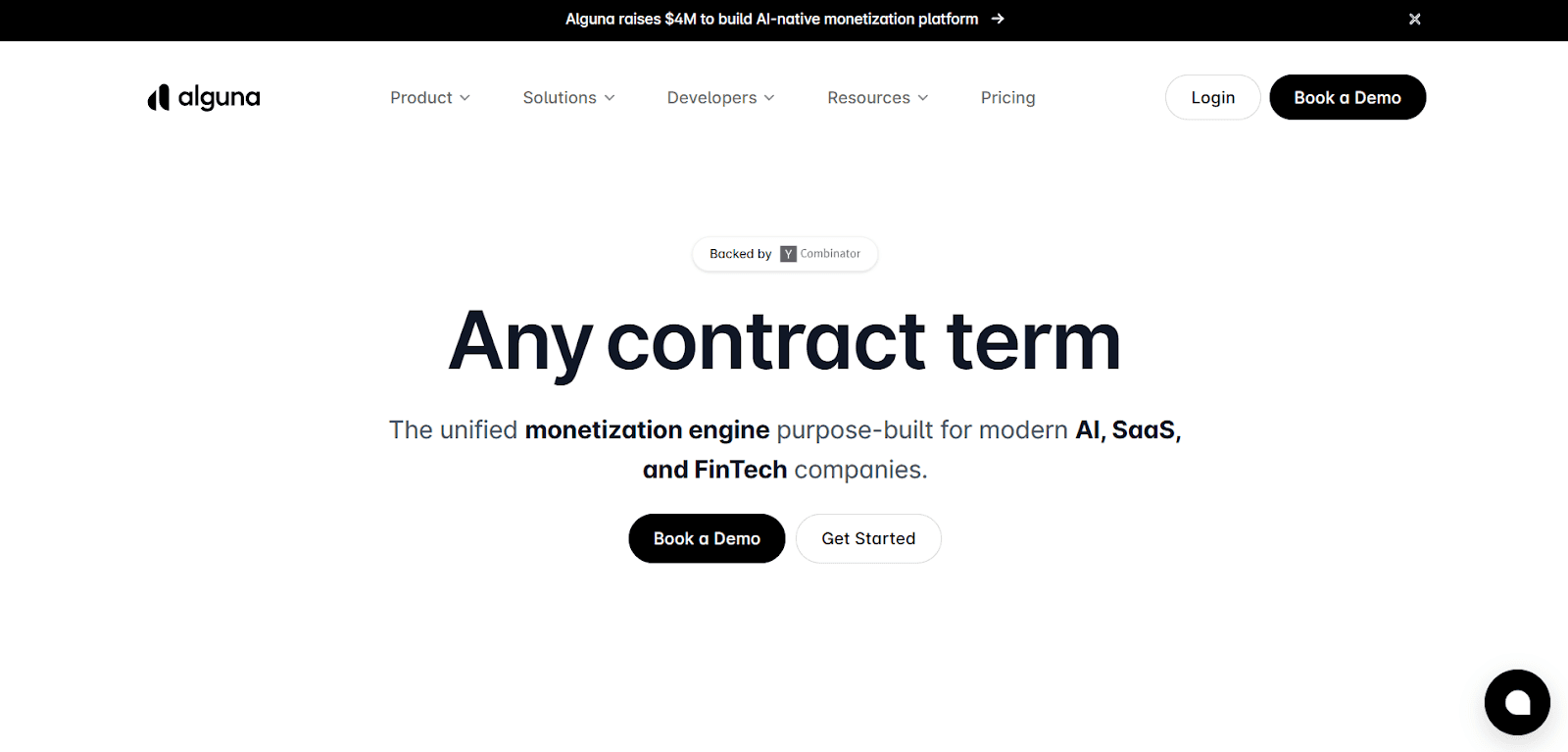
Alguna is a modern pricing, quoting, and billing platform that unifies the quote-to-revenue process for B2B SaaS companies.
It automates complex billing, including usage-based, subscription, and hybrid models, replacing manual spreadsheets with real-time metering and automated invoicing to prevent revenue leakage.
What Alguna does well
Before exploring Alguna alternatives, it is worth understanding where the platform genuinely delivers.
Unified billing and revenue platform:
Alguna brings pricing, CPQ, usage metering, billing, invoicing, and revenue recognition into a single platform. For teams that want one tool handling the entire quote-to-revenue lifecycle instead of stitching together multiple systems, this consolidation is a real strength. It reduces tool sprawl and keeps financial data in one place.
No-code plan configuration for finance teams:
The no-code UI lets finance and RevOps teams configure plans, discounts, ramps, and overage rules without pulling in engineering. This is especially useful for teams running hybrid pricing models or enterprise billing setups where deal structures change frequently, and speed matters more than customization depth.
Real-time usage metering on custom metrics:
Alguna supports real-time usage metering on any custom billable metric, whether that is API calls, tokens, messages, or compute hours. For companies adopting usage-based billing or credit-based billing, this flexibility in metric definition means you are not forced into predefined units that don't match your actual product consumption patterns.
Built-in CPQ with embedded e-signature:
The platform connects quoting directly to billing automation through its built-in CPQ with embedded e-signature. Sales teams can generate quotes, get them signed, and have the billing configuration flow straight into invoicing without manual handoffs. For organizations evaluating an alternative to Alguna, this is one area where the platform reduces friction between sales and finance workflows.
Where Alguna starts to break
Understanding where Alguna falls short makes it easier to evaluate which Alguna alternatives actually solve the right problems.
No self-hosting or infrastructure control
Alguna is a closed-source system with no option to self-host or run billing inside your own infrastructure. For teams handling enterprise billing with strict data residency requirements or compliance constraints, this lack of deployment flexibility becomes a dealbreaker fast. You are locked into their infrastructure with zero visibility into how your billing data is processed or stored.
No streaming pipeline for high-volume usage data
Event ingestion is limited to API and CSV-based methods with no native streaming pipeline for real-time, high-volume usage data. Companies running usage-based billing at scale, where millions of events need to flow in continuously, will hit friction here.
Slow pricing iteration cycles:
Pricing changes rely on multi-step dashboard workflows, making iteration slower and more operational than it needs to be. If you are experimenting with hybrid pricing models or testing new plan structures, every change becomes a manual process instead of a quick API call. Teams looking for an alternative to Alguna often cite this as a core frustration.
Loosely connected metering and entitlements:
Metering and entitlements are not tightly coupled, which makes real-time usage enforcement harder to implement cleanly. For product-led teams that need billing deeply embedded into their product, this gap means building custom glue logic just to gate features based on actual usage.
Basic credit system with limited programmability:
The credit system lacks programmable wallet logic like auto top-ups, priority usage, or conversion rules. Teams running credit-based billing models need wallets that behave like actual financial primitives, not static balances that require manual adjustments every time a rule changes.
No native SDKs for engineering teams
There are no native SDKs, which means integrating Alguna into product usage flows is more manual and time-consuming for engineering teams. Without developer-first tooling, every integration touchpoint requires custom code instead of a simple SDK call.
Why AI and SaaS companies look for Alguna alternatives
Most teams don't start looking for Alguna alternatives because the platform lacks features on paper. The shift happens when billing needs to move from a back-office function to a core part of the product itself. When your billing system can't keep up with how your product actually works, every workaround compounds into engineering debt that slows down your entire monetization strategy.
Here is what typically pushes teams to evaluate an alternative to Alguna:
Teams need billing they can run inside their own stack, not a closed SaaS they can't inspect or control. For companies handling enterprise billing with compliance or data residency requirements, self-hosting isn't an option; it is a hard requirement.
Real-time usage-based products require streaming ingestion and event pipelines, not just API-based metering. When your product generates millions of usage events, batch processing creates blind spots that directly affect billing accuracy.
Credit-based monetization requires programmable wallet systems, not just basic credit tracking. Auto top-ups, priority usage, conversion rules, and expiration logic are table stakes for teams building serious credit-based billing models.
Engineering teams want SDKs and code-driven workflows, not configuration-heavy dashboards. Hybrid pricing experiments, plan changes, and entitlement updates should happen through code, not multi-step UI workflows that bottleneck every iteration cycle.
Top 5 Alguna alternatives for usage-based billing
Flexprice
Polar
Meternome
Lago
Orb
Tool | Pros | Cons |
Flexprice |
|
|
Polar |
|
|
Metronome |
|
|
Lago |
|
|
Orb |
|
|
1. Flexprice
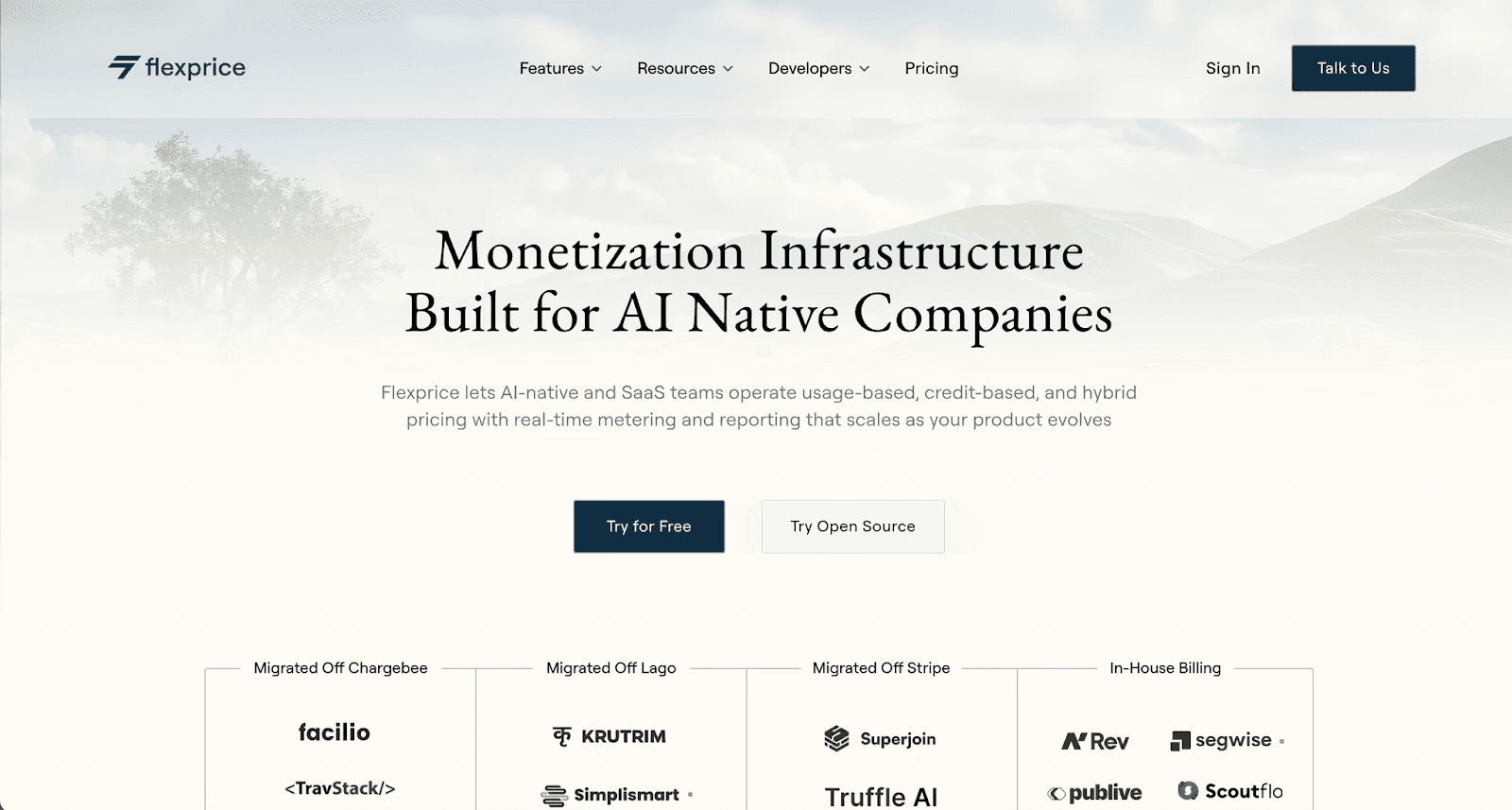
If you are looking for a credible Alguna alternative that is enterprise-grade, developer-first, and built for modern usage-based billing, Flexprice becomes the strongest pick.
While Alguna is optimized for finance teams and sales-led workflows with its unified CPQ, invoicing, and revenue recognition suite, Flexprice takes a fundamentally different approach: billing as composable infrastructure, not dashboard-driven configuration.
Flexprice lets teams define granular, real-time usage metering for any custom metric, whether that is API calls, tokens, compute seconds, or message volumes, using an event-driven architecture powered by Kafka, ClickHouse, and Temporal. This is infrastructure-grade ingestion built to handle high-volume streams reliably, not just API endpoints and CSV uploads.
For companies running usage-based billing at scale, the difference between batch processing and streaming ingestion directly impacts billing accuracy and real-time visibility.
Pricing logic in Flexprice is fully composable. Plans, prices, features, and entitlements exist as independent entities that teams can reconfigure without rebuilding subscriptions from scratch.
Whether you are iterating on hybrid pricing, switching from per-token billing to credit packs with overage, or experimenting with committed spend plus burst pricing, changes happen through code and APIs, not multi-step dashboard workflows.
A key differentiator is Flexprice's credit-native wallet system. Companies can issue free or paid credits, set auto top-up thresholds, define conversion rates for multi-currency or unit-to-currency mapping, enforce expiry rules, and track transaction history.
On the developer experience front, Flexprice ships native SDKs for JavaScript, Python, and Go, the three languages that dominate AI and SaaS infrastructure.
Engineering teams can install, configure, and start metering in minutes instead of writing custom wrappers around a raw HTTP API. Add in multi-environment support with explicit production and staging separation, an event debugger for tracing ingestion issues, and infrastructure-level integrations like Kafka collectors, S3 exports, and HuggingFace support, and the developer tooling gap becomes clear.
Unlike Alguna's closed-source, managed-only model, Flexprice is fully open-source and self-hostable with AWS deployment guides and contributor documentation. Teams get full control over their billing stack, data, and infrastructure decisions.
Key features
Self-hosted or cloud deployment
Flexprice is enterprise-grade, open source usage based billing infrastructure for AI and SaaS companies. It can be deployed in your own VPC, on-prem, or on Flexprice's managed cloud.
For teams evaluating Alguna alternatives because of vendor lock-in concerns, this means full control over your billing infrastructure, data residency, and compliance requirements. Either way, you get developer support from the community for smoother integrations.
Real-time usage metering
Track API calls, GPU hours, tokens, messages, or any custom billable metric at a granular level with low latency. Flexprice handles high-volume event streams at a rate of 20B+ events per month without breaking a sweat, powered by a Kafka and ClickHouse pipeline built for infrastructure-grade usage-based billing.
Streaming event ingestion with built-in aggregation.
Ingest and aggregate usage using pre-built rules like sum, count, and unique counts without extra engineering or custom pipelines. Flexprice also offers a Bento Collector for streaming usage directly from Kafka and other sources, so teams already running Kafka internally can pipe events straight in without an HTTP hop.
Credit and wallet management system
Manage prepaid credits, auto top-ups, conversion rates, promotions, and credit expiry policies with programmable wallet logic. For companies running credit-based billing models like token packs with auto-refill, Flexprice treats wallets as first-class financial primitives, not just invoicing adjustments.
Feature management and entitlements
Control customer access to features, set usage limits, and enable upsell opportunities through plan customization. Metered features are tied directly to the event ingestion pipeline, meaning a single event can simultaneously meter usage and enforce entitlement limits in real time.
Flexibility to run any pricing model
Run subscription-only, usage-based, hybrid pricing, or credit-based billing and experiment with customer-specific plans without rebuilding the stack. Plans, prices, features, and entitlements are fully composable, so pricing iterations take minutes instead of weeks.
Native SDKs and developer-first tooling
Flexprice ships SDKs for JavaScript, Python, and Go along with developer-first APIs and webhooks for fast integration into existing infrastructure. Engineering teams can install and start metering in minutes.
Parent-child accounts
It supports account hierarchies; multiple child workspaces or teams roll up into a single parent billing profile with shared credits and usage.
Multi-environment support
Flexprice offers explicit environment management with production and staging separation as a first-class API concept. Test billing changes, pricing experiments, and entitlement configurations in staging before pushing anything to production.
Advanced pricing logic
Implement volume tiers, graduated pricing, package deals, overage charges, and ramped contracts to optimize enterprise billing across diverse customer segments without writing custom code for each deal.
Customer dashboard API
Give customers and internal teams real-time visibility into consumption and charges via embedded dashboards, keeping billing transparent and reducing support overhead.
Automated invoicing and billing
Generate unified invoices combining subscriptions, usage, and credit adjustments automatically with Flexprice, reducing manual reconciliation for finance teams.
Payment gateway integration
Flexprice integrates with Stripe, Razorpay, Moyasar, Nomod, Paddle, and other payment processors so you can connect metered billing and invoicing to your existing payment flows while staying PSP-agnostic.
Multi-currency support.
Localize pricing and charge different rates across regions and currencies for global customers without workarounds or manual configuration.
Active Slack community
Get hands-on support from an active, dedicated developer community when integrating and implementing the stack with your existing systems.
Pricing
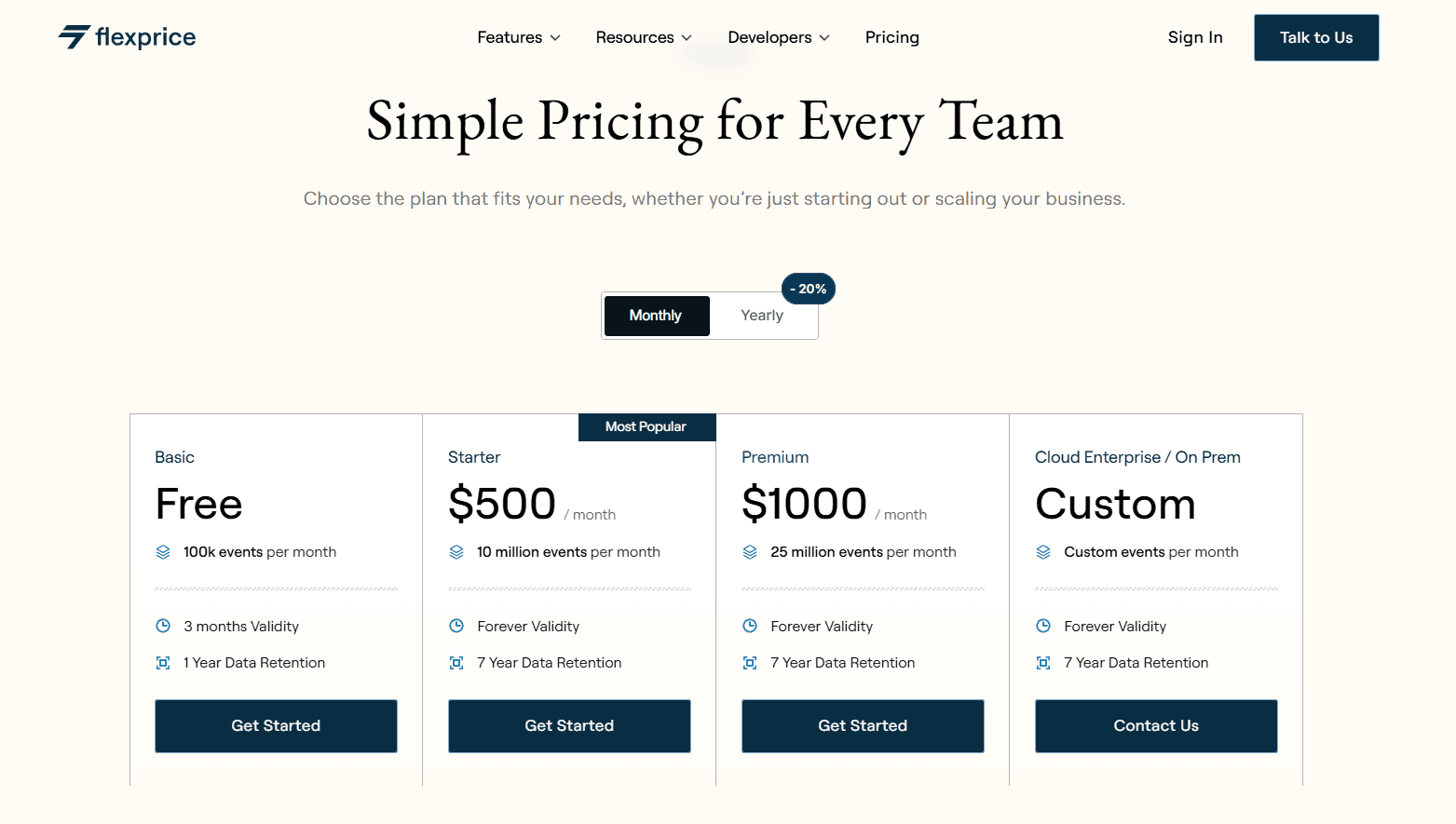
Flexprice offers 4 different pricing options apart from open source, which are:
Basic- free- 100k events per month
Build- $500 / month with 1 million events per month
Scale- $1000 / month with 5 million events per month
Mission critical- custom
Best suited for
Teams building AI-native, API-first, or usage-heavy products that need infrastructure-grade usage-based billing, programmable credit-based billing, real-time entitlement enforcement, and full control over their billing stack. Especially those evaluating Alguna alternatives because they have outgrown dashboard-driven workflows and need an open-source, developer-first platform that treats billing as composable infrastructure rather than a finance-team tool.
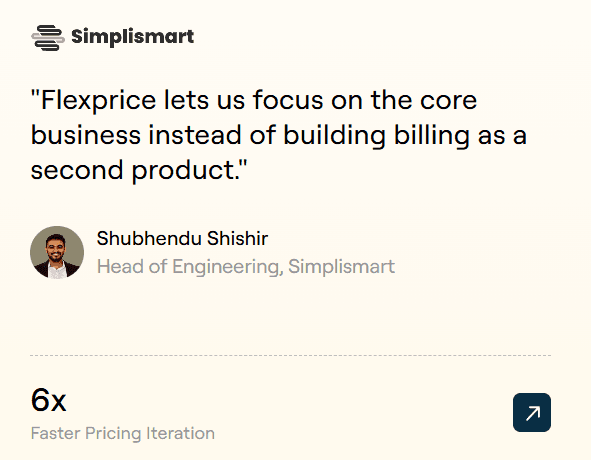
See how Simplismart, an AI inference platform handling high-volume compute workloads, moved to Flexprice to power their real-time usage metering and credit-based billing.
2. Polar
Polar is an open-source merchant of record and monetization platform designed for developers to sell SaaS, digital products, and subscriptions. It handles global tax compliance, VAT, and invoices, acting as the reseller to simplify payment infrastructure, often using Stripe as its foundation.
Polar is primarily built for indie developers and small teams selling digital products, subscriptions, and one-time purchases with a Merchant of Record model handling global tax compliance. There is no dedicated event ingestion pipeline, no event debugger, no wallet system with auto top-ups or conversion rates, and no real-time entitlement enforcement tied to metering.
Key features
Merchant of Record. Polar handles international tax compliance, including VAT, GST, and sales tax across all jurisdictions, so you don't have to manage tax calculations.
Usage-based billing. Supports event ingestion, meters for filtering and aggregating usage, and metered prices attached to subscription products.
Automatically delivers license keys, GitHub repo access, Discord roles, and file downloads tied to product purchases.
Multi-SDK and framework adapters. Ships SDKs for JavaScript, Python, Go, and PHP with framework adapters for Next.js, Laravel, Nuxt, Remix, and 12+ others.
Flexible checkout. Offers no-code checkout links, embedded checkout, and a full checkout API with multi-currency support across 10 currencies.
Pricing
Polar charges 4% + 40¢ per transaction with no monthly fees, plus additional charges for international cards (+1.5%), subscriptions (+0.5%), and Stripe payout fees. Custom volume pricing is available for larger businesses. You need to contact their sales team for more information.
Best suited for
Indie developers, open-source creators, and small teams selling digital products, subscriptions, or one-time purchases who want a simple Merchant of Record handling global tax compliance without building billing infrastructure from scratch.
3. Metronome
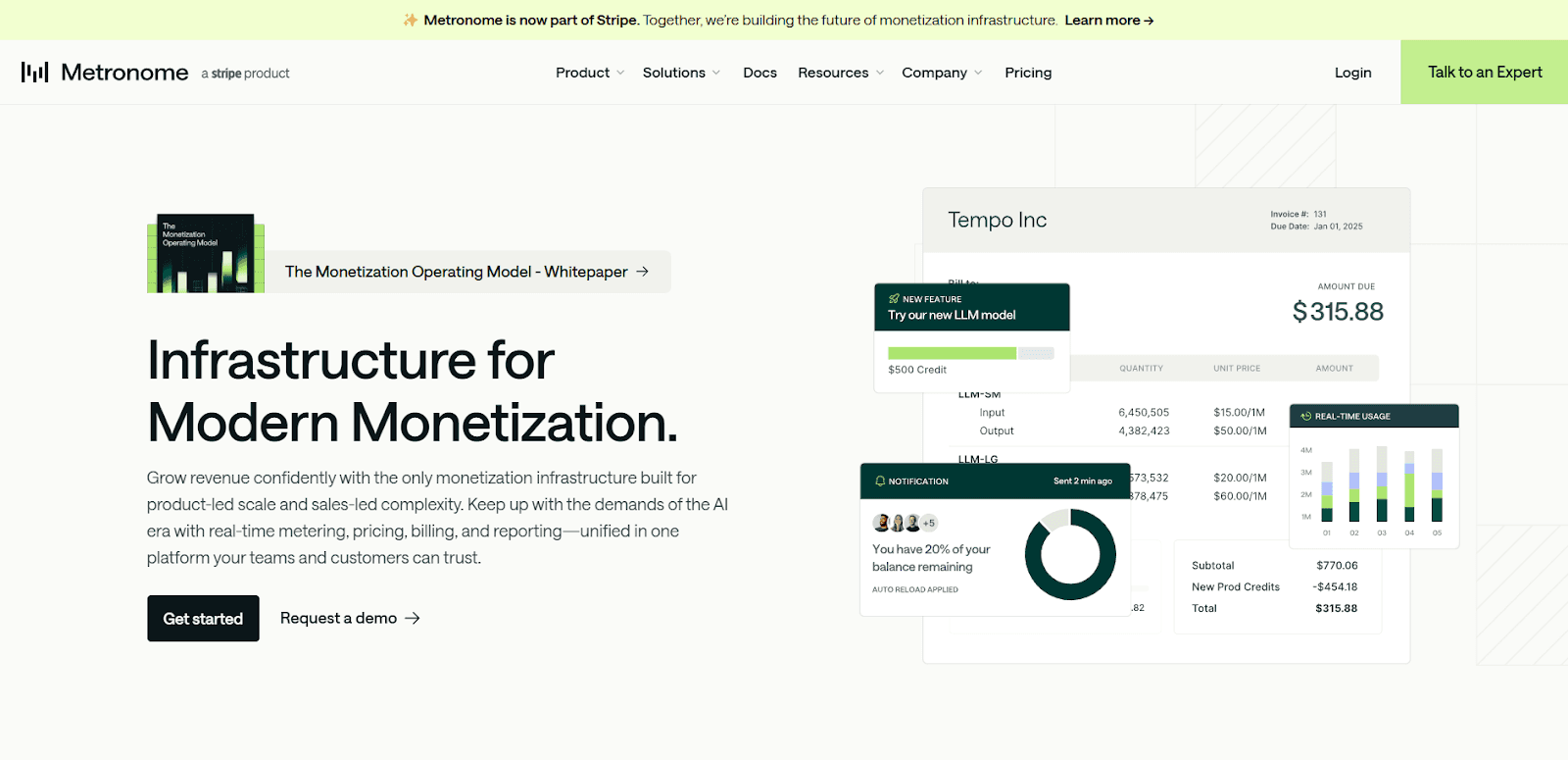
Metronome is a monetization infrastructure platform designed to handle both product-led scale and sales-led complexity. It addresses the demands of the AI era with real-time metering, pricing, billing, and reporting. As an alternative to Alguna, it enables teams to stream usage events, define billable metrics, and apply pricing rules across multiple models.
Stripe has acquired Metronome, which means the platform now fits most naturally within the Stripe ecosystem. This limits flexibility for companies that want to work with multiple payment gateways or avoid dependence on a single payment provider. Over time, this can lead to Stripe lock-in, making it harder to switch payment infrastructure or build multi-gateway strategies as you scale.
Key Features
Event metering and billable metrics. Metronome ingests high-volume usage events and allows teams to define custom billable metrics on top of that data.
Flexible pricing and rate cards. It supports usage-based billing, subscriptions, and composite products with support for tiers, minimums, overages, and dimensional pricing.
Customer-facing usage and spend visibility. Teams can surface real-time usage and send data to customers through dashboards, with configurable alerts and limits so they can monitor and control their consumption.
Pricing
Metronome offers a free Starter plan for teams launching usage-based products. Custom enterprise pricing is available, but you need to contact their sales team for details.
Best Suited For
Best for teams that want a Stripe-native usage metering solution and plan to standardize on Stripe long-term. With Metronome now part of Stripe, it fits well inside that ecosystem, but is less suitable if you need vendor flexibility, cross-provider integrations, or frequent pricing experimentation.
4. Lago
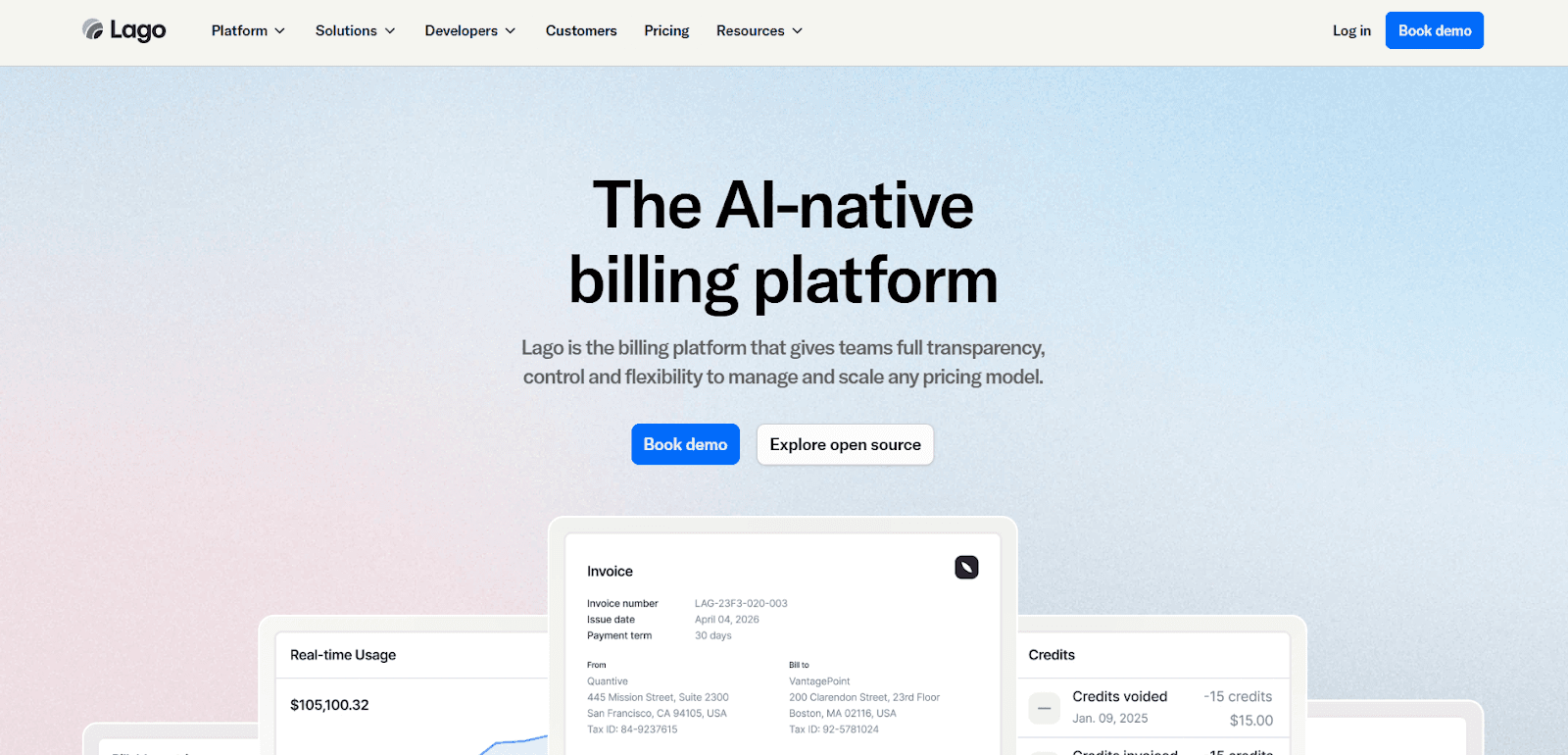
Lago is an open-source Alguna alternative for teams that want to self-host their billing infrastructure. This makes it attractive for engineering teams that prefer managing billing inside their own stack rather than relying on a closed SaaS platform.
However, Lago often falls short for companies running more complex monetization models. It does not support contract ramping, quote or renewal management, or account hierarchies for shared billing across organizations. Credit workflows are also limited with no separate conversion rates for promotional credits, no invoice-backed checkout for credit top-ups, and no advanced balance alerts for spend thresholds.
Key Features
Open-source and self-hostable. Lago can be self-hosted or cloud-hosted, giving teams flexibility over how they run their billing infrastructure.
Real-time usage tracking. You can track all usage events in real time for accurate usage-based billing across your product.
Flexible pricing models. Lago gives you the flexibility to experiment with various pricing models, including subscription, usage-based, and hybrid pricing to find what fits best.
High-volume event ingestion. Lago can handle high volumes of events from metering through to billing and invoicing.
Pricing
Lago offers custom pricing for its Business and Enterprise plans depending on usage scale and deployment needs. For details, you need to contact their sales team.
Best Suited For
Developer teams that want a simple open-source billing foundation for basic usage-based billing and event metering. Companies running straightforward credit-based billing with prepaid wallets, recurring top-ups, and expiration rules. SaaS products with relatively simple pricing models that do not require complex enterprise billing contracts, pricing experimentation, or account hierarchies.
5. Orb
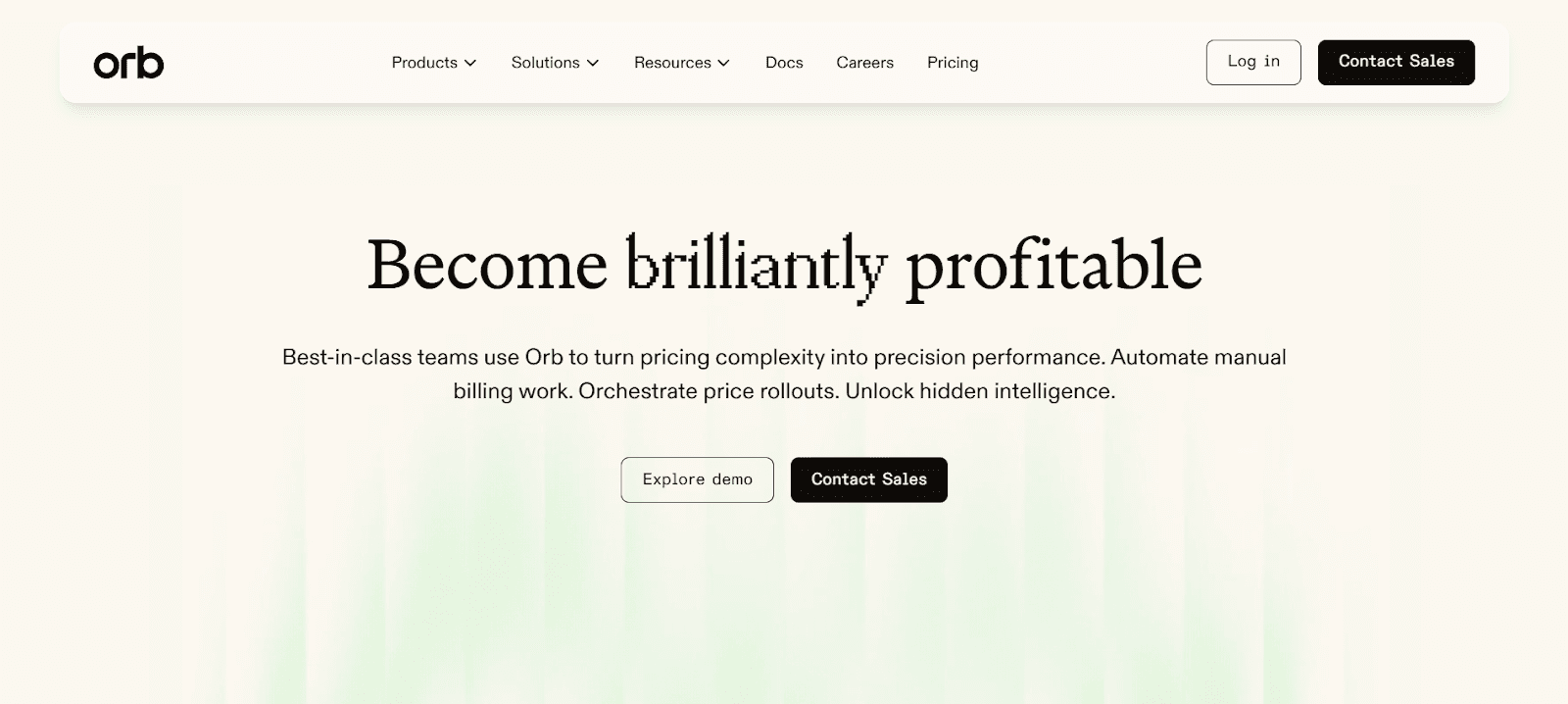
Orb is a usage-based billing platform built primarily for developer-first SaaS and infrastructure products that monetize through consumption. It focuses on ingesting product events such as API calls, compute usage, or storage metrics and converting them into billable charges in real time. Because of its event-driven architecture and flexible pricing models, Orb often appears when companies evaluate Alguna alternatives or other billing tools designed for modern usage-based billing.
However, Orb operates as a fully managed SaaS platform with a closed-source architecture and no self-hosted option. Companies cannot run the billing engine inside their own infrastructure or extend it beyond the platform boundaries. For teams searching for an alternative to Alguna that provides deeper control over billing infrastructure, pricing experimentation, or deployment flexibility, this can become a limiting factor as products scale.
Key Features
Event-based usage metering. Orb ingests raw usage events such as API calls, compute jobs, or storage metrics and converts them into billable usage in real time.
Flexible pricing models. It supports tiered pricing, volume discounts, custom rate cards, and usage-based billing structures tailored to consumption-heavy products.
Credit and balance management. Orb provides prepaid and postpaid credit systems with support for multiple pricing units and credit pools for credit-based billing workflows.
Revenue simulations. Teams can test pricing changes against historical usage data before deploying new billing models, reducing the risk of hybrid pricing experiments in production.
Pricing
Orb does not publish pricing publicly. You need to contact their sales team for custom pricing based on your usage volume and enterprise billing requirements.
Best Suited For
Best suited for companies building usage-based SaaS or infrastructure products that want a managed billing platform with strong enterprise billing features and are comfortable operating within a closed ecosystem. Less ideal if you need self-hosting, vendor flexibility, or cross-provider integrations while evaluating Alguna alternatives.
Why Flexprice is the ultimate Alguna alternative if you have an AI or SaaS product
Now that you have seen where Alguna falls short and what other Alguna alternatives bring to the table, here is why Flexprice stands out as the strongest alternative to Alguna for teams that need billing infrastructure built for scale, flexibility, and developer control.
Built for complex enterprise billing
Flexprice handles enterprise billing complexity that goes beyond what bundled billing systems offer. It supports contract-based pricing alongside hybrid pricing models, so teams can run committed spend deals and usage-based billing under the same subscription. Parent-child account structures let you roll up multiple child workspaces or teams into a single parent billing profile with shared credits and usage.
This multi-layer billing logic is built into the platform natively, not bolted on as an afterthought, which is exactly what teams evaluating Alguna alternatives need when their deal structures outgrow simple plan configurations.
Open and self-hostable infrastructure
Flexprice is open-source and fully self-hostable with dedicated guides for deploying on AWS and your own infrastructure.
This is not a black box where your billing data sits inside someone else's managed environment with no visibility into how events are processed or charges are calculated. For teams looking for an alternative to Alguna specifically because of vendor lock-in concerns, self-hosting eliminates that dependency entirely while giving you full control over your billing stack and data residency.
Streaming event ingestion and real-time metering
Flexprice runs on a Kafka-based event ingestion architecture designed for high-throughput pipelines. It handles high-volume usage events at scale with real-time aggregation, pricing, and billing that keep pace with actual product consumption.
This is infrastructure-grade usage-based billing, not lightweight API endpoints that require you to build your own buffering and batching layer. For AI and SaaS companies metering tokens, API calls, or compute seconds at millions of events per day, this streaming architecture is a fundamental requirement.
Developer first integration
Flexprice ships native SDKs for JavaScript, Python, and Go, the three languages that dominate AI and SaaS infrastructure. The platform is built for code-driven workflows where engineering teams define metering, pricing, and entitlements through APIs, not multi-step dashboard configurations.
This means faster integration into product usage flows. You install the SDK, send usage events, and Flexprice handles aggregation, metering, and billing logic in real time.
Advanced credit and wallet systems
Flexprice treats credits as first-class financial primitives through its wallet system. Teams can issue prepaid and promotional credits, configure auto top-ups with custom thresholds, set expiration rules, and manage conversion rates for multi-currency or unit-to-currency mapping.
Low balance alerts trigger automatically when spending thresholds are hit. This level of programmable credit-based billing is built specifically for AI-style billing models where token packs, credit bundles, and consumption-based monetization require wallet logic that goes far beyond basic credit tracking.
Tight coupling between metering and entitlements
In Flexprice, usage events directly enforce entitlement limits in real time. A single event can simultaneously meter consumption and check whether a customer has exceeded their allocation. This tight coupling means entitlement checks happen at the API level without building custom glue logic between separate metering and access control systems.
For teams running usage-based billing where feature gating needs to respond instantly to consumption changes, this integration between metering and entitlements is a critical differentiator among Alguna alternatives.
Payment flexibility beyond a single gateway
Flexprice integrates with Stripe, Razorpay, and other payment processors. Billing logic is not tied to a single payment provider, so teams can connect metered billing and invoicing to whichever gateway fits their market. This payment flexibility matters for companies operating at a global scale across regions where a single processor does not cover all payment methods or currencies.
Built for modern AI pricing models
Flexprice is optimized for AI and agentic companies that need to monetize tokens, API calls, compute seconds, or any custom usage metric. It supports hybrid pricing models that combine subscriptions with usage-based and credit-based billing components. Teams can iterate on pricing without rebuilding their billing stack because plans, prices, features, and entitlements are composable entities that can be reconfigured through code.
Wrapping Up
Alguna works well if your billing needs are straightforward and your team is finance-led. But the moment your product outgrows dashboard-driven workflows, needs real-time metering at scale, or demands infrastructure you can actually own and control, the cracks start showing.
Each Alguna alternative on this list solves a different piece of the puzzle, like:
Polar is great for indie developers selling digital products.
Metronome fits teams going all-in on Stripe.
Lago gives you open-source basics.
Orb handles consumption-heavy SaaS.
But if you need the full picture, usage-based billing, credit-based billing, enterprise billing, hybrid pricing, real-time entitlements, and the freedom to self-host, Flexprice is the alternative to Alguna that checks every box without locking you into someone else's stack.
Your billing infrastructure should move as fast as your product does. Pick the one that lets you build, not the one that holds you back.
What should AI companies consider before switching from Stripe Billing to a platform built for usage-based AI pricing?
What are the benefits of using a specialized usage-based billing platform over a custom-built solution?
How do usage-based pricing models work for AI automation platforms?
What platforms offer credit-based usage models that can help control costs as my startup grows?
How do I choose a metering and billing solution for a SaaS company with complex pricing?