
Aanchal Parmar
Product Marketing Manager, Flexprice
SaaS subscription management isn’t the flashiest part of building a software company, but it’s definitely one of the most important.
It’s the system that decides who gets billed what, when renewals happen, how upgrades and downgrades work, and whether customers feel taken care of or confused about their invoices.
As pricing moved beyond simple seat-based plans into usage-based, credit-based, and hybrid models, the old “just set up recurring billing” approach stopped working.
One small change in a contract, a missed renewal, or a messy proration can snowball into churn, revenue leakage, and a lot of frustrated conversations between product, finance, and customer success.
In this blog, we’ll break down what SaaS subscription management really looks like today, why it matters so much for modern B2B SaaS, and how getting it right helps you reduce churn, protect revenue, and make the whole customer lifecycle feel smooth instead of fragile.
What is SaaS subscription management?
SaaS subscription management is how software businesses handle everything that happens after a customer signs up plan changes, recurring billing, renewals, and cancellations. If you set it up correctly you can reduce churn, protect revenue, and automate your invoices.
As companies moved from one-off sales to recurring revenue they needed a system to store subscriptions plans and terms, charge companies, and maintain the whole data for invoicing etc.
And as the complexities grew companies like Stripe billing and Chargebee packaged all of this messy work and sold it as SaaS to companies. To be honest this worked really well and still works really well for companies with simple and good old seat based pricing. But the moment you add AI complexities to it, such incumbents aren’t enough anymore.
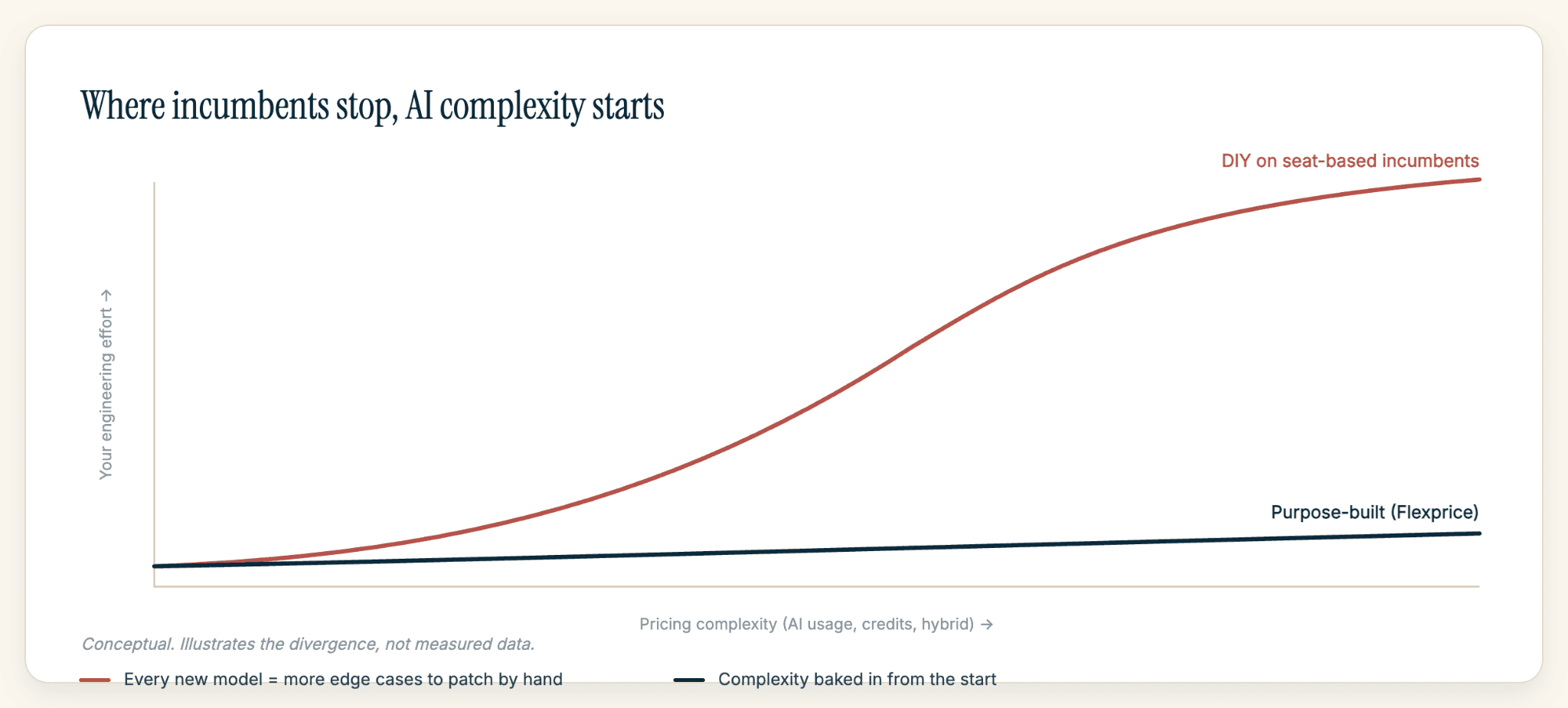
Because now you’re maintaining multiple other systems that you have to build to support all the edge cases that AI brings for you. And hence now modern day subscription management platforms for SaaS like Flexprice and Orb (recently acquired by Ayden) help you manage this entire workflow out of the box with all the complexities baked in from the start.
Why does subscription management matter for B2B SaaS businesses?
For every SaaS business in 2026, it’s not about just one time revenue. You need to constantly make sure that the customers stay, expand and renew the contract with you. Now subscription management is the system that makes sure nothing breaks in between this process neither for you or your customer.
And not having a stable B2B SaaS subscription management system can hamper your growth in multiple ways:
How does subscription management reduce churn?
Churn isn't always a product problem, a lot of it is a billing problem. At Flexprice we have seen customers switching from Chargebee and Zuora just because of an invoice and billing related issues.
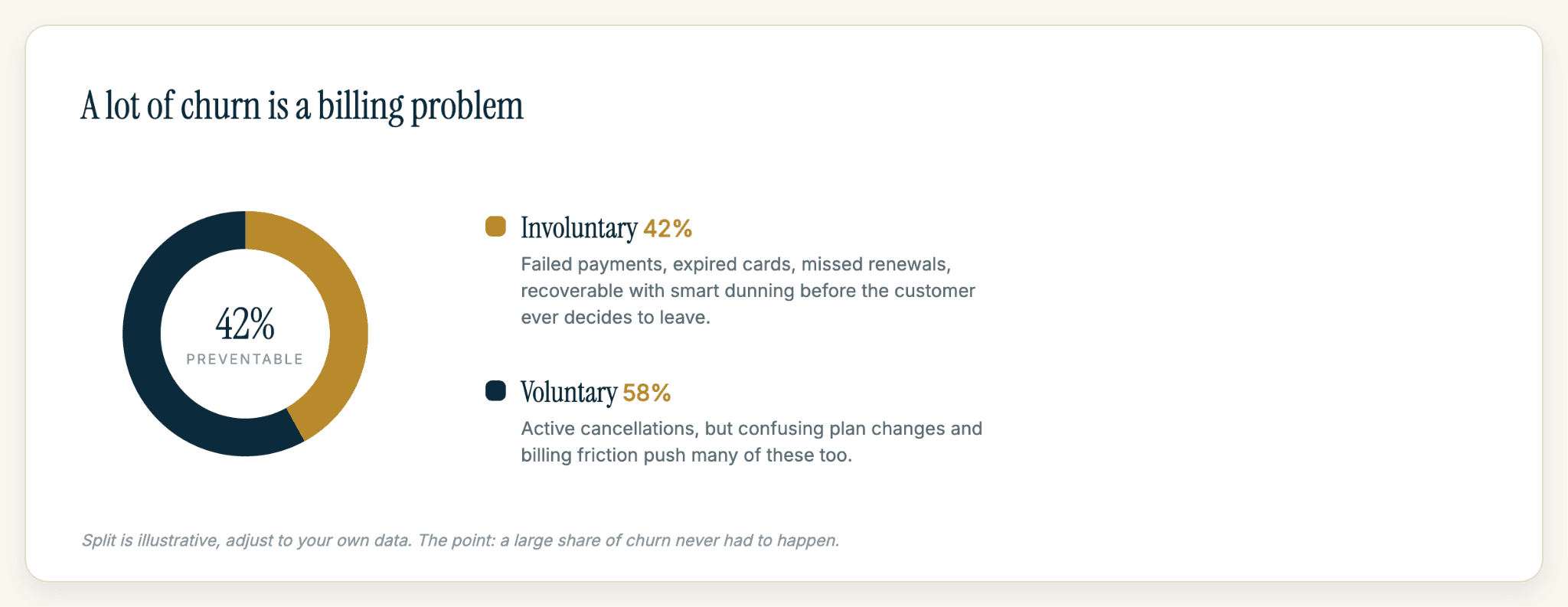
Dunning, missed renewals, and confusing plan changes will kill your retention before your CS team even notices.
How does it impact Customer Lifetime Value (CLV)?
CLV grows when customers expand, not just when they stay. Clean proration, automated upgrade prompts, and mid-cycle plan changes make expansion the path of least resistance.
What revenue leakage does it prevent?
Revenue leakage is the unbilled usage, manual discounts nobody removed, wrong invoice amounts.
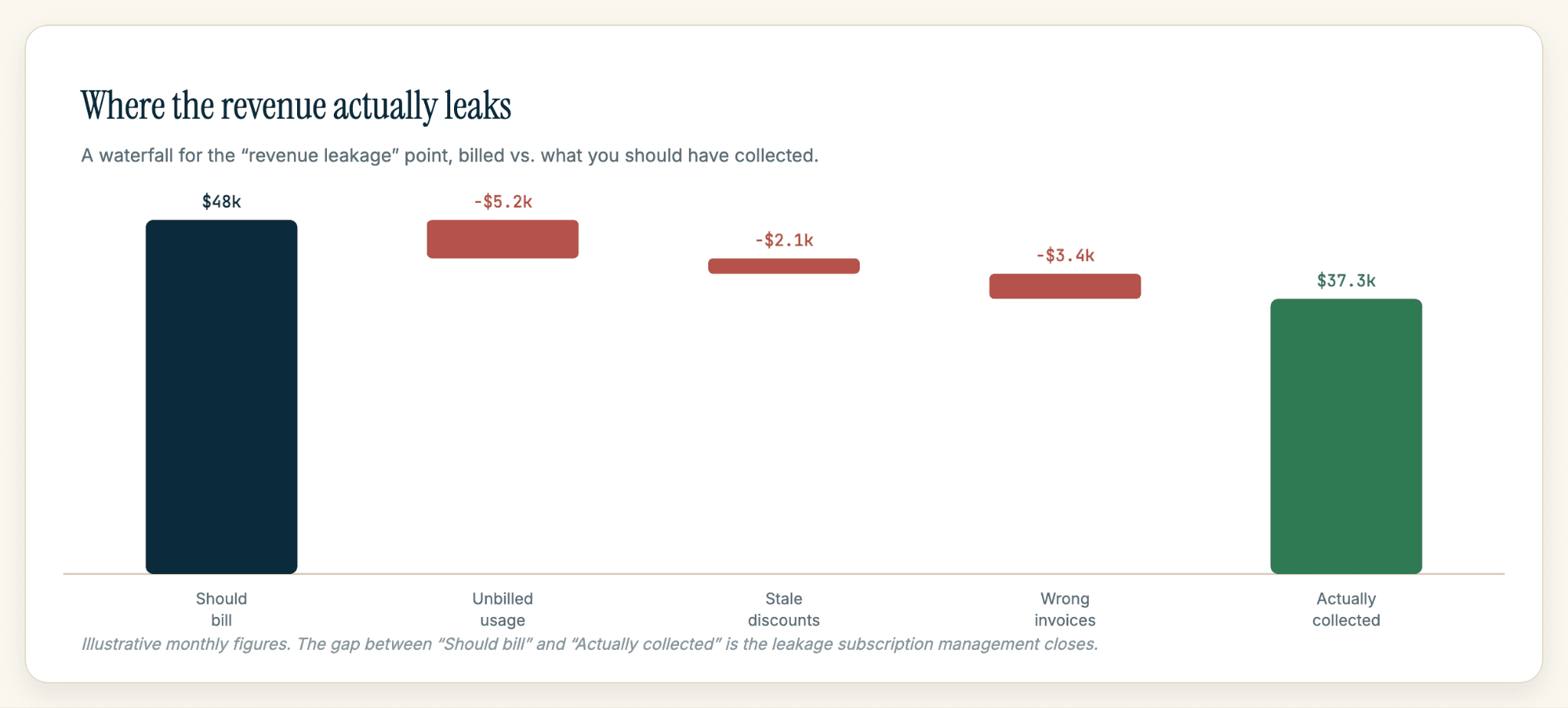
One of our customers, a leading voice AI company, was losing thousands of dollars a month because of exactly this. Subscription management automates the billing logic that humans consistently get wrong at scale.
What are the core features of a subscription management solution?
A subscription management solution is basically the engine room of your recurring revenue. It sits between your payment gateway and your product and handles everything your basic billing tool was never built to do. Here are the six things it needs to get right.
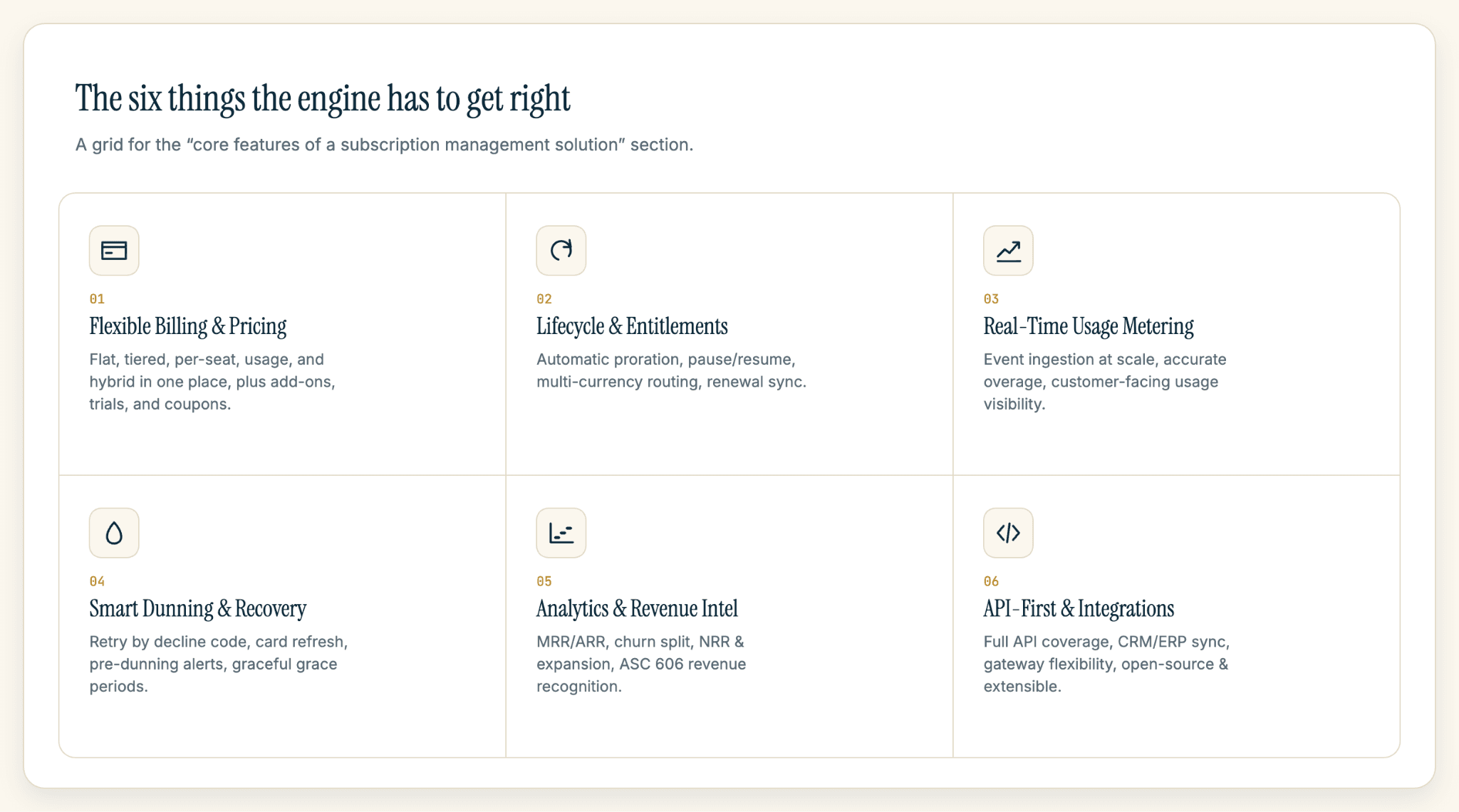
1. Flexible billing and pricing management
Here's the thing about SaaS software pricing models, they're never just one thing. You've got flat-rate customers, customers who are on usage based pricing, enterprise customers on custom contracts, all living in the same system.
A good subscription management solution handles all of them without you having to build separate logic for each one.
Diverse pricing support: Configure flat-rate, tiered, per-seat, usage-based, and hybrid models in one place. Pick your model, set your rules, done.
Add-on orchestration: Set up upsells, bundles, and one-time add-ons without touching a single line of code. People get real creative here.
Trial strategy control: Choose card upfront or no card depending on how you want to acquire customers. Your call.
Coupon and discount engine: Create promo codes, expiring discounts, and percentage-off deals once and let the system run them.
2. Automated lifecycle and entitlement billing
Mid-cycle plan changes sound simple until you're doing them for 500 customers at once. This is honestly where most inhouse billing systems start to break.
Proration calculation: When a customer upgrades mid-cycle, the system calculates the math automatically. No manual adjustments, no billing disputes.
Pause and resume logic: When customers need a break, they pause billing instead of cancelling. So you don’t lose a customer for an entire year and at the same time they can pause and resume the subscription as they like.
Multi-currency routing: The system charges customers in their local currency. Sounds small, bumps approval rates more than you'd think.
Renewal synchronization: Align different billing cycles to one calendar date. Small detail, big deal for enterprise finance teams reviewing invoices.
3. Real-time usage metering
If you run usage-based billing or hybrid pricing and still batch process usage data, you're basically flying blind between billing cycles. Real-time usage metering fixes that.
Event ingestion at scale: The system captures every API call, token, and compute hour and converts it into a billing event the moment it happens.
Accurate overage billing: The system calculates and bills usage beyond included limits automatically. No spreadsheet reconciliation, no revenue left on the table.
Customer-facing usage visibility: Customers track their own consumption in real time. Fewer billing surprises, fewer support tickets, everyone's happier.
4. Smart dunning and payment recovery
Failed payments are honestly the sneakiest cause of involuntary churn in SaaS. Just retrying the card and hoping for the best is not a strategy, that's wishful thinking.
Smart retry logic: The system schedules retries based on specific bank decline codes, not a generic one-size-fits-all schedule.
Card refresh automation: The system updates expired card details automatically before the payment fails. Yes, that's a thing.
Pre-dunning alerts: The system nudges customers before their card expires, not after the damage is done.
Grace period safeguards: The system restricts feature access gradually during payment failure instead of cutting customers off cold. Better for retention, better for the relationship.
5. Subscription analytics and revenue intelligence
If your CFO still pulls billing data into Google Sheets every month to build a revenue report, your subscription management software is not doing its job. Full stop.
MRR and ARR tracking: Track real-time recurring revenue metrics across every plan type including hybrid and usage-based customers.
Churn analytics: Separate voluntary cancellations from involuntary payment failures so you know exactly where the leak is.
NRR and expansion tracking: Measure net revenue retention and upsell performance in one place so your board deck is not built on vibes.
ASC 606 compliance: The system handles revenue recognition automatically for multi-month contracts. Your finance team will genuinely like you for this one.
6. API first architecture and integrations
Your subscription management solution does not live in a vacuum. It needs to talk to your product, your CRM, your data warehouse, and your finance stack without a custom integration project every single time.
Full API coverage: Access every feature through the API, not just the UI. No black boxes, no surprises.
CRM and ERP integrations: Connect Salesforce, HubSpot, NetSuite, and QuickBooks so customer and revenue data stays in sync across every team that needs it.
Payment gateway flexibility: Work with Stripe, Braintree, and Adyen so your billing system fits your payment stack, not the other way around.
Open-source and extensible: Your engineering team owns the billing infrastructure and controls how it scales. No vendor lock-in, no nasty surprises down the road.
What pricing models should a subscription management solution support?
Now this is a loaded question. But if you ask me, any subscription management solution in the entire globe should be able to support seat based pricing, usage based pricing, credit based pricing and hybrid pricing, at least.
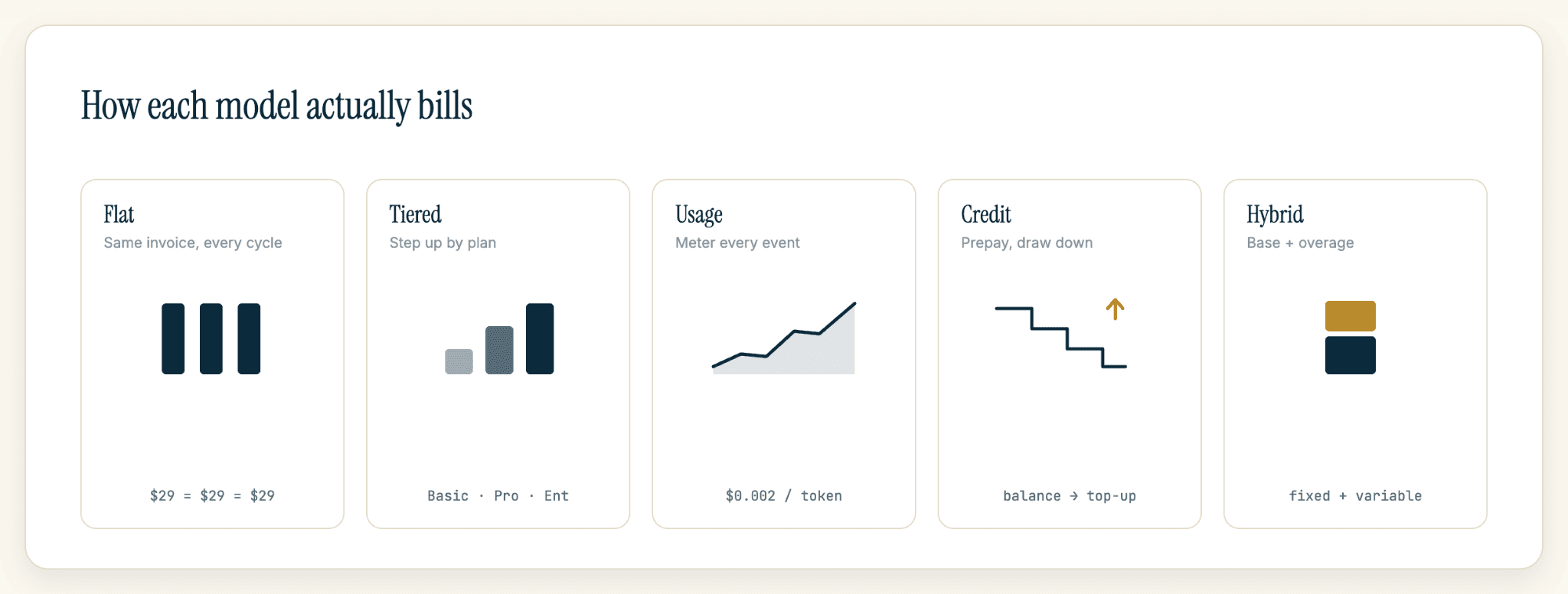
And when I say support, I don't mean that it should just have the containers and the rest of the nuances is something that’s your job to build and maintain on top of it.
Flat rate pricing
Flat-rate is literally the simplest SaaS pricing model you'll come across. One price, one product, same invoice every single month. CFOs love this pricing model because you can predict the revenue for next month without any hiccups.
It has a single fixed fee for access to the entire platform or a specific package. Everyone pays the same thing regardless of how much they use it.
Billing logic: Your subscription management solution generates an identical invoice every recurring interval. $29 this month, $29 next month, $29 till the end of time.
Best for: Early stage startups, simple mobile apps, or utilities where infrastructure costs are predictable and you just want to keep things simple.
Usage based pricing
So usage-based pricing or metered billing is pretty much what it sounds like. You pay for what you use, nothing more or less.
Customers pay based on how much they actually consume, API calls, tokens, compute hours, data storage. The value metric drives the bill.
Billing logic: Your subscription management solution meters every event in real time, adds it all up over the billing period, and sends one invoice. $0.002 per token, 500,000 tokens consumed, your system does the math automatically.
Best for: AI companies, developer tools, and infrastructure platforms where customers consume resources at completely different rates and a flat fee would either overcharge or undercharge almost everyone.
And here's the thing, customers love it because they only pay for what they use. You love it because revenue scales naturally as usage grows. But your finance team?
Not so much. They're going to have a lot of thoughts about revenue predictability. That's just the trade-off with usage-based billing for SaaS.
Tiered pricing
Tiered pricing is probably the most common SaaS pricing model you'll see out there. I mean seriously pull any pricing page and you will see three pricing packages.
With tiered pricing you package your product into different plans, Basic, Pro, Enterprise, each with different features, usage limits, or seat counts at different price points.
Here customers pick the tier that fits and upgrade when they outgrow it.
Billing logic: Your subscription management solution assigns each customer to a tier and generates a fixed invoice based on that tier every billing cycle. When they upgrade or downgrade, proration kicks in automatically.
Best for: SaaS products with diverse customer bases, from solo freelancers all the way up to large enterprises. If your product serves wildly different buyer types, tiered pricing gives everyone a home.
The upgrade path is honestly the best part of this model. Customers grow into higher tiers naturally and your revenue grows with them without you having to renegotiate every contract. The only way you mess this up is if you create too many tiers and confuse everyone. Three tiers is usually the sweet spot, people have been doing this long enough to know that.
Credit-Based Pricing
Credit-based pricing is where customers buy credits upfront and spend them as they go. Think of it as pre-purchasing consumption in a currency your platform controls. Pretty popular with AI tools and developer platforms right now.
Customers purchase a bundle of credits in advance and spend them across features or usage. One API call might cost 10 credits, a longer compute job might cost 500.
Billing logic: Your subscription management solution tracks credit balances in real time, deducts consumption as it happens, and triggers a top-up or renewal when the balance runs low.
Best for: AI SaaS companies and developer tools where consumption varies wildly per session and customers want flexibility in how they spend without committing to a fixed usage plan.
The best part for you as a company is that you collect cash before delivering the service. Great for the runway, great for cash flow.
The part that catches people off guard is unused credits sitting on your balance sheet as liability. And if customers overbuy and underuse, they feel burned and they don't come back. So getting the credit-to-value ratio right is actually more important than most people think.
Hybrid Pricing
Hybrid pricing is basically what happens when you combine a subscription base with usage-based billing on top.
You pay a fixed fee to get in the door and then pay more based on what you actually consume. It's honestly the fastest growing model in B2B SaaS subscription management right now and for good reason.
A base subscription fee plus variable usage charges on top. Customers know their floor, you get your baseline, and everyone has room to grow.
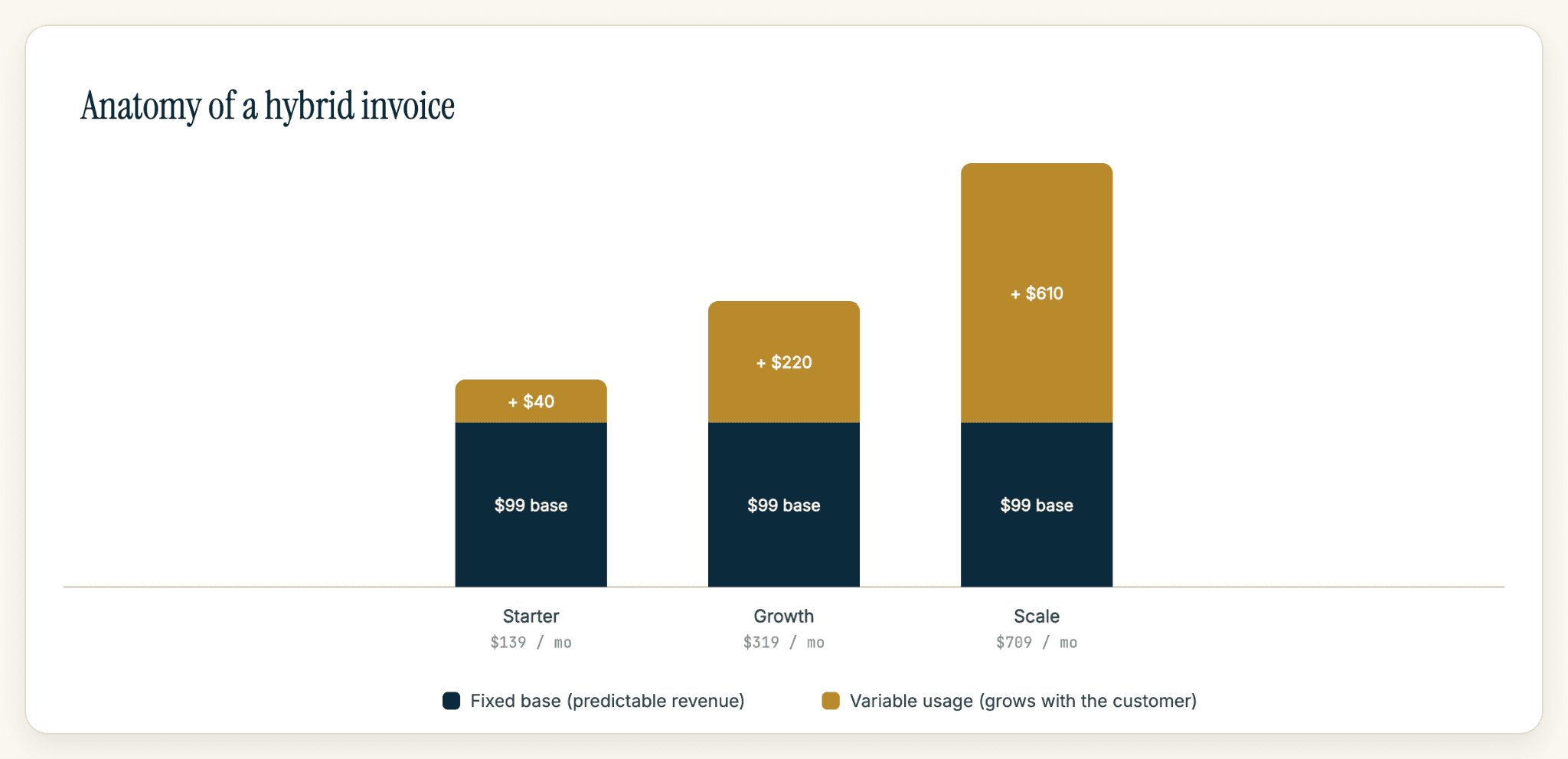
Billing logic: Your subscription management solution calculates the fixed charge and the variable overage separately, then combines them into one clean invoice at the end of the billing cycle. No manual reconciliation, no separate invoices.
Best for: Scalable B2B SaaS tools where baseline access is required but processing demands vary a lot between customers. Think AI platforms, data analytics tools, anything where some customers barely scratch the surface and others are pushing the limits every single day.
Here's why so many companies are moving to hybrid pricing. You get predictable baseline revenue from the subscription component which keeps your finance team happy.
And then usage upside means revenue grows naturally as customers consume more without you having to renegotiate contracts.
The tricky part is getting the base fee to usage ratio right. Price the base too high and you really are saying no to conversions. Price it too low and you leave money on the table.
People spend way more time on this than they'd like to admit.
What are the best practices for SaaS subscription management?
Good B2B SaaS subscription management is really about two things, making sure customers have a smooth experience and making sure your finance team isn't losing their mind. Here are the four practices that actually move the needle.
1. Automate billing and revenue recovery
If someone on your team is manually generating invoices or chasing failed payments, that's a problem. Not a people problem, a systems problem. Your subscription management solution should just handle this.
Seamless invoicing: Set it up once and it handles recurring charges, prorated upgrades, and trial conversions on its own. No manual work, no missed charges.
Dunning management: When a payment fails, the system figures out why and retries based on the actual decline code. As in it's not just blindly retrying the same card and hoping for the best.
Centralize your systems: Use a subscription management tool built for this instead of asking your engineers to build billing logic from scratch. They have enough on their plate.
2. Deliver pricing and plan flexibility
Your customers are not all the same and your subscription management for SaaS needs to reflect that. A startup on a tight budget and an enterprise with complex usage patterns cannot live in the same pricing tier. That just does not work.
Self-serve portals: Customers upgrade, downgrade, or cancel directly from their dashboard. As in they do not have to email your support team to change a plan. That friction is on you if it exists.
Hybrid models: Combine flat-rate, per-seat, and usage-based billing so your SaaS software pricing scales with how customers actually use your product. One size fits nobody here.
3. Focus on retention and churn prevention
Churn is rarely a surprise if you're paying attention. The signals are there weeks before someone actually cancels, you just have to be looking.
Usage tracking: Monitor product activity in real time to catch drops in engagement early. A customer who stops using your product is a customer who's already halfway out the door.
Personalized interventions: When you spot churn signals, trigger targeted in-app messages, emails, or a well-timed discount. Waiting until they cancel to do something about it is waiting too long.
4. Streamline internal management and security
This one does not get talked about enough but it matters a lot when you're scaling B2B SaaS subscription management and things start falling through the cracks.
Vendor and spend management: Audit usage regularly, consolidate tools that do the same thing, and revoke access the moment someone gets offboarded. Shadow IT is expensive and nobody budgets for it until it's too late.
Financial reporting: Your subscription management software needs to connect directly to your accounting systems so revenue recognition stays compliant. Nobody wants to untangle their books at quarter end, that's just not a fun time.
How do you choose the right subscription management tool for your SaaS product?
Choosing the right subscription management tool really comes down to two things, how you charge and how fast you're growing.
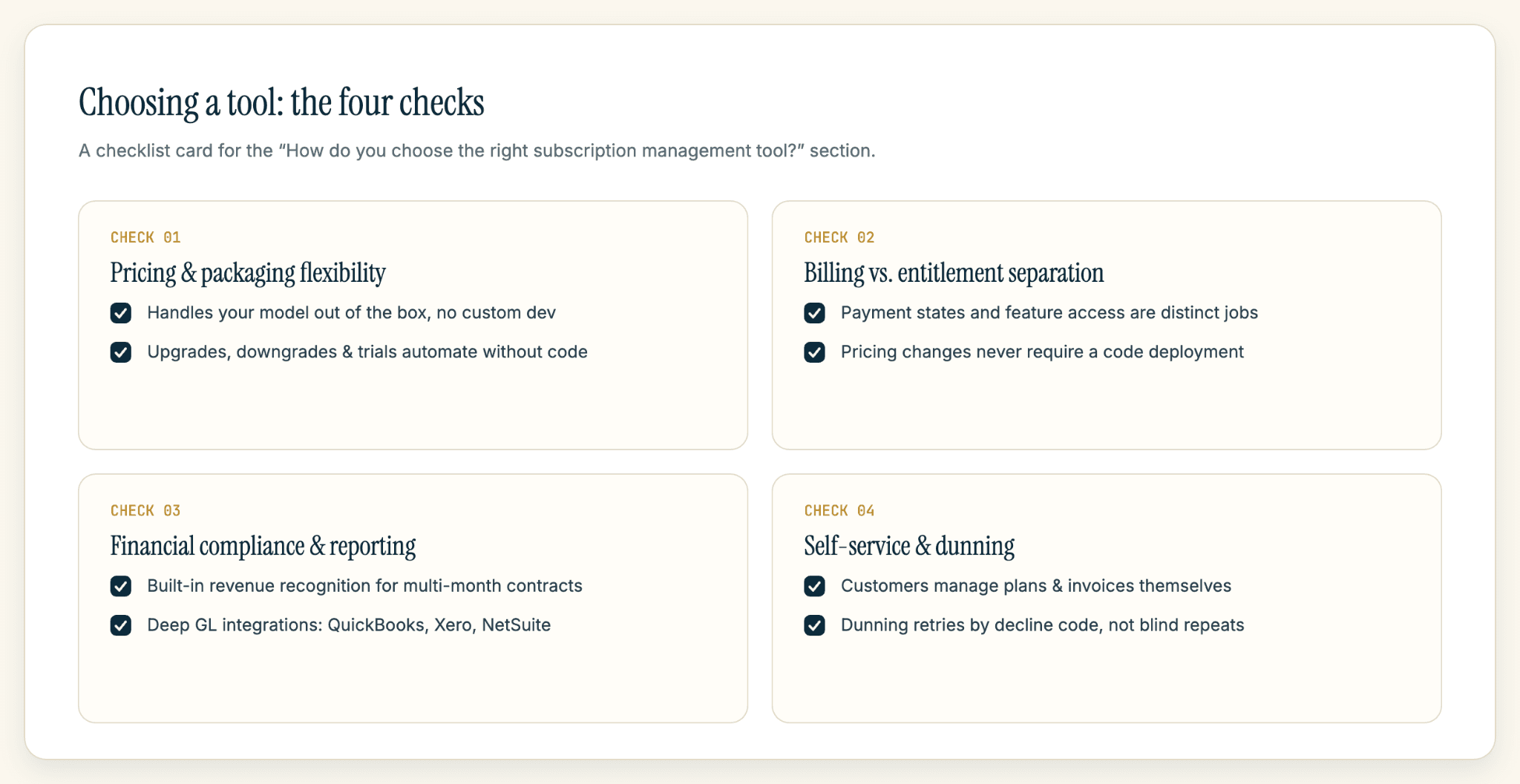
The best platform fits your pricing model natively and scales without your engineering team having to patch it every few months. Here are the four things you actually need to evaluate.
1. Pricing and packaging flexibility
If your subscription management solution can't handle how you charge, nothing else matters. As in, if you're running usage-based billing and your tool doesn't have a proper rating engine, you're going to be in trouble fast.
Check if the tool handles your specific model out of the box, flat-rate, tiered, usage-based, hybrid, without custom development.
Check if upgrades, downgrades, and trials can be automated. If your engineers have to build that logic manually every time pricing changes, that's not a subscription management tool, that's just a payment processor with extra steps.
2. Billing vs. entitlement separation
This one trips up a lot of teams. Your billing engine handles payment states, invoices, dunning, and reconciliation. Your entitlement layer handles what customers can actually access inside your product. These are two different jobs and the tools that try to do both poorly end up doing neither well.
Look for a platform that either handles both cleanly or integrates well with a dedicated entitlement tool.
If a pricing change requires a code deployment to update feature access, that's a sign the architecture isn't set up right.
3. Financial compliance and reporting
As you scale B2B SaaS subscription management, the finance requirements get serious pretty quickly. GAAP compliance, revenue recognition, MRR and ARR tracking, it all needs to work without your CFO manually pulling data every month.
Make sure the platform has built-in revenue recognition that handles multi-month contracts properly, as in not booking everything as a lump sum on day one.
Check for deep integrations with your general ledger, QuickBooks, Xero, NetSuite, so your books actually stay clean.
4. Self-service and dunning
Every support ticket for a plan change or invoice download is time and money you're spending unnecessarily. And every failed payment that doesn't get recovered is revenue you've already earned but won't see.
Look for a built-in self-service portal where customers update payment methods, download invoices, and manage their own plans without pinging your team.
Make sure the dunning logic is actually smart, as in retrying based on decline codes, not just hitting the same card three times and giving up.
The right subscription management tool for SaaS depends on where you are right now. If you're running usage-based or hybrid pricing at any kind of scale, you need a platform built for that specifically.
Flexprice handles all four of these out of the box, open-source, API-first, and without taking a cut of your revenue.
Wrapping up
SaaS subscription management used to mean setting up recurring billing and calling it a day. That's not the world anymore. As more companies move to usage-based and hybrid pricing models, the infrastructure underneath has to keep up with how customers actually consume your product, not just how they signed up.
The teams that get this right early build a commercial foundation that scales with them. Clean billing logic, real-time metering, smart dunning, self-serve portals, revenue analytics that don't require a spreadsheet.
It's not glamorous but it's what separates companies that grow cleanly from companies that grow and then spend six months untangling their billing mess.
If you're at the point where your current setup is starting to show cracks, that's usually the right time to look at purpose-built subscription management for SaaS. Not when everything has already broken.
Flexprice handles the full subscription lifecycle, usage metering, hybrid pricing, invoicing, and revenue analytics, all in one open-source platform built for exactly this. You can check out the docs or get started for free.
What is the difference between subscription billing and subscription management?
How do you track recurring subscription revenue?
How do AI companies handle subscription billing differently?
How do you reduce involuntary churn from failed payments?
How do you choose the right subscription management platform?