
Ayush Parchure
Content Writer, Flexprice

At some point, your engineering team stops shipping product features and starts maintaining your billing system. Not because anyone planned it, but because your pricing evolved, customers wanted flexibility, and now everything is held together with duct tape and good intentions.
Revenue recognition is usually the first thing that quietly falls apart. Invoices go out, but finance can't cleanly tie them back to the right periods or compliance standards. ASC 606 and IFRS 15 aren't optional, and when month-end arrives, and the numbers don't reconcile, it's engineering burning a sprint to fix what billing should have handled from the start.
Then there's the integration mess. Billing needs to talk to your CRM, ERP, payment gateway, and data warehouse, but every tool speaks a slightly different language. So now you've got custom middleware someone built 18 months ago that no one wants to touch.
And underneath all of it, a quieter fear: lock-in. Your billing logic is buried inside a vendor's proprietary system. You can't inspect it, you can't self-host it, and migrating would take quarters, not weeks.
The problem isn't that your team can't handle it. It's that every hour spent patching billing is an hour not spent on the product that actually moves your business forward.
Enterprise billing software exists for exactly this stage, so let's break down what it actually is, how it handles this complexity, and what to look for when you're ready to stop duct-taping your stack together.
TL;DR
Enterprise billing software manages contracts, pricing models, usage tracking, invoicing, and revenue reporting in one system.
It connects product usage, pricing logic, and financial systems into an automated billing workflow.
Modern AI and SaaS companies rely on billing systems to support subscription, usage-based, credit, and hybrid pricing.
Manual billing processes often cause revenue leakage, billing errors, and operational bottlenecks as companies scale.
Enterprise billing platforms track usage events and automatically convert them into billable charges.
These systems integrate with CRM tools, payment gateways, and accounting platforms to keep revenue data synchronized.
AI products generate high-volume usage events such as API calls, tokens, compute usage, and storage consumption.
Implementing enterprise billing infrastructure helps companies scale pricing experiments and revenue operations.
Platforms like Flexprice help AI and SaaS teams manage usage metering, flexible pricing models, and automated billing workflows.
What is enterprise billing software?
Enterprise billing software is a system that sits at the center of your revenue stack, handling custom contracts, hybrid pricing models, regional tax rules, revenue recognition, credits, refunds, and everything else that comes with monetizing at scale.
It helps in automating financial operations. It enables product and finance teams the flexibility where they can launch a new pricing model without any hassle.
Why does it matter now more than ever? To be honest, enterprise billing is not just about sending those invoices, Its is a about how you can run revenue as a core operational function
Billing becomes one of the hardest problems to manage because when AI and SaaS companies start landing larger customers, it leads you to manage multiple things at once, like you’re juggling between usage tracking, credit systems, and compliance across regions all at once. This is where cracks and revenue leakage are visible, and launches are delayed.
It is the actual reason that makes teams shift their focus towards usage-based billing infrastructure instead of just hardcoding pricing logic. And it's not just a
This is exactly why modern teams are moving toward usage-based billing infrastructure instead of hardcoded pricing logic. And it's not a niche shift; over 60% of SaaS companies are actively moving from static subscription models to more dynamic ones like usage-based, credit-based, and hybrid pricing.
In short, the sole purpose of enterprise billing software is to help you scale your revenue
With the same maturity as your product, without the operational exhaustion that usually comes with it.
How enterprise billing software works
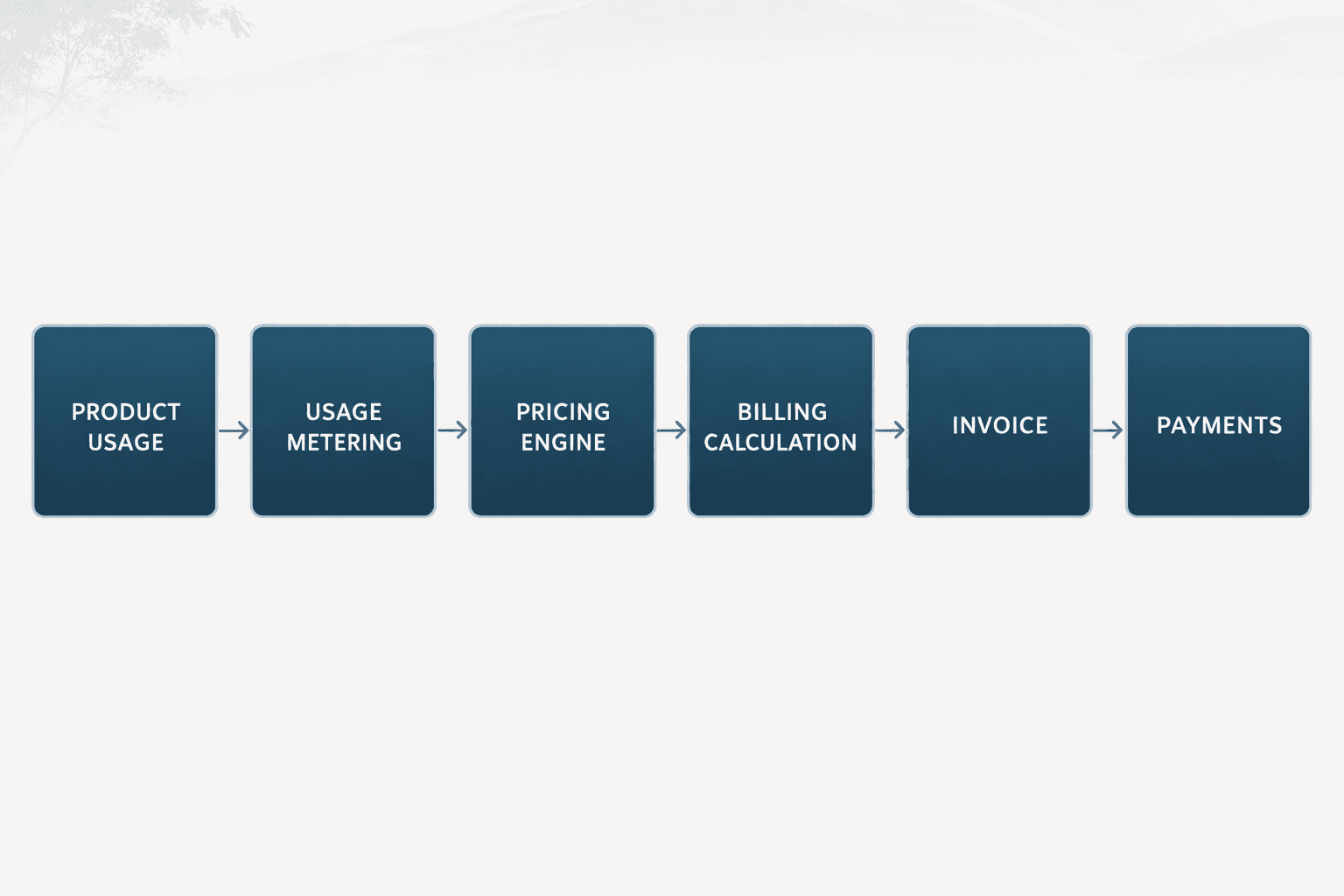
Enterprise billing software works by connecting the customer contracts, product usage, and the financial system into one automated workflow. First, it collects data and contract term systems like CRM or sales tools. Then, as the customer starts using the product, it tracks events like API calls, storage, and compute consumption.
When all of these processes are completed, it moves towards pricing models, where it applies it to calculate charges automatically. Finally, the system generates invoices, processes payments, and syncs the revenue data with accounting systems.
Key components of enterprise billing
Enterprise billing software is made up of several core components that come together to track revenue, calculate charges, and manage payment at scale
Billing engine
Billing engine can be stated as the core system that helps in calculating charges, which are based on pricing rules, usage data, and customer contracts. What it does is apply the subscription fees, usage-based pricing, discounts, and credits, which helps in determining the final amount a customer needs to pay.
Payment infrastructure
To collect revenue, billing systems integrate with payment gateways that support multiple payment methods such as credit cards, bank transfers, and digital payments. This ensures invoices can be settled securely across different regions and currencies.
Automated invoice generation
Enterprise billing software enables you to automatically generate an invoice with the help of pricing rules and billing cycles. This becomes useful because it removes the need for manual calculations and reduces billing errors.
Subscription and contract management
Subscription management becomes the most useful tool in your arsenal because handling upgrades, renewals, contract terms, and billing cycles is necessary for a business that operates on recurring revenue. It ensures that recurring charges are applied consistently across the customer lifecycle.
Reporting and revenue Insights
Billing systems also provide financial reporting and analytics that help teams track revenue, understand customer usage patterns, and forecast growth.
System integrations
Most of the enterprise billing software offers CRM, ERP, and accounting systems integration. These integrations ensure customer data, invoices, and revenue records stay synchronized across the company’s operational tools.
Common enterprise billing challenges
The enterprise billing environment is often complex. As companies scale across products, customers, and regions, billing operations tend to become harder to manage.
Here are some common challenges of enterprise billing
Complex organizational structures
Generally, big enterprises mostly operate across multiple departments, divisions, and subsidiaries. Where each unit may have different billing requirements, this makes it difficult to consolidate billing data and maintain consistency across the organization.
Multiple pricing models
Enterprise products rarely follow a single pricing structure. Businesses may combine subscriptions, usage-based pricing, volume discounts, or contract pricing, which makes billing calculations more complicated.
Large transaction volumes
As your customer base starts to grow, the number of billing events and transactions also increases significantly. Without the right system in place, managing high billing volumes becomes difficult.
Billing errors and revenue leakage
Typically, a result of calculation errors, inaccurate invoices result in customer dissatisfaction, customer churn, and revenue leakage. And these are the things that enterprise-level organizations want to avoid.
Global tax and compliance complexity
Going global is one of the complicated things because when filing international taxes, managing exemptions, calculating VAT, the billing process tends to get even more complex and error-prone.
Inefficient billing processes
Most of the organizations still rely on those ancient billing tools or manual processes. This workflow slows down invoice generation delay billing cycles, and increases the risk of operational bottlenecks.
These operational bottlenecks are more common than you think. And to resolve these issues, you need an ultimate enterprise billing software like Flexprice.
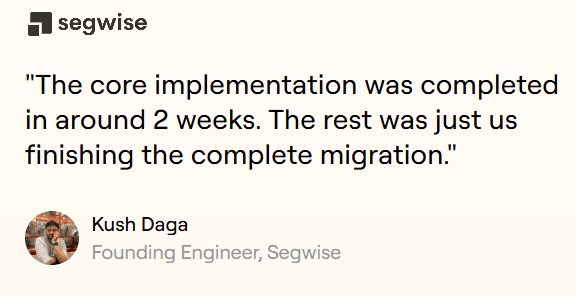
See how Segwise was able to bring its enterprise billing stack live in just a few weeks after moving away from manual billing workflows and engineering-heavy billing infrastructure.
Enterprise billing layers behind the scenes
Enterprise billing is not just a tool that sends invoices. It works across multiple layers that connect pricing strategy, product usage, and financial operations.
Understanding these layers helps explain why enterprise billing is difficult to manage with fragmented tools or custom scripts. Because each layer solves a different problem, and all of them must work together so that billing can scale with the product.
Strategic layer
Behind every enterprise billing system sits a strategic layer where product, finance, and revenue teams decide how the product should generate revenue.
Billing decisions at this stage go far beyond invoice generation. They shape how pricing reflects product value and how revenue grows as your customers use the product.
In practice, teams usually debate on questions like:
What pricing model best represents the value our product delivers?
Should we charge by subscription, usage, credits, or a hybrid of all three?
How do we balance predictable revenue with flexible usage pricing?
How should enterprise contracts, discounts, and minimum commitments be structured?
How do we prevent revenue leakage while keeping pricing transparent for customers?
You know, for an AI and SaaS organization, these decisions are especially important. So that usage can grow quickly, and pricing models can evolve
The billing system must support these strategies by allowing teams to experiment with pricing models, manage enterprise agreements, and adapt monetization as the product evolves.
Without this strategic layer, billing becomes a back-office task. But with it, billing becomes part of the company’s revenue strategy, helping the business scale revenue alongside product adoption.
Technical layer behind billing operations
While pricing decisions start at the strategy level, the technical layer is where billing actually happens. This layer connects product activity, pricing logic, and financial systems so revenue can be calculated automatically and consistently.
In AI and SaaS products, customers generate thousands or even millions of usage events every day. And these events might include API calls, tokens processed, compute time, storage consumption, or workflow executions. Each of these events represents a unit of value that eventually needs to be translated into revenue.
An enterprise billing software acts as the central infrastructure that connects several critical components:
Product usage data
Pricing rules
Billing calculations
Financial reporting
The system works nonstop, ingesting usage events from the product, and then it applies appropriate pricing rules, calculates charges, and prepares that data for invoicing and revenue reporting.
Without a dedicated billing system, you often try to manage this process using a combination of internal scripts, spreadsheets, and payment tools. For early-stage teams that frequently build custom pipelines that export usage data from the product, process it with scripts, and manually generate invoices.
This approach might work when customer volume is low. But as usage grows, the system becomes fragile in no time. Even small pricing changes require engineering updates and billing calculations. These things become hard to verify, which pushes finance teams to spend significant time reconciling usage data with invoices.
Enterprise billing platforms solve this by providing a structured system for managing billing logic.
They standardize billing rules
Instead of hardcoding pricing logic inside the product, teams define pricing models, such as subscriptions, usage-based pricing, hybrid pricing, and credits, directly inside the billing system.
Automate revenue workflows
Usage data flows into the billing platform automatically, charges are calculated based on predefined pricing rules, and invoices are generated without manual intervention.
Reduce manual reconciliation
Finance teams no longer need to cross-check spreadsheets against product data because billing calculations are now handled within a centralized system.
These systems help you to maintain accuracy at scale. As the number of customers, pricing plans, and usage events increases, the billing platform continues to process charges consistently and reliably.
In practice, this technical layer becomes a critical bridge between product, engineering, and finance teams. Engineering teams send usage data, product teams define pricing models, and finance teams rely on the resulting billing data for invoicing and revenue reporting.
If this layer is implemented correctly, billing stops being a collection of fragile scripts and becomes a reliable piece of infrastructure that grows with the product.
How to implement enterprise billing software
You don’t just think about adopting enterprise billing systems because you want another tool in your stack. You adopt it because your current billing setup stops working as the product scales.
In early stages, billing is usually stitched together with a mix of spreadsheets, payment processors, and internal scripts. Where finance teams generate invoices manually, engineers export usage logs to CSV files, and pricing changes require code updates.
At first, this setup feels blissful. But once the product grows, cracks begin to appear.
Typical warning signs include:
Manual invoice creation at the end of every billing cycle
Pricing models that engineering teams struggle to support
Revenue leakage from untracked usage events
Billing logic scattered across multiple tools and scripts
Finance teams are spending days reconciling usage with invoices
These problems are not just operational headaches. They often show up during procurement or enterprise sales cycles when prospects ask for custom pricing, usage visibility, or invoice flexibility. If your billing system can’t support those requests, deals stall or disappear. We break down real examples of how companies lose enterprise deals to broken billing infrastructure.
https://youtube.com/shorts/vxjUEy4CZMo?si=3YPmHz87HIfArCDT
This is the point where companies begin implementing enterprise billing infrastructure. Instead of relying on fragile workarounds, they move to systems that were designed to track usage, calculate charges, and generate invoices automatically.
The goal here is not just to automate, but it is to build a billing infrastructure that scales with product usage, pricing complexity, and customer growth.
Fix the “we don’t know what to bill for” problem
Before implementing anything, you need to ask yourself a deceptively simple question:
What exactly should customers be billed for?
This is the question that many teams struggle to answer, because product usage is not clearly defined in billable terms. Engineering teams can help you with tracking technical metrics, but the requirement of finance teams is a metric that can be directly translated into revenue.
Without a clear definition of billable usage, your billing becomes inconsistent, and revenue reporting becomes unreliable.
The first step in implementation is identifying product activities that represent value to customers. Common billable metrics include:
API requests
Tokens processed
Compute hours
Storage consumed
Seats or active users
Workflows executed
Messages sent
Data processed
These metrics are a direct representation of product value. The more a customer uses the product, the more revenue is generated for you.
During billing implementation, engineering teams instrument the product in such a way that to capture these events, each usage event must contain essential attributes such as:
Customer ID
Event type
Quantity or usage value
Timestamp
Metadata for pricing rules
Once you define these metrics clearly for your product, your billing system can convert your activity into billable charges.
Solve pricing complexity before it breaks billing
As products start to mature, pricing rarely stays simple. Early-stage AI and SaaS products might start with a single subscription plan. But as customer needs grow, pricing structures evolve quickly.
Teams begin introducing:
Usage-based pricing
Enterprise discounts
Feature-based plans
Prepaid credit systems
Minimum usage commitments
Volume pricing tiers
Without the right billing infrastructure, every pricing change becomes an engineering project.
Engineers must update pricing logic inside the product. Finance teams must manually validate calculations. Support teams must handle billing disputes when pricing rules break.
Enterprise billing software solves this by separating pricing logic from application code. Instead of hardcoding pricing rules, companies configure pricing models inside the billing platform.
Common pricing models that are supported by enterprise billing systems include:
Usage-based pricing: Here, customers are charged for their real-time consumption
Hybrid pricing: Customers pay a base subscription fee plus variable usage charges.
Prepaid credit systems: Customers purchase credits in advance and spend them as they use the product.
Tiered or volume pricing: The price per unit decreases as usage increases.
Enterprise contracts: Large customers negotiate custom agreements with minimum commitments and discounted rates.
By supporting these pricing structures natively, enterprise billing systems allow companies to experiment with pricing without constantly modifying backend code.
If you're looking for a no-code usage billing platform, Flexprice is the prime choice because it was built specifically to solve the problems AI and API-first companies face with modern monetization:
Stop revenue leakage from missing usage data
Revenue leakage is one of the most common billing problems in fast-growing AI and SaaS companies.
It happens when product usage is not captured correctly, meaning customers consume resources without being billed for them.
This often occurs when:
Usage events are dropped during system failures
Metering pipelines lose data
Billing scripts fail to process usage logs
The pricing rules do not account for certain product actions
Even small tracking gaps can lead to significant revenue loss at scale.
A reliable enterprise billing implementation introduces a usage metering layer that sits between the product and the billing engine. This layer performs several critical functions.
First, it captures product events in real time. Every billable activity is recorded as it happens.
Then, it associates usage with the correct customer account. This ensures charges are attributed accurately. And then finally, it stores usage data reliably so billing calculations can be performed later.
Every instance launch, storage request, or API call generates usage records that are later converted into billing charges.
Without robust usage metering, billing systems cannot accurately convert product activity into revenue.
See how an enterprise billing software like Flexprice helps you prevent revenue leakage.
It provides a real-time metering pipeline that captures usage events as they occur inside the product.
Each event is validated, associated with the correct customer, and stored for billing calculations. This architecture ensures that:
Usage events are not lost during system failures
billing calculations remain consistent
Finance teams can audit usage data easily
For companies handling millions of usage events per day, this metering layer becomes essential for preventing revenue leakage.
Eliminate manual invoice calculations
The invoicing process begins when finance teams export usage data from internal systems to calculate charges in spreadsheets and generate invoices manually.
This approach quickly becomes unsustainable.
As customer counts increase and pricing models grow more complex, the number of variables involved in invoice calculations expands dramatically. Consider a typical enterprise invoice that includes:
Base subscription charges
Usage-based overages
Discounts or promotional credits
Prepaid credit deductions
Taxes for different regions
Calculating these variables manually introduces errors and slows down the billing cycle. What enterprise billing software does is it automates this entire process.
Calculate charges based on pricing rules
Generate invoices at predefined billing intervals
Apply discounts and promotional credits
Calculate regional taxes
Manage billing cycles and renewal dates
Automation reduces operational workload while ensuring invoices remain accurate and consistent.
Connect billing with finance and revenue systems
Billing does not operate in isolation. Revenue data must flow across multiple business systems. For example:
Sales teams manage contracts inside CRM tools
Finance teams track revenue in accounting software
Payment gateways process customer transactions
Analytics tools monitor business performance
A well-implemented billing system should act as the bridge between these systems. During implementation, companies integrate billing platforms with tools such as:
CRM systems: Customer accounts, contracts, and pricing agreements originate in CRM platforms like Salesforce.
Payment gateways: Payment processors such as Stripe or Adyen handle transactions and payment authorization.
Accounting and ERP systems: Finance teams rely on accounting systems for revenue reporting and compliance.
When these systems are integrated, billing data flows automatically across departments, eliminating duplicate data entry and reconciliation errors.
Give customers visibility into their usage and costs
Billing disputes are often caused by a lack of transparency. If customers cannot see how their usage translates into charges, invoices can appear confusing or unpredictable.
This leads to support tickets, delayed payments, and strained customer relationships.
Modern enterprise billing software addresses this problem by giving your customers visibility into their usage and spending.
Typical capabilities include:
Real-time usage dashboards
Cost tracking based on current consumption
Credit balance monitoring
Downloadable invoice history
Alerts when usage approaches spending limits
Infrastructure companies like Cloudflare provide detailed dashboards showing request counts, bandwidth usage, and service consumption so customers can monitor their spending in real time.
Transparency reduces friction between vendors and customers. When users understand how billing works, invoices become predictable rather than surprising.
Top enterprise billing software for AI and SaaS
Tool | Pros | Cons |
Flexprice |
|
|
Orb |
|
|
Metronome |
|
|
Chargebee |
|
|
Lago |
|
|
1. Flexprice

Flexprice is enterprise-grade, open source usage based billing infrastructure for AI and SaaS companies. It can be deployed in your own VPC, on-prem, or on Flexprice's managed cloud.
Key features
Pricing & Billing
Usage-based, hybrid, tiered, volume, and graduated pricing in a single plan
Outcome-based billing for charging on business results, not raw API calls
Granular usage filtering by model, token type, region, or any event metadata
Pricing iterations with native versioning, staged rollouts, and A/B experiments
Credits & Wallets
Prepaid wallets with recurring grants, rollover logic, and configurable expiry
Auto top-ups with invoice-backed checkout and real-time balance sync
Separate spend vs. top-up conversion rates for promotional campaigns
Per-feature low-balance alerts with multi-level thresholds and webhook notifications
Multi-pool credit infrastructure with custom pricing units and dynamic conversion rates
Enterprise Contracts
Ramped contracts with auto-updating price timelines across phases
Committed usage with configurable overage factors and windowed buckets
Contract amendments with full versioning and audit trails
Built-in quote system with pricing lock-ins, approvals, and CRM sync
Account Management
Parent-child hierarchy with credit sharing, unified usage, and invoice rollups
Feature entitlements as an independent layer with boolean, config, and metered types
Per-customer overrides and dynamic feature experiments without changing plans
Self-serve customer portal for subscriptions, invoices, wallets, and usage breakdowns
Infrastructure & Scale
Go + Kafka engine architected for 1M+ events/sec
Standalone Collector streams from Kafka, webhooks, databases, and files
Multi-gateway support for Stripe, Razorpay, Moyasar, and Nomod
Integrations
Bi-directional CRM sync with HubSpot, Salesforce, Zoho, and Pipedrive
Native QuickBooks integration with auto customer and item sync
MCP server for agent-native billing through Cursor, Claude Code, or VS Code
Open Source & Deployment
Fully open-source with no feature gating between OSS and cloud
Self-hostable on your own infrastructure with full transparency
RBAC, service accounts, and scheduled usage reports included
Best suited for
AI platforms billing tokens, inference, or compute at scale
SaaS products using hybrid subscription + usage pricing
Teams needing entitlement control without hardcoded logic
Companies avoiding payment gateway lock-in
Products with high-variance or unpredictable consumption
2. Orb

Orb is a usage-based billing platform focused on metered pricing, event-driven billing, and invoice generation for modern SaaS and API-first companies. Orb positions itself as an engineering-first billing system, designed to ingest large volumes of usage events and translate them directly into billable revenue.
Key features
Usage-based billing with flexible charge models and real-time event processing
Revenue simulations to model pricing changes on historical data before going live
Custom pricing units with separate ledgers and conversion rates per credit type
Parent-child account hierarchy with shared credits and pooled usage
Progressive billing that triggers invoices automatically at usage thresholds
Enterprise contracts with tiered commitments, ramp schedules, and extended payment terms
Best suited for
Developer-first SaaS and API products monetizing directly from usage events
Engineering teams that prefer API/SQL-driven pricing over no-code tools
Companies handling large volumes of real-time consumption data (APIs, infra, AI)
3. Metronome

Metronome is an enterprise usage-based billing platform originally built to help SaaS and infrastructure companies convert high-volume consumption data into revenue.
Metronome became part of Stripe’s billing stack following its acquisition, meaning Metronome now operates inside Stripe Billing rather than as an independent platform.
Key features
Purpose-built usage-based billing with real-time rating and metering
Flexible pricing model configuration for tiered, volume, and hybrid setups
API-first architecture designed for developer-led implementation
Revenue tracking and billing analytics for finance visibility
Adopted by well-known high-growth companies for scale-stage billing
Best suited for
Already use Stripe as their primary payment processor
Monetize infrastructure, APIs, or AI workloads via postpaid usage
Have strong internal engineering resources to manage billing logic
4. Chargebee

Chargebee is an enterprise subscription billing and revenue operations platform built primarily for SaaS companies managing recurring revenue, invoicing, and subscription lifecycles.
While Chargebee has expanded into usage-based billing, its core architecture remains optimized for traditional SaaS subscriptions rather than AI-native, high-variance consumption models.
Key features
Mature subscription management with quote-to-subscription workflows built in
Global tax compliance and revenue recognition add-ons for multi-region billing
Extensive integration marketplace covering CRMs, ERPs, and analytics tools
Multi-entity support on Enterprise plans for managing separate billing sites
Self-serve customer portal with hosted checkout pages and payment collection
Metered billing with slab and tier configurations for basic usage tracking
Best suited for
Operate primarily on subscription-based SaaS models
Need mature invoicing and RevOps workflows
Rely heavily on CRM + accounting integrations
Run sales-led SaaS with predictable recurring revenue
5. Lago

Lago is an open-source billing platform built for usage-based pricing. It gives engineering teams a self-hostable metering and invoicing engine with enough flexibility to handle standard billing workflows without relying on a closed-source vendor.
Key features
Open-source core with usage metering, aggregations, and flexible charge models
Wallet system with prepaid credits, recurring top-ups, and configurable expiry
Event property filtering to segment billing by model, type, or any metadata key
Self-hostable on your own infrastructure for full data and logic ownership
Growing contributor community with integrations for payment and accounting tools
Best suited for:
Early to mid-stage SaaS companies that need basic usage-based metering out of the box
Engineering teams that prefer self-hosting billing infrastructure for data control
Companies with straightforward billing models that don't require advanced contract or credit workflows
Teams with dev bandwidth to build around gaps in entitlements, hierarchy, and pricing iteration
Wrapping up
If you’re building an AI or SaaS product, billing eventually stops being a simple invoicing task. Once you introduce usage-based pricing, credits, enterprise contracts, or hybrid models, billing becomes part of your core infrastructure.
Without the right system, you end up maintaining internal scripts to track usage, updating pricing logic inside the product, and reconciling invoices manually every month. That setup might work early on, but it becomes fragile as usage grows and pricing evolves.
Enterprise billing software solves this by giving you a system that tracks usage, applies pricing rules, and generates accurate invoices automatically. Instead of constantly fixing billing workflows, you get infrastructure that keeps revenue operations stable as your product scales.
That’s exactly where platforms like Flexprice come in. By handling usage metering, flexible pricing models, and automated billing workflows in one place, Flexprice lets you focus on building and monetizing your product instead of maintaining billing infrastructure.
What are the advantages of using a usage-based billing platform instead of building billing internally?
How does usage-based billing work for AI platforms that charge for tokens, API calls, or compute?
What’s the difference between subscription billing, usage-based billing, and hybrid billing models for SaaS?
What is enterprise billing software for AI and SaaS companies?
What features should the best enterprise billing software include in 2026?