Ayush Parchure
Content Writer, Flexprice
Schematic is an entitlement tool that got marketed as a billing solution. That gap is exactly why teams outgrow it, and exactly why this list exists.
When your pricing is simple, Schematic holds up fine. You're on Stripe, your plans are clean, and all you really need is something that tells your product who gets access to what. It handles that well. The problem starts when usage actually needs to be metered, credits need to be tracked in real time, or your pricing model evolves beyond flat plans and feature flags. At that point, Schematic stops being a billing platform and starts being a very expensive middleware layer between you and Stripe.
That is where Schematic alternatives like Flexprice come in, built for the full billing lifecycle rather than just access control. If you are shopping around because you hit that wall, or because you want to avoid it entirely, this guide breaks down five options that actually handle real metering, credit systems, and invoicing without the duct tape.
TL;DR
Schematic works well for linking feature flags and entitlements with Stripe-based subscriptions, making it useful for early-stage SaaS monetization.
As products scale, teams often need more advanced billing infrastructure for usage-based pricing, credit wallets, hybrid pricing models, and high-volume metering.
This is why many companies start exploring Schematic alternatives built for modern SaaS and AI monetization.
Flexprice is best for companies that need enterprise billing infrastructure with real-time metering, credit wallets, hybrid pricing, and multi-payment gateway support.
Metronome is a strong option for teams committed to the Stripe ecosystem that want scalable usage metering.
Lago is an open-source billing platform for teams that want self-hosted usage-based billing.
OpenMeter is an open-source usage metering layer typically combined with other billing tools.
Orb manages a SaaS billing platform designed for usage-based pricing at scale.
What is Schematic?
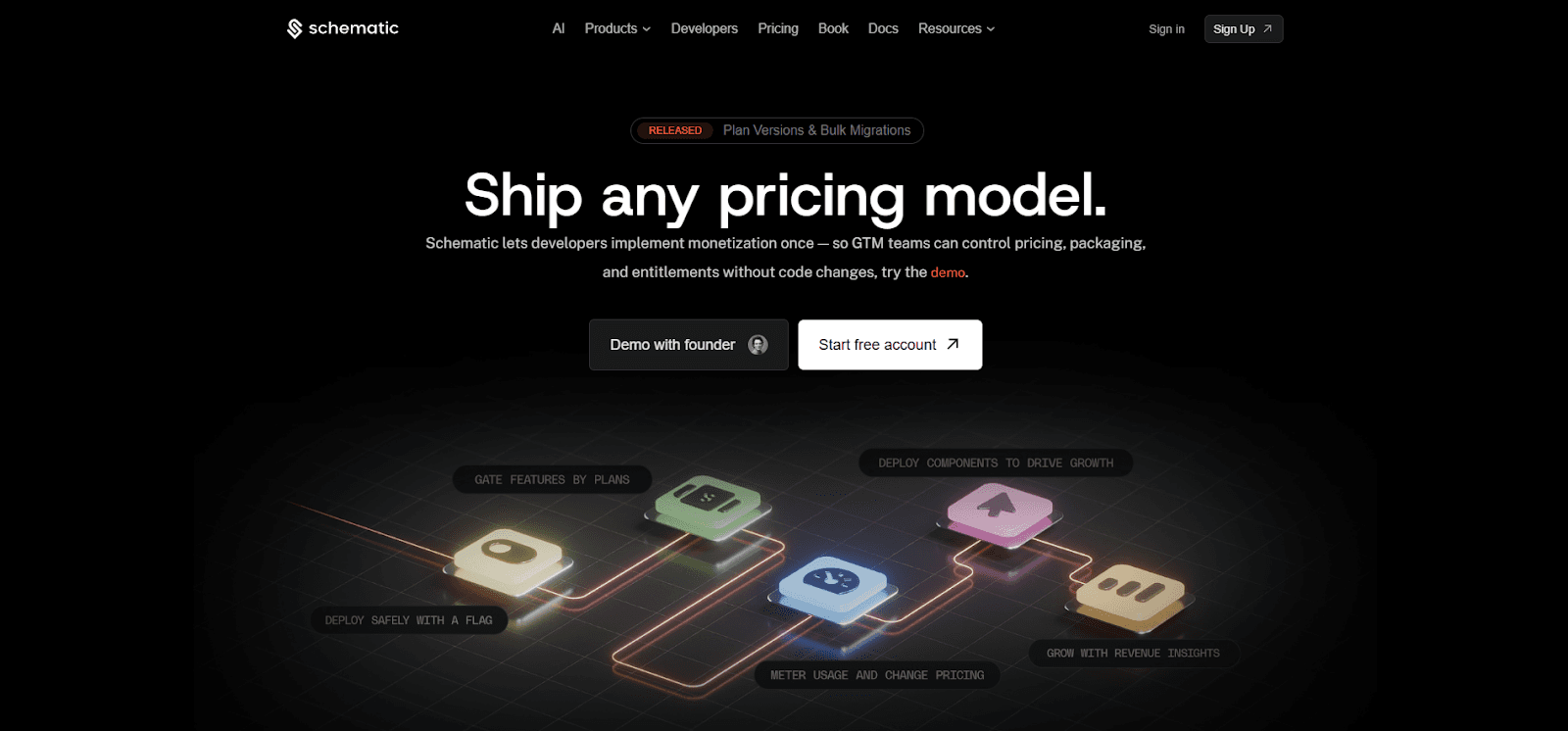
Schematic is a monetization and entitlement management platform that is particularly
designed to sit between B2B SaaS applications and billing systems. It helps in empowering the product and GTM teams to manage plans, billing, pricing, and entitlements without any requirement for engineering code changes. It acts as a single source of truth for customer access rights
Key features of schematic
Entitlement and feature management: You can enable/disable features for users, manage plan limits, and handle usage-based entitlements without manual database overrides.
No-code pricing changes: It allows teams to iterate on packaging, launch trials, and change limits without engineering tickets.
Usage-based metering: Tracks usage to support hybrid or purely metered billing models, enforcing limits at runtime.
Customer-facing components: Provides embeddable UI components for checkout flows, customer portals, and usage dashboards
Internal tools: Features built-in dashboards for sales and account management to handle customer overrides.
What Schematic does well
Before exploring Schematic alternatives, it’s useful to understand where the platform actually performs well. Schematic was built to connect feature flagging with monetization logic, helping teams control product access and pricing rules in one system.
For SaaS and AI companies experimenting with usage-based billing, this approach can simplify how feature access and entitlements are enforced across the product.
Here are the areas where Schematic works well:
Combines feature flags and billing entitlements into a single system.
Supports basic usage-based billing for SaaS and AI products.
Allows teams to gate product features by plan or usage limits.
Enables runtime access checks through SDKs.
Provides embeddable UI components for billing workflows.
Reduces the engineering effort required to launch monetization systems before teams start evaluating a Schematic alternative.
Where Schematic starts to break
While Schematic works well for connecting feature flags with pricing logic, many teams start looking for Schematic alternatives once their billing needs become more complex.
This usually happens when companies move from simple plan enforcement to enterprise billing, flexible payment infrastructure, or AI-specific pricing models.
Here are some of the areas where teams begin evaluating an alternative to Schematic:
Relies heavily on Stripe for subscriptions and payments, since Stripe remains the system of record for billing.
Not designed as a standalone billing engine because Stripe handles billing and payment processing.
Limited flexibility for companies that want to use payment providers other than Stripe.
Lacks deeper enterprise billing capabilities like complex contract structures or account hierarchies.
Limited infrastructure for advanced credit wallets or prepaid usage systems used in AI and API businesses.
Closed platform with no open-source or self-hosting option.
Because of these limitations, teams building AI platforms, API products, or complex usage-based systems often start evaluating Schematic alternatives that offer more complete billing infrastructure, flexible pricing models, and payment provider independence.
Why companies look for schematic alternatives
Schematic solves a real problem. If you run a SaaS product on Stripe and want feature flags and entitlements to stay in sync with billing, Schematic handles that well. The setup is fast, the developer experience is clean, and teams can gate features based on billing state without building custom logic.
But Schematic is built around a few assumptions: Stripe is the billing system, pricing fits into plans and add-ons, and entitlement enforcement is the main challenge. That works for many early-stage SaaS products.
But as companies grow, pricing models evolve, and usage volumes increase. At that point, teams often start exploring Schematic alternatives.
Here are the most common reasons that make companies look for schematic alternatives.
Growing AI companies need more advanced billing models
AI products rarely fit neatly into seat-based plans. Pricing often depends on tokens, API calls, GPU minutes, or workflow executions.
Teams need billing systems that can meter usage at a granular level and support hybrid pricing, credits, and usage tiers. Schematic works well for basic usage limits, but companies building complex monetization models often start evaluating Schematic alternatives built for usage-heavy products.
Stripe lock-in restricts payment flexibility
Schematic relies heavily on Stripe’s billing infrastructure. This works well if Stripe is your only payment provider. But many companies eventually need multiple payment processors for regional coverage, cost optimization, or enterprise contracts.
When billing infrastructure depends on a single provider, switching becomes difficult. That’s a common reason teams start looking for an alternative to Schematic.
Limited support for advanced credit and wallet systems
Schematic supports basic credit burndown models, where usage deducts from a prepaid balance. However, many AI and API companies rely on more advanced wallet systems like multiple credit pools, promotional credits, auto top-ups, expiration rules, and detailed usage ledgers.
As credits become the core monetization model, teams often explore Schematic alternatives that offer more flexible wallet infrastructure.
Closed-source infrastructure introduces vendor risk
Schematic is a proprietary SaaS platform with no self-hosting option. For many startups, this is fine. But larger companies and regulated industries often require more control over infrastructure and data.
That concern can push teams toward an alternative to Schematic with more transparent or flexible deployment options.
Scaling usage metering becomes difficult
Stripe’s metered billing works well for moderate usage tracking, but it was not designed for high-volume event pipelines.
AI and API companies often need real-time usage visibility, event-level audit trails, and multi-dimensional usage aggregation.
As usage volumes grow, many teams start evaluating Schematic alternatives that are built specifically for usage-based billing and large-scale metering.
Top 5 Schematic alternatives for usage-based billing
Flexprice
Metronome
Lago
OpenMeter
Orb
Tool | Pros | Cons |
Flexprice |
|
|
Metronome |
|
|
Lago |
|
|
OpenMeter |
|
|
Orb |
|
|
1. Flexprice
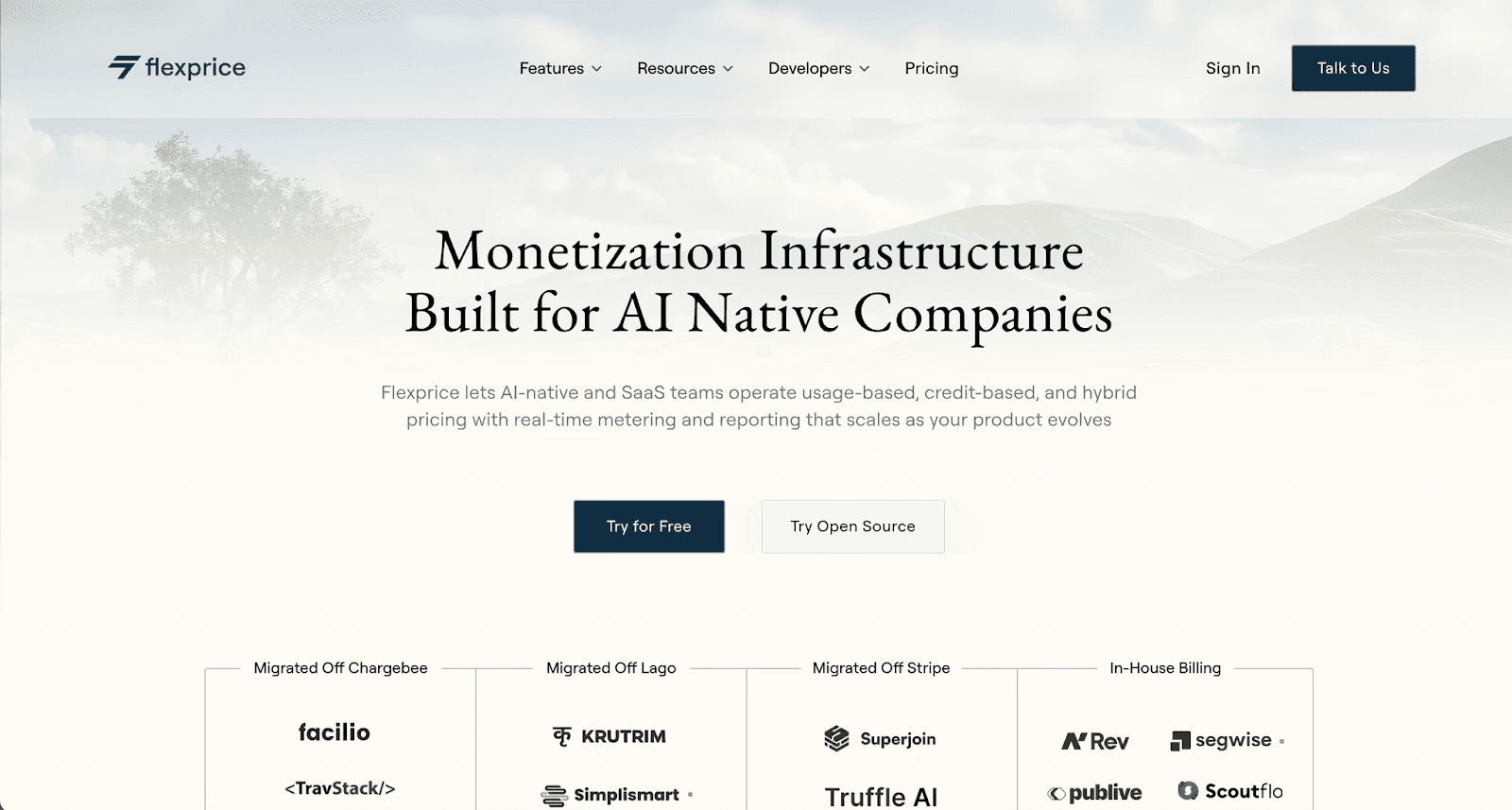
Flexprice is enterprise-grade, open source usage based billing infrastructure for AI and SaaS companies. It can be deployed in your own VPC, on-prem, or on Flexprice's managed cloud.
It provides real-time usage metering powered by Kafka and ClickHouse, enabling teams to process large volumes of product events and convert them into billable usage.
Flexprice also includes a native credit wallet system that supports prepaid credits, auto top-ups, and flexible credit consumption models. It also integrates with multiple payment providers, allowing companies to run billing across different regions without being locked into a single payment gateway.
Unlike Schematic, which functions primarily as an entitlement and plan management layer built on top of Stripe, Flexprice operates as a standalone billing engine. You can layer it on top of your existing payment provider or run it independently.
The core codebase is open source under AGPLv3, which means your team can audit every workflow, self-host on your own infrastructure, and avoid the kind of vendor dependency that makes finance and security teams uncomfortable.
Where this becomes especially relevant for teams evaluating Schematic alternatives is in how Flexprice handles AI-specific billing complexity. If your product charges based on tokens consumed, GPU compute time, agent task completions, or model-specific inference costs, you need a billing system that can ingest those events in real time, apply credit deductions at the point of consumption, and generate invoices that actually reflect what happened. Flexprice does this natively.
Key features
Real-time usage metering
Processes product events in real time using a pipeline built on Kafka and ClickHouse, allowing teams to convert API calls, tokens, compute time, or agent tasks into billable usage.
Flexible event aggregation engine
Supports multiple aggregation types such as Count, Sum, Average, Count Unique, Latest, Weighted Sum, and Max with bucketing, enabling complex usage calculations.
High-volume event ingestion pipeline
Includes a standalone Collector built on Bento that can ingest events from APIs, Kafka streams, databases, webhooks, and 100+ data sources with batching and retry logic.
Programmable credit wallet system
Provides prepaid credits, promotional credits, recurring credit grants, expiration rules, and configurable conversion rates for credit-based monetization.
Automated credit workflows
Supports auto top-ups, low-balance alerts, credit priority ordering, rollover rules, and wallet freeze states when payments fail.
Flexible pricing engine
Supports flat-fee, package, tiered, and volume pricing, allowing teams to combine subscriptions and usage charges into hybrid pricing models.
Enterprise contract support
Includes commitment-based pricing, reservation discounts, true-up billing, and per-customer pricing overrides for enterprise deals.
Feature entitlements and access control
Allows teams to define feature flags, usage limits, and configuration values per plan or customer, enforced directly through API checks.
Parent-child accounts
Parent accounts can manage multiple child accounts while maintaining separate usage visibility. This structure supports enterprise customers with multiple departments or internal teams.
Multi-gateway payment integrations
Works with Stripe, Razorpay, Adyen, and integrates with tools like Salesforce, HubSpot, Zoho, QuickBooks, PayPal, and Snowflake.
Open-source and self-hostable infrastructure
Licensed under AGPLv3, allowing teams to audit the billing logic, deploy on their own infrastructure, and avoid vendor lock-in.
Pros
Built for usage-based billing, credit systems, and AI monetization models.
Real-time metering architecture designed for high-volume event processing.
Fully programmable credit wallet infrastructure.
Works with multiple payment providers, reducing dependency on Stripe.
Open-source core with self-hosting support.
Supports complex enterprise pricing models and contracts.
Cons
The ecosystem and marketplace are still growing compared to older billing platforms.
Pricing
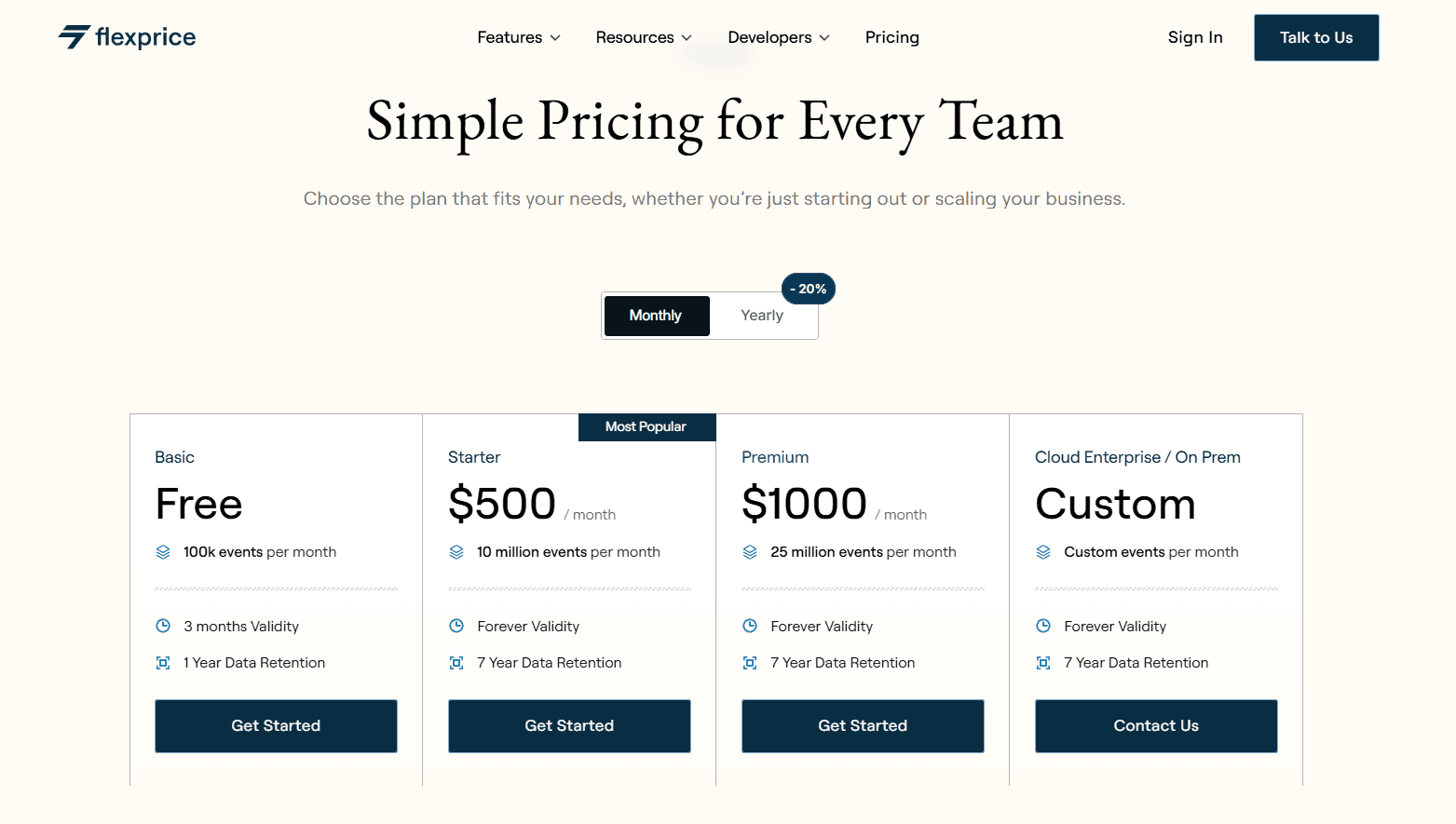
Flexprice offers 4 different pricing options apart from open source, which are:
Basic- free- 100k events per month
Build- $500 / month with 1 million events per month
Scale- $1000 / month with 5 million events per month
Mission critical- custom
Best suited for
AI-native companies building APIs, agents, or inference-driven products that need real-time metering across tokens, compute, GPU hours, or task completions.
Developer-first SaaS teams that want open-source, API-first control over their billing infrastructure instead of relying on closed entitlement dashboards.
Companies running credit-based or prepaid billing models with real-time balances, auto top-ups, and clean rollover logic.
Teams scaling from product-led self-serve plans to enterprise contracts with commitments, overages, and per-customer pricing.
Organizations operating across multiple payment gateways or regions without rebuilding billing logic.
Teams exploring Schematic alternatives after hitting limits around credit wallets, payment lock-in, or AI billing complexity.
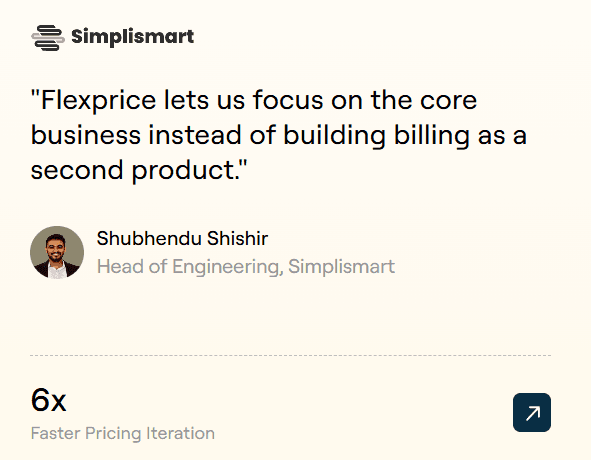
See how Simplismart scaled complex AI pricing models and billing workflows without rebuilding their monetization infrastructure
2. Metronome
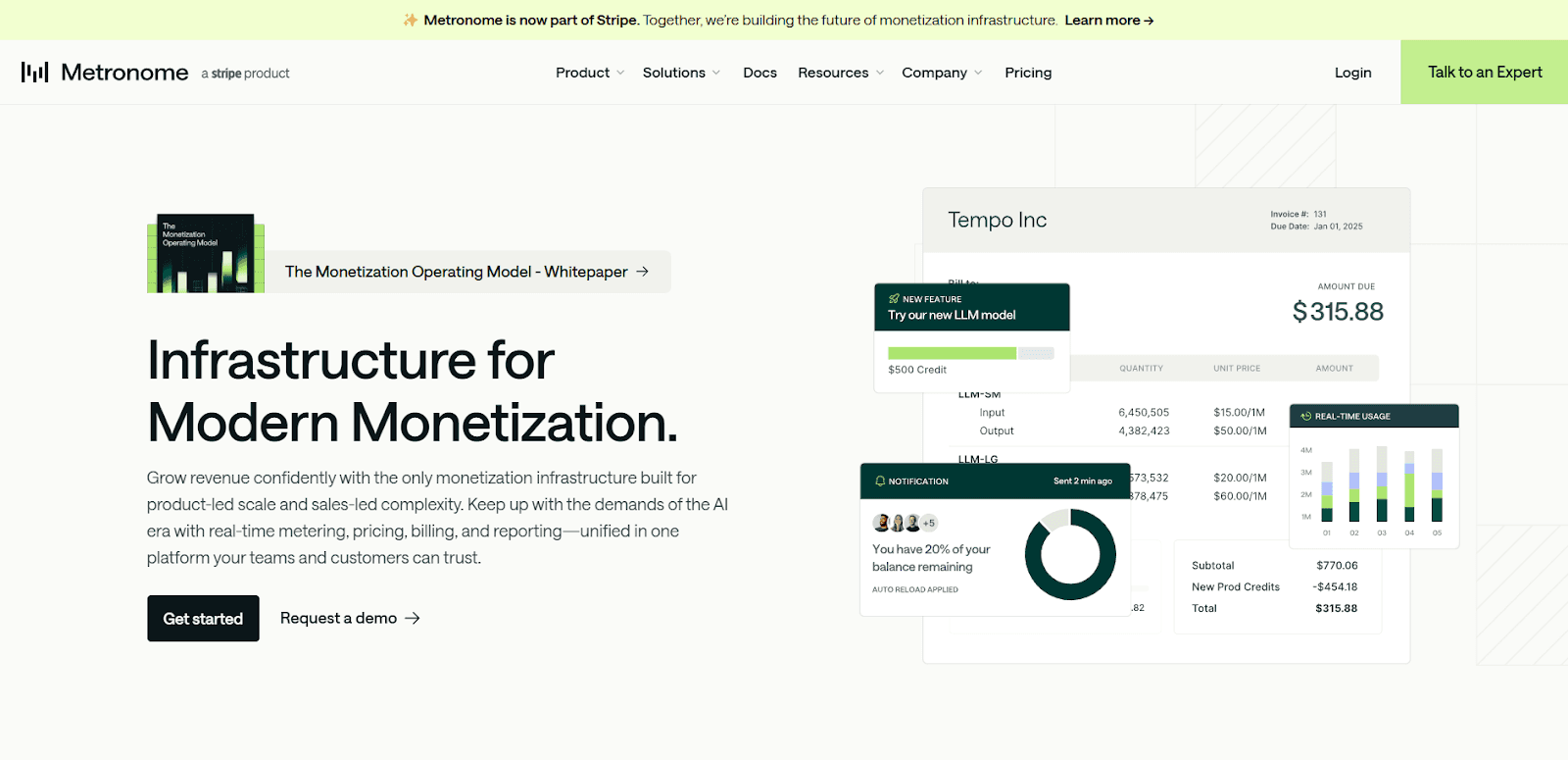
Metronome is a monetization infrastructure that is built for product-led scale and sales-led complexity. To keep up with the demands of the AI era with real-time metering, pricing, billing, and reporting. As one of the alternatives to Schematic, it lets teams stream events, define metrics and pricing, and then apply those rules across various pricing models.
Stripe has acquired Metronome, which means it fits most naturally within the Stripe ecosystem.
This limits flexibility for companies that want to use multiple payment gateways or avoid relying entirely on a single payment provider. Over time, this can create Stripe lock-in, making it harder for you to switch payment infrastructure or implement multi-gateway payment strategies as they scale.
Key features
Event metering and billable metrics: Metronome ingests high-volume usage events and lets teams define billable metrics.
Flexible pricing and rate cards: It supports usage-based, subscription, and composite products, and handles tiers, minimums, overages, and dimensional pricing
Customer-facing usage and spend visibility: You can show real-time usage and spend data to your customers via dashboards, with configurable alerts and limits so that they can monitor and control consumption.
Pros
Highly scalable usage metering: Built to process millions of usage events and track metrics like API calls, compute, or storage with high accuracy.
Developer-friendly architecture: Strong APIs and event-driven infrastructure make it easier for engineering teams to integrate billing directly into product workflows.
Flexible pricing models: Supports usage-based, hybrid, and tiered pricing structures for modern SaaS and AI products.
Strong support team: User reviews highlight responsive support and the ability of the team to understand complex processes quickly.
Cons
Engineering-heavy implementation: Integrating and maintaining metering pipelines can require significant engineering effort compared to more plug-and-play billing tools.
Focused primarily on metering: The platform is strong for usage tracking, but may require additional systems for broader finance operations.
Operational complexity with usage billing: Teams adopting usage-based pricing often face challenges around pricing strategy and cost predictability.
Pricing
Metronome offers a free Starter plan for teams launching usage-based products. Custom enterprise pricing is available, but for that, you need to contact their sales team.
Best suited for
Best for teams that want a Stripe-native usage metering solution and plan to standardize on Stripe long-term. With Metronome now part of Stripe, it fits well inside that ecosystem, but is less suitable if you need vendor flexibility, cross-provider integrations, or frequent pricing experimentation.
3. Lago
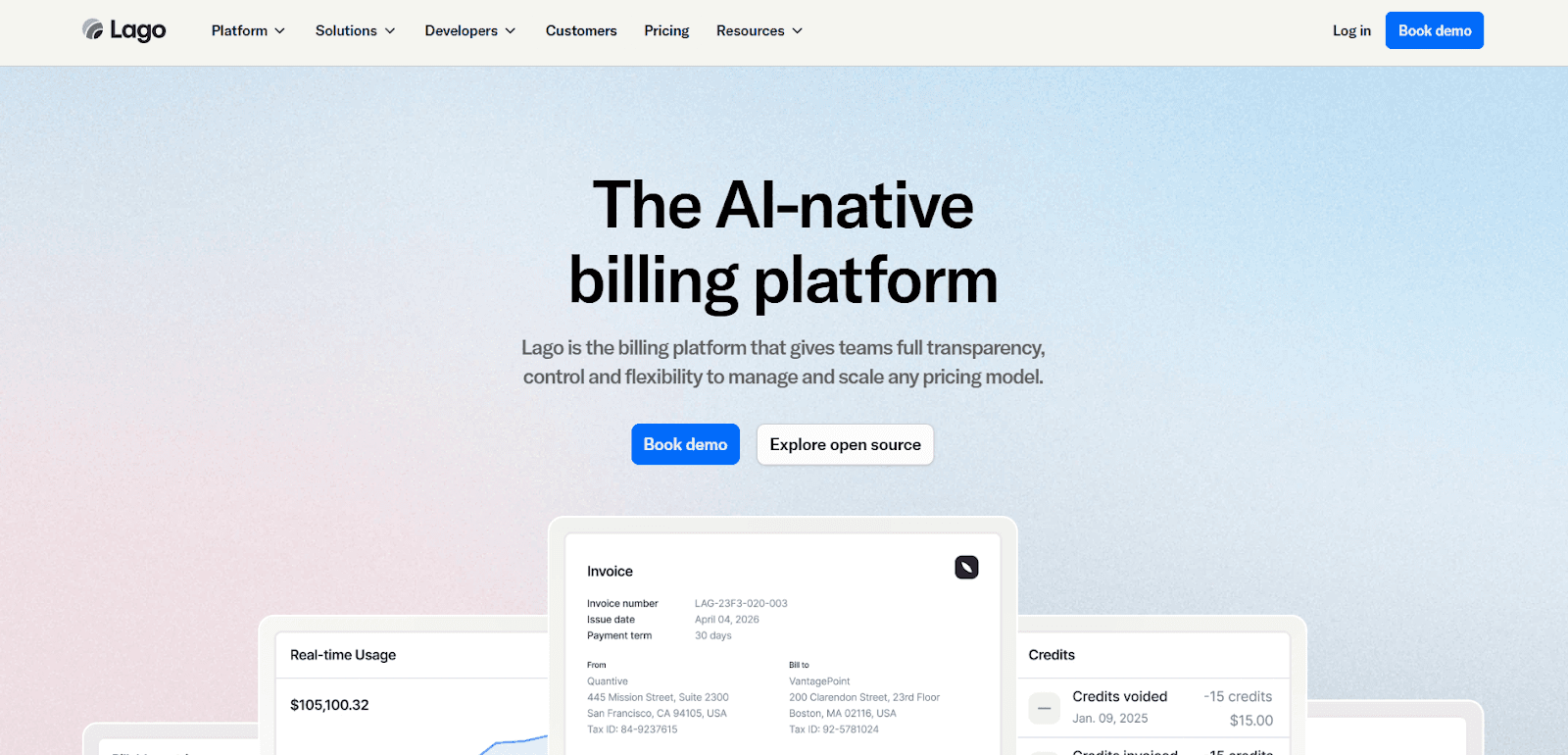
Lago is an open-source option among Schematic alternatives for teams that want to self-host billing infrastructure. This makes it attractive for engineering teams that prefer managing billing inside their own stack.
However, it often falls short for companies running more complex monetization models. Lago does not support contract ramping, quote or renewal management, or account hierarchies for shared billing across organizations.
Credit workflows are also limited; there are no separate conversion rates for promotional credits, no invoice-backed checkout for credit top-ups, and no advanced balance alerts for spend thresholds.
Key features
Open-source: Lago can be self-hosted and cloud-hosted for maximum flexibility
Real-time usage tracking: You can track all the events in real-time for accurate billing
Flexible pricing: You get the flexibility to go with various pricing models to see what fits best
High-volume event ingestion: Lago can handle high volumes of events from metering to billing
Pros
Open-source and self-hostable, giving teams code transparency and deployment control similar to Flexprice.
Solid basic usage-based metering with event aggregations and flexible charge models handling around 15K billing events per second.
Supports prepaid credit wallets with recurring top-ups, expiration dates, and up to 5 active wallets per customer.
Granular usage filtering lets you segment billing by metadata like model type or token category within a single billable metric.
Custom pricing units with conversion to fiat for invoicing, useful for abstracting billing into credits or tokens.
Cons
No parent-child account hierarchy, so multi-entity billing, credit sharing, and consolidated invoicing require custom workarounds.
No ramped contracts, meaning pilot-to-scale pricing transitions need manually created plan versions and backend scheduling logic.
No built-in quote or renewal management, forcing sales-led deals into spreadsheets, PDFs, or external CRM add-ons.
Entitlements are tightly coupled to the subscription lifecycle rather than operating as a flexible, independent layer.
No separate spend vs. top-up conversion rates, making promotional credit campaigns harder to model without distorting revenue accounting.
No per-feature low-balance alerts, multi-level threshold notifications, or invoice-backed checkout flow for credit top-ups.
No native pricing iteration tools like staged rollouts, A/B experiments, or version history; core plan properties lock once subscribers are attached.
Pricing
Lago offers custom pricing for its Business and Enterprise plans, depending on usage scale and deployment needs. For more information, contact their sales team.
Best suited for
Developer teams that want a simple open-source billing foundation for basic usage-based pricing and event metering. Companies running straightforward credit-based billing with prepaid wallets, recurring top-ups, and expiration rules. SaaS products with relatively simple pricing models that do not require complex enterprise contracts, pricing experimentation, or account hierarchies. Teams are comfortable building additional billing workflows themselves, such as consolidated invoicing, credit automation, or pricing migrations, as their monetization needs grow.
4. OpenMeter
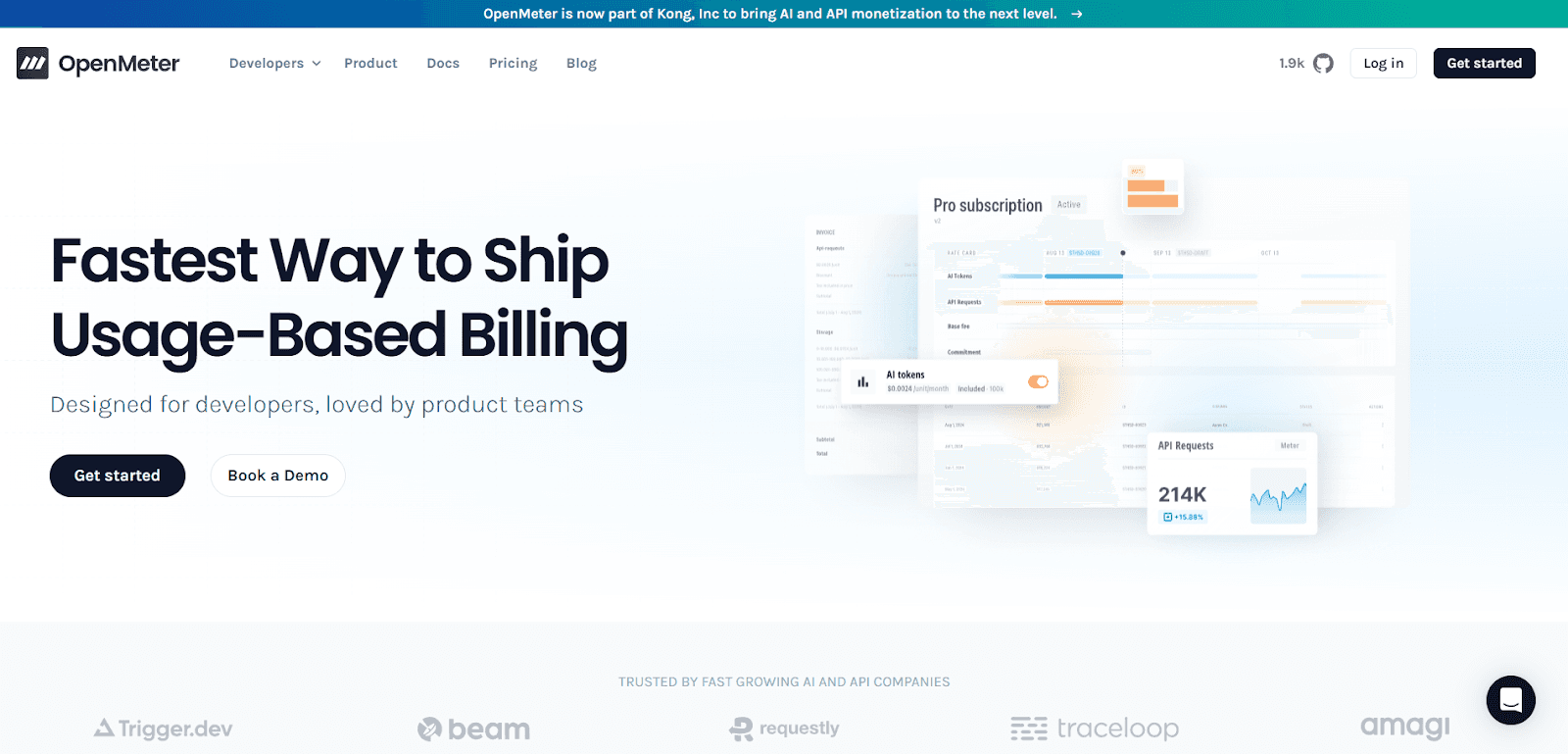
OpenMeter is an open-source usage metering platform built to track real-time product usage for APIs, infrastructure services, and AI applications. It captures events like API calls, tokens, compute usage, or model interactions and converts them into measurable usage data for usage-based billing.
For teams evaluating Schematic alternatives, OpenMeter provides the core metering layer that tracks product consumption.
However, OpenMeter focuses mainly on usage tracking and pricing calculations, not the full billing lifecycle. Teams typically integrate separate tools for payments, invoicing, credit systems, and subscription management, making it one component in a larger billing stack rather than a complete billing platform.
Key features
Real-time event metering for tracking AI Agent usage, API calls, and infrastructure consumption
Open-source deployment with self-hosting or managed cloud options
Product catalog with plans, subscriptions, and usage-based pricing models
Flexible pricing models, including per-unit, tiered, and volume pricing
Usage limits and entitlements for controlling AI Agent access or quotas
Event ingestion APIs and SDKs for integrating metering into AI platforms
Pros
Open-source usage metering platform with transparent infrastructure
Strong real-time event tracking for AI Agents and API consumption
Flexible pricing models built around usage events
Entitlements and quotas are useful for controlling AI feature access
Cons
Primarily focused on usage metering, not full billing infrastructure
Requires external systems for payments, contracts, and revenue workflows
Limited native support for advanced Agentic AI monetization models like outcome-based pricing
Less built-in support for enterprise billing features like complex contract workflows
Pricing
OpenMeter pricing is not publicly listed. You can contact their sales team for more information
Best suited for
Developer teams building usage-based pricing who need a reliable way to track product consumption, such as API requests, tokens, or compute usage.
AI, API, and DevTool companies that need event-based metering to convert product activity into measurable usage data.
Teams that want an open-source metering layer they can self-host and integrate with their own billing stack.
Companies that already use tools like Stripe or external billing systems and just need accurate usage tracking to sync with those platforms.
5. Orb
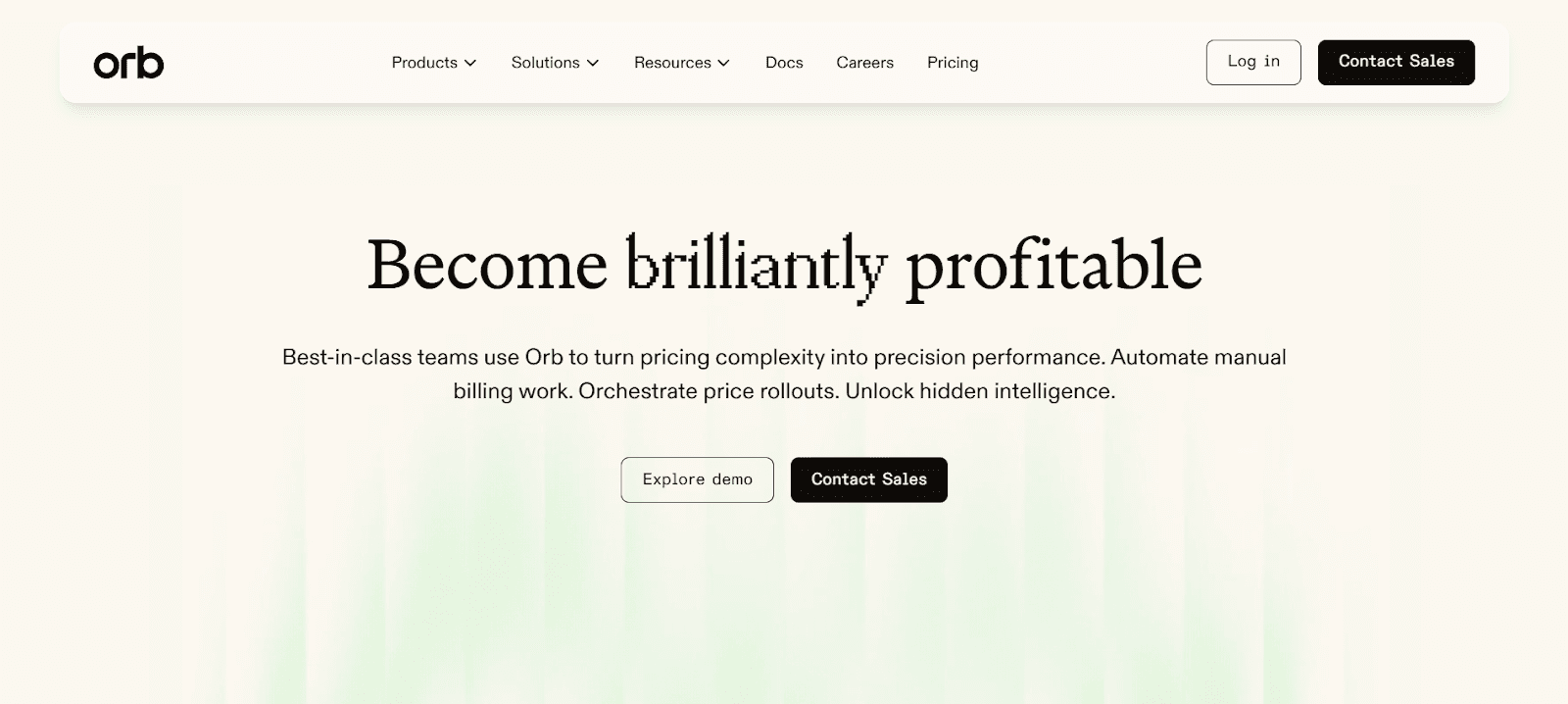
Orb is a usage-based billing platform built primarily for developer-first SaaS and infrastructure products that monetize through consumption. It focuses on ingesting product events such as API calls, compute usage, or storage metrics and converting them into billable charges in real time. Because of its event-driven architecture and flexible pricing models, Orb often appears when companies evaluate Schematic alternatives or other billing tools designed for modern usage-based pricing.
However, Orb operates as a fully managed SaaS platform with a closed-source architecture and no self-hosted option. Companies cannot run the billing engine inside their own infrastructure or extend it beyond the platform boundaries. For teams searching for an alternative to Schematic that provides deeper control over billing infrastructure, pricing experimentation, or deployment flexibility, this can become a limitation as products scale.
Key features
Event-based usage metering: Ingests raw usage events such as API calls, compute jobs, or storage metrics and converts them into billable usage.
Flexible pricing models: Supports tiered pricing, volume discounts, custom rate cards, and usage-based billing structures.
Credit and balance management: Provides prepaid and postpaid credit systems with support for multiple pricing units and credit pools.
Revenue simulations: Allows teams to test pricing changes against historical usage data before deploying new billing models.
Pros
Strong enterprise billing capabilities: Supports customer hierarchies, shared credits, contract commitments, and extended payment terms.
Advanced usage pricing infrastructure: Flexible charge models and real-time event processing for complex consumption billing.
Robust credit systems: Supports multiple credit pools, custom pricing units, and parent-child credit sharing.
Cons
Closed-source platform: No self-hosting option or ability to inspect and extend the billing engine.
High starting price: Plans start around $720 per month, with advanced integrations requiring higher tiers.
Limited payment gateway flexibility: Primarily built around Stripe, with limited native support for regional payment providers.
No agent-native billing interface: Billing configuration must be done through the dashboard or APIs without MCP or agent workflow integration.
Pricing
Orb does not publicly list its pricing. If you want to know the cost, you need to contact the Orb sales team
Best suited for
Best suited for companies building usage-based SaaS or infrastructure products that want a managed billing platform with strong enterprise billing features and are comfortable operating inside the Stripe ecosystem while evaluating Schematic alternatives.
Why Flexprice is one of the best Schematic alternatives
As there are many Schematic alternatives available today, Flexprice is the ultimate alternative to Schematic. The reason is that Flexprice is designed as a complete enterprise billing infrastructure, whereas Schematic primarily focuses on feature entitlements and plan management layered on top of Stripe.
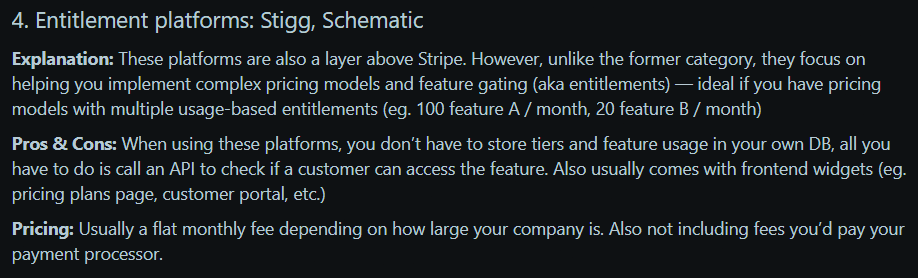
Here are some of the features that Flexprice provides, which make it a suitable alternative to Schematic.
Built for enterprise billing complexity
Flexprice is designed as a full enterprise billing infrastructure, not just an entitlement layer. While Schematic focuses on linking feature flags to subscription plans, Flexprice manages the full billing lifecycle for enterprise SaaS and AI companies.
Enterprise teams often need capabilities like:
Contract-based pricing
Hybrid pricing models
Multi-level account structures
Advanced credit systems
Flexprice supports these through a flexible pricing engine that combines subscriptions, usage-based billing, credits, and commitments in the same system.
For example, you can think of it as the platform that processes product usage events in real time, converts them into billable usage, and automatically applies pricing rules, credits, and commitments when generating invoices.
Parent-child account hierarchies are the one thing that many of these so-called modern billing platforms lack. Why is it important? Because it allows enterprise customers with multiple teams or departments to manage usage under one contract while maintaining separate usage visibility.
Flexprice operates as a standalone billing engine, which allows companies to run enterprise billing across multiple payment providers and regions without relying on a single gateway.
Open-source and self-hostable billing infrastructure
One of the reasons that companies evaluating Schematic alternatives choose Flexprice is its open-source billing architecture. Unlike other platforms where the billing engine is a black box, Flexprice allows teams to inspect, audit, and run the billing infrastructure themselves. This level of transparency reduces vendor risk.
Licensed under AGPLv3 using an open-core model
The main GitHub repository has 3,500+ stars, 130+ forks, and 60+ contributors.
The entire billing pipeline is auditable, allowing teams to inspect how usage metering, pricing, and invoicing work.
Can be self-hosted on your own infrastructure, avoiding vendor lock-in common in proprietary billing tools.
SOC 2 Type I compliant, which helps teams pass enterprise procurement and security reviews.
For companies that are building AI platforms, APIs, and SaaS products with hybrid pricing models, this architecture becomes especially important, which is why Flexprice is considered a strong alternative to Schematic for enterprise billing.
Multi-payment gateway support, not just Stripe
Another major reason companies explore Schematic alternatives is payment flexibility. Schematic’s billing functionality is tightly coupled with Stripe. Here, Flexprice takes a different approach by acting as a payment-provider-agnostic billing engine that allows companies to run enterprise billing and usage-based billing across multiple gateways.
Integrates with Stripe and Razorpay, enabling companies to run billing across different payment providers.
Billing infrastructure works independently from the payment processor, rather than being tied to one gateway.
Allows companies to operate enterprise billing across multiple regions without relying on a single provider.
Reduces the Stripe lock-in risk, which is common in many billing platforms.
Makes it easier to support global payment infrastructure as companies expand.
Flexprice allows teams to run the billing engine independently and connect it to whichever payment provider fits their infrastructure.
Advanced credit wallets and prepaid billing models
Flexprice provides an advanced credit wallet infrastructure where usage is deducted from prepaid balances rather than billed purely at the end of the cycle.
Supports prepaid credits, promotional credits, and recurring credit grants.
Includes auto top-ups, credit expiration rules, and rollover logic.
Allows credit consumption priority, for example, promotional credits burn before paid credits.
Built to support credit-based billing and hybrid pricing models commonly used by AI products.
Flexprice’s wallet system provides that flexibility, making it more complete than Schematic’s basic credit burn model.
Real-time event ingestion for high-volume usage data
Flexprice is built to handle high-volume usage-based billing, which is critical for AI platforms, APIs, and infrastructure products that generate millions of usage events.
Uses Kafka for event ingestion and ClickHouse for real-time aggregation.
Processes millions of usage events per second with real-time updates to usage and billing data.
Each event is validated, deduplicated, and priced within milliseconds.
Ensures zero data loss and accurate billing even under peak event loads.
This architecture allows companies to process large usage streams and convert them into invoices without manual reconciliation. Building a similar usage metering pipeline from scratch typically takes 3-6 months of engineering work, but with Flexprice, it can be done within days
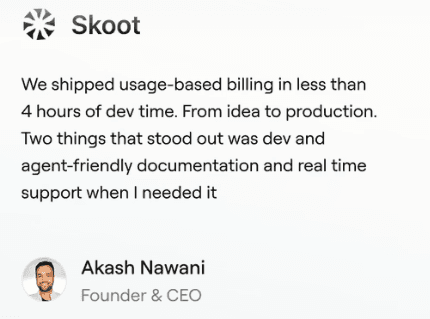
See how Flexprice helped Skoot to ship usage-based billing in less than 4 hours of dev time. From idea to production –Founder and CEO of Skoot, Akash Nawani
Built for modern AI pricing models
Teams experiment with usage-based billing, credits, hybrid plans, and outcome-based pricing as their product and infrastructure costs scale. This is where many companies start evaluating Schematic alternatives, because entitlement-focused tools struggle to support complex or changing monetization models.
Supports token-based billing for LLM input and output usage.
Enables per-model pricing so different AI models can have different rates.
Tracks GPU minutes, compute usage, API calls, and other infrastructure metrics.
Supports credit-based billing and prepaid usage models.
Allows hybrid pricing models combining subscriptions with usage charges.
Enables outcome-based billing, such as charging for completed workflows or successful tasks.
With Flexprice, teams can update pricing structures, adjust credit models, or introduce new usage metrics without rebuilding the billing system. This makes it easier to experiment with different AI pricing strategies while keeping usage-based billing and enterprise billing infrastructure stable.
Wrapping up
Schematic solves a very specific problem well: linking feature flags and entitlements with subscription plans.
If your SaaS product runs on Stripe and your main goal is to control feature access based on billing state, Schematic can work as a lightweight layer between your product and your billing system.
Teams often need a full billing infrastructure that can meter product usage, apply pricing rules, manage credits, and generate invoices from real-time product activity.
That is where many teams start evaluating Schematic alternatives. Here’s a quick way to think about the main Schematic alternatives:
Flexprice
Best choice if you need a complete enterprise billing infrastructure. It combines real-time usage metering, advanced credit wallets, hybrid pricing models, and multi-payment gateway support in one system. Built for AI and modern SaaS products where pricing depends on tokens, APIs, compute usage, or credits.
Metronome
A solid option for teams committed to the Stripe ecosystem that want scalable usage metering.
Lago
Good for developers who want a self-hosted open-source billing foundation for basic usage-based pricing.
OpenMeter
Primarily a usage metering layer, usually paired with other tools for payments and invoicing.
Orb
A managed SaaS billing platform for companies that want enterprise usage-based billing without running their own infrastructure.
As AI and usage-based SaaS models grow, the winning billing stack is usually the one that lets you iterate on pricing without rebuilding infrastructure every time your product changes.
What is the difference between a feature entitlement platform and a usage-based billing platform?
How does credit-based pricing work for AI and SaaS products?
What are the best open-source billing platforms for usage-based pricing?
Can I run usage-based billing without being locked into Stripe?
How do AI companies meter and bill for token usage, GPU compute, and API calls at scale?