
Aanchal ParmarFlexprice vs Metronome: Which Usage-Based Billing Platform Should You Choose?
Flexprice vs Metronome: Which Usage-Based Billing Platform Should You Choose?
Jan 20, 2026
Jan 20, 2026
Jan 20, 2026
13 mins
13 mins
13 mins

Aanchal Parmar
Aanchal Parmar
Aanchal Parmar
Product Marketing Manager, Flexprice



Usage-based billing isn't optional anymore; it's how modern AI and SaaS companies monetize. Metronome built a strong reputation as a usage metering platform, but it's not the right fit for everyone.
Teams often hit two main issues: pricing changes require too much engineering time, and since Stripe acquired Metronome, you're essentially locked into their ecosystem.
That's why companies are looking for Metronome alternatives that offer faster pricing iteration, multi-PSP flexibility, and end-to-end billing without vendor lock-in.
Flexprice is the best Metronome alternative for teams that need control and speed. It's open-source, works with any payment provider, and lets you change pricing in minutes without engineering help.
Here's how Flexprice and Metronome compare across metering, pricing flexibility, credits, enterprise contracts, and scalability.
TL;DR
Looking for the best metronome alternative to support the usage-based pricing in 2026? Here’s what you need to know:
Flexprice is an open-source, end-to-end billing platform built for AI, SaaS, and infra teams. It combines metering, pricing, credits, contracts, and invoicing in one system.
Metronome, now acquired by Stripe, is a powerful usage metering and contract engine. It works best as a Stripe-native billing logic layer, but depends on external systems for full-stack billing.
Flexprice supports multi-metric, real-time billing for events like tokens, GPU time, and API calls and lets product, finance, and engineering teams collaborate on pricing experiments without code changes.
It offers deeper credit-based pricing capabilities, multi-currency support, native invoicing, and vendor flexibility across Stripe, Razorpay, and others making it one of the most flexible Metronome alternatives today.
Metronome is a good fit if you’re fully committed to Stripe and have the engineering bandwidth to model contracts and maintain downstream workflows across multiple tools.
But if you want faster iteration, real-time visibility, credit as a first-class system, and complete control over your billing architecture, Flexprice is the most complete Stripe billing alternative in 2026 especially for companies operating at high usage scale.
Flexprice vs Metronome: Detailed Comparison for Usage Based Billing
Feature | Flexprice | Metronome |
Built for | Open source, developer first, end to end usage based billing stack that includes metering, pricing, credits, entitlements, invoicing, and enterprise contracts | Usage metering and billing logic layer that converts raw events into billable metrics and ties them to contracts and downstream invoicing, often via Stripe |
Best for | AI, API, infra, and agentic companies that need fast pricing iteration, real time visibility, and unified billing workflows | Teams that want scalable usage metering with structured contracts, and are comfortable integrating invoicing and payments through Stripe and other systems |
Scope | Full billing system, single source of truth across usage, pricing, credits, contracts, and invoices | Strong metering and contract modeling, with invoicing, payments, and tax typically handled outside in Stripe or other tools |
Open source | Fully open source with self hosting and auditability | SaaS with proprietary core engine, not self hostable |
Self hosting | Supported, plus managed option | Not supported |
Real time usage tracking | Real time ingestion and processing with low latency aggregation and real time credit and limit checks | High scale ingestion and metering, with raw events separated from billable metrics, overall real time experience depends on integration patterns |
Event ingestion architecture | Kafka and Temporal workflows for high volume ingestion and processing | API based ingestion with strong meter definition and transformation layer |
Usage based billing | Native, first class usage based billing with pricing defined outside application code | Usage based billing centered around metering and contracts, often paired with Stripe for invoicing and payments |
Multi metric pricing | Natural support for multi metric and multi dimensional pricing where one event can influence multiple priced metrics via metadata | Supports multiple meters from raw events, multi dimensional models often require more structured modeling through meters, contracts, and rate configurations |
Credit based pricing | Wallet and credit system designed for prepaid credits, promotions, expiry, roll over, and auto top ups, can be tied to entitlements and product behavior | Supports credits through commitments and contract structures, advanced credit governance and product level credit workflows often require extra logic outside |
Enterprise contracts | Native support for ramped pricing, overrides, minimum commits, proration, and evolving terms without migrations | Strong contract first approach with commitments, discounts, custom rates, structured updates for changes |
Account hierarchies | Native parent child hierarchies with shared usage, shared credits, roll ups, and consolidated billing | Organizational structures modeled through customers and contracts, advanced roll ups and shared pools may need extra modeling or middleware |
Invoicing | Built in invoicing that combines subscriptions, usage, and credit adjustments, with finance friendly line items | Invoice ready outputs with final invoicing typically in Stripe or another invoicing tool |
Taxes and proration | Included in invoicing workflows as described in your content | Typically handled downstream in Stripe or external systems |
Payment options | Multi PSP integration, not tied to a single payment ecosystem | Designed to work closely with Stripe for subscriptions, payments, and invoicing |
Vendor lock in | Low, open source and multi PSP flexibility | Higher, especially for Stripe centric stacks |
Multi currency and regional pricing | Native multi currency pricing and regional rate control in the platform | Multi currency possible, often depends on Stripe setup and surrounding tooling for advanced workflows |
Pricing iteration speed | Minutes level iteration, pricing logic outside core product code, less engineering dependency | Slower iteration for complex changes due to structured contracts and coordination across metering and Stripe workflows |
Scalability | End to end scaling across ingestion, pricing, credits, contracts, and invoicing, designed for billions of events per month | Scales strongly for metering, full billing scale depends on downstream invoicing, payments, and reconciliation systems |
Finance and RevOps experience | Unified view across usage, credits, contracts, and invoices, easier reconciliation with traceability | Engineering oriented metering layer, finance workflows often distributed across Stripe and external systems |
Customer facing usage visibility | Customer Dashboard API to embed real time usage and charges into your UI | Usually built using Metronome outputs plus Stripe and internal dashboards |
Cost attribution and unit economics | AI Cost Sheet connects usage to cost logic for margin visibility by customer, feature, or model | Typically handled outside via internal analytics, warehouse, or finance tooling |
Community and support | Open source community plus Slack and forums, contribution friendly | Strong official support and documentation, smaller external community since it is not open source |
Best fit summary | Metronome alternative for teams that want control, unified billing, real time visibility, and fast pricing iteration | Best for Stripe first teams that want enterprise grade metering and structured contract workflows |
Flexprice

Flexprice is an open source, end to end usage based billing platform built for AI, SaaS, and agentic teams that need to move fast on pricing without getting bogged down in billing complexity.
It is designed as a modern Metronome alternative for companies that want control, flexibility, and real time accuracy instead of rigid, vendor tied workflows.
Unlike traditional billing tools, Flexprice gives you full ownership over your pricing logic, contracts, and credits.
You can self host it on your own infrastructure or run it as a managed service, ensuring that your monetization stack remains within your control rather than locked inside a third party ecosystem.
Flexprice is built on Kafka and Temporal workflows, which allows it to handle high volume event streams of over 20 billion events per month with low latency and strong consistency.
This makes it particularly well suited for tracking granular usage such as API calls, GPU hours, tokens, and model consumption in real time, while also giving you deep cost attribution and margin visibility down to each customer, feature, and workload.
Flexprice treats billing as a core product primitive rather than just a back office finance function. Pricing logic lives outside your application code, so teams can run experiments, adjust rates, or introduce new pricing dimensions in minutes rather than days.
Real time usage metering is native, meaning every event is tracked as it happens, and built in aggregation rules such as sum, count, and unique counts remove the need for custom data pipelines.
One of the standout capabilities for AI and infra teams is the AI Cost Sheet. It ties raw usage events to internal cost logic and gives you a clear view of true unit economics by customer, feature, or model. This enables product, engineering, and finance teams to make pricing and packaging decisions based on actual margins instead of estimates.
Flexprice also provides a Customer Dashboard API so you can surface real time usage and charge visibility directly inside your own product UI for both customers and internal teams.
This reduces billing surprises, improves transparency, and builds trust with end users.
On the enterprise side, Flexprice supports ramped contracts that evolve from pilot to scaled deployment with changing prices over time, all without custom code or schema migrations. Native parent child account hierarchies allow you to model resellers, MSPs, or multi team workspaces with shared credits and consolidated billing.
On the monetization front, Flexprice is built for flexibility. It supports subscription only, usage based, hybrid, and credit based pricing in the same stack. You can implement volume tiers, package deals, and overage charges, and use plan versioning and overrides to run customer specific pricing or experiments without re architecting your system.
Flexprice includes a full credit and wallet management system for prepaid balances, auto top ups, promotions, and expiry policies. It also provides automated invoicing that combines subscriptions, usage, and credit adjustments into unified, finance friendly invoices.
The platform integrates with multiple payment gateways such as Stripe and Razorpay, supports multi currency pricing, and follows SOC2 aligned security practices for enterprise readiness.
Flexprice is best suited for AI and SaaS companies scaling from early growth to millions in revenue, especially those with dozens of enterprise clients and a need for enterprise level flexibility, efficiency, and rapid pricing iteration. For teams evaluating a true Metronome alternative, Flexprice offers a more open, flexible, and real time approach to modern usage based billing.
Read: Top Metronome Alternatives for Usage Based Pricing
Metronome (Acquired By Stripe)
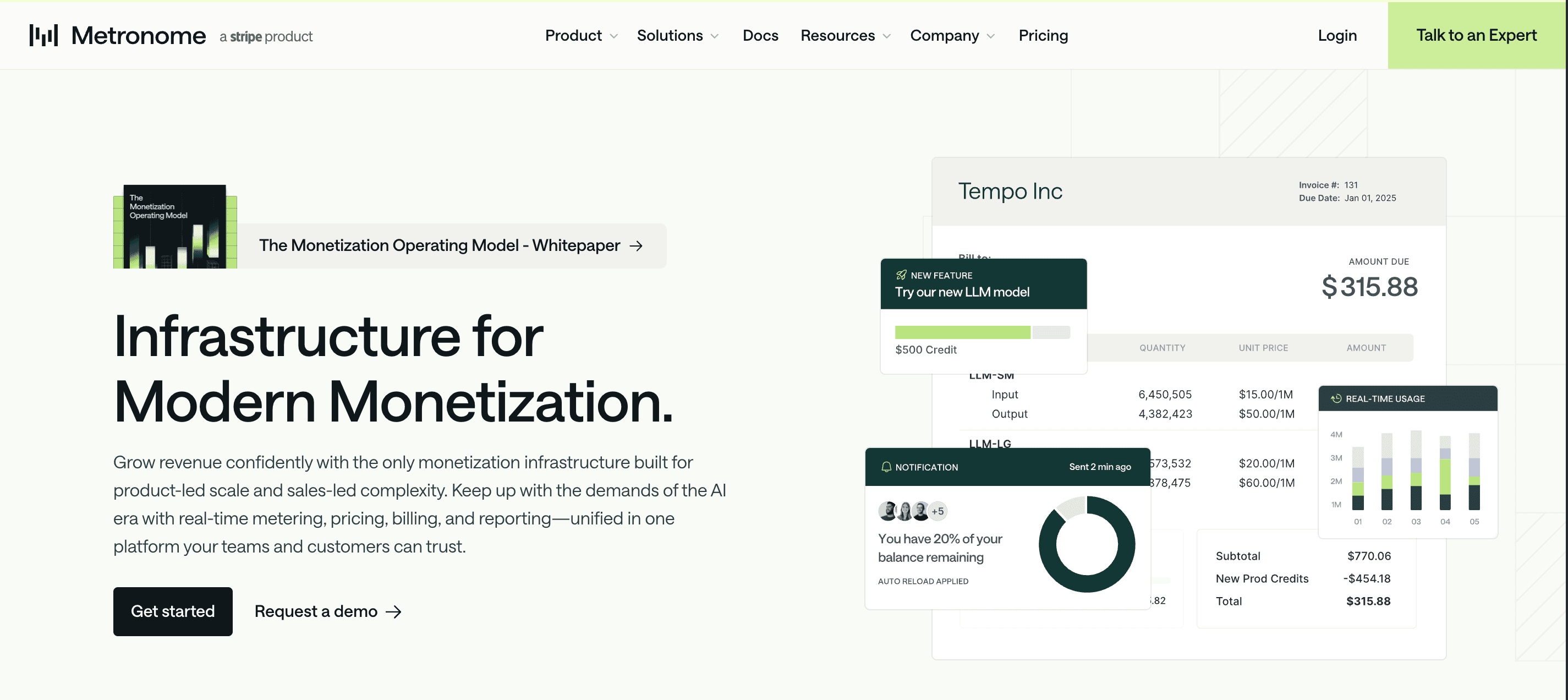
Metronome is a usage based billing and metering platform that recently got acquired by Stripe.
It is built primarily for teams that want a reliable, scalable way to meter usage and connect that usage to Stripe centered billing workflows.
At its core, Metronome focuses on collecting high volume usage events through its APIs and SDKs, and then converting those events into well defined meters that represent what actually gets billed. This separation between raw usage and billable metrics allows teams to evolve their pricing logic over time without constantly changing product instrumentation.
Metronome works closely with Stripe for subscriptions, payments, and invoicing. In most setups, Metronome handles the usage calculation and billing logic, while Stripe manages payments, taxes, disputes, and customer facing invoices.
This makes Metronome a strong fit for companies that are already deeply embedded in the Stripe ecosystem and want tight integration between metering and payments.
For enterprise customers, Metronome supports contracts with commitments, custom rates, discounts, and structured pricing models.
Teams can model minimum spend agreements, ramped pricing, and usage based overages within its contract framework, making it suitable for B2B SaaS and infrastructure companies with complex commercial arrangements.
Metronome also supports prepaid credits and commitments, allowing companies to offer usage allowances, promotional grants, or minimum consumption agreements.
These credits are typically managed at the contract or invoice level and are closely tied to Stripe based billing workflows.
From a scalability perspective, Metronome is built to handle large volumes of usage data and complex aggregations. It is commonly used by companies with millions or billions of events per month, especially in API, data, and infrastructure businesses where usage patterns are highly variable.
However, because Metronome is not open source, teams rely primarily on official documentation, SDKs, and support from the Metronome or Stripe team rather than a large external developer community. This makes it a more managed, vendor supported platform rather than a community driven one.
Overall, Metronome is best suited for companies that want a powerful, Stripe native usage metering and billing layer, with strong support for enterprise contracts and scalable event processing.
It works particularly well for organizations that prefer structured workflows, predictable revenue operations, and deep alignment with Stripe as their primary payments platform.
Stripe acquires Metronome to offer metered pricing for its customers.
Feature Comparison
Open‑Source Vs Vendor Dependancy
Flexprice
Flexprice is a fully open-source billing and pricing platform. You can self-host it on your own infrastructure, audit the code, modify core components, and extend the system to fit your product’s unique requirements.
This gives you genuine vendor independence: your data, pricing logic, credit rules, contract models, and billing workflows remain under your control.
There is no forced dependency on a single cloud, a single payment provider, or a single proprietary platform. If your business evolves, you can evolve Flexprice with it, without needing permission from a vendor or undergoing painful migrations.
Because Flexprice is open source, teams can also debug issues internally, customize event pipelines, adapt metering logic, and integrate deeply with internal systems like data warehouses, observability tools, and finance workflows.
For companies that care about long-term control, compliance, and architectural flexibility, this makes Flexprice one of the strongest Metronome alternatives available today.
Read: Why Did We Build Open Source Billing Software?
Metronome
Metronome, by contrast, is not fully open-source. It is a SaaS product that provides APIs and SDKs for sending usage events and defining pricing, but its core metering and billing engine is proprietary.
You cannot self-host the platform, modify its internals, or fully control how your billing logic is executed under the hood. Your ability to customize is constrained by what Metronome’s product surface exposes.
Since Stripe’s acquisition of Metronome, the platform has become increasingly aligned with the Stripe ecosystem. This tight integration can be an advantage if your company is already fully committed to Stripe. However, it also creates a form of vendor dependency.
If you ever want to switch payment providers, run billing on your own stack, or reduce reliance on Stripe, moving away from Metronome would require significant re-engineering.
For teams evaluating an alternative to Metronome, this is a key trade-off: convenience within Stripe versus long-term architectural flexibility.
Verdict: Flexprice wins
If your priority is control, flexibility, and avoiding vendor lock-in, Flexprice is the stronger choice and a superior Metronome alternative.
If you are already deeply embedded in Stripe and prefer a managed, Stripe-centric workflow, Metronome can still work well, but you accept tighter ecosystem dependency in exchange for that convenience
Real‑Time Usage Tracking & Event Ingestion
Flexprice
Flexprice is designed for real-time, high-volume usage tracking. Its architecture uses Kafka for streaming event ingestion and Temporal for orchestrating distributed workflows, which allows continuous processing of usage data rather than relying primarily on batch reconciliation.
Because events are processed as they arrive, Flexprice can perform low-latency aggregation and real-time credit or limit checks.
This makes it suitable for AI, API, and agentic workloads where usage is bursty, unpredictable, and high throughput. In this sense, Flexprice behaves like a “raw events first” system, where every event can immediately influence pricing, credits, and access control.
Teams using Flexprice can track usage, apply pricing rules, and update customer balances in near real time, reducing delays between consumption and billing logic. This positioning makes Flexprice a strong alternative to Metronome for companies that want immediate feedback loops between product usage and billing behavior.
Metronome
Metronome also supports high-volume event ingestion via its API and is built to handle large-scale usage data reliably. A core design pattern in Metronome is the separation between raw usage events and billable metrics.
You send raw events to Metronome, and then define how those events are transformed into meters and billable outputs.
This separation allows teams to evolve how they measure and price usage without needing to change product instrumentation each time, which is a practical advantage for long-term pricing iteration.
Metronome’s model is therefore more transformation-oriented: raw events are collected, processed, and converted into billable metrics that are then tied to contracts and downstream billing workflows.
While Metronome is capable of handling high-scale ingestion, the end-to-end responsiveness of billing often depends on how it is integrated with Stripe and other surrounding systems in a company’s stack.
Verdict: Flexprice wins for real-time, end-to-end responsiveness and immediate billing feedback.
If your priority is instant pricing evaluation, real-time credit enforcement, and tight coupling between usage and billing behavior, Flexprice is the stronger alternative to Metronome.
Metronome remains a solid choice for teams that value flexible metric modeling and are already deeply integrated with Stripe, but it is less “real-time first” in its overall billing flow compared to Flexprice.
Usage Based Billing
Flexprice
Flexprice treats usage based billing as a native, first-class capability rather than an add-on to subscriptions. The platform is built around the assumption that modern AI, API, and infra businesses do not fit neatly into flat plans, so usage sits at the center of the pricing model rather than at the edge.
You can define granular usage signals such as API calls, tokens, GPU time, model type, region, workload class, or any custom product dimension, and directly attach pricing to them without needing complex workarounds.
A single event can carry rich metadata that influences how it is priced, which makes usage based pricing more expressive and less brittle over time.
Where Flexprice stands out is in iteration speed and operational flexibility. You can refine meters, adjust rates, introduce new dimensions, or tweak thresholds without re-instrumenting your product or rebuilding your billing logic. This is particularly valuable for AI companies where costs, models, and usage patterns change frequently.
Another nuance is that Flexprice tightly couples usage with credits, entitlements, and contracts in one system. That means your usage based billing logic can immediately influence access, limits, and customer balances rather than living in a separate metering layer.
For teams looking for a Metronome alternative that keeps usage, pricing, and billing behavior closely aligned, this tight integration is a meaningful advantage.
Read: Best Usage Based Pricing Software for SaaS Companies in 2026
Metronome
Metronome is fundamentally built around usage metering, and usage based billing is one of its core use cases. Its strength lies in collecting raw usage events and transforming them into well-structured, billable metrics that can be tied to contracts, commitments, and invoices.
You can create sophisticated meters from your raw events, which gives you flexibility to evolve how you measure usage without constantly changing product instrumentation.
For many teams, this separation between “what the product emits” and “what gets billed” is a clean architectural pattern.
However, when it comes to more complex usage based pricing, especially multi-dimensional models (for example, pricing by model + region + workload class simultaneously), Metronome often requires more upfront modeling in contracts, rate cards, or custom configurations.
In practice, this can mean more coordination between engineering, sales, and finance when pricing becomes highly granular.
Another nuance is that Metronome’s usage layer typically feeds into downstream billing workflows, often centered around Stripe.
This works well if your stack is already Stripe-native, but it can introduce additional layers of complexity if you want fully unified, real-time usage-to-billing behavior inside one platform.
Verdict: Flexprice wins for modern, product-led usage based billing.
If you need fast-moving, highly granular usage based pricing that evolves with your product, Flexprice is the stronger alternative to Metronome because it keeps usage, credits, contracts, and billing tightly integrated in one system.
Metronome remains a powerful option for teams that prioritize clean metering and are comfortable modeling complexity in contracts and Stripe workflows.
But for companies that want simpler iteration, deeper control, and tighter coupling between usage and billing behavior, Flexprice is the clearer choice.
Usage-based billing isn't optional anymore; it's how modern AI and SaaS companies monetize. Metronome built a strong reputation as a usage metering platform, but it's not the right fit for everyone.
Teams often hit two main issues: pricing changes require too much engineering time, and since Stripe acquired Metronome, you're essentially locked into their ecosystem.
That's why companies are looking for Metronome alternatives that offer faster pricing iteration, multi-PSP flexibility, and end-to-end billing without vendor lock-in.
Flexprice is the best Metronome alternative for teams that need control and speed. It's open-source, works with any payment provider, and lets you change pricing in minutes without engineering help.
Here's how Flexprice and Metronome compare across metering, pricing flexibility, credits, enterprise contracts, and scalability.
TL;DR
Looking for the best metronome alternative to support the usage-based pricing in 2026? Here’s what you need to know:
Flexprice is an open-source, end-to-end billing platform built for AI, SaaS, and infra teams. It combines metering, pricing, credits, contracts, and invoicing in one system.
Metronome, now acquired by Stripe, is a powerful usage metering and contract engine. It works best as a Stripe-native billing logic layer, but depends on external systems for full-stack billing.
Flexprice supports multi-metric, real-time billing for events like tokens, GPU time, and API calls and lets product, finance, and engineering teams collaborate on pricing experiments without code changes.
It offers deeper credit-based pricing capabilities, multi-currency support, native invoicing, and vendor flexibility across Stripe, Razorpay, and others making it one of the most flexible Metronome alternatives today.
Metronome is a good fit if you’re fully committed to Stripe and have the engineering bandwidth to model contracts and maintain downstream workflows across multiple tools.
But if you want faster iteration, real-time visibility, credit as a first-class system, and complete control over your billing architecture, Flexprice is the most complete Stripe billing alternative in 2026 especially for companies operating at high usage scale.
Flexprice vs Metronome: Detailed Comparison for Usage Based Billing
Feature | Flexprice | Metronome |
Built for | Open source, developer first, end to end usage based billing stack that includes metering, pricing, credits, entitlements, invoicing, and enterprise contracts | Usage metering and billing logic layer that converts raw events into billable metrics and ties them to contracts and downstream invoicing, often via Stripe |
Best for | AI, API, infra, and agentic companies that need fast pricing iteration, real time visibility, and unified billing workflows | Teams that want scalable usage metering with structured contracts, and are comfortable integrating invoicing and payments through Stripe and other systems |
Scope | Full billing system, single source of truth across usage, pricing, credits, contracts, and invoices | Strong metering and contract modeling, with invoicing, payments, and tax typically handled outside in Stripe or other tools |
Open source | Fully open source with self hosting and auditability | SaaS with proprietary core engine, not self hostable |
Self hosting | Supported, plus managed option | Not supported |
Real time usage tracking | Real time ingestion and processing with low latency aggregation and real time credit and limit checks | High scale ingestion and metering, with raw events separated from billable metrics, overall real time experience depends on integration patterns |
Event ingestion architecture | Kafka and Temporal workflows for high volume ingestion and processing | API based ingestion with strong meter definition and transformation layer |
Usage based billing | Native, first class usage based billing with pricing defined outside application code | Usage based billing centered around metering and contracts, often paired with Stripe for invoicing and payments |
Multi metric pricing | Natural support for multi metric and multi dimensional pricing where one event can influence multiple priced metrics via metadata | Supports multiple meters from raw events, multi dimensional models often require more structured modeling through meters, contracts, and rate configurations |
Credit based pricing | Wallet and credit system designed for prepaid credits, promotions, expiry, roll over, and auto top ups, can be tied to entitlements and product behavior | Supports credits through commitments and contract structures, advanced credit governance and product level credit workflows often require extra logic outside |
Enterprise contracts | Native support for ramped pricing, overrides, minimum commits, proration, and evolving terms without migrations | Strong contract first approach with commitments, discounts, custom rates, structured updates for changes |
Account hierarchies | Native parent child hierarchies with shared usage, shared credits, roll ups, and consolidated billing | Organizational structures modeled through customers and contracts, advanced roll ups and shared pools may need extra modeling or middleware |
Invoicing | Built in invoicing that combines subscriptions, usage, and credit adjustments, with finance friendly line items | Invoice ready outputs with final invoicing typically in Stripe or another invoicing tool |
Taxes and proration | Included in invoicing workflows as described in your content | Typically handled downstream in Stripe or external systems |
Payment options | Multi PSP integration, not tied to a single payment ecosystem | Designed to work closely with Stripe for subscriptions, payments, and invoicing |
Vendor lock in | Low, open source and multi PSP flexibility | Higher, especially for Stripe centric stacks |
Multi currency and regional pricing | Native multi currency pricing and regional rate control in the platform | Multi currency possible, often depends on Stripe setup and surrounding tooling for advanced workflows |
Pricing iteration speed | Minutes level iteration, pricing logic outside core product code, less engineering dependency | Slower iteration for complex changes due to structured contracts and coordination across metering and Stripe workflows |
Scalability | End to end scaling across ingestion, pricing, credits, contracts, and invoicing, designed for billions of events per month | Scales strongly for metering, full billing scale depends on downstream invoicing, payments, and reconciliation systems |
Finance and RevOps experience | Unified view across usage, credits, contracts, and invoices, easier reconciliation with traceability | Engineering oriented metering layer, finance workflows often distributed across Stripe and external systems |
Customer facing usage visibility | Customer Dashboard API to embed real time usage and charges into your UI | Usually built using Metronome outputs plus Stripe and internal dashboards |
Cost attribution and unit economics | AI Cost Sheet connects usage to cost logic for margin visibility by customer, feature, or model | Typically handled outside via internal analytics, warehouse, or finance tooling |
Community and support | Open source community plus Slack and forums, contribution friendly | Strong official support and documentation, smaller external community since it is not open source |
Best fit summary | Metronome alternative for teams that want control, unified billing, real time visibility, and fast pricing iteration | Best for Stripe first teams that want enterprise grade metering and structured contract workflows |
Flexprice

Flexprice is an open source, end to end usage based billing platform built for AI, SaaS, and agentic teams that need to move fast on pricing without getting bogged down in billing complexity.
It is designed as a modern Metronome alternative for companies that want control, flexibility, and real time accuracy instead of rigid, vendor tied workflows.
Unlike traditional billing tools, Flexprice gives you full ownership over your pricing logic, contracts, and credits.
You can self host it on your own infrastructure or run it as a managed service, ensuring that your monetization stack remains within your control rather than locked inside a third party ecosystem.
Flexprice is built on Kafka and Temporal workflows, which allows it to handle high volume event streams of over 20 billion events per month with low latency and strong consistency.
This makes it particularly well suited for tracking granular usage such as API calls, GPU hours, tokens, and model consumption in real time, while also giving you deep cost attribution and margin visibility down to each customer, feature, and workload.
Flexprice treats billing as a core product primitive rather than just a back office finance function. Pricing logic lives outside your application code, so teams can run experiments, adjust rates, or introduce new pricing dimensions in minutes rather than days.
Real time usage metering is native, meaning every event is tracked as it happens, and built in aggregation rules such as sum, count, and unique counts remove the need for custom data pipelines.
One of the standout capabilities for AI and infra teams is the AI Cost Sheet. It ties raw usage events to internal cost logic and gives you a clear view of true unit economics by customer, feature, or model. This enables product, engineering, and finance teams to make pricing and packaging decisions based on actual margins instead of estimates.
Flexprice also provides a Customer Dashboard API so you can surface real time usage and charge visibility directly inside your own product UI for both customers and internal teams.
This reduces billing surprises, improves transparency, and builds trust with end users.
On the enterprise side, Flexprice supports ramped contracts that evolve from pilot to scaled deployment with changing prices over time, all without custom code or schema migrations. Native parent child account hierarchies allow you to model resellers, MSPs, or multi team workspaces with shared credits and consolidated billing.
On the monetization front, Flexprice is built for flexibility. It supports subscription only, usage based, hybrid, and credit based pricing in the same stack. You can implement volume tiers, package deals, and overage charges, and use plan versioning and overrides to run customer specific pricing or experiments without re architecting your system.
Flexprice includes a full credit and wallet management system for prepaid balances, auto top ups, promotions, and expiry policies. It also provides automated invoicing that combines subscriptions, usage, and credit adjustments into unified, finance friendly invoices.
The platform integrates with multiple payment gateways such as Stripe and Razorpay, supports multi currency pricing, and follows SOC2 aligned security practices for enterprise readiness.
Flexprice is best suited for AI and SaaS companies scaling from early growth to millions in revenue, especially those with dozens of enterprise clients and a need for enterprise level flexibility, efficiency, and rapid pricing iteration. For teams evaluating a true Metronome alternative, Flexprice offers a more open, flexible, and real time approach to modern usage based billing.
Read: Top Metronome Alternatives for Usage Based Pricing
Metronome (Acquired By Stripe)

Metronome is a usage based billing and metering platform that recently got acquired by Stripe.
It is built primarily for teams that want a reliable, scalable way to meter usage and connect that usage to Stripe centered billing workflows.
At its core, Metronome focuses on collecting high volume usage events through its APIs and SDKs, and then converting those events into well defined meters that represent what actually gets billed. This separation between raw usage and billable metrics allows teams to evolve their pricing logic over time without constantly changing product instrumentation.
Metronome works closely with Stripe for subscriptions, payments, and invoicing. In most setups, Metronome handles the usage calculation and billing logic, while Stripe manages payments, taxes, disputes, and customer facing invoices.
This makes Metronome a strong fit for companies that are already deeply embedded in the Stripe ecosystem and want tight integration between metering and payments.
For enterprise customers, Metronome supports contracts with commitments, custom rates, discounts, and structured pricing models.
Teams can model minimum spend agreements, ramped pricing, and usage based overages within its contract framework, making it suitable for B2B SaaS and infrastructure companies with complex commercial arrangements.
Metronome also supports prepaid credits and commitments, allowing companies to offer usage allowances, promotional grants, or minimum consumption agreements.
These credits are typically managed at the contract or invoice level and are closely tied to Stripe based billing workflows.
From a scalability perspective, Metronome is built to handle large volumes of usage data and complex aggregations. It is commonly used by companies with millions or billions of events per month, especially in API, data, and infrastructure businesses where usage patterns are highly variable.
However, because Metronome is not open source, teams rely primarily on official documentation, SDKs, and support from the Metronome or Stripe team rather than a large external developer community. This makes it a more managed, vendor supported platform rather than a community driven one.
Overall, Metronome is best suited for companies that want a powerful, Stripe native usage metering and billing layer, with strong support for enterprise contracts and scalable event processing.
It works particularly well for organizations that prefer structured workflows, predictable revenue operations, and deep alignment with Stripe as their primary payments platform.
Stripe acquires Metronome to offer metered pricing for its customers.
Feature Comparison
Open‑Source Vs Vendor Dependancy
Flexprice
Flexprice is a fully open-source billing and pricing platform. You can self-host it on your own infrastructure, audit the code, modify core components, and extend the system to fit your product’s unique requirements.
This gives you genuine vendor independence: your data, pricing logic, credit rules, contract models, and billing workflows remain under your control.
There is no forced dependency on a single cloud, a single payment provider, or a single proprietary platform. If your business evolves, you can evolve Flexprice with it, without needing permission from a vendor or undergoing painful migrations.
Because Flexprice is open source, teams can also debug issues internally, customize event pipelines, adapt metering logic, and integrate deeply with internal systems like data warehouses, observability tools, and finance workflows.
For companies that care about long-term control, compliance, and architectural flexibility, this makes Flexprice one of the strongest Metronome alternatives available today.
Read: Why Did We Build Open Source Billing Software?
Metronome
Metronome, by contrast, is not fully open-source. It is a SaaS product that provides APIs and SDKs for sending usage events and defining pricing, but its core metering and billing engine is proprietary.
You cannot self-host the platform, modify its internals, or fully control how your billing logic is executed under the hood. Your ability to customize is constrained by what Metronome’s product surface exposes.
Since Stripe’s acquisition of Metronome, the platform has become increasingly aligned with the Stripe ecosystem. This tight integration can be an advantage if your company is already fully committed to Stripe. However, it also creates a form of vendor dependency.
If you ever want to switch payment providers, run billing on your own stack, or reduce reliance on Stripe, moving away from Metronome would require significant re-engineering.
For teams evaluating an alternative to Metronome, this is a key trade-off: convenience within Stripe versus long-term architectural flexibility.
Verdict: Flexprice wins
If your priority is control, flexibility, and avoiding vendor lock-in, Flexprice is the stronger choice and a superior Metronome alternative.
If you are already deeply embedded in Stripe and prefer a managed, Stripe-centric workflow, Metronome can still work well, but you accept tighter ecosystem dependency in exchange for that convenience
Real‑Time Usage Tracking & Event Ingestion
Flexprice
Flexprice is designed for real-time, high-volume usage tracking. Its architecture uses Kafka for streaming event ingestion and Temporal for orchestrating distributed workflows, which allows continuous processing of usage data rather than relying primarily on batch reconciliation.
Because events are processed as they arrive, Flexprice can perform low-latency aggregation and real-time credit or limit checks.
This makes it suitable for AI, API, and agentic workloads where usage is bursty, unpredictable, and high throughput. In this sense, Flexprice behaves like a “raw events first” system, where every event can immediately influence pricing, credits, and access control.
Teams using Flexprice can track usage, apply pricing rules, and update customer balances in near real time, reducing delays between consumption and billing logic. This positioning makes Flexprice a strong alternative to Metronome for companies that want immediate feedback loops between product usage and billing behavior.
Metronome
Metronome also supports high-volume event ingestion via its API and is built to handle large-scale usage data reliably. A core design pattern in Metronome is the separation between raw usage events and billable metrics.
You send raw events to Metronome, and then define how those events are transformed into meters and billable outputs.
This separation allows teams to evolve how they measure and price usage without needing to change product instrumentation each time, which is a practical advantage for long-term pricing iteration.
Metronome’s model is therefore more transformation-oriented: raw events are collected, processed, and converted into billable metrics that are then tied to contracts and downstream billing workflows.
While Metronome is capable of handling high-scale ingestion, the end-to-end responsiveness of billing often depends on how it is integrated with Stripe and other surrounding systems in a company’s stack.
Verdict: Flexprice wins for real-time, end-to-end responsiveness and immediate billing feedback.
If your priority is instant pricing evaluation, real-time credit enforcement, and tight coupling between usage and billing behavior, Flexprice is the stronger alternative to Metronome.
Metronome remains a solid choice for teams that value flexible metric modeling and are already deeply integrated with Stripe, but it is less “real-time first” in its overall billing flow compared to Flexprice.
Usage Based Billing
Flexprice
Flexprice treats usage based billing as a native, first-class capability rather than an add-on to subscriptions. The platform is built around the assumption that modern AI, API, and infra businesses do not fit neatly into flat plans, so usage sits at the center of the pricing model rather than at the edge.
You can define granular usage signals such as API calls, tokens, GPU time, model type, region, workload class, or any custom product dimension, and directly attach pricing to them without needing complex workarounds.
A single event can carry rich metadata that influences how it is priced, which makes usage based pricing more expressive and less brittle over time.
Where Flexprice stands out is in iteration speed and operational flexibility. You can refine meters, adjust rates, introduce new dimensions, or tweak thresholds without re-instrumenting your product or rebuilding your billing logic. This is particularly valuable for AI companies where costs, models, and usage patterns change frequently.
Another nuance is that Flexprice tightly couples usage with credits, entitlements, and contracts in one system. That means your usage based billing logic can immediately influence access, limits, and customer balances rather than living in a separate metering layer.
For teams looking for a Metronome alternative that keeps usage, pricing, and billing behavior closely aligned, this tight integration is a meaningful advantage.
Read: Best Usage Based Pricing Software for SaaS Companies in 2026
Metronome
Metronome is fundamentally built around usage metering, and usage based billing is one of its core use cases. Its strength lies in collecting raw usage events and transforming them into well-structured, billable metrics that can be tied to contracts, commitments, and invoices.
You can create sophisticated meters from your raw events, which gives you flexibility to evolve how you measure usage without constantly changing product instrumentation.
For many teams, this separation between “what the product emits” and “what gets billed” is a clean architectural pattern.
However, when it comes to more complex usage based pricing, especially multi-dimensional models (for example, pricing by model + region + workload class simultaneously), Metronome often requires more upfront modeling in contracts, rate cards, or custom configurations.
In practice, this can mean more coordination between engineering, sales, and finance when pricing becomes highly granular.
Another nuance is that Metronome’s usage layer typically feeds into downstream billing workflows, often centered around Stripe.
This works well if your stack is already Stripe-native, but it can introduce additional layers of complexity if you want fully unified, real-time usage-to-billing behavior inside one platform.
Verdict: Flexprice wins for modern, product-led usage based billing.
If you need fast-moving, highly granular usage based pricing that evolves with your product, Flexprice is the stronger alternative to Metronome because it keeps usage, credits, contracts, and billing tightly integrated in one system.
Metronome remains a powerful option for teams that prioritize clean metering and are comfortable modeling complexity in contracts and Stripe workflows.
But for companies that want simpler iteration, deeper control, and tighter coupling between usage and billing behavior, Flexprice is the clearer choice.
Usage-based billing isn't optional anymore; it's how modern AI and SaaS companies monetize. Metronome built a strong reputation as a usage metering platform, but it's not the right fit for everyone.
Teams often hit two main issues: pricing changes require too much engineering time, and since Stripe acquired Metronome, you're essentially locked into their ecosystem.
That's why companies are looking for Metronome alternatives that offer faster pricing iteration, multi-PSP flexibility, and end-to-end billing without vendor lock-in.
Flexprice is the best Metronome alternative for teams that need control and speed. It's open-source, works with any payment provider, and lets you change pricing in minutes without engineering help.
Here's how Flexprice and Metronome compare across metering, pricing flexibility, credits, enterprise contracts, and scalability.
TL;DR
Looking for the best metronome alternative to support the usage-based pricing in 2026? Here’s what you need to know:
Flexprice is an open-source, end-to-end billing platform built for AI, SaaS, and infra teams. It combines metering, pricing, credits, contracts, and invoicing in one system.
Metronome, now acquired by Stripe, is a powerful usage metering and contract engine. It works best as a Stripe-native billing logic layer, but depends on external systems for full-stack billing.
Flexprice supports multi-metric, real-time billing for events like tokens, GPU time, and API calls and lets product, finance, and engineering teams collaborate on pricing experiments without code changes.
It offers deeper credit-based pricing capabilities, multi-currency support, native invoicing, and vendor flexibility across Stripe, Razorpay, and others making it one of the most flexible Metronome alternatives today.
Metronome is a good fit if you’re fully committed to Stripe and have the engineering bandwidth to model contracts and maintain downstream workflows across multiple tools.
But if you want faster iteration, real-time visibility, credit as a first-class system, and complete control over your billing architecture, Flexprice is the most complete Stripe billing alternative in 2026 especially for companies operating at high usage scale.
Flexprice vs Metronome: Detailed Comparison for Usage Based Billing
Feature | Flexprice | Metronome |
Built for | Open source, developer first, end to end usage based billing stack that includes metering, pricing, credits, entitlements, invoicing, and enterprise contracts | Usage metering and billing logic layer that converts raw events into billable metrics and ties them to contracts and downstream invoicing, often via Stripe |
Best for | AI, API, infra, and agentic companies that need fast pricing iteration, real time visibility, and unified billing workflows | Teams that want scalable usage metering with structured contracts, and are comfortable integrating invoicing and payments through Stripe and other systems |
Scope | Full billing system, single source of truth across usage, pricing, credits, contracts, and invoices | Strong metering and contract modeling, with invoicing, payments, and tax typically handled outside in Stripe or other tools |
Open source | Fully open source with self hosting and auditability | SaaS with proprietary core engine, not self hostable |
Self hosting | Supported, plus managed option | Not supported |
Real time usage tracking | Real time ingestion and processing with low latency aggregation and real time credit and limit checks | High scale ingestion and metering, with raw events separated from billable metrics, overall real time experience depends on integration patterns |
Event ingestion architecture | Kafka and Temporal workflows for high volume ingestion and processing | API based ingestion with strong meter definition and transformation layer |
Usage based billing | Native, first class usage based billing with pricing defined outside application code | Usage based billing centered around metering and contracts, often paired with Stripe for invoicing and payments |
Multi metric pricing | Natural support for multi metric and multi dimensional pricing where one event can influence multiple priced metrics via metadata | Supports multiple meters from raw events, multi dimensional models often require more structured modeling through meters, contracts, and rate configurations |
Credit based pricing | Wallet and credit system designed for prepaid credits, promotions, expiry, roll over, and auto top ups, can be tied to entitlements and product behavior | Supports credits through commitments and contract structures, advanced credit governance and product level credit workflows often require extra logic outside |
Enterprise contracts | Native support for ramped pricing, overrides, minimum commits, proration, and evolving terms without migrations | Strong contract first approach with commitments, discounts, custom rates, structured updates for changes |
Account hierarchies | Native parent child hierarchies with shared usage, shared credits, roll ups, and consolidated billing | Organizational structures modeled through customers and contracts, advanced roll ups and shared pools may need extra modeling or middleware |
Invoicing | Built in invoicing that combines subscriptions, usage, and credit adjustments, with finance friendly line items | Invoice ready outputs with final invoicing typically in Stripe or another invoicing tool |
Taxes and proration | Included in invoicing workflows as described in your content | Typically handled downstream in Stripe or external systems |
Payment options | Multi PSP integration, not tied to a single payment ecosystem | Designed to work closely with Stripe for subscriptions, payments, and invoicing |
Vendor lock in | Low, open source and multi PSP flexibility | Higher, especially for Stripe centric stacks |
Multi currency and regional pricing | Native multi currency pricing and regional rate control in the platform | Multi currency possible, often depends on Stripe setup and surrounding tooling for advanced workflows |
Pricing iteration speed | Minutes level iteration, pricing logic outside core product code, less engineering dependency | Slower iteration for complex changes due to structured contracts and coordination across metering and Stripe workflows |
Scalability | End to end scaling across ingestion, pricing, credits, contracts, and invoicing, designed for billions of events per month | Scales strongly for metering, full billing scale depends on downstream invoicing, payments, and reconciliation systems |
Finance and RevOps experience | Unified view across usage, credits, contracts, and invoices, easier reconciliation with traceability | Engineering oriented metering layer, finance workflows often distributed across Stripe and external systems |
Customer facing usage visibility | Customer Dashboard API to embed real time usage and charges into your UI | Usually built using Metronome outputs plus Stripe and internal dashboards |
Cost attribution and unit economics | AI Cost Sheet connects usage to cost logic for margin visibility by customer, feature, or model | Typically handled outside via internal analytics, warehouse, or finance tooling |
Community and support | Open source community plus Slack and forums, contribution friendly | Strong official support and documentation, smaller external community since it is not open source |
Best fit summary | Metronome alternative for teams that want control, unified billing, real time visibility, and fast pricing iteration | Best for Stripe first teams that want enterprise grade metering and structured contract workflows |
Flexprice

Flexprice is an open source, end to end usage based billing platform built for AI, SaaS, and agentic teams that need to move fast on pricing without getting bogged down in billing complexity.
It is designed as a modern Metronome alternative for companies that want control, flexibility, and real time accuracy instead of rigid, vendor tied workflows.
Unlike traditional billing tools, Flexprice gives you full ownership over your pricing logic, contracts, and credits.
You can self host it on your own infrastructure or run it as a managed service, ensuring that your monetization stack remains within your control rather than locked inside a third party ecosystem.
Flexprice is built on Kafka and Temporal workflows, which allows it to handle high volume event streams of over 20 billion events per month with low latency and strong consistency.
This makes it particularly well suited for tracking granular usage such as API calls, GPU hours, tokens, and model consumption in real time, while also giving you deep cost attribution and margin visibility down to each customer, feature, and workload.
Flexprice treats billing as a core product primitive rather than just a back office finance function. Pricing logic lives outside your application code, so teams can run experiments, adjust rates, or introduce new pricing dimensions in minutes rather than days.
Real time usage metering is native, meaning every event is tracked as it happens, and built in aggregation rules such as sum, count, and unique counts remove the need for custom data pipelines.
One of the standout capabilities for AI and infra teams is the AI Cost Sheet. It ties raw usage events to internal cost logic and gives you a clear view of true unit economics by customer, feature, or model. This enables product, engineering, and finance teams to make pricing and packaging decisions based on actual margins instead of estimates.
Flexprice also provides a Customer Dashboard API so you can surface real time usage and charge visibility directly inside your own product UI for both customers and internal teams.
This reduces billing surprises, improves transparency, and builds trust with end users.
On the enterprise side, Flexprice supports ramped contracts that evolve from pilot to scaled deployment with changing prices over time, all without custom code or schema migrations. Native parent child account hierarchies allow you to model resellers, MSPs, or multi team workspaces with shared credits and consolidated billing.
On the monetization front, Flexprice is built for flexibility. It supports subscription only, usage based, hybrid, and credit based pricing in the same stack. You can implement volume tiers, package deals, and overage charges, and use plan versioning and overrides to run customer specific pricing or experiments without re architecting your system.
Flexprice includes a full credit and wallet management system for prepaid balances, auto top ups, promotions, and expiry policies. It also provides automated invoicing that combines subscriptions, usage, and credit adjustments into unified, finance friendly invoices.
The platform integrates with multiple payment gateways such as Stripe and Razorpay, supports multi currency pricing, and follows SOC2 aligned security practices for enterprise readiness.
Flexprice is best suited for AI and SaaS companies scaling from early growth to millions in revenue, especially those with dozens of enterprise clients and a need for enterprise level flexibility, efficiency, and rapid pricing iteration. For teams evaluating a true Metronome alternative, Flexprice offers a more open, flexible, and real time approach to modern usage based billing.
Read: Top Metronome Alternatives for Usage Based Pricing
Metronome (Acquired By Stripe)

Metronome is a usage based billing and metering platform that recently got acquired by Stripe.
It is built primarily for teams that want a reliable, scalable way to meter usage and connect that usage to Stripe centered billing workflows.
At its core, Metronome focuses on collecting high volume usage events through its APIs and SDKs, and then converting those events into well defined meters that represent what actually gets billed. This separation between raw usage and billable metrics allows teams to evolve their pricing logic over time without constantly changing product instrumentation.
Metronome works closely with Stripe for subscriptions, payments, and invoicing. In most setups, Metronome handles the usage calculation and billing logic, while Stripe manages payments, taxes, disputes, and customer facing invoices.
This makes Metronome a strong fit for companies that are already deeply embedded in the Stripe ecosystem and want tight integration between metering and payments.
For enterprise customers, Metronome supports contracts with commitments, custom rates, discounts, and structured pricing models.
Teams can model minimum spend agreements, ramped pricing, and usage based overages within its contract framework, making it suitable for B2B SaaS and infrastructure companies with complex commercial arrangements.
Metronome also supports prepaid credits and commitments, allowing companies to offer usage allowances, promotional grants, or minimum consumption agreements.
These credits are typically managed at the contract or invoice level and are closely tied to Stripe based billing workflows.
From a scalability perspective, Metronome is built to handle large volumes of usage data and complex aggregations. It is commonly used by companies with millions or billions of events per month, especially in API, data, and infrastructure businesses where usage patterns are highly variable.
However, because Metronome is not open source, teams rely primarily on official documentation, SDKs, and support from the Metronome or Stripe team rather than a large external developer community. This makes it a more managed, vendor supported platform rather than a community driven one.
Overall, Metronome is best suited for companies that want a powerful, Stripe native usage metering and billing layer, with strong support for enterprise contracts and scalable event processing.
It works particularly well for organizations that prefer structured workflows, predictable revenue operations, and deep alignment with Stripe as their primary payments platform.
Stripe acquires Metronome to offer metered pricing for its customers.
Feature Comparison
Open‑Source Vs Vendor Dependancy
Flexprice
Flexprice is a fully open-source billing and pricing platform. You can self-host it on your own infrastructure, audit the code, modify core components, and extend the system to fit your product’s unique requirements.
This gives you genuine vendor independence: your data, pricing logic, credit rules, contract models, and billing workflows remain under your control.
There is no forced dependency on a single cloud, a single payment provider, or a single proprietary platform. If your business evolves, you can evolve Flexprice with it, without needing permission from a vendor or undergoing painful migrations.
Because Flexprice is open source, teams can also debug issues internally, customize event pipelines, adapt metering logic, and integrate deeply with internal systems like data warehouses, observability tools, and finance workflows.
For companies that care about long-term control, compliance, and architectural flexibility, this makes Flexprice one of the strongest Metronome alternatives available today.
Read: Why Did We Build Open Source Billing Software?
Metronome
Metronome, by contrast, is not fully open-source. It is a SaaS product that provides APIs and SDKs for sending usage events and defining pricing, but its core metering and billing engine is proprietary.
You cannot self-host the platform, modify its internals, or fully control how your billing logic is executed under the hood. Your ability to customize is constrained by what Metronome’s product surface exposes.
Since Stripe’s acquisition of Metronome, the platform has become increasingly aligned with the Stripe ecosystem. This tight integration can be an advantage if your company is already fully committed to Stripe. However, it also creates a form of vendor dependency.
If you ever want to switch payment providers, run billing on your own stack, or reduce reliance on Stripe, moving away from Metronome would require significant re-engineering.
For teams evaluating an alternative to Metronome, this is a key trade-off: convenience within Stripe versus long-term architectural flexibility.
Verdict: Flexprice wins
If your priority is control, flexibility, and avoiding vendor lock-in, Flexprice is the stronger choice and a superior Metronome alternative.
If you are already deeply embedded in Stripe and prefer a managed, Stripe-centric workflow, Metronome can still work well, but you accept tighter ecosystem dependency in exchange for that convenience
Real‑Time Usage Tracking & Event Ingestion
Flexprice
Flexprice is designed for real-time, high-volume usage tracking. Its architecture uses Kafka for streaming event ingestion and Temporal for orchestrating distributed workflows, which allows continuous processing of usage data rather than relying primarily on batch reconciliation.
Because events are processed as they arrive, Flexprice can perform low-latency aggregation and real-time credit or limit checks.
This makes it suitable for AI, API, and agentic workloads where usage is bursty, unpredictable, and high throughput. In this sense, Flexprice behaves like a “raw events first” system, where every event can immediately influence pricing, credits, and access control.
Teams using Flexprice can track usage, apply pricing rules, and update customer balances in near real time, reducing delays between consumption and billing logic. This positioning makes Flexprice a strong alternative to Metronome for companies that want immediate feedback loops between product usage and billing behavior.
Metronome
Metronome also supports high-volume event ingestion via its API and is built to handle large-scale usage data reliably. A core design pattern in Metronome is the separation between raw usage events and billable metrics.
You send raw events to Metronome, and then define how those events are transformed into meters and billable outputs.
This separation allows teams to evolve how they measure and price usage without needing to change product instrumentation each time, which is a practical advantage for long-term pricing iteration.
Metronome’s model is therefore more transformation-oriented: raw events are collected, processed, and converted into billable metrics that are then tied to contracts and downstream billing workflows.
While Metronome is capable of handling high-scale ingestion, the end-to-end responsiveness of billing often depends on how it is integrated with Stripe and other surrounding systems in a company’s stack.
Verdict: Flexprice wins for real-time, end-to-end responsiveness and immediate billing feedback.
If your priority is instant pricing evaluation, real-time credit enforcement, and tight coupling between usage and billing behavior, Flexprice is the stronger alternative to Metronome.
Metronome remains a solid choice for teams that value flexible metric modeling and are already deeply integrated with Stripe, but it is less “real-time first” in its overall billing flow compared to Flexprice.
Usage Based Billing
Flexprice
Flexprice treats usage based billing as a native, first-class capability rather than an add-on to subscriptions. The platform is built around the assumption that modern AI, API, and infra businesses do not fit neatly into flat plans, so usage sits at the center of the pricing model rather than at the edge.
You can define granular usage signals such as API calls, tokens, GPU time, model type, region, workload class, or any custom product dimension, and directly attach pricing to them without needing complex workarounds.
A single event can carry rich metadata that influences how it is priced, which makes usage based pricing more expressive and less brittle over time.
Where Flexprice stands out is in iteration speed and operational flexibility. You can refine meters, adjust rates, introduce new dimensions, or tweak thresholds without re-instrumenting your product or rebuilding your billing logic. This is particularly valuable for AI companies where costs, models, and usage patterns change frequently.
Another nuance is that Flexprice tightly couples usage with credits, entitlements, and contracts in one system. That means your usage based billing logic can immediately influence access, limits, and customer balances rather than living in a separate metering layer.
For teams looking for a Metronome alternative that keeps usage, pricing, and billing behavior closely aligned, this tight integration is a meaningful advantage.
Read: Best Usage Based Pricing Software for SaaS Companies in 2026
Metronome
Metronome is fundamentally built around usage metering, and usage based billing is one of its core use cases. Its strength lies in collecting raw usage events and transforming them into well-structured, billable metrics that can be tied to contracts, commitments, and invoices.
You can create sophisticated meters from your raw events, which gives you flexibility to evolve how you measure usage without constantly changing product instrumentation.
For many teams, this separation between “what the product emits” and “what gets billed” is a clean architectural pattern.
However, when it comes to more complex usage based pricing, especially multi-dimensional models (for example, pricing by model + region + workload class simultaneously), Metronome often requires more upfront modeling in contracts, rate cards, or custom configurations.
In practice, this can mean more coordination between engineering, sales, and finance when pricing becomes highly granular.
Another nuance is that Metronome’s usage layer typically feeds into downstream billing workflows, often centered around Stripe.
This works well if your stack is already Stripe-native, but it can introduce additional layers of complexity if you want fully unified, real-time usage-to-billing behavior inside one platform.
Verdict: Flexprice wins for modern, product-led usage based billing.
If you need fast-moving, highly granular usage based pricing that evolves with your product, Flexprice is the stronger alternative to Metronome because it keeps usage, credits, contracts, and billing tightly integrated in one system.
Metronome remains a powerful option for teams that prioritize clean metering and are comfortable modeling complexity in contracts and Stripe workflows.
But for companies that want simpler iteration, deeper control, and tighter coupling between usage and billing behavior, Flexprice is the clearer choice.
Get started with your billing today.
Credit Based Pricing
Flexprice
Flexprice treats credit based pricing as a first-class primitive rather than a layer that sits on top of usage or invoices.
Credits are not just a discount mechanism or a billing adjustment; they are a core construct that can directly influence product behavior, access, and monetization logic.
You can model credits as wallets, balances, or prepaid units and tie them to feature entitlements. For example, you can enforce rules such as “this feature is only available while credits are above X,” or “premium API access unlocks only when a minimum credit threshold is maintained.” This makes credits both a billing tool and a product control mechanism, eliminating the need for custom middleware or complex internal logic.
Flexprice also provides richer governance around credits. You can define credit expiry policies, roll-over rules, replenishment logic, and automated top-ups based on usage or contractual terms.
This allows teams to design sophisticated credit based pricing models such as consumption caps, trial grants, promotional credits, or usage buffers without rebuilding these workflows from scratch.
Another important nuance is that credits in Flexprice are tightly integrated with real-time usage, pricing, and contracts.
When a customer consumes resources, their credit balance updates instantly, which means access control, billing, and product limits remain in sync. For teams evaluating Metronome alternatives that truly center credits in both billing and product logic, Flexprice offers a more cohesive and flexible model.
Read: How Segwise Shipped Credit-Based Pricing in 3 Days After Spending 3 Weeks Building It In-House
Metronome
Metronome also supports credit based pricing, but credits are modeled primarily within the context of contracts, commitments, and billing reconciliation rather than as a deeply integrated product control layer.
Credits in Metronome typically appear as prepaid commitments, contract-based allowances, or invoice adjustments. You can apply credits to reduce billed amounts or structure minimum commitments with usage offsets, which works well for enterprise deals and predictable revenue models.
However, advanced credit governance is more constrained. Features like dynamic expiry rules, automatic roll-overs across billing periods, granular auto top-ups, or real-time feature gating based on credit balances are less native and often require additional custom logic in your application or middleware layer.
Because Metronome’s credit system is closely tied to its contract and Stripe-centered billing workflows, teams often need to build extra logic outside the platform to manage complex credit based pricing scenarios, such as usage-based trials, promotional grants, or fine-grained access control tied directly to credit balances.
This makes Metronome a workable option, but not the most flexible among alternatives to Metronome for credit-centric products.
Verdict: Flexprice wins for modern, product-native credit based pricing.
If credits are central to how your product works, Flexprice is the stronger alternative to Metronome because it treats credits as a core system primitive that governs both billing and product access in real time.
Metronome remains a solid choice for teams that mainly use credits for enterprise commitments and invoice adjustments, especially if they are already deeply integrated with Stripe.
But for companies that want deeper credit governance, faster iteration, and tighter coupling between credits, usage, and feature access, Flexprice is the clearer winner.
Enterprise Contracts & Ramping
Flexprice
Flexprice is built with enterprise billing controls as a core design principle rather than an afterthought layered on top of usage. Enterprise contracts are native to the platform, which means complex deal structures can live inside the same system that handles metering, credits, pricing, and invoicing.
You can model ramped pricing, tiered rates, minimum commits, usage floors, contract overrides, and custom terms at a customer level without needing schema migrations or code deploys. If a deal evolves mid-cycle, you can update terms directly in the platform and Flexprice automatically handles proration, overages, and reconciliation across past and future usage.
A key nuance is that Flexprice treats enterprise billing workflows as dynamic rather than static. Instead of locking contracts into rigid templates, it allows continuous evolution of terms as the customer relationship matures.
For example, you can start with a simple usage-based model, later introduce committed spend, and eventually layer in custom pricing dimensions without re-architecting your billing stack.
Another strength is that contract logic is tightly integrated with real-time usage and credits. This means changes to enterprise terms immediately reflect in how usage is priced, how credits are consumed, and how invoices are generated.
Product, sales, and finance teams can collaborate directly inside the system, reducing reliance on engineering for every pricing tweak.
For teams evaluating Metronome alternatives that prioritize fast-moving, flexible enterprise billing workflows, this level of contract agility is a major differentiator.
Metronome
Metronome also supports enterprise billing controls and is designed to handle sophisticated enterprise pricing models.
You can define contracts with base pricing, custom rates, discounts, commitments, and structured payment terms, making it a reliable system for enterprise-grade billing.
Metronome follows a more “contract-first” philosophy. This means enterprise billing workflows are typically modeled through well-defined contract structures, rate cards, and commitments that bring stability and predictability to revenue operations.
For organizations that prioritize consistency and auditability, this structured approach can be a strength.
However, this structure can also make iteration slower. When enterprise terms evolve, such as modifying ramped pricing, adding new commitments, or introducing new pricing dimensions, changes often require careful coordination between sales, finance, and engineering.
In some cases, usage data may need to be re-aggregated or mapped to updated contracts, adding operational overhead.
Because Metronome is closely aligned with Stripe-centered billing workflows, companies that want to significantly customize or decouple their enterprise billing stack may find themselves constrained.
This is why some teams look for alternatives to Metronome when they need more flexibility and faster deal iteration.
Verdict: Flexprice wins for flexible, product-led enterprise billing workflows.
If you need fast-moving, highly adaptable enterprise billing controls that can evolve alongside your product without constant engineering involvement, Flexprice is the stronger alternative to Metronome.
Metronome remains a strong option for teams that value stability, structured contracts, and tight alignment with Stripe. But for companies that prioritize agility, real-time deal adjustments, and deeper integration between usage, credits, and contracts, Flexprice is the clearer choice.
Multi‑Metric Pricing
Flexprice
Flexprice is built with multi-metric and multi-dimensional pricing as a native capability rather than a special case layered on top of basic usage billing.
You can define multiple independent metrics such as tokens, API calls, GPU time, model type, region, or workload class and attach pricing to each of them in a flexible, composable way.
A key strength of Flexprice’s model is that a single usage event can contribute to multiple metrics simultaneously based on its metadata.
For example, one API request can be priced differently depending on the model used, the region it ran in, and the compute class it consumed. This avoids the need to duplicate data or create artificial event splits just to support complex pricing.
Another important nuance is how iteration works. When you want to introduce a new dimension, say, pricing differently for premium vs standard models you can do so within the same event and pricing framework without redesigning your entire billing architecture.
This makes experimentation with multi-metric pricing faster and safer, which is critical for AI and infra teams where pricing models evolve frequently.
Because Flexprice keeps metering, pricing, credits, and contracts tightly connected, multi-metric pricing also flows naturally into enterprise deals, entitlements, and invoicing.
For teams evaluating Metronome alternatives, this integrated approach reduces operational complexity and keeps pricing logic clean as products scale.
Metronome
Metronome also supports complex meters and allows you to derive multiple billable metrics from the same raw usage events. You can define different meters based on event properties and use them in contracts, commitments, and invoices, which makes it suitable for sophisticated usage-based pricing.
However, when pricing becomes truly multi-dimensional for example, pricing simultaneously by model, region, and workload class, Metronome often requires more explicit modeling.
Teams typically handle this by creating separate metrics for each dimension, using contract overrides, or designing more intricate rate cards. While this works, it can increase cognitive and operational complexity over time.
Another nuance is that keeping multi-metric pricing clean in Metronome often demands more upfront coordination between engineering, finance, and revenue teams. As pricing logic grows, the system can become harder to reason about unless carefully structured from the start.
This is why some companies begin looking for alternatives to Metronome as their pricing becomes more granular and multi-dimensional. Metronome is powerful, but its model can feel heavier when pricing complexity increases rapidly
Verdict: Flexprice wins for intuitive, scalable multi-metric pricing. If you need flexible, fast-moving, and truly multi-dimensional pricing that evolves with your product, Flexprice is the stronger alternative to Metronome.
Metronome remains a capable option for teams that prefer structured metering and are comfortable investing more effort in upfront modeling. But for companies that want cleaner iteration, fewer workarounds, and tighter integration between usage and pricing, Flexprice is the clearer choice.
Payment Options & Vendor Lock‑in
Flexprice
Flexprice is designed as a vendor-flexible billing platform rather than one that is tied to a single payments ecosystem.
It supports integrations with multiple payment service providers such as Stripe, Chargebee, Razorpay, and others, which gives teams freedom to choose, combine, or switch gateways based on cost, geography, compliance, or performance needs.
Because Flexprice is open source and self-hostable, you retain full control over your billing logic, data, and infrastructure. You are not constrained by the roadmap, pricing, or technical limitations of a single vendor.
If your business expands into new regions, requires localized payment methods, or wants to optimize processing fees, you can add new PSPs without re-architecting your core billing stack.
Another important nuance is that Flexprice separates billing logic from payment execution. This means pricing rules, credits, contracts, and invoicing can remain consistent even if your underlying payment provider changes. For teams evaluating Metronome alternatives, this architectural decoupling significantly reduces long-term risk and technical debt.
In practice, this flexibility makes Flexprice particularly attractive for fast-scaling AI, SaaS, and API businesses that expect their payment and billing needs to evolve over time rather than remain static.
Read: Flexprice vs Chargebee vs Stripe: Which is the Best Billing Platform For AI and SaaS Companies in 2026
Metronome
Metronome is deeply integrated with Stripe and is designed to work primarily within the Stripe ecosystem for subscriptions, payments, and invoicing. Since Stripe’s acquisition of Metronome, this alignment has become even tighter, reinforcing its role as a Stripe-native usage billing layer.
This tight coupling can be an advantage if your company is already fully committed to Stripe. You benefit from seamless interoperability, consistent data models, and native Stripe workflows for payments, disputes, and financial reporting.
However, this integration also creates a meaningful form of vendor dependency. Moving away from Stripe while using Metronome would likely require significant re-engineering, data migration, and changes to how contracts, invoices, and payments are structured.
In effect, your billing architecture becomes closely bound to Stripe’s platform decisions and evolution.
For organizations that prioritize flexibility, multi-PSP strategies, or long-term independence from any single vendor, this is a common reason teams start exploring alternatives to Metronome.
Verdict: Flexprice wins for payment flexibility and avoiding vendor lock-in.
If your priority is control, optionality, and the ability to use multiple payment providers without rebuilding your billing system, Flexprice is the stronger alternative to Metronome.
Metronome is still a solid choice if you are already all-in on Stripe and value deep native integration over flexibility. But for companies that want freedom from a single payments ecosystem and long-term architectural control, Flexprice is the clearer winner.
Pricing Iteration Speed
Flexprice
Flexprice is designed for rapid pricing iteration, where changes to rates, meters, or contracts do not require code deployments or heavy data reprocessing.
Pricing rules live in a configurable layer rather than buried in application code, which allows product, sales, and finance teams to make adjustments directly in the system.
In practice, this means you can introduce new pricing dimensions, modify existing rates, update commitments, or tweak credit policies in minutes rather than weeks.
Because metering, pricing, credits, and contracts are tightly integrated, these changes propagate automatically across usage, balances, and invoices without needing large-scale re-aggregation or engineering coordination.
Another important nuance is ownership. Flexprice enables non-engineering teams to safely experiment with pricing for example, testing new usage tiers, time-based discounts, or region-specific rates, without breaking production systems. This is particularly valuable for AI and API companies where costs, models, and usage patterns change frequently and pricing needs to evolve just as fast.
For teams evaluating Metronome alternatives, this speed and autonomy reduce operational bottlenecks and make pricing a strategic lever rather than a technical dependency.
Metronome
Metronome also supports pricing changes, but its iteration model tends to be more structured and engineering-involved.
Because pricing is closely tied to how usage is transformed into billable metrics and mapped to contracts, significant changes often require careful review across multiple layers of the system.
When teams modify complex pricing such as adding new dimensions, changing ramped rates, or introducing new commitments, they may need to re-aggregate historical usage, update contract mappings, or coordinate changes across metering, billing, and Stripe workflows.
This can slow down experimentation and introduce additional operational overhead.
As a result, pricing iteration in Metronome often becomes more engineering-owned. Product or revenue teams may depend on technical support to validate changes, adjust meters, or ensure downstream billing accuracy.
While this structure can provide stability and predictability, it can also make rapid pricing experiments and GTM adjustments harder to execute.
This is a common reason companies begin exploring alternatives to Metronome as their pricing models become more dynamic and experimental.
Verdict: Flexprice wins for fast, product-led pricing iteration.
If you need to move quickly, run experiments, and let product or revenue teams own pricing without constant engineering involvement, Flexprice is the stronger alternative to Metronome.
Metronome remains a reliable option for teams that prioritize structured workflows and auditability over speed. But for companies that treat pricing as a rapidly evolving product surface, Flexprice offers clearer advantages in agility and operational efficiency.
Scalability & Event Handling
Flexprice
Flexprice is designed for extreme, production-grade scale where usage volumes can spike unpredictably.
The platform is designed to handle billions of events per month using a streaming-first architecture built on Kafka for ingestion and Temporal for distributed workflow orchestration. This allows continuous processing of events rather than relying primarily on batch jobs.
A key nuance is that scalability is not limited to metering alone. Flexprice scales across the full billing lifecycle from real-time event ingestion to pricing evaluation, credit consumption, entitlement enforcement, and invoice generation.
Even at peak load, the system is optimized for low-latency aggregation and real-time credit or limit checks, so customer balances and access controls remain consistent and up to date.
Because metering, pricing, credits, contracts, and invoicing are tightly integrated in a single platform, Flexprice avoids the common “hand-off bottlenecks” that occur when different tools handle different parts of billing. This makes its scaling behavior more predictable as usage grows.
For teams evaluating Metronome alternatives, this end-to-end scalability is a major differentiator; you are not just scaling event ingestion, but the entire billing system that depends on those events.
Metronome
Metronome is highly scalable when it comes to usage metering. It is designed to ingest and process large volumes of usage events reliably, and can handle complex aggregations across millions or billions of events.
For companies with heavy, variable usage workloads, Metronome’s metering layer is built to perform at scale.
However, scalability in Metronome is more segmented. While the metering layer itself can scale effectively, the overall billing scale including invoice generation, payments, disputes, and reconciliation is largely dependent on how Metronome is integrated with Stripe and other parts of your financial stack.
In practice, this means that as usage grows, potential bottlenecks may shift from Metronome’s metering engine to downstream systems such as Stripe, accounting tools, or internal finance workflows.
Teams often need to invest additional effort in monitoring, coordination, and performance tuning across multiple tools to ensure smooth end-to-end operations.
This architectural dependency is one of the reasons some companies begin looking for alternatives to Metronome as their usage and billing complexity increase.
Verdict: Flexprice wins for end-to-end scalability and predictable performance.
If your priority is a single system that scales consistently across metering, pricing, credits, contracts, and invoicing, Flexprice is the stronger alternative to Metronome.
Metronome remains a solid choice for high-scale metering, especially for Stripe-native companies. But for businesses that want more predictable, integrated, and horizontally scalable billing as they grow, Flexprice offers clearer advantages.
Invoicing
Flexprice
Flexprice includes built-in, native invoicing as part of its core billing stack rather than treating invoices as an external artifact generated elsewhere. It can automatically generate invoices from usage, subscriptions, and credits in a single, unified system.
The platform handles key enterprise billing details such as tax calculations, proration for mid-cycle changes, overages beyond committed usage, and clearly itemized line items that map directly back to metered consumption. This makes invoices easier for finance and RevOps teams to understand, audit, and reconcile against internal records.
A practical nuance is that because invoicing is tightly connected to metering, pricing, and credits, there is less risk of mismatches between what was consumed and what was billed. Every charge on an invoice can be traced back to a specific usage event, rate, or contract term inside Flexprice.
For teams evaluating Metronome alternatives, this end-to-end approach reduces operational overhead, eliminates the need for a separate reconciliation layer, and gives customers more transparent, readable invoices without additional tooling.
Metronome
Metronome can produce invoice-ready data based on usage, contracts, and commitments, but it does not function as a fully self-contained invoicing system in the same way. In most implementations, the final invoice generation, tax handling, payment collection, and customer-facing invoice presentation are handled in Stripe or another external billing tool.
In practice, this means Metronome acts more like an invoicing input layer rather than the system of record for invoices. It sends structured billing data downstream, where another platform formats, calculates taxes, applies adjustments, and delivers invoices to customers.
This architecture can work well if your stack is already tightly integrated with Stripe and you are comfortable managing invoicing across multiple tools.
However, it introduces additional complexity: teams often need to build extra reconciliation workflows, mapping layers, or reporting systems to ensure alignment between Metronome’s usage data and the invoices produced elsewhere.
As companies scale and billing becomes more complex, this dependency on external systems is a common reason teams start exploring alternatives to Metronome that provide more native, end-to-end invoicing capabilities.
Verdict: Flexprice wins for native, finance-friendly invoicing.
If you want a single system that handles usage, pricing, credits, and final invoices in one place, Flexprice is the stronger alternative to Metronome.
Metronome remains a solid option for Stripe-native companies that are comfortable managing invoicing in a multi-tool stack. But for teams that want simpler reconciliation, clearer audit trails, and fewer external dependencies, Flexprice offers the cleaner solution.
Multi‑Currency & Regional Pricing
Flexprice
Flexprice treats multi-currency and regional pricing as native parts of its core billing model rather than features that rely heavily on downstream payment infrastructure.
You can define prices in multiple currencies and control rates at a regional level directly within the platform.
This means you can maintain distinct rate cards for different geographies, adjust pricing based on market conditions, and localize customer billing without duplicating pricing logic across tools.
For global products, this is particularly useful because you can price in local currencies while keeping a single, consistent system of record for usage, credits, contracts, and invoices.
A key nuance is that Flexprice decouples pricing logic from payment execution. You can set region-specific or currency-specific prices independently of which payment provider ultimately collects funds. This reduces friction when expanding into new markets, supporting new currencies, or working with multiple PSPs.
Because multi-currency is integrated alongside metering, credits, and enterprise contracts, changes to regional pricing automatically flow through to usage calculations, overages, and invoicing. For teams evaluating Metronome alternatives, this tight integration makes international billing simpler, more predictable, and easier to govern over time.
Metronome
Metronome can support multi-currency pricing, but its capabilities are more closely tied to how it is integrated with Stripe and other downstream payment systems.
In many implementations, currency handling, tax logic, and regional payment nuances are managed primarily within Stripe rather than entirely inside Metronome.
You can still define different prices or contracts for different regions, but more advanced workflows such as granular regional rate control, complex currency conversion rules, or hybrid pricing models across multiple geographies often require additional configuration or custom logic outside Metronome.
In practice, this means teams may need to maintain more coordination between Metronome, Stripe, and internal finance tools to ensure consistency across currencies, taxes, and regional billing rules. While this works well for Stripe-native companies, it can add operational complexity as your global footprint grows.
This dependency on external systems is one reason some companies begin looking for alternatives to Metronome when they need more flexible, centrally managed multi-currency and regional pricing capabilities.
Verdict: Flexprice wins for native, flexible multi-currency and regional pricing.
If you want centralized control over regional rate cards, cleaner multi-currency workflows, and less dependency on downstream payment tools, Flexprice is the stronger alternative to Metronome.
Metronome remains a solid option for teams already deeply embedded in Stripe who are comfortable managing currency and regional complexity across multiple systems. But for companies that want simpler, more integrated global pricing in one platform, Flexprice offers clearer advantages.
Account Hierarchies
Flexprice
Flexprice treats account hierarchies as a native part of its data and billing model rather than something that has to be simulated through contracts or workarounds.
You can create clear parent-child relationships between accounts, where usage, credits, and billing can be shared, rolled up, or centralized depending on how you want to structure your organization.
In practical terms, this means a parent account can see aggregated usage across all child accounts, set shared credit pools, and receive a single consolidated invoice rather than managing fragmented bills across multiple teams or subsidiaries. This is especially useful for large enterprises, multi-team SaaS organizations, MSPs, or platforms that manage many customers under a single master account.
Another important nuance is flexibility. You can decide what is shared versus siloed: for example, you might share credits across child accounts but keep usage reporting separate, or centralize billing while allowing each team to retain operational independence.
Because hierarchies are deeply integrated with metering, credits, and contracts, changes at the parent level automatically propagate to child accounts without manual reconciliation.
For teams evaluating Metronome alternatives, this native support for structured, scalable account hierarchies reduces complexity as organizations grow and billing relationships become more layered.
Metronome
Metronome supports organizational structures primarily through its customer and contract models. Teams can represent relationships between entities by linking customers, sub-customers, and contracts, and by defining how commitments or billing terms apply across them.
However, these relationships are typically expressed through contracts and customer configurations rather than through a dedicated, system-native parent–child account hierarchy layer.
As a result, more advanced scenarios such as real-time shared credit pools across many teams, automated usage roll-ups across dozens of accounts, or highly flexible centralized billing rules may require additional custom modeling or middleware outside Metronome.
This approach works well for many enterprise billing setups, particularly those that are already structured around contracts and commitments. But as organizational complexity grows, teams may need to invest more effort in maintaining hierarchy logic across multiple systems.
Verdict: Flexprice wins for simpler, more scalable account hierarchies.
If you need clear parent–child structures with built-in support for shared usage, consolidated billing, and flexible credit management, Flexprice provides a more native and cohesive model.
Metronome remains a solid option for organizations that are comfortable representing hierarchies through customers and contracts, especially in Stripe-centric environments. But for highly complex multi-account use cases, Flexprice offers a cleaner and more scalable approach.
Finance & RevOps Experience
Flexprice
Flexprice is built to be a shared system of record for product, finance, and revenue operations rather than a tool that primarily serves engineering. Usage, credits, contracts, and invoices live in one unified platform, which gives finance and RevOps teams a single, consistent view of how value is created, priced, and billed.
A key operational nuance is reconciliation. Because every charge on an invoice is directly linked to a tracked usage event, a defined rate, or a specific contract term inside Flexprice, finance teams can trace revenue back to its source without needing to stitch together data from multiple systems.
This reduces manual reconciliation work, spreadsheet-heavy processes, and dependency on engineering to explain billing outcomes.
Flexprice also enables more self-serve workflows for non-technical teams.
Revenue and finance users can review usage patterns, adjust credits, validate commitments, and analyze invoicing trends without constantly relying on engineers to extract data or modify configurations. This creates better alignment between product strategy and financial outcomes.
For teams evaluating Metronome alternatives, this cross-functional design makes Flexprice particularly strong: it bridges the gap between real-time usage data and downstream financial reporting, rather than treating them as separate layers.
Metronome
Metronome is highly capable from an engineering and metering perspective. It gives technical teams granular control over how usage is captured, transformed into billable metrics, and mapped to contracts. For companies with complex product usage patterns, this level of precision is valuable.
However, finance and RevOps workflows in Metronome are often more distributed across multiple tools rather than centralized in one platform. In many setups, Metronome feeds billing data into Stripe, accounting systems, or internal analytics tools, where final invoicing, tax handling, reconciliation, and reporting take place.
This multi-tool architecture can work well for Stripe-native organizations, but it can also create a practical gap between engineering and finance. Engineers tend to own metering and pricing logic inside Metronome, while finance teams rely on downstream systems for visibility and reconciliation. Bridging that gap often requires additional integrations, custom dashboards, or manual processes.
As billing complexity grows, this is a common reason companies begin exploring alternatives to Metronome that offer a more unified, finance-friendly experience without as much cross-system coordination.
Verdict
Flexprice wins for a truly unified Finance and RevOps experience.
If you want one system where usage, credits, contracts, and invoices are all connected and accessible to non-technical teams, Flexprice is the stronger alternative to Metronome.
Metronome remains a strong choice for engineering-led organizations that prioritize precise metering and are comfortable managing finance workflows across multiple tools. But for companies that want tighter alignment between product usage and financial operations, Flexprice offers a cleaner, more collaborative solution.
Developer & Community Support
Flexprice
Flexprice is built as an open-source platform with developer collaboration at its core rather than just developer consumption. Because the entire codebase is publicly available, teams can inspect, extend, and contribute to the product instead of treating it as a black box.
This creates a stronger feedback loop between users and the platform, especially for edge cases, custom use cases, and advanced billing workflows.
The developer experience is designed to be as plug-and-play as possible.
You can instrument usage events through well-documented SDKs and APIs, configure meters, pricing, and credits in the dashboard, and have billing behavior update automatically without stitching together multiple tools or writing large amounts of glue code. This reduces onboarding friction for engineering teams and shortens time to production.
Beyond the product itself, Flexprice maintains active community channels such as Slack and public forums where developers, product teams, and implementers share patterns, troubleshoot issues, and discuss real-world billing use cases. This collective knowledge base is particularly valuable for companies experimenting with complex usage models, AI workloads, or novel credit systems.
For teams evaluating Metronome alternatives, this combination of open source, strong documentation, and community support makes Flexprice easier to adopt, customize, and scale over time.
Metronome
Metronome provides strong official developer support, high-quality documentation, and well-designed SDKs and APIs that allow teams to send usage events, define meters, and integrate with billing workflows effectively. Engineering teams generally find its technical surface area clear and reliable.
However, Metronome is not open source, which means there is no broad community of external contributors iterating on the core platform. Best practices, patterns, and edge-case solutions tend to come primarily from Metronome’s official documentation, support channels, or direct interactions with the Metronome (now Stripe) team.
In practice, this means companies rely more heavily on vendor-provided guidance rather than a large ecosystem of peer developers sharing implementations, workarounds, and battle-tested architectures. For many organizations this is acceptable, especially if they prefer a managed, vendor-supported solution.
That said, as teams scale into more unconventional billing scenarios, some begin looking for alternatives to Metronome that offer greater community collaboration, transparency, and the ability to learn from other users facing similar challenges.
Verdict: Flexprice wins for developer freedom and community support.
If you value open source, shared knowledge, and the ability to customize your billing stack alongside a community of practitioners, Flexprice is the stronger alternative to Metronome.
Metronome remains a solid choice for teams that prefer strong official support and a polished, managed developer experience. But for organizations that want deeper transparency, collective learning, and long-term flexibility, Flexprice offers clearer advantages.
Who Should Use Flexprice Over Metronome?
Both platforms support usage based billing. But when it comes to speed, control, and long term agility, Flexprice often fits AI and SaaS companies better, especially those that want billing to behave like a product layer rather than just a Stripe add on.
Choose Metronome if you
Have a dedicated engineering team for billing. Your engineers are comfortable owning metering logic, maintaining pipelines, and managing pricing configurations over time.
Are deeply committed to Stripe and prefer to centralize payments, taxes, disputes, and invoicing inside Stripe.
Prefer structured, contract first workflows where stability matters more than rapid experimentation.
Are okay stitching together finance, analytics, and reconciliation across multiple tools.
Choose Flexprice if you
Want pricing agility across teams. Product, finance, and revenue teams can experiment, adjust rates, and launch new pricing without writing code or reprocessing data.
Need real time visibility and auditability. Finance can see exactly how usage, credits, and contracts translate into invoices, with clear traceability back to raw events.
Care about scaling with confidence. Flexprice is built on Kafka and Temporal to handle billions of events per month, supports enterprise grade models like ramped contracts and parent child hierarchies, and adapts as your business complexity grows.
Treat credits as core to your product. If you rely on prepaid wallets, promotions, auto top ups, or feature gating based on credit balances, Flexprice’s credit system is deeper and more product native.
Want full control over your billing stack. You can self host, avoid vendor lock in, and work with multiple payment providers rather than being tied to a single ecosystem.
Value unified billing. Metering, pricing, credits, contracts, and invoicing live in one system instead of being split across tools.
Need strategic flexibility. Flexprice is designed to evolve with you, whether you move from subscription to usage, introduce hybrid models, or build complex enterprise deals over time.
Why Flexprice is the Right Usage Based Billing Stack for 2026
Flexprice is built for companies that treat billing as a core part of their product rather than a backend afterthought. If your business relies on high volume, multi dimensional usage, real time pricing, and complex enterprise contracts, Flexprice gives you a modern, scalable, and truly flexible foundation.
Because it is open source, you keep full control over your billing logic, your data, and your infrastructure. You are not locked into a single vendor or payment ecosystem, and you can evolve your monetization strategy at your own pace. At the same time, you still get production ready workflows for metering, pricing, credits, entitlements, and invoicing in one unified platform.
For AI and agentic workloads, Flexprice delivers the performance you need. It can process billions of events per month in real time using Kafka and Temporal, while keeping customer balances, credits, and invoices continuously up to date.
Customers get transparent, real time visibility into their usage through your own dashboards, which reduces billing friction and builds long term trust. Finance and RevOps teams, meanwhile, get a single, reliable source of truth for revenue, contracts, and reconciliation.
If you want a billing system that grows with your product, supports sophisticated enterprise deals out of the box, and gives you the freedom to design pricing on your own terms, Flexprice is the clear choice for 2026 and beyond.
Explore Flexprice’s documentation to learn more about its features and get started today.
Frequently Asked Questions
1. What does “Stripe acquires Metronome” mean for users?
Stripe acquires Metronome means Metronome is now part of the Stripe ecosystem, which
has both advantages and tradeoffs.
For existing Metronome users, it generally results in tighter native integration with Stripe for subscriptions, payments, taxes, and invoicing. This can reduce integration overhead if your stack is already Stripe first.
However, it also increases vendor dependency. If you ever want to move away from Stripe or use multiple payment providers, your billing architecture becomes harder to decouple.
Teams that value flexibility, multi PSP support, or self hosting often start evaluating alternatives like Flexprice after the acquisition.
2. Which is actually better, Metronome usage based billing or other platforms?
Metronome usage based billing is very strong for teams that want reliable, scalable metering tightly integrated with Stripe and structured enterprise contracts. If your priority is Stripe alignment, Metronome can be an excellent choice.
Other platforms, including Flexprice, tend to be better if you prioritize real time pricing iteration, deeper credit governance, multi PSP flexibility, and unified billing across metering, contracts, and invoicing.
There is no single “best” tool for everyone. The right choice depends on whether you optimize for Stripe centric reliability or product led pricing agility.
3. How does the usage based billing and revenue operations company Metronome handle hybrid pricing?
The usage based billing and revenue operations company Metronome supports hybrid pricing by combining subscriptions, commitments, and usage based overages inside contracts.
Teams can define base subscription fees, minimum commits, and then meter actual usage against those commitments.
Hybrid models are typically managed through contracts and rate cards, with usage feeding into Stripe for final invoicing.
This works well for structured enterprise deals, but more experimental or rapidly changing hybrid models can require additional engineering coordination compared to platforms like Flexprice that centralize subscriptions, usage, credits, and invoicing in one system.
4. Can I migrate from Metronome to Flexprice?
Yes, you can migrate from Metronome to Flexprice. Most migrations involve moving usage event schemas, meters, pricing rules, contracts, and historical billing data into Flexprice.
Flexprice’s raw events first model often makes this transition smoother, since you can replay or map existing usage data directly into its system.
Teams typically migrate in phases. First, mirror metering in Flexprice. Then gradually move pricing, credits, and contracts over.
Finally, shift invoicing and payments once confidence is established. Many companies choose Flexprice specifically because it reduces future migration risk through open source and multi PSP support.
5. Is there a free tier for Flexprice or Metronome?

Flexprice offers an open source version that you can self host for free, making it attractive for startups, developers, and teams that want full control over their billing stack. Managed pricing varies based on usage and enterprise needs.
Metronome does not have a free tier in the same way. Pricing is typically sales driven and tailored to enterprise customers, especially since it is now part of Stripe.
Small teams or early stage startups often find Flexprice’s open source option more accessible for experimentation.
Credit Based Pricing
Flexprice
Flexprice treats credit based pricing as a first-class primitive rather than a layer that sits on top of usage or invoices.
Credits are not just a discount mechanism or a billing adjustment; they are a core construct that can directly influence product behavior, access, and monetization logic.
You can model credits as wallets, balances, or prepaid units and tie them to feature entitlements. For example, you can enforce rules such as “this feature is only available while credits are above X,” or “premium API access unlocks only when a minimum credit threshold is maintained.” This makes credits both a billing tool and a product control mechanism, eliminating the need for custom middleware or complex internal logic.
Flexprice also provides richer governance around credits. You can define credit expiry policies, roll-over rules, replenishment logic, and automated top-ups based on usage or contractual terms.
This allows teams to design sophisticated credit based pricing models such as consumption caps, trial grants, promotional credits, or usage buffers without rebuilding these workflows from scratch.
Another important nuance is that credits in Flexprice are tightly integrated with real-time usage, pricing, and contracts.
When a customer consumes resources, their credit balance updates instantly, which means access control, billing, and product limits remain in sync. For teams evaluating Metronome alternatives that truly center credits in both billing and product logic, Flexprice offers a more cohesive and flexible model.
Read: How Segwise Shipped Credit-Based Pricing in 3 Days After Spending 3 Weeks Building It In-House
Metronome
Metronome also supports credit based pricing, but credits are modeled primarily within the context of contracts, commitments, and billing reconciliation rather than as a deeply integrated product control layer.
Credits in Metronome typically appear as prepaid commitments, contract-based allowances, or invoice adjustments. You can apply credits to reduce billed amounts or structure minimum commitments with usage offsets, which works well for enterprise deals and predictable revenue models.
However, advanced credit governance is more constrained. Features like dynamic expiry rules, automatic roll-overs across billing periods, granular auto top-ups, or real-time feature gating based on credit balances are less native and often require additional custom logic in your application or middleware layer.
Because Metronome’s credit system is closely tied to its contract and Stripe-centered billing workflows, teams often need to build extra logic outside the platform to manage complex credit based pricing scenarios, such as usage-based trials, promotional grants, or fine-grained access control tied directly to credit balances.
This makes Metronome a workable option, but not the most flexible among alternatives to Metronome for credit-centric products.
Verdict: Flexprice wins for modern, product-native credit based pricing.
If credits are central to how your product works, Flexprice is the stronger alternative to Metronome because it treats credits as a core system primitive that governs both billing and product access in real time.
Metronome remains a solid choice for teams that mainly use credits for enterprise commitments and invoice adjustments, especially if they are already deeply integrated with Stripe.
But for companies that want deeper credit governance, faster iteration, and tighter coupling between credits, usage, and feature access, Flexprice is the clearer winner.
Enterprise Contracts & Ramping
Flexprice
Flexprice is built with enterprise billing controls as a core design principle rather than an afterthought layered on top of usage. Enterprise contracts are native to the platform, which means complex deal structures can live inside the same system that handles metering, credits, pricing, and invoicing.
You can model ramped pricing, tiered rates, minimum commits, usage floors, contract overrides, and custom terms at a customer level without needing schema migrations or code deploys. If a deal evolves mid-cycle, you can update terms directly in the platform and Flexprice automatically handles proration, overages, and reconciliation across past and future usage.
A key nuance is that Flexprice treats enterprise billing workflows as dynamic rather than static. Instead of locking contracts into rigid templates, it allows continuous evolution of terms as the customer relationship matures.
For example, you can start with a simple usage-based model, later introduce committed spend, and eventually layer in custom pricing dimensions without re-architecting your billing stack.
Another strength is that contract logic is tightly integrated with real-time usage and credits. This means changes to enterprise terms immediately reflect in how usage is priced, how credits are consumed, and how invoices are generated.
Product, sales, and finance teams can collaborate directly inside the system, reducing reliance on engineering for every pricing tweak.
For teams evaluating Metronome alternatives that prioritize fast-moving, flexible enterprise billing workflows, this level of contract agility is a major differentiator.
Metronome
Metronome also supports enterprise billing controls and is designed to handle sophisticated enterprise pricing models.
You can define contracts with base pricing, custom rates, discounts, commitments, and structured payment terms, making it a reliable system for enterprise-grade billing.
Metronome follows a more “contract-first” philosophy. This means enterprise billing workflows are typically modeled through well-defined contract structures, rate cards, and commitments that bring stability and predictability to revenue operations.
For organizations that prioritize consistency and auditability, this structured approach can be a strength.
However, this structure can also make iteration slower. When enterprise terms evolve, such as modifying ramped pricing, adding new commitments, or introducing new pricing dimensions, changes often require careful coordination between sales, finance, and engineering.
In some cases, usage data may need to be re-aggregated or mapped to updated contracts, adding operational overhead.
Because Metronome is closely aligned with Stripe-centered billing workflows, companies that want to significantly customize or decouple their enterprise billing stack may find themselves constrained.
This is why some teams look for alternatives to Metronome when they need more flexibility and faster deal iteration.
Verdict: Flexprice wins for flexible, product-led enterprise billing workflows.
If you need fast-moving, highly adaptable enterprise billing controls that can evolve alongside your product without constant engineering involvement, Flexprice is the stronger alternative to Metronome.
Metronome remains a strong option for teams that value stability, structured contracts, and tight alignment with Stripe. But for companies that prioritize agility, real-time deal adjustments, and deeper integration between usage, credits, and contracts, Flexprice is the clearer choice.
Multi‑Metric Pricing
Flexprice
Flexprice is built with multi-metric and multi-dimensional pricing as a native capability rather than a special case layered on top of basic usage billing.
You can define multiple independent metrics such as tokens, API calls, GPU time, model type, region, or workload class and attach pricing to each of them in a flexible, composable way.
A key strength of Flexprice’s model is that a single usage event can contribute to multiple metrics simultaneously based on its metadata.
For example, one API request can be priced differently depending on the model used, the region it ran in, and the compute class it consumed. This avoids the need to duplicate data or create artificial event splits just to support complex pricing.
Another important nuance is how iteration works. When you want to introduce a new dimension, say, pricing differently for premium vs standard models you can do so within the same event and pricing framework without redesigning your entire billing architecture.
This makes experimentation with multi-metric pricing faster and safer, which is critical for AI and infra teams where pricing models evolve frequently.
Because Flexprice keeps metering, pricing, credits, and contracts tightly connected, multi-metric pricing also flows naturally into enterprise deals, entitlements, and invoicing.
For teams evaluating Metronome alternatives, this integrated approach reduces operational complexity and keeps pricing logic clean as products scale.
Metronome
Metronome also supports complex meters and allows you to derive multiple billable metrics from the same raw usage events. You can define different meters based on event properties and use them in contracts, commitments, and invoices, which makes it suitable for sophisticated usage-based pricing.
However, when pricing becomes truly multi-dimensional for example, pricing simultaneously by model, region, and workload class, Metronome often requires more explicit modeling.
Teams typically handle this by creating separate metrics for each dimension, using contract overrides, or designing more intricate rate cards. While this works, it can increase cognitive and operational complexity over time.
Another nuance is that keeping multi-metric pricing clean in Metronome often demands more upfront coordination between engineering, finance, and revenue teams. As pricing logic grows, the system can become harder to reason about unless carefully structured from the start.
This is why some companies begin looking for alternatives to Metronome as their pricing becomes more granular and multi-dimensional. Metronome is powerful, but its model can feel heavier when pricing complexity increases rapidly
Verdict: Flexprice wins for intuitive, scalable multi-metric pricing. If you need flexible, fast-moving, and truly multi-dimensional pricing that evolves with your product, Flexprice is the stronger alternative to Metronome.
Metronome remains a capable option for teams that prefer structured metering and are comfortable investing more effort in upfront modeling. But for companies that want cleaner iteration, fewer workarounds, and tighter integration between usage and pricing, Flexprice is the clearer choice.
Payment Options & Vendor Lock‑in
Flexprice
Flexprice is designed as a vendor-flexible billing platform rather than one that is tied to a single payments ecosystem.
It supports integrations with multiple payment service providers such as Stripe, Chargebee, Razorpay, and others, which gives teams freedom to choose, combine, or switch gateways based on cost, geography, compliance, or performance needs.
Because Flexprice is open source and self-hostable, you retain full control over your billing logic, data, and infrastructure. You are not constrained by the roadmap, pricing, or technical limitations of a single vendor.
If your business expands into new regions, requires localized payment methods, or wants to optimize processing fees, you can add new PSPs without re-architecting your core billing stack.
Another important nuance is that Flexprice separates billing logic from payment execution. This means pricing rules, credits, contracts, and invoicing can remain consistent even if your underlying payment provider changes. For teams evaluating Metronome alternatives, this architectural decoupling significantly reduces long-term risk and technical debt.
In practice, this flexibility makes Flexprice particularly attractive for fast-scaling AI, SaaS, and API businesses that expect their payment and billing needs to evolve over time rather than remain static.
Read: Flexprice vs Chargebee vs Stripe: Which is the Best Billing Platform For AI and SaaS Companies in 2026
Metronome
Metronome is deeply integrated with Stripe and is designed to work primarily within the Stripe ecosystem for subscriptions, payments, and invoicing. Since Stripe’s acquisition of Metronome, this alignment has become even tighter, reinforcing its role as a Stripe-native usage billing layer.
This tight coupling can be an advantage if your company is already fully committed to Stripe. You benefit from seamless interoperability, consistent data models, and native Stripe workflows for payments, disputes, and financial reporting.
However, this integration also creates a meaningful form of vendor dependency. Moving away from Stripe while using Metronome would likely require significant re-engineering, data migration, and changes to how contracts, invoices, and payments are structured.
In effect, your billing architecture becomes closely bound to Stripe’s platform decisions and evolution.
For organizations that prioritize flexibility, multi-PSP strategies, or long-term independence from any single vendor, this is a common reason teams start exploring alternatives to Metronome.
Verdict: Flexprice wins for payment flexibility and avoiding vendor lock-in.
If your priority is control, optionality, and the ability to use multiple payment providers without rebuilding your billing system, Flexprice is the stronger alternative to Metronome.
Metronome is still a solid choice if you are already all-in on Stripe and value deep native integration over flexibility. But for companies that want freedom from a single payments ecosystem and long-term architectural control, Flexprice is the clearer winner.
Pricing Iteration Speed
Flexprice
Flexprice is designed for rapid pricing iteration, where changes to rates, meters, or contracts do not require code deployments or heavy data reprocessing.
Pricing rules live in a configurable layer rather than buried in application code, which allows product, sales, and finance teams to make adjustments directly in the system.
In practice, this means you can introduce new pricing dimensions, modify existing rates, update commitments, or tweak credit policies in minutes rather than weeks.
Because metering, pricing, credits, and contracts are tightly integrated, these changes propagate automatically across usage, balances, and invoices without needing large-scale re-aggregation or engineering coordination.
Another important nuance is ownership. Flexprice enables non-engineering teams to safely experiment with pricing for example, testing new usage tiers, time-based discounts, or region-specific rates, without breaking production systems. This is particularly valuable for AI and API companies where costs, models, and usage patterns change frequently and pricing needs to evolve just as fast.
For teams evaluating Metronome alternatives, this speed and autonomy reduce operational bottlenecks and make pricing a strategic lever rather than a technical dependency.
Metronome
Metronome also supports pricing changes, but its iteration model tends to be more structured and engineering-involved.
Because pricing is closely tied to how usage is transformed into billable metrics and mapped to contracts, significant changes often require careful review across multiple layers of the system.
When teams modify complex pricing such as adding new dimensions, changing ramped rates, or introducing new commitments, they may need to re-aggregate historical usage, update contract mappings, or coordinate changes across metering, billing, and Stripe workflows.
This can slow down experimentation and introduce additional operational overhead.
As a result, pricing iteration in Metronome often becomes more engineering-owned. Product or revenue teams may depend on technical support to validate changes, adjust meters, or ensure downstream billing accuracy.
While this structure can provide stability and predictability, it can also make rapid pricing experiments and GTM adjustments harder to execute.
This is a common reason companies begin exploring alternatives to Metronome as their pricing models become more dynamic and experimental.
Verdict: Flexprice wins for fast, product-led pricing iteration.
If you need to move quickly, run experiments, and let product or revenue teams own pricing without constant engineering involvement, Flexprice is the stronger alternative to Metronome.
Metronome remains a reliable option for teams that prioritize structured workflows and auditability over speed. But for companies that treat pricing as a rapidly evolving product surface, Flexprice offers clearer advantages in agility and operational efficiency.
Scalability & Event Handling
Flexprice
Flexprice is designed for extreme, production-grade scale where usage volumes can spike unpredictably.
The platform is designed to handle billions of events per month using a streaming-first architecture built on Kafka for ingestion and Temporal for distributed workflow orchestration. This allows continuous processing of events rather than relying primarily on batch jobs.
A key nuance is that scalability is not limited to metering alone. Flexprice scales across the full billing lifecycle from real-time event ingestion to pricing evaluation, credit consumption, entitlement enforcement, and invoice generation.
Even at peak load, the system is optimized for low-latency aggregation and real-time credit or limit checks, so customer balances and access controls remain consistent and up to date.
Because metering, pricing, credits, contracts, and invoicing are tightly integrated in a single platform, Flexprice avoids the common “hand-off bottlenecks” that occur when different tools handle different parts of billing. This makes its scaling behavior more predictable as usage grows.
For teams evaluating Metronome alternatives, this end-to-end scalability is a major differentiator; you are not just scaling event ingestion, but the entire billing system that depends on those events.
Metronome
Metronome is highly scalable when it comes to usage metering. It is designed to ingest and process large volumes of usage events reliably, and can handle complex aggregations across millions or billions of events.
For companies with heavy, variable usage workloads, Metronome’s metering layer is built to perform at scale.
However, scalability in Metronome is more segmented. While the metering layer itself can scale effectively, the overall billing scale including invoice generation, payments, disputes, and reconciliation is largely dependent on how Metronome is integrated with Stripe and other parts of your financial stack.
In practice, this means that as usage grows, potential bottlenecks may shift from Metronome’s metering engine to downstream systems such as Stripe, accounting tools, or internal finance workflows.
Teams often need to invest additional effort in monitoring, coordination, and performance tuning across multiple tools to ensure smooth end-to-end operations.
This architectural dependency is one of the reasons some companies begin looking for alternatives to Metronome as their usage and billing complexity increase.
Verdict: Flexprice wins for end-to-end scalability and predictable performance.
If your priority is a single system that scales consistently across metering, pricing, credits, contracts, and invoicing, Flexprice is the stronger alternative to Metronome.
Metronome remains a solid choice for high-scale metering, especially for Stripe-native companies. But for businesses that want more predictable, integrated, and horizontally scalable billing as they grow, Flexprice offers clearer advantages.
Invoicing
Flexprice
Flexprice includes built-in, native invoicing as part of its core billing stack rather than treating invoices as an external artifact generated elsewhere. It can automatically generate invoices from usage, subscriptions, and credits in a single, unified system.
The platform handles key enterprise billing details such as tax calculations, proration for mid-cycle changes, overages beyond committed usage, and clearly itemized line items that map directly back to metered consumption. This makes invoices easier for finance and RevOps teams to understand, audit, and reconcile against internal records.
A practical nuance is that because invoicing is tightly connected to metering, pricing, and credits, there is less risk of mismatches between what was consumed and what was billed. Every charge on an invoice can be traced back to a specific usage event, rate, or contract term inside Flexprice.
For teams evaluating Metronome alternatives, this end-to-end approach reduces operational overhead, eliminates the need for a separate reconciliation layer, and gives customers more transparent, readable invoices without additional tooling.
Metronome
Metronome can produce invoice-ready data based on usage, contracts, and commitments, but it does not function as a fully self-contained invoicing system in the same way. In most implementations, the final invoice generation, tax handling, payment collection, and customer-facing invoice presentation are handled in Stripe or another external billing tool.
In practice, this means Metronome acts more like an invoicing input layer rather than the system of record for invoices. It sends structured billing data downstream, where another platform formats, calculates taxes, applies adjustments, and delivers invoices to customers.
This architecture can work well if your stack is already tightly integrated with Stripe and you are comfortable managing invoicing across multiple tools.
However, it introduces additional complexity: teams often need to build extra reconciliation workflows, mapping layers, or reporting systems to ensure alignment between Metronome’s usage data and the invoices produced elsewhere.
As companies scale and billing becomes more complex, this dependency on external systems is a common reason teams start exploring alternatives to Metronome that provide more native, end-to-end invoicing capabilities.
Verdict: Flexprice wins for native, finance-friendly invoicing.
If you want a single system that handles usage, pricing, credits, and final invoices in one place, Flexprice is the stronger alternative to Metronome.
Metronome remains a solid option for Stripe-native companies that are comfortable managing invoicing in a multi-tool stack. But for teams that want simpler reconciliation, clearer audit trails, and fewer external dependencies, Flexprice offers the cleaner solution.
Multi‑Currency & Regional Pricing
Flexprice
Flexprice treats multi-currency and regional pricing as native parts of its core billing model rather than features that rely heavily on downstream payment infrastructure.
You can define prices in multiple currencies and control rates at a regional level directly within the platform.
This means you can maintain distinct rate cards for different geographies, adjust pricing based on market conditions, and localize customer billing without duplicating pricing logic across tools.
For global products, this is particularly useful because you can price in local currencies while keeping a single, consistent system of record for usage, credits, contracts, and invoices.
A key nuance is that Flexprice decouples pricing logic from payment execution. You can set region-specific or currency-specific prices independently of which payment provider ultimately collects funds. This reduces friction when expanding into new markets, supporting new currencies, or working with multiple PSPs.
Because multi-currency is integrated alongside metering, credits, and enterprise contracts, changes to regional pricing automatically flow through to usage calculations, overages, and invoicing. For teams evaluating Metronome alternatives, this tight integration makes international billing simpler, more predictable, and easier to govern over time.
Metronome
Metronome can support multi-currency pricing, but its capabilities are more closely tied to how it is integrated with Stripe and other downstream payment systems.
In many implementations, currency handling, tax logic, and regional payment nuances are managed primarily within Stripe rather than entirely inside Metronome.
You can still define different prices or contracts for different regions, but more advanced workflows such as granular regional rate control, complex currency conversion rules, or hybrid pricing models across multiple geographies often require additional configuration or custom logic outside Metronome.
In practice, this means teams may need to maintain more coordination between Metronome, Stripe, and internal finance tools to ensure consistency across currencies, taxes, and regional billing rules. While this works well for Stripe-native companies, it can add operational complexity as your global footprint grows.
This dependency on external systems is one reason some companies begin looking for alternatives to Metronome when they need more flexible, centrally managed multi-currency and regional pricing capabilities.
Verdict: Flexprice wins for native, flexible multi-currency and regional pricing.
If you want centralized control over regional rate cards, cleaner multi-currency workflows, and less dependency on downstream payment tools, Flexprice is the stronger alternative to Metronome.
Metronome remains a solid option for teams already deeply embedded in Stripe who are comfortable managing currency and regional complexity across multiple systems. But for companies that want simpler, more integrated global pricing in one platform, Flexprice offers clearer advantages.
Account Hierarchies
Flexprice
Flexprice treats account hierarchies as a native part of its data and billing model rather than something that has to be simulated through contracts or workarounds.
You can create clear parent-child relationships between accounts, where usage, credits, and billing can be shared, rolled up, or centralized depending on how you want to structure your organization.
In practical terms, this means a parent account can see aggregated usage across all child accounts, set shared credit pools, and receive a single consolidated invoice rather than managing fragmented bills across multiple teams or subsidiaries. This is especially useful for large enterprises, multi-team SaaS organizations, MSPs, or platforms that manage many customers under a single master account.
Another important nuance is flexibility. You can decide what is shared versus siloed: for example, you might share credits across child accounts but keep usage reporting separate, or centralize billing while allowing each team to retain operational independence.
Because hierarchies are deeply integrated with metering, credits, and contracts, changes at the parent level automatically propagate to child accounts without manual reconciliation.
For teams evaluating Metronome alternatives, this native support for structured, scalable account hierarchies reduces complexity as organizations grow and billing relationships become more layered.
Metronome
Metronome supports organizational structures primarily through its customer and contract models. Teams can represent relationships between entities by linking customers, sub-customers, and contracts, and by defining how commitments or billing terms apply across them.
However, these relationships are typically expressed through contracts and customer configurations rather than through a dedicated, system-native parent–child account hierarchy layer.
As a result, more advanced scenarios such as real-time shared credit pools across many teams, automated usage roll-ups across dozens of accounts, or highly flexible centralized billing rules may require additional custom modeling or middleware outside Metronome.
This approach works well for many enterprise billing setups, particularly those that are already structured around contracts and commitments. But as organizational complexity grows, teams may need to invest more effort in maintaining hierarchy logic across multiple systems.
Verdict: Flexprice wins for simpler, more scalable account hierarchies.
If you need clear parent–child structures with built-in support for shared usage, consolidated billing, and flexible credit management, Flexprice provides a more native and cohesive model.
Metronome remains a solid option for organizations that are comfortable representing hierarchies through customers and contracts, especially in Stripe-centric environments. But for highly complex multi-account use cases, Flexprice offers a cleaner and more scalable approach.
Finance & RevOps Experience
Flexprice
Flexprice is built to be a shared system of record for product, finance, and revenue operations rather than a tool that primarily serves engineering. Usage, credits, contracts, and invoices live in one unified platform, which gives finance and RevOps teams a single, consistent view of how value is created, priced, and billed.
A key operational nuance is reconciliation. Because every charge on an invoice is directly linked to a tracked usage event, a defined rate, or a specific contract term inside Flexprice, finance teams can trace revenue back to its source without needing to stitch together data from multiple systems.
This reduces manual reconciliation work, spreadsheet-heavy processes, and dependency on engineering to explain billing outcomes.
Flexprice also enables more self-serve workflows for non-technical teams.
Revenue and finance users can review usage patterns, adjust credits, validate commitments, and analyze invoicing trends without constantly relying on engineers to extract data or modify configurations. This creates better alignment between product strategy and financial outcomes.
For teams evaluating Metronome alternatives, this cross-functional design makes Flexprice particularly strong: it bridges the gap between real-time usage data and downstream financial reporting, rather than treating them as separate layers.
Metronome
Metronome is highly capable from an engineering and metering perspective. It gives technical teams granular control over how usage is captured, transformed into billable metrics, and mapped to contracts. For companies with complex product usage patterns, this level of precision is valuable.
However, finance and RevOps workflows in Metronome are often more distributed across multiple tools rather than centralized in one platform. In many setups, Metronome feeds billing data into Stripe, accounting systems, or internal analytics tools, where final invoicing, tax handling, reconciliation, and reporting take place.
This multi-tool architecture can work well for Stripe-native organizations, but it can also create a practical gap between engineering and finance. Engineers tend to own metering and pricing logic inside Metronome, while finance teams rely on downstream systems for visibility and reconciliation. Bridging that gap often requires additional integrations, custom dashboards, or manual processes.
As billing complexity grows, this is a common reason companies begin exploring alternatives to Metronome that offer a more unified, finance-friendly experience without as much cross-system coordination.
Verdict
Flexprice wins for a truly unified Finance and RevOps experience.
If you want one system where usage, credits, contracts, and invoices are all connected and accessible to non-technical teams, Flexprice is the stronger alternative to Metronome.
Metronome remains a strong choice for engineering-led organizations that prioritize precise metering and are comfortable managing finance workflows across multiple tools. But for companies that want tighter alignment between product usage and financial operations, Flexprice offers a cleaner, more collaborative solution.
Developer & Community Support
Flexprice
Flexprice is built as an open-source platform with developer collaboration at its core rather than just developer consumption. Because the entire codebase is publicly available, teams can inspect, extend, and contribute to the product instead of treating it as a black box.
This creates a stronger feedback loop between users and the platform, especially for edge cases, custom use cases, and advanced billing workflows.
The developer experience is designed to be as plug-and-play as possible.
You can instrument usage events through well-documented SDKs and APIs, configure meters, pricing, and credits in the dashboard, and have billing behavior update automatically without stitching together multiple tools or writing large amounts of glue code. This reduces onboarding friction for engineering teams and shortens time to production.
Beyond the product itself, Flexprice maintains active community channels such as Slack and public forums where developers, product teams, and implementers share patterns, troubleshoot issues, and discuss real-world billing use cases. This collective knowledge base is particularly valuable for companies experimenting with complex usage models, AI workloads, or novel credit systems.
For teams evaluating Metronome alternatives, this combination of open source, strong documentation, and community support makes Flexprice easier to adopt, customize, and scale over time.
Metronome
Metronome provides strong official developer support, high-quality documentation, and well-designed SDKs and APIs that allow teams to send usage events, define meters, and integrate with billing workflows effectively. Engineering teams generally find its technical surface area clear and reliable.
However, Metronome is not open source, which means there is no broad community of external contributors iterating on the core platform. Best practices, patterns, and edge-case solutions tend to come primarily from Metronome’s official documentation, support channels, or direct interactions with the Metronome (now Stripe) team.
In practice, this means companies rely more heavily on vendor-provided guidance rather than a large ecosystem of peer developers sharing implementations, workarounds, and battle-tested architectures. For many organizations this is acceptable, especially if they prefer a managed, vendor-supported solution.
That said, as teams scale into more unconventional billing scenarios, some begin looking for alternatives to Metronome that offer greater community collaboration, transparency, and the ability to learn from other users facing similar challenges.
Verdict: Flexprice wins for developer freedom and community support.
If you value open source, shared knowledge, and the ability to customize your billing stack alongside a community of practitioners, Flexprice is the stronger alternative to Metronome.
Metronome remains a solid choice for teams that prefer strong official support and a polished, managed developer experience. But for organizations that want deeper transparency, collective learning, and long-term flexibility, Flexprice offers clearer advantages.
Who Should Use Flexprice Over Metronome?
Both platforms support usage based billing. But when it comes to speed, control, and long term agility, Flexprice often fits AI and SaaS companies better, especially those that want billing to behave like a product layer rather than just a Stripe add on.
Choose Metronome if you
Have a dedicated engineering team for billing. Your engineers are comfortable owning metering logic, maintaining pipelines, and managing pricing configurations over time.
Are deeply committed to Stripe and prefer to centralize payments, taxes, disputes, and invoicing inside Stripe.
Prefer structured, contract first workflows where stability matters more than rapid experimentation.
Are okay stitching together finance, analytics, and reconciliation across multiple tools.
Choose Flexprice if you
Want pricing agility across teams. Product, finance, and revenue teams can experiment, adjust rates, and launch new pricing without writing code or reprocessing data.
Need real time visibility and auditability. Finance can see exactly how usage, credits, and contracts translate into invoices, with clear traceability back to raw events.
Care about scaling with confidence. Flexprice is built on Kafka and Temporal to handle billions of events per month, supports enterprise grade models like ramped contracts and parent child hierarchies, and adapts as your business complexity grows.
Treat credits as core to your product. If you rely on prepaid wallets, promotions, auto top ups, or feature gating based on credit balances, Flexprice’s credit system is deeper and more product native.
Want full control over your billing stack. You can self host, avoid vendor lock in, and work with multiple payment providers rather than being tied to a single ecosystem.
Value unified billing. Metering, pricing, credits, contracts, and invoicing live in one system instead of being split across tools.
Need strategic flexibility. Flexprice is designed to evolve with you, whether you move from subscription to usage, introduce hybrid models, or build complex enterprise deals over time.
Why Flexprice is the Right Usage Based Billing Stack for 2026
Flexprice is built for companies that treat billing as a core part of their product rather than a backend afterthought. If your business relies on high volume, multi dimensional usage, real time pricing, and complex enterprise contracts, Flexprice gives you a modern, scalable, and truly flexible foundation.
Because it is open source, you keep full control over your billing logic, your data, and your infrastructure. You are not locked into a single vendor or payment ecosystem, and you can evolve your monetization strategy at your own pace. At the same time, you still get production ready workflows for metering, pricing, credits, entitlements, and invoicing in one unified platform.
For AI and agentic workloads, Flexprice delivers the performance you need. It can process billions of events per month in real time using Kafka and Temporal, while keeping customer balances, credits, and invoices continuously up to date.
Customers get transparent, real time visibility into their usage through your own dashboards, which reduces billing friction and builds long term trust. Finance and RevOps teams, meanwhile, get a single, reliable source of truth for revenue, contracts, and reconciliation.
If you want a billing system that grows with your product, supports sophisticated enterprise deals out of the box, and gives you the freedom to design pricing on your own terms, Flexprice is the clear choice for 2026 and beyond.
Explore Flexprice’s documentation to learn more about its features and get started today.
Frequently Asked Questions
1. What does “Stripe acquires Metronome” mean for users?
Stripe acquires Metronome means Metronome is now part of the Stripe ecosystem, which
has both advantages and tradeoffs.
For existing Metronome users, it generally results in tighter native integration with Stripe for subscriptions, payments, taxes, and invoicing. This can reduce integration overhead if your stack is already Stripe first.
However, it also increases vendor dependency. If you ever want to move away from Stripe or use multiple payment providers, your billing architecture becomes harder to decouple.
Teams that value flexibility, multi PSP support, or self hosting often start evaluating alternatives like Flexprice after the acquisition.
2. Which is actually better, Metronome usage based billing or other platforms?
Metronome usage based billing is very strong for teams that want reliable, scalable metering tightly integrated with Stripe and structured enterprise contracts. If your priority is Stripe alignment, Metronome can be an excellent choice.
Other platforms, including Flexprice, tend to be better if you prioritize real time pricing iteration, deeper credit governance, multi PSP flexibility, and unified billing across metering, contracts, and invoicing.
There is no single “best” tool for everyone. The right choice depends on whether you optimize for Stripe centric reliability or product led pricing agility.
3. How does the usage based billing and revenue operations company Metronome handle hybrid pricing?
The usage based billing and revenue operations company Metronome supports hybrid pricing by combining subscriptions, commitments, and usage based overages inside contracts.
Teams can define base subscription fees, minimum commits, and then meter actual usage against those commitments.
Hybrid models are typically managed through contracts and rate cards, with usage feeding into Stripe for final invoicing.
This works well for structured enterprise deals, but more experimental or rapidly changing hybrid models can require additional engineering coordination compared to platforms like Flexprice that centralize subscriptions, usage, credits, and invoicing in one system.
4. Can I migrate from Metronome to Flexprice?
Yes, you can migrate from Metronome to Flexprice. Most migrations involve moving usage event schemas, meters, pricing rules, contracts, and historical billing data into Flexprice.
Flexprice’s raw events first model often makes this transition smoother, since you can replay or map existing usage data directly into its system.
Teams typically migrate in phases. First, mirror metering in Flexprice. Then gradually move pricing, credits, and contracts over.
Finally, shift invoicing and payments once confidence is established. Many companies choose Flexprice specifically because it reduces future migration risk through open source and multi PSP support.
5. Is there a free tier for Flexprice or Metronome?

Flexprice offers an open source version that you can self host for free, making it attractive for startups, developers, and teams that want full control over their billing stack. Managed pricing varies based on usage and enterprise needs.
Metronome does not have a free tier in the same way. Pricing is typically sales driven and tailored to enterprise customers, especially since it is now part of Stripe.
Small teams or early stage startups often find Flexprice’s open source option more accessible for experimentation.
Credit Based Pricing
Flexprice
Flexprice treats credit based pricing as a first-class primitive rather than a layer that sits on top of usage or invoices.
Credits are not just a discount mechanism or a billing adjustment; they are a core construct that can directly influence product behavior, access, and monetization logic.
You can model credits as wallets, balances, or prepaid units and tie them to feature entitlements. For example, you can enforce rules such as “this feature is only available while credits are above X,” or “premium API access unlocks only when a minimum credit threshold is maintained.” This makes credits both a billing tool and a product control mechanism, eliminating the need for custom middleware or complex internal logic.
Flexprice also provides richer governance around credits. You can define credit expiry policies, roll-over rules, replenishment logic, and automated top-ups based on usage or contractual terms.
This allows teams to design sophisticated credit based pricing models such as consumption caps, trial grants, promotional credits, or usage buffers without rebuilding these workflows from scratch.
Another important nuance is that credits in Flexprice are tightly integrated with real-time usage, pricing, and contracts.
When a customer consumes resources, their credit balance updates instantly, which means access control, billing, and product limits remain in sync. For teams evaluating Metronome alternatives that truly center credits in both billing and product logic, Flexprice offers a more cohesive and flexible model.
Read: How Segwise Shipped Credit-Based Pricing in 3 Days After Spending 3 Weeks Building It In-House
Metronome
Metronome also supports credit based pricing, but credits are modeled primarily within the context of contracts, commitments, and billing reconciliation rather than as a deeply integrated product control layer.
Credits in Metronome typically appear as prepaid commitments, contract-based allowances, or invoice adjustments. You can apply credits to reduce billed amounts or structure minimum commitments with usage offsets, which works well for enterprise deals and predictable revenue models.
However, advanced credit governance is more constrained. Features like dynamic expiry rules, automatic roll-overs across billing periods, granular auto top-ups, or real-time feature gating based on credit balances are less native and often require additional custom logic in your application or middleware layer.
Because Metronome’s credit system is closely tied to its contract and Stripe-centered billing workflows, teams often need to build extra logic outside the platform to manage complex credit based pricing scenarios, such as usage-based trials, promotional grants, or fine-grained access control tied directly to credit balances.
This makes Metronome a workable option, but not the most flexible among alternatives to Metronome for credit-centric products.
Verdict: Flexprice wins for modern, product-native credit based pricing.
If credits are central to how your product works, Flexprice is the stronger alternative to Metronome because it treats credits as a core system primitive that governs both billing and product access in real time.
Metronome remains a solid choice for teams that mainly use credits for enterprise commitments and invoice adjustments, especially if they are already deeply integrated with Stripe.
But for companies that want deeper credit governance, faster iteration, and tighter coupling between credits, usage, and feature access, Flexprice is the clearer winner.
Enterprise Contracts & Ramping
Flexprice
Flexprice is built with enterprise billing controls as a core design principle rather than an afterthought layered on top of usage. Enterprise contracts are native to the platform, which means complex deal structures can live inside the same system that handles metering, credits, pricing, and invoicing.
You can model ramped pricing, tiered rates, minimum commits, usage floors, contract overrides, and custom terms at a customer level without needing schema migrations or code deploys. If a deal evolves mid-cycle, you can update terms directly in the platform and Flexprice automatically handles proration, overages, and reconciliation across past and future usage.
A key nuance is that Flexprice treats enterprise billing workflows as dynamic rather than static. Instead of locking contracts into rigid templates, it allows continuous evolution of terms as the customer relationship matures.
For example, you can start with a simple usage-based model, later introduce committed spend, and eventually layer in custom pricing dimensions without re-architecting your billing stack.
Another strength is that contract logic is tightly integrated with real-time usage and credits. This means changes to enterprise terms immediately reflect in how usage is priced, how credits are consumed, and how invoices are generated.
Product, sales, and finance teams can collaborate directly inside the system, reducing reliance on engineering for every pricing tweak.
For teams evaluating Metronome alternatives that prioritize fast-moving, flexible enterprise billing workflows, this level of contract agility is a major differentiator.
Metronome
Metronome also supports enterprise billing controls and is designed to handle sophisticated enterprise pricing models.
You can define contracts with base pricing, custom rates, discounts, commitments, and structured payment terms, making it a reliable system for enterprise-grade billing.
Metronome follows a more “contract-first” philosophy. This means enterprise billing workflows are typically modeled through well-defined contract structures, rate cards, and commitments that bring stability and predictability to revenue operations.
For organizations that prioritize consistency and auditability, this structured approach can be a strength.
However, this structure can also make iteration slower. When enterprise terms evolve, such as modifying ramped pricing, adding new commitments, or introducing new pricing dimensions, changes often require careful coordination between sales, finance, and engineering.
In some cases, usage data may need to be re-aggregated or mapped to updated contracts, adding operational overhead.
Because Metronome is closely aligned with Stripe-centered billing workflows, companies that want to significantly customize or decouple their enterprise billing stack may find themselves constrained.
This is why some teams look for alternatives to Metronome when they need more flexibility and faster deal iteration.
Verdict: Flexprice wins for flexible, product-led enterprise billing workflows.
If you need fast-moving, highly adaptable enterprise billing controls that can evolve alongside your product without constant engineering involvement, Flexprice is the stronger alternative to Metronome.
Metronome remains a strong option for teams that value stability, structured contracts, and tight alignment with Stripe. But for companies that prioritize agility, real-time deal adjustments, and deeper integration between usage, credits, and contracts, Flexprice is the clearer choice.
Multi‑Metric Pricing
Flexprice
Flexprice is built with multi-metric and multi-dimensional pricing as a native capability rather than a special case layered on top of basic usage billing.
You can define multiple independent metrics such as tokens, API calls, GPU time, model type, region, or workload class and attach pricing to each of them in a flexible, composable way.
A key strength of Flexprice’s model is that a single usage event can contribute to multiple metrics simultaneously based on its metadata.
For example, one API request can be priced differently depending on the model used, the region it ran in, and the compute class it consumed. This avoids the need to duplicate data or create artificial event splits just to support complex pricing.
Another important nuance is how iteration works. When you want to introduce a new dimension, say, pricing differently for premium vs standard models you can do so within the same event and pricing framework without redesigning your entire billing architecture.
This makes experimentation with multi-metric pricing faster and safer, which is critical for AI and infra teams where pricing models evolve frequently.
Because Flexprice keeps metering, pricing, credits, and contracts tightly connected, multi-metric pricing also flows naturally into enterprise deals, entitlements, and invoicing.
For teams evaluating Metronome alternatives, this integrated approach reduces operational complexity and keeps pricing logic clean as products scale.
Metronome
Metronome also supports complex meters and allows you to derive multiple billable metrics from the same raw usage events. You can define different meters based on event properties and use them in contracts, commitments, and invoices, which makes it suitable for sophisticated usage-based pricing.
However, when pricing becomes truly multi-dimensional for example, pricing simultaneously by model, region, and workload class, Metronome often requires more explicit modeling.
Teams typically handle this by creating separate metrics for each dimension, using contract overrides, or designing more intricate rate cards. While this works, it can increase cognitive and operational complexity over time.
Another nuance is that keeping multi-metric pricing clean in Metronome often demands more upfront coordination between engineering, finance, and revenue teams. As pricing logic grows, the system can become harder to reason about unless carefully structured from the start.
This is why some companies begin looking for alternatives to Metronome as their pricing becomes more granular and multi-dimensional. Metronome is powerful, but its model can feel heavier when pricing complexity increases rapidly
Verdict: Flexprice wins for intuitive, scalable multi-metric pricing. If you need flexible, fast-moving, and truly multi-dimensional pricing that evolves with your product, Flexprice is the stronger alternative to Metronome.
Metronome remains a capable option for teams that prefer structured metering and are comfortable investing more effort in upfront modeling. But for companies that want cleaner iteration, fewer workarounds, and tighter integration between usage and pricing, Flexprice is the clearer choice.
Payment Options & Vendor Lock‑in
Flexprice
Flexprice is designed as a vendor-flexible billing platform rather than one that is tied to a single payments ecosystem.
It supports integrations with multiple payment service providers such as Stripe, Chargebee, Razorpay, and others, which gives teams freedom to choose, combine, or switch gateways based on cost, geography, compliance, or performance needs.
Because Flexprice is open source and self-hostable, you retain full control over your billing logic, data, and infrastructure. You are not constrained by the roadmap, pricing, or technical limitations of a single vendor.
If your business expands into new regions, requires localized payment methods, or wants to optimize processing fees, you can add new PSPs without re-architecting your core billing stack.
Another important nuance is that Flexprice separates billing logic from payment execution. This means pricing rules, credits, contracts, and invoicing can remain consistent even if your underlying payment provider changes. For teams evaluating Metronome alternatives, this architectural decoupling significantly reduces long-term risk and technical debt.
In practice, this flexibility makes Flexprice particularly attractive for fast-scaling AI, SaaS, and API businesses that expect their payment and billing needs to evolve over time rather than remain static.
Read: Flexprice vs Chargebee vs Stripe: Which is the Best Billing Platform For AI and SaaS Companies in 2026
Metronome
Metronome is deeply integrated with Stripe and is designed to work primarily within the Stripe ecosystem for subscriptions, payments, and invoicing. Since Stripe’s acquisition of Metronome, this alignment has become even tighter, reinforcing its role as a Stripe-native usage billing layer.
This tight coupling can be an advantage if your company is already fully committed to Stripe. You benefit from seamless interoperability, consistent data models, and native Stripe workflows for payments, disputes, and financial reporting.
However, this integration also creates a meaningful form of vendor dependency. Moving away from Stripe while using Metronome would likely require significant re-engineering, data migration, and changes to how contracts, invoices, and payments are structured.
In effect, your billing architecture becomes closely bound to Stripe’s platform decisions and evolution.
For organizations that prioritize flexibility, multi-PSP strategies, or long-term independence from any single vendor, this is a common reason teams start exploring alternatives to Metronome.
Verdict: Flexprice wins for payment flexibility and avoiding vendor lock-in.
If your priority is control, optionality, and the ability to use multiple payment providers without rebuilding your billing system, Flexprice is the stronger alternative to Metronome.
Metronome is still a solid choice if you are already all-in on Stripe and value deep native integration over flexibility. But for companies that want freedom from a single payments ecosystem and long-term architectural control, Flexprice is the clearer winner.
Pricing Iteration Speed
Flexprice
Flexprice is designed for rapid pricing iteration, where changes to rates, meters, or contracts do not require code deployments or heavy data reprocessing.
Pricing rules live in a configurable layer rather than buried in application code, which allows product, sales, and finance teams to make adjustments directly in the system.
In practice, this means you can introduce new pricing dimensions, modify existing rates, update commitments, or tweak credit policies in minutes rather than weeks.
Because metering, pricing, credits, and contracts are tightly integrated, these changes propagate automatically across usage, balances, and invoices without needing large-scale re-aggregation or engineering coordination.
Another important nuance is ownership. Flexprice enables non-engineering teams to safely experiment with pricing for example, testing new usage tiers, time-based discounts, or region-specific rates, without breaking production systems. This is particularly valuable for AI and API companies where costs, models, and usage patterns change frequently and pricing needs to evolve just as fast.
For teams evaluating Metronome alternatives, this speed and autonomy reduce operational bottlenecks and make pricing a strategic lever rather than a technical dependency.
Metronome
Metronome also supports pricing changes, but its iteration model tends to be more structured and engineering-involved.
Because pricing is closely tied to how usage is transformed into billable metrics and mapped to contracts, significant changes often require careful review across multiple layers of the system.
When teams modify complex pricing such as adding new dimensions, changing ramped rates, or introducing new commitments, they may need to re-aggregate historical usage, update contract mappings, or coordinate changes across metering, billing, and Stripe workflows.
This can slow down experimentation and introduce additional operational overhead.
As a result, pricing iteration in Metronome often becomes more engineering-owned. Product or revenue teams may depend on technical support to validate changes, adjust meters, or ensure downstream billing accuracy.
While this structure can provide stability and predictability, it can also make rapid pricing experiments and GTM adjustments harder to execute.
This is a common reason companies begin exploring alternatives to Metronome as their pricing models become more dynamic and experimental.
Verdict: Flexprice wins for fast, product-led pricing iteration.
If you need to move quickly, run experiments, and let product or revenue teams own pricing without constant engineering involvement, Flexprice is the stronger alternative to Metronome.
Metronome remains a reliable option for teams that prioritize structured workflows and auditability over speed. But for companies that treat pricing as a rapidly evolving product surface, Flexprice offers clearer advantages in agility and operational efficiency.
Scalability & Event Handling
Flexprice
Flexprice is designed for extreme, production-grade scale where usage volumes can spike unpredictably.
The platform is designed to handle billions of events per month using a streaming-first architecture built on Kafka for ingestion and Temporal for distributed workflow orchestration. This allows continuous processing of events rather than relying primarily on batch jobs.
A key nuance is that scalability is not limited to metering alone. Flexprice scales across the full billing lifecycle from real-time event ingestion to pricing evaluation, credit consumption, entitlement enforcement, and invoice generation.
Even at peak load, the system is optimized for low-latency aggregation and real-time credit or limit checks, so customer balances and access controls remain consistent and up to date.
Because metering, pricing, credits, contracts, and invoicing are tightly integrated in a single platform, Flexprice avoids the common “hand-off bottlenecks” that occur when different tools handle different parts of billing. This makes its scaling behavior more predictable as usage grows.
For teams evaluating Metronome alternatives, this end-to-end scalability is a major differentiator; you are not just scaling event ingestion, but the entire billing system that depends on those events.
Metronome
Metronome is highly scalable when it comes to usage metering. It is designed to ingest and process large volumes of usage events reliably, and can handle complex aggregations across millions or billions of events.
For companies with heavy, variable usage workloads, Metronome’s metering layer is built to perform at scale.
However, scalability in Metronome is more segmented. While the metering layer itself can scale effectively, the overall billing scale including invoice generation, payments, disputes, and reconciliation is largely dependent on how Metronome is integrated with Stripe and other parts of your financial stack.
In practice, this means that as usage grows, potential bottlenecks may shift from Metronome’s metering engine to downstream systems such as Stripe, accounting tools, or internal finance workflows.
Teams often need to invest additional effort in monitoring, coordination, and performance tuning across multiple tools to ensure smooth end-to-end operations.
This architectural dependency is one of the reasons some companies begin looking for alternatives to Metronome as their usage and billing complexity increase.
Verdict: Flexprice wins for end-to-end scalability and predictable performance.
If your priority is a single system that scales consistently across metering, pricing, credits, contracts, and invoicing, Flexprice is the stronger alternative to Metronome.
Metronome remains a solid choice for high-scale metering, especially for Stripe-native companies. But for businesses that want more predictable, integrated, and horizontally scalable billing as they grow, Flexprice offers clearer advantages.
Invoicing
Flexprice
Flexprice includes built-in, native invoicing as part of its core billing stack rather than treating invoices as an external artifact generated elsewhere. It can automatically generate invoices from usage, subscriptions, and credits in a single, unified system.
The platform handles key enterprise billing details such as tax calculations, proration for mid-cycle changes, overages beyond committed usage, and clearly itemized line items that map directly back to metered consumption. This makes invoices easier for finance and RevOps teams to understand, audit, and reconcile against internal records.
A practical nuance is that because invoicing is tightly connected to metering, pricing, and credits, there is less risk of mismatches between what was consumed and what was billed. Every charge on an invoice can be traced back to a specific usage event, rate, or contract term inside Flexprice.
For teams evaluating Metronome alternatives, this end-to-end approach reduces operational overhead, eliminates the need for a separate reconciliation layer, and gives customers more transparent, readable invoices without additional tooling.
Metronome
Metronome can produce invoice-ready data based on usage, contracts, and commitments, but it does not function as a fully self-contained invoicing system in the same way. In most implementations, the final invoice generation, tax handling, payment collection, and customer-facing invoice presentation are handled in Stripe or another external billing tool.
In practice, this means Metronome acts more like an invoicing input layer rather than the system of record for invoices. It sends structured billing data downstream, where another platform formats, calculates taxes, applies adjustments, and delivers invoices to customers.
This architecture can work well if your stack is already tightly integrated with Stripe and you are comfortable managing invoicing across multiple tools.
However, it introduces additional complexity: teams often need to build extra reconciliation workflows, mapping layers, or reporting systems to ensure alignment between Metronome’s usage data and the invoices produced elsewhere.
As companies scale and billing becomes more complex, this dependency on external systems is a common reason teams start exploring alternatives to Metronome that provide more native, end-to-end invoicing capabilities.
Verdict: Flexprice wins for native, finance-friendly invoicing.
If you want a single system that handles usage, pricing, credits, and final invoices in one place, Flexprice is the stronger alternative to Metronome.
Metronome remains a solid option for Stripe-native companies that are comfortable managing invoicing in a multi-tool stack. But for teams that want simpler reconciliation, clearer audit trails, and fewer external dependencies, Flexprice offers the cleaner solution.
Multi‑Currency & Regional Pricing
Flexprice
Flexprice treats multi-currency and regional pricing as native parts of its core billing model rather than features that rely heavily on downstream payment infrastructure.
You can define prices in multiple currencies and control rates at a regional level directly within the platform.
This means you can maintain distinct rate cards for different geographies, adjust pricing based on market conditions, and localize customer billing without duplicating pricing logic across tools.
For global products, this is particularly useful because you can price in local currencies while keeping a single, consistent system of record for usage, credits, contracts, and invoices.
A key nuance is that Flexprice decouples pricing logic from payment execution. You can set region-specific or currency-specific prices independently of which payment provider ultimately collects funds. This reduces friction when expanding into new markets, supporting new currencies, or working with multiple PSPs.
Because multi-currency is integrated alongside metering, credits, and enterprise contracts, changes to regional pricing automatically flow through to usage calculations, overages, and invoicing. For teams evaluating Metronome alternatives, this tight integration makes international billing simpler, more predictable, and easier to govern over time.
Metronome
Metronome can support multi-currency pricing, but its capabilities are more closely tied to how it is integrated with Stripe and other downstream payment systems.
In many implementations, currency handling, tax logic, and regional payment nuances are managed primarily within Stripe rather than entirely inside Metronome.
You can still define different prices or contracts for different regions, but more advanced workflows such as granular regional rate control, complex currency conversion rules, or hybrid pricing models across multiple geographies often require additional configuration or custom logic outside Metronome.
In practice, this means teams may need to maintain more coordination between Metronome, Stripe, and internal finance tools to ensure consistency across currencies, taxes, and regional billing rules. While this works well for Stripe-native companies, it can add operational complexity as your global footprint grows.
This dependency on external systems is one reason some companies begin looking for alternatives to Metronome when they need more flexible, centrally managed multi-currency and regional pricing capabilities.
Verdict: Flexprice wins for native, flexible multi-currency and regional pricing.
If you want centralized control over regional rate cards, cleaner multi-currency workflows, and less dependency on downstream payment tools, Flexprice is the stronger alternative to Metronome.
Metronome remains a solid option for teams already deeply embedded in Stripe who are comfortable managing currency and regional complexity across multiple systems. But for companies that want simpler, more integrated global pricing in one platform, Flexprice offers clearer advantages.
Account Hierarchies
Flexprice
Flexprice treats account hierarchies as a native part of its data and billing model rather than something that has to be simulated through contracts or workarounds.
You can create clear parent-child relationships between accounts, where usage, credits, and billing can be shared, rolled up, or centralized depending on how you want to structure your organization.
In practical terms, this means a parent account can see aggregated usage across all child accounts, set shared credit pools, and receive a single consolidated invoice rather than managing fragmented bills across multiple teams or subsidiaries. This is especially useful for large enterprises, multi-team SaaS organizations, MSPs, or platforms that manage many customers under a single master account.
Another important nuance is flexibility. You can decide what is shared versus siloed: for example, you might share credits across child accounts but keep usage reporting separate, or centralize billing while allowing each team to retain operational independence.
Because hierarchies are deeply integrated with metering, credits, and contracts, changes at the parent level automatically propagate to child accounts without manual reconciliation.
For teams evaluating Metronome alternatives, this native support for structured, scalable account hierarchies reduces complexity as organizations grow and billing relationships become more layered.
Metronome
Metronome supports organizational structures primarily through its customer and contract models. Teams can represent relationships between entities by linking customers, sub-customers, and contracts, and by defining how commitments or billing terms apply across them.
However, these relationships are typically expressed through contracts and customer configurations rather than through a dedicated, system-native parent–child account hierarchy layer.
As a result, more advanced scenarios such as real-time shared credit pools across many teams, automated usage roll-ups across dozens of accounts, or highly flexible centralized billing rules may require additional custom modeling or middleware outside Metronome.
This approach works well for many enterprise billing setups, particularly those that are already structured around contracts and commitments. But as organizational complexity grows, teams may need to invest more effort in maintaining hierarchy logic across multiple systems.
Verdict: Flexprice wins for simpler, more scalable account hierarchies.
If you need clear parent–child structures with built-in support for shared usage, consolidated billing, and flexible credit management, Flexprice provides a more native and cohesive model.
Metronome remains a solid option for organizations that are comfortable representing hierarchies through customers and contracts, especially in Stripe-centric environments. But for highly complex multi-account use cases, Flexprice offers a cleaner and more scalable approach.
Finance & RevOps Experience
Flexprice
Flexprice is built to be a shared system of record for product, finance, and revenue operations rather than a tool that primarily serves engineering. Usage, credits, contracts, and invoices live in one unified platform, which gives finance and RevOps teams a single, consistent view of how value is created, priced, and billed.
A key operational nuance is reconciliation. Because every charge on an invoice is directly linked to a tracked usage event, a defined rate, or a specific contract term inside Flexprice, finance teams can trace revenue back to its source without needing to stitch together data from multiple systems.
This reduces manual reconciliation work, spreadsheet-heavy processes, and dependency on engineering to explain billing outcomes.
Flexprice also enables more self-serve workflows for non-technical teams.
Revenue and finance users can review usage patterns, adjust credits, validate commitments, and analyze invoicing trends without constantly relying on engineers to extract data or modify configurations. This creates better alignment between product strategy and financial outcomes.
For teams evaluating Metronome alternatives, this cross-functional design makes Flexprice particularly strong: it bridges the gap between real-time usage data and downstream financial reporting, rather than treating them as separate layers.
Metronome
Metronome is highly capable from an engineering and metering perspective. It gives technical teams granular control over how usage is captured, transformed into billable metrics, and mapped to contracts. For companies with complex product usage patterns, this level of precision is valuable.
However, finance and RevOps workflows in Metronome are often more distributed across multiple tools rather than centralized in one platform. In many setups, Metronome feeds billing data into Stripe, accounting systems, or internal analytics tools, where final invoicing, tax handling, reconciliation, and reporting take place.
This multi-tool architecture can work well for Stripe-native organizations, but it can also create a practical gap between engineering and finance. Engineers tend to own metering and pricing logic inside Metronome, while finance teams rely on downstream systems for visibility and reconciliation. Bridging that gap often requires additional integrations, custom dashboards, or manual processes.
As billing complexity grows, this is a common reason companies begin exploring alternatives to Metronome that offer a more unified, finance-friendly experience without as much cross-system coordination.
Verdict
Flexprice wins for a truly unified Finance and RevOps experience.
If you want one system where usage, credits, contracts, and invoices are all connected and accessible to non-technical teams, Flexprice is the stronger alternative to Metronome.
Metronome remains a strong choice for engineering-led organizations that prioritize precise metering and are comfortable managing finance workflows across multiple tools. But for companies that want tighter alignment between product usage and financial operations, Flexprice offers a cleaner, more collaborative solution.
Developer & Community Support
Flexprice
Flexprice is built as an open-source platform with developer collaboration at its core rather than just developer consumption. Because the entire codebase is publicly available, teams can inspect, extend, and contribute to the product instead of treating it as a black box.
This creates a stronger feedback loop between users and the platform, especially for edge cases, custom use cases, and advanced billing workflows.
The developer experience is designed to be as plug-and-play as possible.
You can instrument usage events through well-documented SDKs and APIs, configure meters, pricing, and credits in the dashboard, and have billing behavior update automatically without stitching together multiple tools or writing large amounts of glue code. This reduces onboarding friction for engineering teams and shortens time to production.
Beyond the product itself, Flexprice maintains active community channels such as Slack and public forums where developers, product teams, and implementers share patterns, troubleshoot issues, and discuss real-world billing use cases. This collective knowledge base is particularly valuable for companies experimenting with complex usage models, AI workloads, or novel credit systems.
For teams evaluating Metronome alternatives, this combination of open source, strong documentation, and community support makes Flexprice easier to adopt, customize, and scale over time.
Metronome
Metronome provides strong official developer support, high-quality documentation, and well-designed SDKs and APIs that allow teams to send usage events, define meters, and integrate with billing workflows effectively. Engineering teams generally find its technical surface area clear and reliable.
However, Metronome is not open source, which means there is no broad community of external contributors iterating on the core platform. Best practices, patterns, and edge-case solutions tend to come primarily from Metronome’s official documentation, support channels, or direct interactions with the Metronome (now Stripe) team.
In practice, this means companies rely more heavily on vendor-provided guidance rather than a large ecosystem of peer developers sharing implementations, workarounds, and battle-tested architectures. For many organizations this is acceptable, especially if they prefer a managed, vendor-supported solution.
That said, as teams scale into more unconventional billing scenarios, some begin looking for alternatives to Metronome that offer greater community collaboration, transparency, and the ability to learn from other users facing similar challenges.
Verdict: Flexprice wins for developer freedom and community support.
If you value open source, shared knowledge, and the ability to customize your billing stack alongside a community of practitioners, Flexprice is the stronger alternative to Metronome.
Metronome remains a solid choice for teams that prefer strong official support and a polished, managed developer experience. But for organizations that want deeper transparency, collective learning, and long-term flexibility, Flexprice offers clearer advantages.
Who Should Use Flexprice Over Metronome?
Both platforms support usage based billing. But when it comes to speed, control, and long term agility, Flexprice often fits AI and SaaS companies better, especially those that want billing to behave like a product layer rather than just a Stripe add on.
Choose Metronome if you
Have a dedicated engineering team for billing. Your engineers are comfortable owning metering logic, maintaining pipelines, and managing pricing configurations over time.
Are deeply committed to Stripe and prefer to centralize payments, taxes, disputes, and invoicing inside Stripe.
Prefer structured, contract first workflows where stability matters more than rapid experimentation.
Are okay stitching together finance, analytics, and reconciliation across multiple tools.
Choose Flexprice if you
Want pricing agility across teams. Product, finance, and revenue teams can experiment, adjust rates, and launch new pricing without writing code or reprocessing data.
Need real time visibility and auditability. Finance can see exactly how usage, credits, and contracts translate into invoices, with clear traceability back to raw events.
Care about scaling with confidence. Flexprice is built on Kafka and Temporal to handle billions of events per month, supports enterprise grade models like ramped contracts and parent child hierarchies, and adapts as your business complexity grows.
Treat credits as core to your product. If you rely on prepaid wallets, promotions, auto top ups, or feature gating based on credit balances, Flexprice’s credit system is deeper and more product native.
Want full control over your billing stack. You can self host, avoid vendor lock in, and work with multiple payment providers rather than being tied to a single ecosystem.
Value unified billing. Metering, pricing, credits, contracts, and invoicing live in one system instead of being split across tools.
Need strategic flexibility. Flexprice is designed to evolve with you, whether you move from subscription to usage, introduce hybrid models, or build complex enterprise deals over time.
Why Flexprice is the Right Usage Based Billing Stack for 2026
Flexprice is built for companies that treat billing as a core part of their product rather than a backend afterthought. If your business relies on high volume, multi dimensional usage, real time pricing, and complex enterprise contracts, Flexprice gives you a modern, scalable, and truly flexible foundation.
Because it is open source, you keep full control over your billing logic, your data, and your infrastructure. You are not locked into a single vendor or payment ecosystem, and you can evolve your monetization strategy at your own pace. At the same time, you still get production ready workflows for metering, pricing, credits, entitlements, and invoicing in one unified platform.
For AI and agentic workloads, Flexprice delivers the performance you need. It can process billions of events per month in real time using Kafka and Temporal, while keeping customer balances, credits, and invoices continuously up to date.
Customers get transparent, real time visibility into their usage through your own dashboards, which reduces billing friction and builds long term trust. Finance and RevOps teams, meanwhile, get a single, reliable source of truth for revenue, contracts, and reconciliation.
If you want a billing system that grows with your product, supports sophisticated enterprise deals out of the box, and gives you the freedom to design pricing on your own terms, Flexprice is the clear choice for 2026 and beyond.
Explore Flexprice’s documentation to learn more about its features and get started today.
Frequently Asked Questions
1. What does “Stripe acquires Metronome” mean for users?
Stripe acquires Metronome means Metronome is now part of the Stripe ecosystem, which
has both advantages and tradeoffs.
For existing Metronome users, it generally results in tighter native integration with Stripe for subscriptions, payments, taxes, and invoicing. This can reduce integration overhead if your stack is already Stripe first.
However, it also increases vendor dependency. If you ever want to move away from Stripe or use multiple payment providers, your billing architecture becomes harder to decouple.
Teams that value flexibility, multi PSP support, or self hosting often start evaluating alternatives like Flexprice after the acquisition.
2. Which is actually better, Metronome usage based billing or other platforms?
Metronome usage based billing is very strong for teams that want reliable, scalable metering tightly integrated with Stripe and structured enterprise contracts. If your priority is Stripe alignment, Metronome can be an excellent choice.
Other platforms, including Flexprice, tend to be better if you prioritize real time pricing iteration, deeper credit governance, multi PSP flexibility, and unified billing across metering, contracts, and invoicing.
There is no single “best” tool for everyone. The right choice depends on whether you optimize for Stripe centric reliability or product led pricing agility.
3. How does the usage based billing and revenue operations company Metronome handle hybrid pricing?
The usage based billing and revenue operations company Metronome supports hybrid pricing by combining subscriptions, commitments, and usage based overages inside contracts.
Teams can define base subscription fees, minimum commits, and then meter actual usage against those commitments.
Hybrid models are typically managed through contracts and rate cards, with usage feeding into Stripe for final invoicing.
This works well for structured enterprise deals, but more experimental or rapidly changing hybrid models can require additional engineering coordination compared to platforms like Flexprice that centralize subscriptions, usage, credits, and invoicing in one system.
4. Can I migrate from Metronome to Flexprice?
Yes, you can migrate from Metronome to Flexprice. Most migrations involve moving usage event schemas, meters, pricing rules, contracts, and historical billing data into Flexprice.
Flexprice’s raw events first model often makes this transition smoother, since you can replay or map existing usage data directly into its system.
Teams typically migrate in phases. First, mirror metering in Flexprice. Then gradually move pricing, credits, and contracts over.
Finally, shift invoicing and payments once confidence is established. Many companies choose Flexprice specifically because it reduces future migration risk through open source and multi PSP support.
5. Is there a free tier for Flexprice or Metronome?

Flexprice offers an open source version that you can self host for free, making it attractive for startups, developers, and teams that want full control over their billing stack. Managed pricing varies based on usage and enterprise needs.
Metronome does not have a free tier in the same way. Pricing is typically sales driven and tailored to enterprise customers, especially since it is now part of Stripe.
Small teams or early stage startups often find Flexprice’s open source option more accessible for experimentation.

Aanchal Parmar
Aanchal Parmar
Aanchal Parmar
Aanchal Parmar
Aanchal Parmar heads content marketing at Flexprice.io. She’s been in the content for seven years across SaaS, Web3, and now AI infra. When she’s not writing about monetization, she’s either signing up for a new dance class or testing a recipe that’s definitely too ambitious for a weeknight.
Share it on: