

How Simplismart Scaled to 750+ Pricing Features and Reclaimed 30% of Daily Engineering Bandwidth with Flexprice
How Simplismart Scaled to 750+ Pricing Features and Reclaimed 30% of Daily Engineering Bandwidth with Flexprice
$145K+
Annual Cost Savings
Annual Cost Savings
100%
Transparency
Data Interportability
6x
Faster Pricing Iteration
Faster Pricing Iteration

Company
Industry
MLOps & AI Infrastructure
Size
High-growth AI Infrastructure Platform
Customers
InVideo, Ema, Swiggy, BFSI & Healthcare Enterprises
The Challenge
Simplismart was facing a critical issue, billing was consuming engineering resources meant for building product, and the lack of real-time visibility was eating away customer trust.
The Solution
A unified billing platform that automated metering across 750+ pricing features, provided real-time customer analytics, and scaled with their GenAI workloads all without touching business-critical code.
Company
Industry
MLOps & AI Infrastructure
Size
High-growth AI Infrastructure Platform
Customers
InVideo, Ema, Swiggy, BFSI & Healthcare Enterprises

"If billing doesn't work, we don't make money. Flexprice lets us focus on the core business instead of building billing as a second product."
— Shubhendu Shishir, Simplismart
Simplismart is a full-stack MLOps platform that powers GenAI and machine learning models for companies across BFSI, healthcare, and technology.
Their customers run everything from LLMs and diffusion models to Whisper-based audio pipelines on dedicated GPU clusters workloads where reliability and cost transparency determine product viability.
But as Simplismart scaled, their billing infrastructure couldn't keep pace.
"Very initially, we basically captured the log lines 'like x number of requests are coming,' and whatever was necessarily required, we wrote some queries on top of it, and finally did the billing manually"
recalls Shubhendu Shishir.
This manual approach offered zero visibility into usage or costs until invoices were sent. For an enterprise platform serving banking and healthcare customers, trust built on blind faith wasn't sustainable.
Simplismart is a full-stack MLOps platform that powers GenAI and machine learning models for companies across BFSI, healthcare, and technology.
Their customers run everything from LLMs and diffusion models to Whisper-based audio pipelines on dedicated GPU clusters workloads where reliability and cost transparency determine product viability.
But as Simplismart scaled, their billing infrastructure couldn't keep pace.
"Very initially, we basically captured the log lines 'like x number of requests are coming,' and whatever was necessarily required, we wrote some queries on top of it, and finally did the billing manually"
recalls Shubhendu Shishir.
This manual approach offered zero visibility into usage or costs until invoices were sent. For an enterprise platform serving banking and healthcare customers, trust built on blind faith wasn't sustainable.
Simplismart is a full-stack MLOps platform that powers GenAI and machine learning models for companies across BFSI, healthcare, and technology.
Their customers run everything from LLMs and diffusion models to Whisper-based audio pipelines on dedicated GPU clusters workloads where reliability and cost transparency determine product viability.
But as Simplismart scaled, their billing infrastructure couldn't keep pace.
"Very initially, we basically captured the log lines 'like x number of requests are coming,' and whatever was necessarily required, we wrote some queries on top of it, and finally did the billing manually"
recalls Shubhendu Shishir.
This manual approach offered zero visibility into usage or costs until invoices were sent. For an enterprise platform serving banking and healthcare customers, trust built on blind faith wasn't sustainable.

Start Building for Free
Get started with our open-source platform
The DIY Detour

Recognizing they couldn't scale with manual billing, Simplismart turned to Lago, an open-source billing platform. What seemed like a solution became an engineering trap.
The cost of going DIY:
1.5–2 months spent building a custom billing engine
20–30% of a developer's daily bandwidth consumed maintaining it
Their systems used to break during heavy load
Data sync was cron-based, not real-time
Pricing iteration was practically impossible; the system simply couldn’t adapt. Every change required engineering intervention, weeks of delays, and zero room for experimentation.
Sales teams blocked by engineering for every price change
Month-end finance reconciliation still required manual intervention for tech and finance teams
"When we started building our own billing engine on top of Lago, it took us around 1.5 months to 2 months to build something which is not something you would like to build"
Shubhendu explains.
As customer growth accelerated and model complexity increased, Simplismart reached a critical decision point.
Recognizing they couldn't scale with manual billing, Simplismart turned to Lago, an open-source billing platform. What seemed like a solution became an engineering trap.
The cost of going DIY:
1.5–2 months spent building a custom billing engine
20–30% of a developer's daily bandwidth consumed maintaining it
Their systems used to break during heavy load
Data sync was cron-based, not real-time
Pricing iteration was practically impossible; the system simply couldn’t adapt. Every change required engineering intervention, weeks of delays, and zero room for experimentation.
Sales teams blocked by engineering for every price change
Month-end finance reconciliation still required manual intervention for tech and finance teams
"When we started building our own billing engine on top of Lago, it took us around 1.5 months to 2 months to build something which is not something you would like to build"
Shubhendu explains.
As customer growth accelerated and model complexity increased, Simplismart reached a critical decision point.
Recognizing they couldn't scale with manual billing, Simplismart turned to Lago, an open-source billing platform. What seemed like a solution became an engineering trap.
The cost of going DIY:
1.5–2 months spent building a custom billing engine
20–30% of a developer's daily bandwidth consumed maintaining it
Their systems used to break during heavy load
Data sync was cron-based, not real-time
Pricing iteration was practically impossible; the system simply couldn’t adapt. Every change required engineering intervention, weeks of delays, and zero room for experimentation.
Sales teams blocked by engineering for every price change
Month-end finance reconciliation still required manual intervention for tech and finance teams
"When we started building our own billing engine on top of Lago, it took us around 1.5 months to 2 months to build something which is not something you would like to build"
Shubhendu explains.
As customer growth accelerated and model complexity increased, Simplismart reached a critical decision point.
Open-Source Architecture
Architectural Maturity
Zero Added Latency to Inference
Data Interportability
Why Simplismart Chose Flexprice?
Why Simplismart Chose Flexprice?
Having already tried building their own solution, Simplismart's team knew exactly what they needed.
But Flexprice offered something that fundamentally changed the calculus.

Flexprice's open-source architecture eliminated vendor lock-in concerns entirely. With full access to source code and self-hosting capabilities, Simplismart had optionality at every stage critical for board-level vendor risk assessment.
"It was a win-win situation for anyone to try it out."
For procurement and security teams, this meant full code auditability and no black-box dependencies in critical revenue infrastructure.

Simplismart's technical leadership had already architected their ideal billing system. When evaluating Flexprice, they found the alignment they needed.
"The architecture is similar to what we are envisioning."
This wasn't just about features, it was confidence that Flexprice could handle not just their current number of features but future expansion into new markets and pricing models.

For a high-performance API gateway where every millisecond matters, Simplismart needed billing that didn't slow down inference.
Flexprice's Python + Go SDKs, asynchronous event sending, and low-latency credit checks ensured usage tracking never interfered with model serving.

Having experienced one painful migration, Simplismart prioritized data portability from day one.
"In terms of engineering, it's interoperability. I can port it from one place to another place without doing much migration."
No proprietary data formats. Clean APIs. Full flexibility if business requirements change.

Instead of quarterly roadmaps, Simplismart watched Flexprice ship multiple critical features, analytics APIs, subscription price overrides, UI improvements within days. Critical production issues received the same urgency.
Having already tried building their own solution, Simplismart's team knew exactly what they needed.
But Flexprice offered something that fundamentally changed the calculus.
Flexprice's open-source architecture eliminated vendor lock-in concerns entirely. With full access to source code and self-hosting capabilities, Simplismart had optionality at every stage critical for board-level vendor risk assessment.
"It was a win-win situation for anyone to try it out."
For procurement and security teams, this meant full code auditability and no black-box dependencies in critical revenue infrastructure.
Simplismart's technical leadership had already architected their ideal billing system. When evaluating Flexprice, they found the alignment they needed.
"The architecture is similar to what we are envisioning."
This wasn't just about features, it was confidence that Flexprice could handle not just their current number of features but future expansion into new markets and pricing models.
For a high-performance API gateway where every millisecond matters, Simplismart needed billing that didn't slow down inference.
Flexprice's Python + Go SDKs, asynchronous event sending, and low-latency credit checks ensured usage tracking never interfered with model serving.
Having experienced one painful migration, Simplismart prioritized data portability from day one.
"In terms of engineering, it's interoperability. I can port it from one place to another place without doing much migration."
No proprietary data formats. Clean APIs. Full flexibility if business requirements change.
Instead of quarterly roadmaps, Simplismart watched Flexprice ship multiple critical features, analytics APIs, subscription price overrides, UI improvements within days. Critical production issues received the same urgency.
Having already tried building their own solution, Simplismart's team knew exactly what they needed.
But Flexprice offered something that fundamentally changed the calculus.
Flexprice's open-source architecture eliminated vendor lock-in concerns entirely. With full access to source code and self-hosting capabilities, Simplismart had optionality at every stage critical for board-level vendor risk assessment.
"It was a win-win situation for anyone to try it out."
For procurement and security teams, this meant full code auditability and no black-box dependencies in critical revenue infrastructure.
Simplismart's technical leadership had already architected their ideal billing system. When evaluating Flexprice, they found the alignment they needed.
"The architecture is similar to what we are envisioning."
This wasn't just about features, it was confidence that Flexprice could handle not just their current number of features but future expansion into new markets and pricing models.
For a high-performance API gateway where every millisecond matters, Simplismart needed billing that didn't slow down inference.
Flexprice's Python + Go SDKs, asynchronous event sending, and low-latency credit checks ensured usage tracking never interfered with model serving.
Having experienced one painful migration, Simplismart prioritized data portability from day one.
"In terms of engineering, it's interoperability. I can port it from one place to another place without doing much migration."
No proprietary data formats. Clean APIs. Full flexibility if business requirements change.
Instead of quarterly roadmaps, Simplismart watched Flexprice ship multiple critical features, analytics APIs, subscription price overrides, UI improvements within days. Critical production issues received the same urgency.
Schedule a Demo
Talk to our team about your billing challenges
Implementation Timeline & Technical Rollout
Implementation Timeline & Technical Rollout
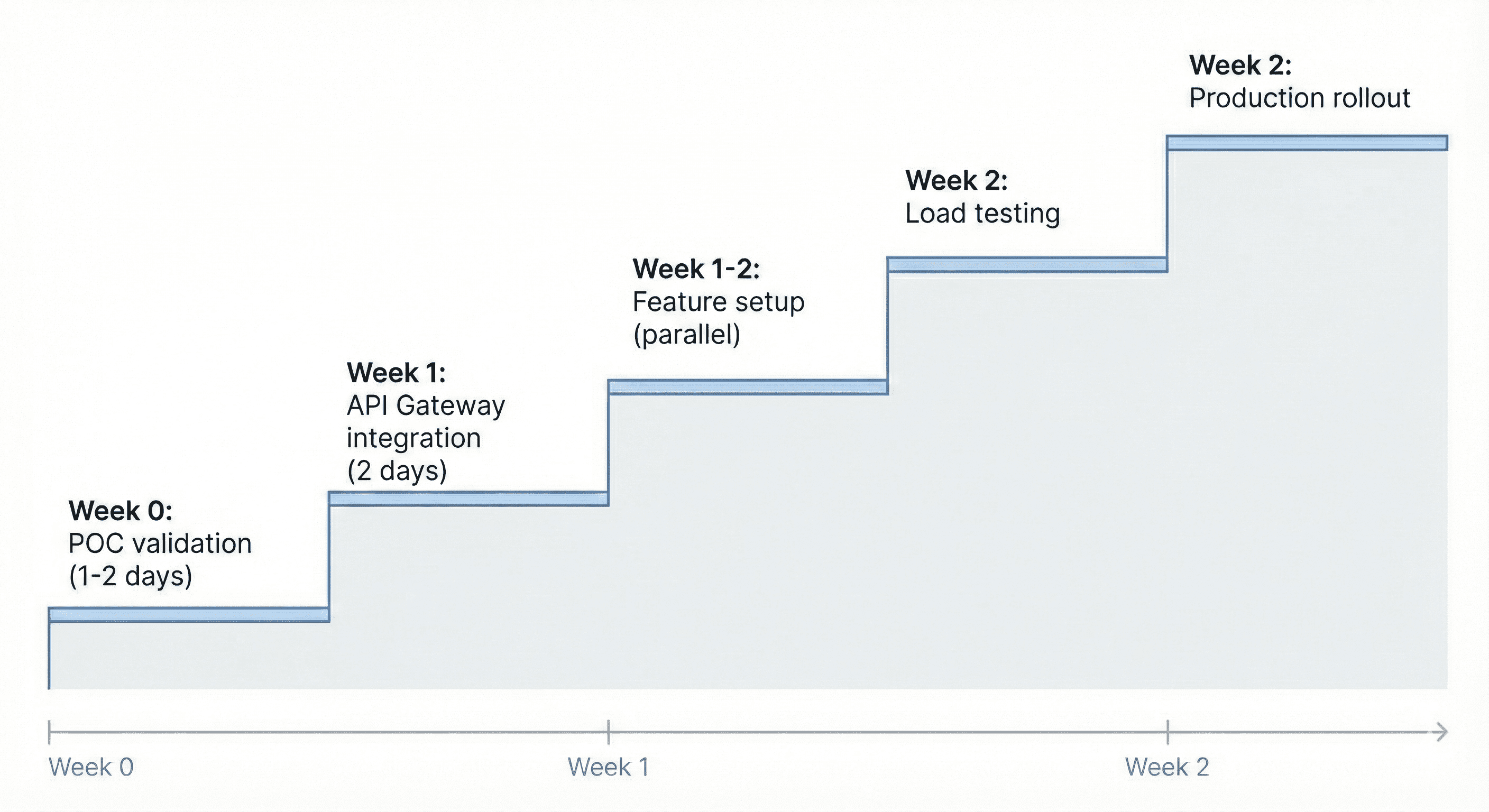
Simplismart's migration to Flexprice was not a multi-quarter engineering initiative. Despite operating one of the most complex pricing architectures in the AI-infrastructure ecosystem, the implementation was executed with remarkable speed and minimal disruption to production workloads.
Shubhendu described the rollout succinctly:
Simplismart's migration to Flexprice was not a multi-quarter engineering initiative. Despite operating one of the most complex pricing architectures in the AI-infrastructure ecosystem, the implementation was executed with remarkable speed and minimal disruption to production workloads.
Shubhendu described the rollout succinctly:
"It was very seamless integrating Flexprice into code. It was done in 3–4 days. The rest was just validating that everything works correctly."
Real-Time Metering
Credit Wallets & Hybrid Pricing
Custom Pricing for Every Enterprise
Dashboards
The Solution
The Solution
1. Real-Time Metering Across 750+ Pricing Features
Simplismart's pricing complexity comes from the nature of GenAI workloads. Their platform supports the full spectrum—each with its own billing unit.
Before Flexprice, this meant manual log parsing, SQL scripts, and cron jobs. Today, the same metering system runs deterministically and in real time.
2. Credit Wallets & Hybrid Pricing
Simplismart's initial monetization was purely usage-based. As they moved upmarket, enterprises wanted credit bundles, prepaid limits, and hybrid charging.
With Flexprice, Simplismart evolved pricing without touching business-critical code:
Prepaid tenants operate on credit wallets with automated blocking
Postpaid tenants operate on run-now, pay-later cycles
Both groups use a shared pricing and metering foundation—no forks or special-case logic
The same platform now monetizes:
Serverless endpoints (tokens, audio minutes, megapixels)
Dedicated GPUs (GPU-minute billing with multiple hardware tiers)
Subscriptions and committed-use plans layered on top
3. Subscriptions & Custom Pricing for Every Enterprise
For Simplismart's enterprise deals, every contract can contain different GPU rates, model rates, token thresholds, or bundle compositions.
Previously, changing pricing meant code changes, PR reviews, and deployment cycles delaying deals and consuming engineering time.
With Flexprice:
Sales or finance can update pricing per customer directly in the dashboard
Contract-specific overrides trigger zero downtime
No developer involvement required
What previously took 3–4 days of engineering work now takes 15–40 minutes end-to-end, including approvals.
4. Analytics & Customer Dashboards
When Simplismart reflects on their Flexprice implementation, one capability consistently stands out: analytics and customer dashboards.
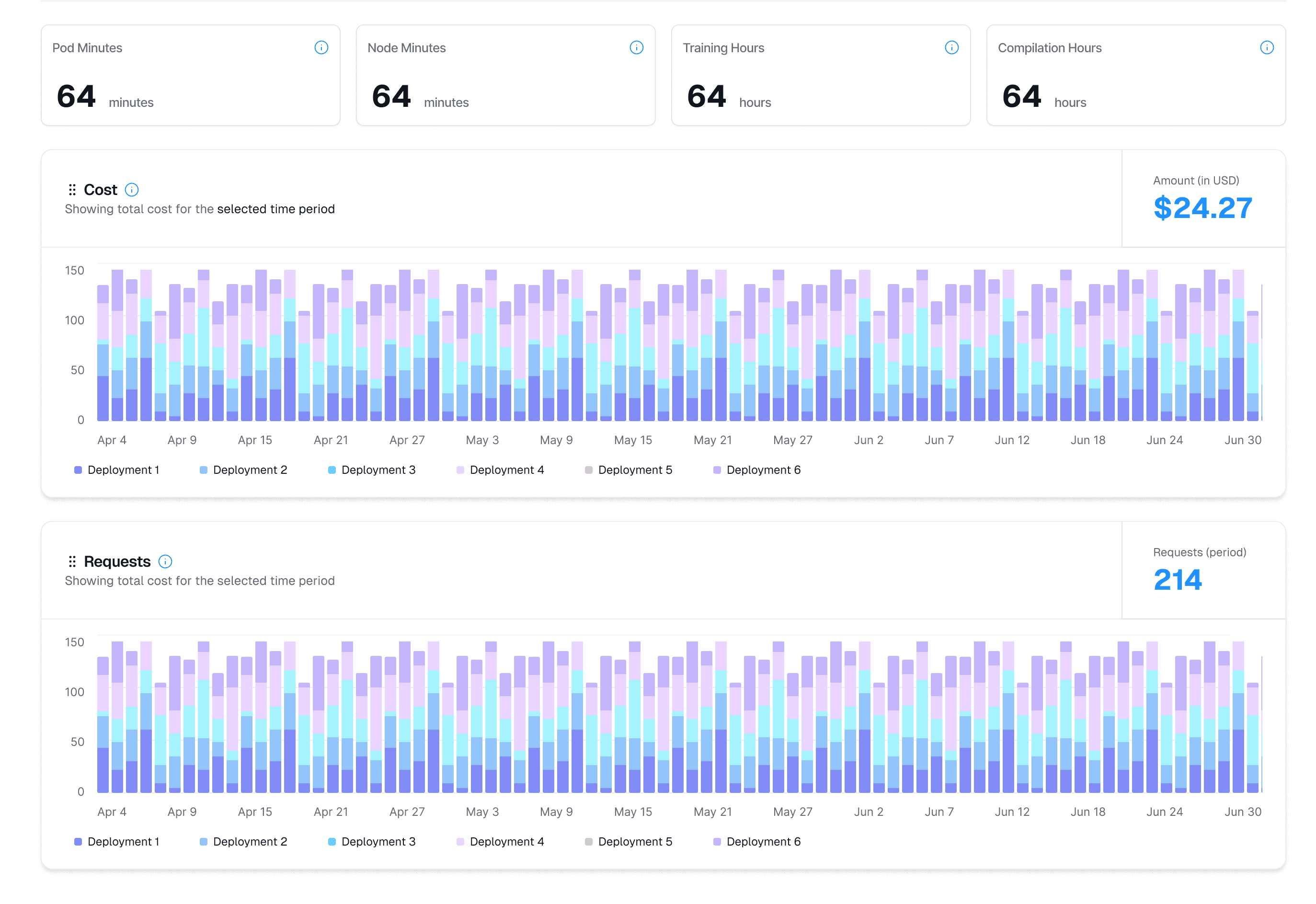
"One of the most important features we rely on."
Before Flexprice, Simplismart had no meaningful way to show customers what they were consuming or spending.
Customers had to trust the final invoice with no way to independently verify it.
Today, Simplismart shows an entire usage breakdown inside its platform UI, powered entirely by Flexprice analytics.
What Customers See:
Insight Type | What They See |
|---|---|
Total usage | Overall consumption for the selected time period (e.g., “46.823K node minutes”) |
Meter-level breakdown | Cost and volume per LLM model, Whisper model, GPU type, etc. |
Token/minute/pixel tracking | Input tokens, output tokens, audio minutes, megapixels, GPU minutes consumed |
Cost trends over time | Daily/weekly usage spikes and cost curves |
Cost per deployment/API/model | Consumption per workload or deployment |
Time window filters | Last 3 months, custom date ranges |
Deployment-level drill-downs | GPU type, minutes consumed, total cost billed |
Local timezone normalization | Auto-adapts to customer’s timezone for accuracy |
For an AI infrastructure platform selling into BFSI, healthcare, and enterprise, this level of visibility directly influences renewals, contract upgrades, and time-to-close.
1. Real-Time Metering Across 750+ Pricing Features
Simplismart's pricing complexity comes from the nature of GenAI workloads. Their platform supports the full spectrum—each with its own billing unit.
Before Flexprice, this meant manual log parsing, SQL scripts, and cron jobs. Today, the same metering system runs deterministically and in real time.
2. Credit Wallets & Hybrid Pricing
Simplismart's initial monetization was purely usage-based. As they moved upmarket, enterprises wanted credit bundles, prepaid limits, and hybrid charging.
With Flexprice, Simplismart evolved pricing without touching business-critical code:
Prepaid tenants operate on credit wallets with automated blocking
Postpaid tenants operate on run-now, pay-later cycles
Both groups use a shared pricing and metering foundation—no forks or special-case logic
The same platform now monetizes:
Serverless endpoints (tokens, audio minutes, megapixels)
Dedicated GPUs (GPU-minute billing with multiple hardware tiers)
Subscriptions and committed-use plans layered on top
3. Subscriptions & Custom Pricing for Every Enterprise
For Simplismart's enterprise deals, every contract can contain different GPU rates, model rates, token thresholds, or bundle compositions.
Previously, changing pricing meant code changes, PR reviews, and deployment cycles delaying deals and consuming engineering time.
With Flexprice:
Sales or finance can update pricing per customer directly in the dashboard
Contract-specific overrides trigger zero downtime
No developer involvement required
What previously took 3–4 days of engineering work now takes 15–40 minutes end-to-end, including approvals.
4. Analytics & Customer Dashboards
When Simplismart reflects on their Flexprice implementation, one capability consistently stands out: analytics and customer dashboards.
"One of the most important features we rely on."
Before Flexprice, Simplismart had no meaningful way to show customers what they were consuming or spending.
Customers had to trust the final invoice with no way to independently verify it.
Today, Simplismart shows an entire usage breakdown inside its platform UI, powered entirely by Flexprice analytics.
What Customers See:
Insight Type | What They See |
|---|---|
Total usage | Overall consumption for the selected time period (e.g., “46.823K node minutes”) |
Meter-level breakdown | Cost and volume per LLM model, Whisper model, GPU type, etc. |
Token/minute/pixel tracking | Input tokens, output tokens, audio minutes, megapixels, GPU minutes consumed |
Cost trends over time | Daily/weekly usage spikes and cost curves |
Cost per deployment/API/model | Consumption per workload or deployment |
Time window filters | Last 3 months, custom date ranges |
Deployment-level drill-downs | GPU type, minutes consumed, total cost billed |
Local timezone normalization | Auto-adapts to customer’s timezone for accuracy |
For an AI infrastructure platform selling into BFSI, healthcare, and enterprise, this level of visibility directly influences renewals, contract upgrades, and time-to-close.
Scaling Models on Autopilot
End-to-End Billing Automation
Flexprice as the Long-Term Billing OS
What's Next in Billing For Simplismart?
Simplismart's monetization strategy is evolving faster, and Flexprice will be the billing backbone as they scale deeper into enterprise GenAI workloads.
Three priorities already in motion:
1. Scaling New Models & Meters on Autopilot
Simplismart continuously introduces new AI models. Every model introduces multiple new meters (tokens, audio minutes, megapixels, GPU minutes).
Today, every time a new model launches, Flexprice becomes the default system of record for pricing and metering without needing Flexprice engineering involvement.
This ensures monetization keeps pace with product innovation rather than slowing it down.
2. End-to-End Enterprise Billing Automation
Now that real-time metering and hybrid pricing are stable at scale, Simplismart's next phase is complete billing automation:
Automated tax handling within invoices
Out-of-the-box payment gateway integrations with Razorpay
Today, their finance team references Flexprice dashboards but still processes taxation and certain payment flows manually. Their objective is to move all of this into Flexprice, creating a single system of truth for revenue.
3. Flexprice as the Long-Term "Billing OS" for GenAI Infrastructure
Simplismart sees Flexprice not as a vendor, but as core infrastructure. The decision was shaped by two realities:
Billing is the business for GenAI infrastructure companies every token, pixel, and GPU minute is revenue
Building a billing platform internally is not a generative moat it diverts engineering from product, uptime, and performance
With the combination of:
Real-time metering for high-cardinality AI usage
Hybrid credit + usage + subscription billing
Customer-facing analytics that build trust
Rapid turnarouwnd for pricing changes and feature requests
Flexprice is expected to serve as a permanent layer in Simplismart's product architecture, not just an operational add-on.
Simplismart's monetization strategy is evolving faster, and Flexprice will be the billing backbone as they scale deeper into enterprise GenAI workloads.
Three priorities already in motion:
1. Scaling New Models & Meters on Autopilot
Simplismart continuously introduces new AI models. Every model introduces multiple new meters (tokens, audio minutes, megapixels, GPU minutes).
Today, every time a new model launches, Flexprice becomes the default system of record for pricing and metering without needing Flexprice engineering involvement.
This ensures monetization keeps pace with product innovation rather than slowing it down.
2. End-to-End Enterprise Billing Automation
Now that real-time metering and hybrid pricing are stable at scale, Simplismart's next phase is complete billing automation:
Automated tax handling within invoices
Out-of-the-box payment gateway integrations with Razorpay
Today, their finance team references Flexprice dashboards but still processes taxation and certain payment flows manually. Their objective is to move all of this into Flexprice, creating a single system of truth for revenue.
3. Flexprice as the Long-Term "Billing OS" for GenAI Infrastructure
Simplismart sees Flexprice not as a vendor, but as core infrastructure. The decision was shaped by two realities:
Billing is the business for GenAI infrastructure companies every token, pixel, and GPU minute is revenue
Building a billing platform internally is not a generative moat it diverts engineering from product, uptime, and performance
With the combination of:
Real-time metering for high-cardinality AI usage
Hybrid credit + usage + subscription billing
Customer-facing analytics that build trust
Rapid turnarouwnd for pricing changes and feature requests
Flexprice is expected to serve as a permanent layer in Simplismart's product architecture, not just an operational add-on.
Scaling Models on Autopilot
End-to-End Billing Automation
Flexprice as the Long-Term Billing OS
What's Next in Billing For Simplismart?
Simplismart's monetization strategy is evolving faster, and Flexprice will be the billing backbone as they scale deeper into enterprise GenAI workloads.
Three priorities already in motion:
1. Scaling New Models & Meters on Autopilot
Simplismart continuously introduces new AI models. Every model introduces multiple new meters (tokens, audio minutes, megapixels, GPU minutes).
Today, every time a new model launches, Flexprice becomes the default system of record for pricing and metering without needing Flexprice engineering involvement.
This ensures monetization keeps pace with product innovation rather than slowing it down.
2. End-to-End Enterprise Billing Automation
Now that real-time metering and hybrid pricing are stable at scale, Simplismart's next phase is complete billing automation:
Automated tax handling within invoices
Out-of-the-box payment gateway integrations with Razorpay
Today, their finance team references Flexprice dashboards but still processes taxation and certain payment flows manually. Their objective is to move all of this into Flexprice, creating a single system of truth for revenue.
3. Flexprice as the Long-Term "Billing OS" for GenAI Infrastructure
Simplismart sees Flexprice not as a vendor, but as core infrastructure. The decision was shaped by two realities:
Billing is the business for GenAI infrastructure companies every token, pixel, and GPU minute is revenue
Building a billing platform internally is not a generative moat it diverts engineering from product, uptime, and performance
With the combination of:
Real-time metering for high-cardinality AI usage
Hybrid credit + usage + subscription billing
Customer-facing analytics that build trust
Rapid turnarouwnd for pricing changes and feature requests
Flexprice is expected to serve as a permanent layer in Simplismart's product architecture, not just an operational add-on.
Ready to transform your billing infrastructure?
Ready to transform your billing infrastructure?
If you're spending valuable engineering time on billing instead of your core product or if you need to scale complex usage-based pricing without the overhead, Flexprice can help.
If you're spending valuable engineering time on billing instead of your core product or if you need to scale complex usage-based pricing without the overhead, Flexprice can help.
Schedule a Demo
Schedule a Demo
Talk to our team about your billing challenges
Talk to our team about your billing challenges
Start Building for Free
Start Building for Free
Get started with our open-source platform
Get started with our open-source platform
Read the Docs
Read the Docs
Explore our technical documentation
Explore our technical documentation
Join our Community
Join our Community
Connect with other teams solving similar challenges
Connect with other teams solving similar challenges















