
Ayush Parchure
Content Writer, Flexprice

Most billing setups that were built for self-serve SaaS start to crack the moment a real enterprise contract lands on the table. Multi-period ramps, custom credit grants, committed usage, and quarterly true-ups quickly turn a clean Stripe Billing setup into a patchwork of scripts, spreadsheets, and engineering tickets that nobody wants to maintain.
The problems here compound fast, where finance ends up in Excel and engineering writes more billing code than product. By year two, the question is not whether to switch platforms but how to switch without breaking revenue recognition.
Skipping all of that pain means picking the right enterprise billing software the first time around.
This guide covers what enterprise billing software actually does, the features that matter once your contracts get complex, and the five lenses that take you from shortlist to a signed contract
TL;DR
Enterprise billing software handles invoicing, contract management, usage metering, and revenue recognition at a scale traditional billing tools cannot reach.
It supports multi-layered contracts, gives finance and product teams low-code pricing tools, meets enterprise security and compliance bars, and cleans up revenue recognition.
Must-have features: phased contracts, real-time metering, configurable dunning, compliance and security, audit trails, entitlements, multi-currency, multi-entity, etc.
How to evaluate vendors on these five lenses: brand equity, regulatory adherence, customer billing experience, pricing transparency, and data ownership.
Flexprice is enterprise-grade, open source usage based billing infrastructure for AI and SaaS companies. It can be deployed in your own VPC, on-prem, or on Flexprice's managed cloud.
What is enterprise billing software?
Enterprise billing software is an automated, cloud or self-hosted platform that handles invoicing, contract management, usage metering, subscription lifecycle, and revenue recognition at enterprise scale.
You can think of it as the system of record for every dollar your company invoices, every event your customers consume, and every line item your auditor will read during the next close.
The difference between a traditional billing tool and modern enterprise billing systems shows up the moment you sign a contract that does not look like a credit-card checkout. Traditional billing covers flat-rate subscriptions, one or two pricing tiers, and a billing cycle that resets on the first of every month. But the enterprise billing systems handle:
High-volume transaction processing across millions of usage events per day
Long, custom contract negotiations with ramps, commitments, and per-customer terms
Detailed audit trails and regulatory compliance covering ASC 606, IFRS 15, SOC 2, and GDPR
Multi-layered security and role-based access for finance, sales, engineering, and external auditors
The benefits of enterprise billing software
Here are some of the benefits of enterprise billing software:
Supports multi-layered contracts and pricing plans
A real enterprise billing platform combines flat fees, tiered pricing, usage components, and minimum commitments inside one plan, no custom code required. Sales can close a non-standard deal on Friday, and your engineers are not forking the codebase by Monday to support it.
The path from signed contract to correct first invoice should run in days, not the four-week implementation sprint that some legacy systems say is normal.
Low-code tools and developer-grade APIs
Your finance and product teams should ship pricing changes through a UI, not by filing an engineering ticket and waiting two sprints. The APIs and webhooks underneath handle the heavy lifting into your CRM, ERP, warehouse, and payment processors. Engineering gets back to building product, finance owns billing, and nobody is stuck in the middle.
Enterprise-grade security and compliance
SOC 2, ISO 27001, GDPR, and PCI DSS should be your top priority when you shortlist things. Role-based access, immutable audit logs, and data residency options keep both your auditors and your CISO calm. If you sell into healthcare, fintech, or the public sector, a self-hostable option is often the difference between closing the deal and losing it on the security review.
Faster finance ops and cleaner revenue recognition
Prorations, mid-cycle changes, dunning, and collections should run themselves, so your finance team can do actual finance work instead of clicking buttons every cycle. Rule-based revenue recognition auto-generates ASC 606 and IFRS 15 reports, so close week stops feeling like a fire drill.
18 Must have features in enterprise billing software
Here is the bar your shortlist actually needs to clear before you sign anything. Skip a few of these, and within a quarter, your engineers are writing the missing pieces while finance backfills the rest in spreadsheets. Two years later, you are running a billing migration that you could have avoided
Phased contracts
Enterprise deals never look like a clean monthly subscription. Your platform has to handle the structures your sales team is actually negotiating around the table:
Ramp deals across multiple periods
Free months at the start of the contract
Step-up commitments tied to fiscal milestones
Mid-term escalators on price or volume
Scheduled price changes that roll automatically
Here is a quick test for any vendor on your shortlist: ask them to model a 24-month contract with $50K in year one, $100K in year two, and a free first month. If they need a custom script or a "professional services engagement" just to set that up, that is the same contract you will be running for every enterprise customer you close after them.
Real-time event metering
If you charge by usage, your metering layer is the place where you either generate revenue or lose it. Here is what matters most:
Sub-second ingestion with documented events-per-second SLAs
Idempotent event APIs so retries do not double-count
Deduplication by event ID
Configurable aggregation windows including sum, count, max, average, P95, and unique values
Clean handling of late-arriving events, retroactive corrections, and event replay
Throughput is the easy thing to ask about, so pull the recent load test reports right in the demo. The edge cases matter more because if late events or replays need a support ticket every time, you have just hired a full-time engineer to babysit your billing.
Dunning workflows
Failed payments quietly cause 30 to 40 percent of involuntary churn in B2B SaaS.

The strongest dunning setups recover most of those failures, while default settings claw back only some percentage, and the gap is usually bigger than what you pay the billing vendor in a year.
A real dunning engine lets you configure retry schedules, usually retries on day 0, 3, 7, and 14 with a tighter cadence for high-value accounts. Smart retries adapt to the decline code, so insufficient funds get handled differently from a fraud block.
Layer in network-level intelligence like Stripe Smart Retries or Adyen RevenueProtect, and each retry runs against the issuer's actual success patterns instead of a fixed schedule.
Beyond the retry engine itself, you should look for:
Pre-dunning notifications, such as card expiring in 30 days emails, low-balance warnings, and expiring credit alerts
Branded, localizable email sequences segmented by customer tier, since your $500K enterprise account should not get the same recovery flow as a $5K SMB
Account-state thresholds that decide when a failed payment triggers a feature pause, a portal banner, an account suspension, or a cancellation
Webhook events at every dunning state transition, so customer success, sales, and finance can intervene manually on the accounts that matter
The biggest red flag is a global-only setup. If you cannot run different recovery flows for different customer segments, you are leaving real money on the table every month, and that's the issue most founders ignore.
Compliance and security
Your billing platform holds payment details, contract values, usage records, and revenue numbers, which are essentially the most sensitive operational data your company owns.
A breach or audit failure here is not a paper cut; it can be existential, so treat security as a P0 buying criterion rather than a procurement checkbox at the end of the cycle.
Each of these certifications proves something different, and you want every relevant one in hand before you sign anything:
SOC 2 Type II: A current report, not Type I, and not "in progress." Type I confirms that a vendor wrote down the right policies. But Type II proves that an independent auditor verified those controls operated effectively for at least six months.
ISO 27001: The international equivalent, often required by EU and APAC procurement teams alongside SOC 2.
PCI DSS Level 1: Required if the platform touches card data anywhere in the flow, even via a tokenization handoff.
HIPAA: Required for healthcare. Ask for a signed BAA, not a vague "we are HIPAA-aligned."
GDPR and CCPA alignment: Required if you have any European or California customers, with a DPA available without an enterprise upsell.
FedRAMP: Required for the US public sector and considerably harder to fake than commercial certifications.
The single best question you can ask in any security conversation is: "Can I see your most recent SOC 2 Type II report and the latest pen test executive summary under NDA?" Vendors who hesitate, redirect you to a generic security page, or stall until you sign the order form are telling you exactly what their security posture looks like under pressure.
Audit trails
Every change, like price, plan, invoice, contract, or customer record, should leave a timestamped, immutable record of who did what and when. This is your floor for SOC 2, the table stakes for any revenue audit, and the first artifact you will reach for when someone asks why a customer got billed $40K extra last quarter.
Look for SOX-aligned controls, including:
Separation of duties between price-setters and approvers
Approval workflows on high-value changes
Tamper-evident log storage that not even platform admins can edit
Entitlements
Pricing decides what a customer pays, and entitlements decide what they can actually use. They are the same decision, and your platform should treat them that way. A proper entitlements engine gates features, quotas, and limits based on the customer's plan, with real-time API checks that your product calls directly, so you are not maintaining the same logic across three services and watching it drift the next time someone changes a plan.
The decisions worth interrogating during evaluation:
What happens when a customer hits a hard limit mid-period: block, throttle, queue, or auto-convert to overage charges?
Can entitlements aggregate across multiple subscriptions for the same parent customer?
Can sales grant per-customer entitlement bumps without modifying the underlying plan?
APIs, webhooks, and SDKs
Treat the developer surface as a real buying criterion, not an afterthought. Every action available in the UI should also live in a clean, versioned, well-documented API, with first-party SDKs in the languages your team actually writes (Python, Go, Java)
Webhooks specifically need:
At least once delivery with retries
Signed payloads
Documented event schemas
A sandbox or test mode that mirrors production behavior
A rate-limited, partial-coverage API is the clearest signal that the vendor's UI is the real product, and you will hit a wall with that API inside six months of trying to build on it.
For context, this is the bar Flexprice SDK is built against. You get first-party libraries for Python, Go, and Java:

Multi currency
Native multi-currency invoicing means the pricing table maps each plan tier to amounts in every supported currency, fully version-controlled and dated. Most enterprise deals lock in a negotiated currency, while self-serve plans run on FX-linked prices that refresh on a schedule.
At the accounting layer, the platform should:
Auto-load FX rates from a trusted source
Run revaluation on foreign-currency balances at close
Post unrealized gain or loss entries automatically
If FX revaluation is not part of the close workflow, finance is doing it in Excel, and those errors compound every quarter.
Multi-entity
Once you bill the same customer base from multiple legal entities (US Inc, UK Ltd, and an APAC entity), each one needs its own tax profile, invoice number sequence, revenue recognition schedule, payment processor, and role-based permissions.
Intercompany is the harder half: the platform should track and eliminate intercompany transactions and handle transfer pricing allocation, so consolidation stops living inside your finance team's spreadsheets.
Quick test in any demo: ask for a single parent customer with subscriptions billed by two entities, with intercompany allocation and a consolidated waterfall. If the vendor cannot show it live, it does not exist.
Transparent metering UI
Bill shock is the biggest trigger for support escalations and a top driver of enterprise churn on usage-priced products. A transparent metering UI tells your customer that nothing about how the bill was calculated is hidden, which is exactly the message you want to send.
Look for:
A real-time consumption dashboard with charge accumulation and projected end-of-period totals
Drill down from each line item back to the underlying event
Usage alerts at configurable thresholds (50%, 80%, 100% of commitment)
An embedded usage API so you can surface the same data inside your own product
Contract overrides
No two enterprise contracts are identical, so the platform has to support contract-level overrides for:
Prices
Commitments
Credits
Payment terms
Billing cycles.
You should not be cloning an entire plan every time sales close a slightly different deal.
Sales should apply standard overrides like volume discounts, ramp deferrals, or custom credit grants self-serve, with engineering and finance only stepping in on non-standard structures.
Correct invoices
Invoices are the artifact your customers see most often, and generating them should not depend on an engineer staying awake at month-end. The minimum invoice feature set covers:
Branded templates with multi-language and multi-currency support
Auto-attached usage breakdowns (detailed line items or supplemental CSVs)
PDF generation tied directly to your billing cycle
Configurable due dates and payment terms
Sequential auto-numbering with legal integrity
Clean credit-note and re-issuance flows
For global rollouts, e-invoicing is becoming more popular every quarter. UBL, Factur-X, Peppol, and country-specific formats like Italy's SDI, Mexico's CFDI, and India's IRP are increasingly mandated by tax authorities, and your platform should support them natively.
Integrations
Billing data needs to flow cleanly into your CRM, ERP, data warehouse, finance close tools, and product analytics. The source of each integration is a strong indicator of how reliable it will be at month-end.
The minimum connector list for any enterprise shortlist:
CRM: Salesforce, HubSpot
ERP and accounting: NetSuite, QuickBooks, Sage Intacct
Payments: Stripe, Adyen, GoCardless
Tax: Avalara
Data warehouse and analytics: Snowflake, BigQuery, Segment
Customer support
When something breaks at the month-end close, you need a human on the other end of the line, not a chatbot and not a four-hour first-response SLA. At the enterprise tier, expect:
A named CSM is tied to your account
A dedicated Slack or shared channel
Sub-one-hour P0 response
A documented escalation path
Post-incident root-cause docs you can share with finance and engineering
The question here should not be "Do you offer enterprise support?" because every vendor says yes to that, but the right question should be, "What happens at 11 PM when our automated invoice run fails for 800 customers?" The specificity of the answer tells you whether you are buying a partner or a portal.
Grandfathered pricing
When you raise public pricing, existing customers stay on their old terms, and that has to be a first-class concept inside the platform. Not a hack held together with tags, custom fields, and a spreadsheet your billing ops lead prays nobody loses.
Look for explicit price versioning, the ability to lock a subscription to its start-date pricing, and clean migration paths between versions when you decide to bring legacy customers forward.
Credits and wallets
Modern AI and agentic products need first-class credit handling, and most billing systems still treat credits like an afterthought. You want dedicated support for:
One-off and recurring credit grants
Credit refresh on a schedule
Rollover with caps so unused credits do not stack indefinitely
Auto top-ups when the wallet drops below a threshold
Expiration rules tied to either time or usage
A unified wallet that aggregates across credit types
This is the biggest gap in legacy enterprise billing systems for AI-native companies, so it deserves a real demo and not a slide.
Parent-child customer accounts
Parent-child describes your customer's own org structure: one parent account with sub-accounts beneath it, shared credits, pooled usage across teams, and a single roll-up invoice at the top.
The moment your customer expands across departments (which every healthy mid-market and enterprise account does inside year one), this becomes critical.
Quotes and renewals (CPQ)
Enterprise sales never start at a checkout page. Built-in quoting closes the loop between your sales motion and your billing engine, and the basics to expect are:
Pricing lock-in from quote to subscription
Approval workflows for non-standard terms
Automatic sync from accepted quote to active subscription
Phased contracts handle the math underneath, but you still need a clean quote-to-cash flow sitting on top.
How to evaluate enterprise billing software vendors
Features get you to a shortlist, but these five lenses get you to the right enterprise billing software for your stage and your customers.
Brand equity and stability
Migrating between enterprise billing systems is a multi-quarter project, so you need confidence that the vendor will still be around in five years. Check funding rounds, recent product velocity, and current G2 reviews instead of the polished case studies on the homepage.
Regulatory adherence
Certifications are the floor, and we covered them in the features section. The real test is the relationship:
Will the vendor share their pen test summary under NDA?
Will they sign your DPA and BAA without an enterprise upsell?
Will they let your security team interview their CISO before you sign?
Their answers say more about culture than any badge on a marketing page.
Billing experience for your customers
Your invoices and customer portal directly reflect your brand. Ask to see a real invoice and a live customer portal in the demo.
If your customer cannot self-serve usage, payments, and seats without filing a ticket, the vendor is selling you 2018 software with a 2026 price tag.
Pricing transparency and total cost of ownership
Most enterprise billing systems still hide pricing behind "contact sales," and when they do, the price depends on what the vendor thinks you can pay. Insist on public pricing tiers, model a month-12 invoice based on your actual projected volume, and build a five-year TCO that includes:
Implementation and onboarding fees
Connector and integration add-ons
Support tier upgrades
Engineering hours your team will spend filling product gaps
Data ownership and extensibility
Self-hosting and open source represent the strongest forms of data ownership, and even if you never exercise the option, having it gives you serious leverage at renewal. Check whether your team can write custom pricing or dunning logic without waiting two quarters for a feature request to ship.
Why companies choose Flexprice for enterprise billing
Flexprice is a monetization infrastructure built for AI-native and SaaS companies. The platform handles usage-based, credit-based, and hybrid pricing on a real-time metering and reporting layer that scales as your product grows. This is what your team needs once contracts stop fitting on a checkout page.
Every must-have feature and evaluation lens covered above maps directly to how Flexprice was designed.
Open source
Flexprice lives on GitHub and your team can read every line of the metering, pricing, and invoicing logic before you commit to a deployment.
You can self-host on your own infrastructure (Postgres, Kafka, ClickHouse, and Temporal under the hood), or stay on the managed cloud and switch later if your security team raises the question. Either way, your billing logic is not sitting inside someone else's black box.
Transparent pricing
Flexprice publishes its pricing publicly, and it looks like this:
Basic- free- 100k events per month
Build- $500 / month with 1 million events per month
Scale- $1000 / month with 5 million events per month
Mission critical- custom
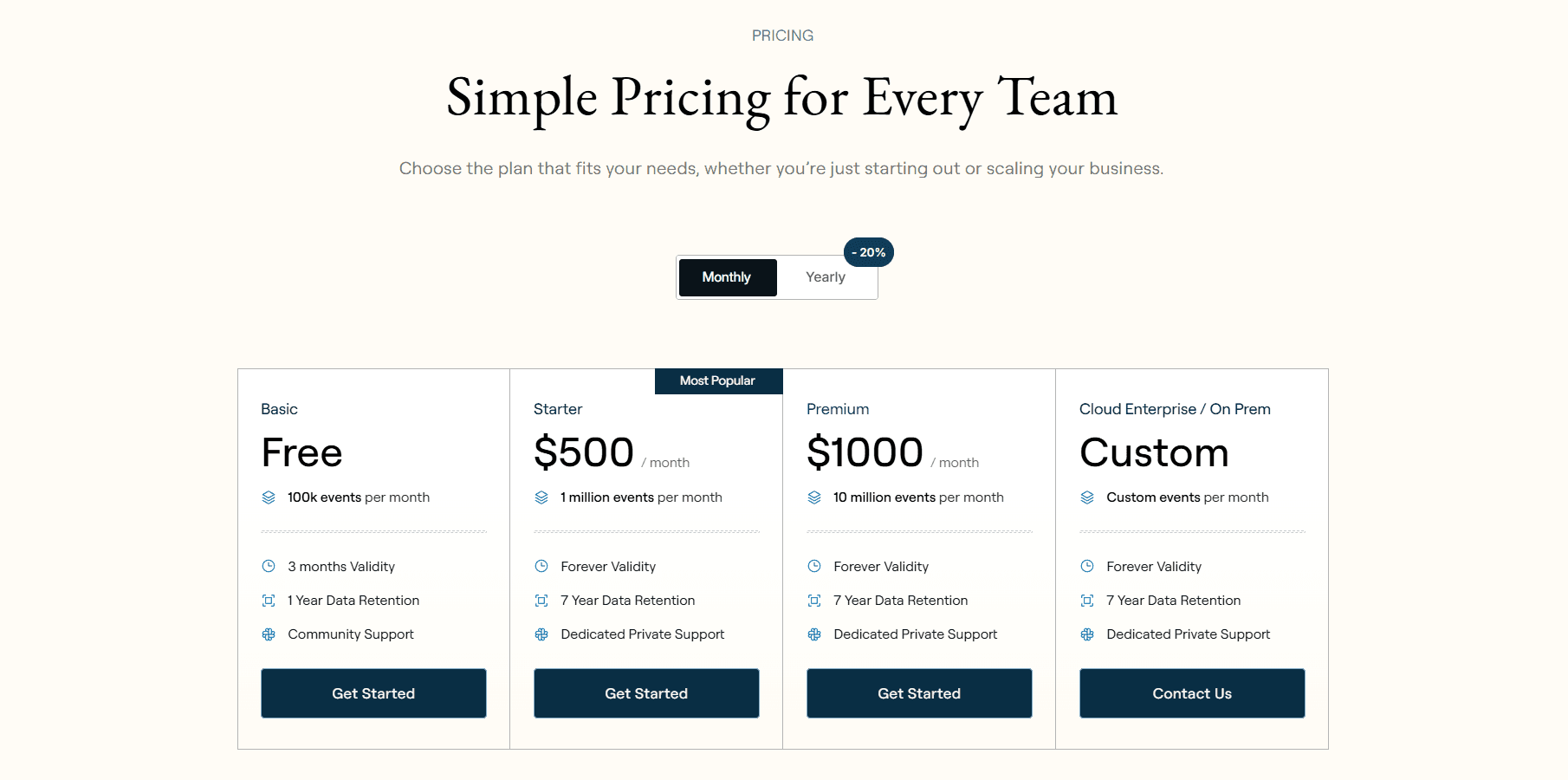
All of these directly on the website, with Cloud and on-prem options spelled out for each. There are no event-volume cliffs that surprise you at renewal, no forced implementation packages, and no integration fees that appear after the order form is signed. The price you see on the site is the price you actually pay.
Built for developers
Engineering gets first-party SDKs for Go, Python, and JavaScript, an API-first design, and a clean event-ingestion layer that drops into existing telemetry.
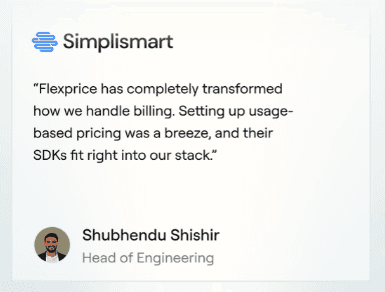
You can see one of our customers, Simplismart’s Head of Engineering, Shubendu Shishir, quotes: “Flexprice has completely transformed how we handle billing. Their SDKs fit right into our stack
All compliances covered
Flexprice covers the compliance bar that enterprise procurement actually demands. The platform supports SOC 2, ISO 27001, GDPR, PCI DSS, and HIPAA-aligned controls, with role-based access, immutable audit logs, and configurable data residency for teams selling into regulated markets like healthcare, fintech, and the public sector. Your security review becomes a checkbox conversation instead of the gating risk on every enterprise order form.
On-premises deployment
For teams that cannot run billing in someone else's cloud (regulated industries, sovereign data requirements, or internal security policies that block third-party SaaS), Flexprice ships a fully on-prem deployment option. You run the entire stack (Postgres, Kafka, ClickHouse, and Temporal) inside your own infrastructure, with no events leaving your environment. Same product, same APIs, same dashboard, just deployed where your security team needs it to live.
Integration capabilities
Flexprice connects cleanly into the rest of your stack through first-party APIs, webhooks, and SDKs in Go, Python, and JavaScript. Native integrations cover the systems your finance and product teams already run on, including Stripe and other payment processors, your CRM, ERP, data warehouse, and analytics pipeline. Every action available in the dashboard is also available through the API, so engineering teams can build on top of Flexprice without hitting walls.
Dedicated support and 24/7/365 coverage
At the enterprise tier, Flexprice gives you a named CSM, a dedicated Slack or shared channel, and 24/7/365 coverage with a documented escalation path. When something breaks at the month-end close, you reach a human inside minutes, not a ticket queue or a chatbot. Post-incident root-cause docs come standard, so your finance and engineering teams have what they need to keep the rest of the company informed.
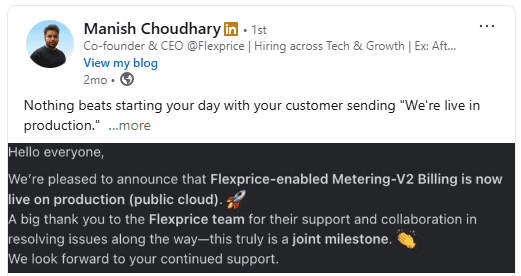
The strongest signal of dedicated support is a customer publicly thanking the team after hitting production. Here is one such note shared recently by Flexprice's CEO, Manish Choudhary
Backed by funding and real customers
Switching billing platforms is a multi-quarter project, and the worst version of that decision is signing with a vendor who will not be around in five years. Flexprice is a well-funded company with AI-native and SaaS customers running production billing on the platform today. Funding rounds, customer logos, and shipped product velocity are all public, so you can run that diligence yourself before you commit.

Wrapping up
Picking the right enterprise billing software is a decision you will live with for at least three years, and probably longer. Most enterprise billing systems lock you in through their data model, their integration footprint, and the reports your finance team has already built on top of them, so the cost of switching only grows with time.
The features above will get you to a shortlist of three or four credible vendors. The five evaluation lenses (brand stability, regulatory adherence, customer billing experience, pricing transparency, and data ownership) will get you to the one you should actually sign with.
If you want to see how Flexprice handles ramp deals, real-time metering, dunning, and credit wallets in a single open-source platform, you can spin up a sandbox in fifteen minutes or talk to our team about a guided demo against your real contract structures.
What is the difference between traditional billing software and enterprise billing software?
Is Stripe Billing enough for enterprise contracts, or do I need a dedicated enterprise billing platform?
What features should I look for when choosing enterprise billing software for an AI or SaaS company?
Can enterprise billing software handle usage-based, credit-based, and hybrid pricing in one platform?
How do I evaluate enterprise billing software vendors before signing?