
Ayush Parchure
Content Writer, Flexprice

Orb was built for the first wave of usage-based SaaS, where the main challenge was turning product usage into billable metrics. For many teams, it did well.
But modern SaaS and AI products have pushed billing far beyond simple usage aggregation. Pricing now includes credits, prepaid balances, complex contract terms, and frequent pricing changes as products evolve.
Now this becomes a friction for teams because what began as a simple usage metering layer now becomes harder to adapt when pricing models expand, or finance workflows get more complex.
This leads them to search for a better alternative, which can provide them with more flexibility in how pricing and billing are designed.
The better orb alternative like Flexprice supports both simple subscriptions and complex usage-based pricing and can handle credits or prepaid models when needed.
For teams who want more freedom, better pricing control, and a smoother customer experience, here are five Orb alternatives worth considering for usage-based pricing and billing.
Note: Even though this post is published on Flexprice, it’s not a biased roundup. We’ve evaluated each tool based on flexibility, technical capabilities, and developer experience, the same criteria any team building serious billing infrastructure should use.
TL;DR
Orb works well for usage metering and consumption billing, especially for API and infrastructure products.
As pricing models evolve to include credits, prepaid balances, and complex contracts, some teams start looking for more flexible billing systems.
Flexprice is enterprise-grade, open source usage based billing infrastructure for AI and SaaS companies. It can be deployed in your own VPC, on-prem, or on Flexprice's managed cloud.
Schematic focuses on entitlements and pricing logic, sitting between your product and Stripe for packaging and feature control.
Metronome (now part of Stripe) provides high-scale usage metering and fits teams already committed to the Stripe ecosystem.
Chargebee is a strong option for subscription-first SaaS companies and seat based pricing that need basic usage based pricing features.
Lago offers an open-source billing platform with usage metering, invoicing, and flexible deployment options.
The right Orb alternative depends on whether you prioritize developer control, open-source infrastructure, enterprise finance workflows, or Stripe-native billing.
What is Orb
Orb is a usage-based billing platform that is specially designed for API calls, compute time, or other events that turn raw usage into accurate invoices for modern SaaS and infrastructure products.
For companies that require high-volume event metering and precise billing, it works like a charm, especially for developer-first products like APIs, AI tools, and cloud infrastructure, where billing depends on real usage.
But Orb was originally designed around the core challenge of usage metering and consumption billing. As pricing models become more complex, many companies also need broader billing capabilities like flexible contract structures, finance workflows, and faster pricing experimentation.
What Orb Does Well
Orb is designed to solve a very specific problem, like turning product usage into accurate, billable revenue. If your product relies heavily on consumption-based pricing, Orb handles several core pieces of that workflow well.
Real-time usage metering
Orb allows you to send usage events from your product as they happen. These events can represent API calls, compute usage, storage consumption, or any other billable action. Orb processes these events in near real time, so you can track customer usage continuously instead of waiting until the end of a billing cycle.
Tiered and hybrid pricing models
If your pricing includes tiers, overages, or combinations of subscription and usage billing, Orb can model those structures. For example, you can charge a base platform fee and then apply tiered pricing for usage that exceeds certain thresholds. This makes it easier to support common SaaS pricing patterns without building custom billing logic internally.
Revenue recognition workflows
Orb also includes tools that help finance teams track revenue recognition. Usage data, invoices, and billing events can be organized in ways that support accounting workflows, which becomes important as companies scale and financial reporting becomes more structured.
High-volume event handling
Many developer-focused products generate large numbers of usage events. Orb’s infrastructure is built to ingest and process high volumes of these events reliably. For companies with APIs, AI workloads, or infrastructure services, this ability to handle large streams of usage data is one of Orb’s biggest strengths.
When does it start to break?
As your pricing model evolves, the limits of a usage-metering-focused system can start to appear.
Closed, proprietary architecture
Orb operates as a fully managed platform. That simplifies setup, but it also means you’re working inside a proprietary system. If your team needs deeper customization or wants billing logic to live directly inside your infrastructure, the platform boundaries can become restrictive.
Rising costs at high event volume
Usage-based billing platforms often price based on the number of events processed. As your product grows and event volume increases, billing infrastructure costs can grow alongside it. For companies processing extremely large usage streams, this can become an important factor in long-term architecture decisions.
Growing vendor lock-in risk
Once billing is deeply connected to your product and handling pricing rules, customer balances, invoices, and usage data, switching providers becomes harder. Migration can involve moving historical usage data, recreating pricing logic, and updating product integrations.
Billing becomes core product infrastructure
In the early stages, billing can be treated as an external service. But as pricing becomes more strategic, billing logic often becomes tightly tied to product behavior, entitlements, and internal systems. At that point, teams sometimes want more control over how billing works inside their architecture.
Signs that show you’ve outgrown Orb
Certain requirements tend to signal that a team may need a different billing architecture.
Native multi-gateway payment orchestration
If you need to route payments across multiple gateways for global coverage, redundancy, or cost optimization, your billing system needs deeper payment orchestration capabilities.
Self-hosted or open-source billing requirements
Some companies prefer infrastructure that they can host and control themselves, especially for compliance, customization, or cost management reasons.
Billing logic must run fully in-house
If billing directly controls product access, credits, or runtime enforcement, you may want pricing and billing logic running directly within your system instead of relying entirely on an external platform.
CPQ and sales workflows are tightly integrated
Enterprise sales often require custom contracts, negotiated pricing, and approval workflows. When sales operations become tightly connected to billing configuration, deeper integration with CPQ systems becomes important.
Warehouse-first monetization architecture
Some companies centralize usage data in their data warehouse and prefer billing systems that operate directly on warehouse data rather than requiring a separate metering pipeline.
Top 5 Usage based billing alternatives to Orb for AI and SaaS Companies
Flexprice
Schematic
Metronome
Chargebee
Lago
Tool | Best for | Key features | Limitations |
Flexprice | AI and SaaS companies that need flexible usage billing, credits, and enterprise contracts |
| Newer ecosystem compared to long-established billing vendors |
Schematic | B2B SaaS companies that want flexible feature packaging and entitlement control alongside Stripe billing |
| Focuses on entitlements and pricing logic rather than full billing infrastructure |
Metronome (Stripe) | SaaS and AI companies needing high-scale usage metering and planning to standardize on Stripe |
| Strong dependency on the Stripe ecosystem and limited vendor flexibility |
Chargebee | Subscription-first SaaS companies that need mature billing workflows and RevOps integrations |
| Usage-based billing is secondary to subscription workflows |
Lago | Teams that want an open-source billing infrastructure and control over deployment |
| Requires engineering effort to operate and extend for complex billing workflows |
1. Flexprice

Flexprice is enterprise-grade, open source usage based billing infrastructure for AI and SaaS companies. It can be deployed in your own VPC, on-prem, or on Flexprice's managed cloud.
Most teams evaluating Orb alternatives hit the same set of walls. Orb is closed source with no way to inspect or extend the billing engine. It is locked to Stripe as the only payment gateway. For early-stage AI companies iterating on pricing or teams selling into regions where Stripe coverage is limited, these become real blockers.
Flexprice was built to bridge exactly these gaps. It gives you the same depth of usage-based billing that Orb offers (credits, wallets, hybrid pricing, entitlements, ramped contracts) but without the vendor lock-in, gateway restrictions, or upfront cost.
Because it is open source, you can self-host on your own infrastructure, read the billing logic, debug edge cases at the engine level, and extend functionality when your pricing model evolves faster than any vendor roadmap. And because it is enterprise-grade, you get parent-child account hierarchy, contract amendments with versioning, commitment discounts, bi-directional CRM sync, and quotes with pricing lock-ins. All included in the open-source tier, not gated behind higher plans.
Flexprice also covers the full go-to-market spectrum. You can start with a product-led self-serve motion at zero cost, then scale into sales-led enterprise deals without switching platforms or unlocking features. Orb's pricing structure makes this difficult because you are paying enterprise billing prices at the PLG stage.
For AI and agentic companies specifically, Flexprice supports outcome-based billing (charge for resolved tickets or completed workflows, not just API calls), ships with an MCP server so AI assistants like Cursor and Claude Code can configure billing through prompts, and processes 1M events per second on a Go + Kafka architecture with a standalone event collector that streams directly from Kafka, webhooks, and databases. No custom ingestion pipelines needed.
Key Features
Open source and self-hosted. Fully open source on GitHub (3,500+ stars, 61+ contributors). Self-host on your own infrastructure for full transparency, compliance, and zero vendor lock-in.
Multi-payment-gateway support. Native integrations with Stripe, Razorpay (India/SEA), Moyasar (MENA/GCC), and Nomod. Collect payments globally through each region's preferred rail from a single billing instance.
Credits and wallets. Prepaid wallets, recurring grants, rollover logic, auto top-ups with invoice-backed checkout, low-balance alerts, and separate spend vs. top-up conversion rates. Custom pricing units (1 Credit = $0.01) as a billing abstraction.
Outcome-based billing. Charge for business outcomes like resolved tickets, successful calls, or completed workflows. Not just raw API calls or tokens.
Feature entitlements. Define per-plan feature limits (credits, video minutes, API calls) with built-in usage tracking, enforcement, and reset logic.
Enterprise contracts. Ramped contracts, commitment discounts with configurable overage factors, parent-child account hierarchy, contract amendments with full versioning, and quotes with pricing lock-ins.
CRM sync. Bi-directional integration with HubSpot, Salesforce, Zoho CRM, and Pipedrive. Deals convert to subscriptions, invoices sync under the correct customer, and ARR/MRR are visible in your CRM. All included in the open-source tier.
MCP server. First billing platform with a Model Context Protocol server. Connect AI coding assistants to your billing dashboard. Create plans, issue invoices, and manage wallets through natural language prompts.
High-throughput event ingestion. Go + Kafka engine handling 60K+ events/sec. Standalone collector (built on Bento) streams from Kafka, webhooks, databases, and files with auto-batching and exponential retries.
Pricing
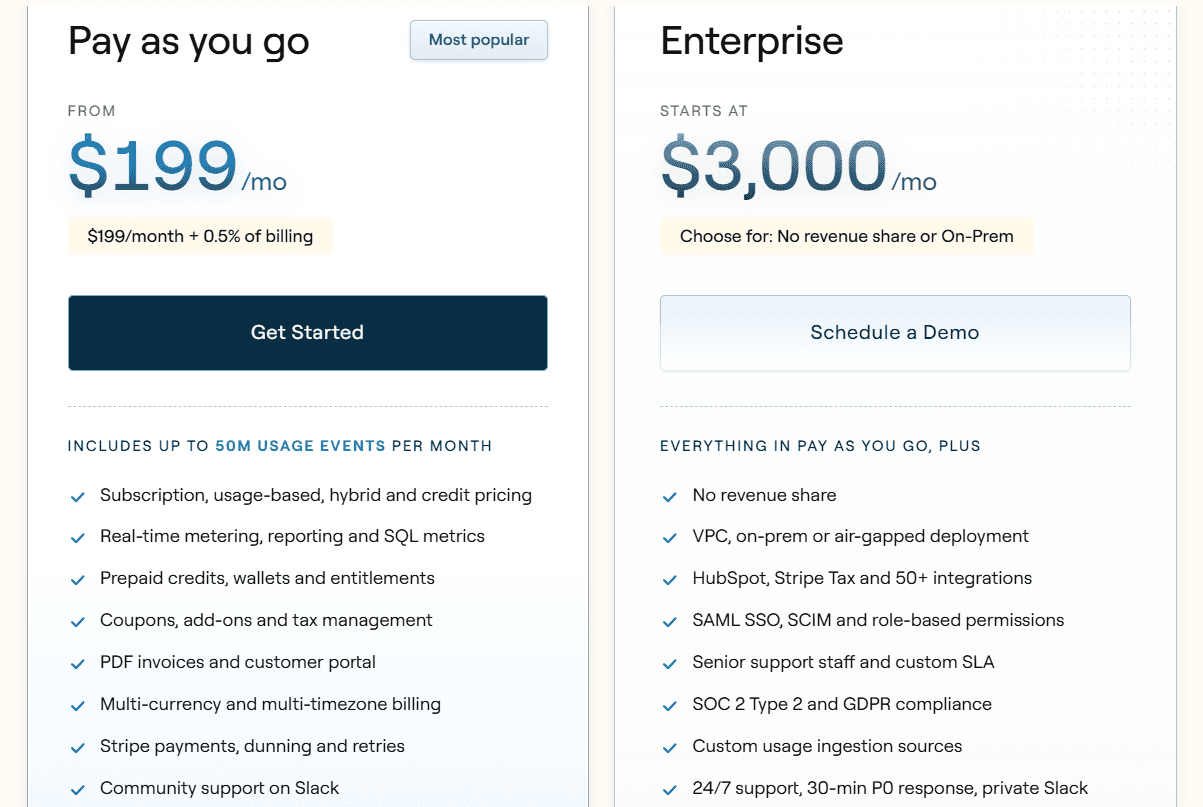
Flexprice has two pricing tiers, along with an open-source tier. Flexprice has two paid tiers:
1. Pay-as-you-go (pay $199 + 0.5% what you bill)
2. Enterprise (fixed price $3000 with no revenue share)
Best Suited For
AI and agentic companies that need usage-based, credit-based, or outcome-based billing and want full control over their billing infrastructure.
Teams that are scaling globally and need payment gateway flexibility beyond Stripe.
Companies spanning product-led self-serve to sales-led enterprise deals that do not want to pay $$$$/month before they have enterprise revenue or switch platforms when they get there.
See how Simplismart scaled to 750+ pricing features and reclaimed 30% of daily engineering bandwidth with flexprice

2. Schematic
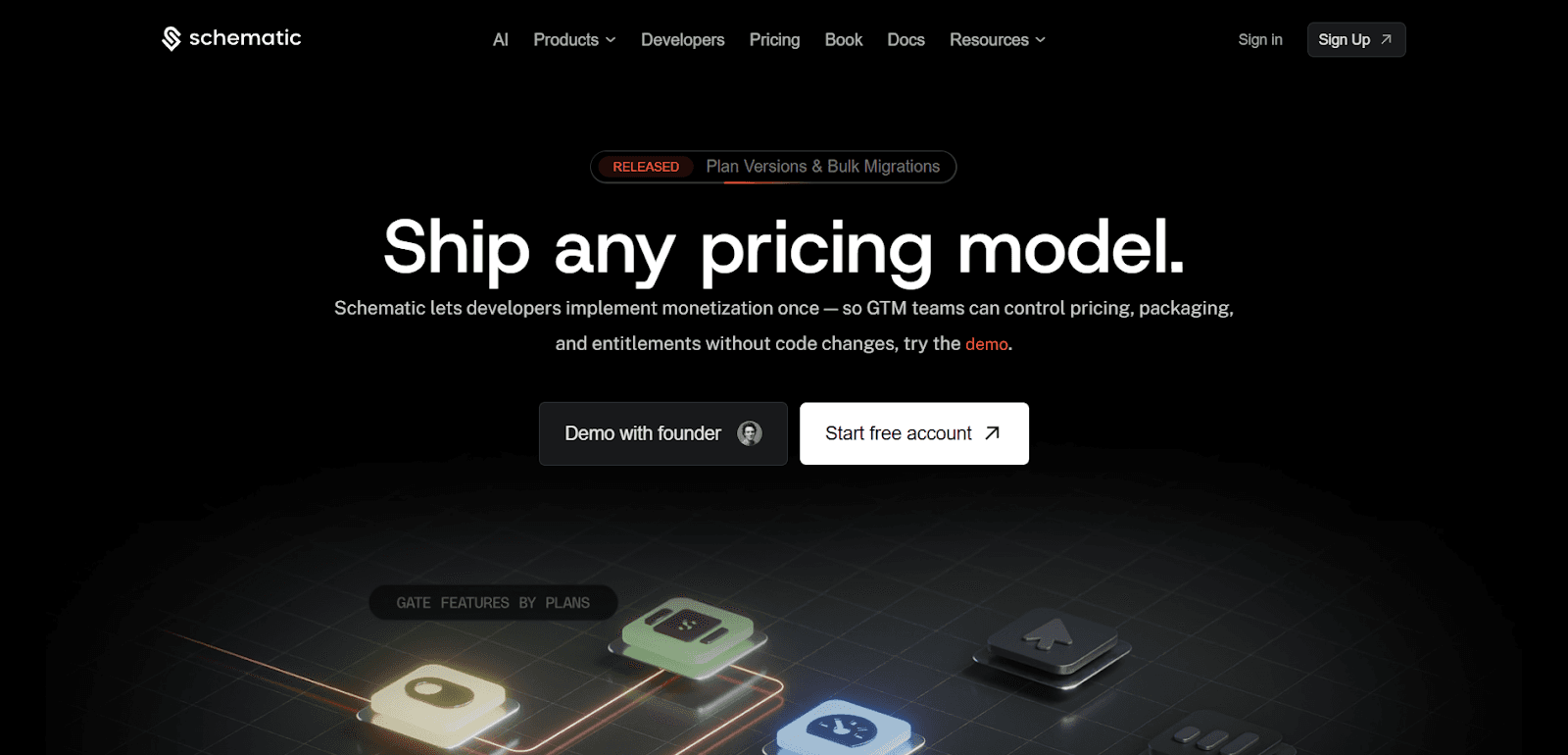
Schematic is another Orb alternative focused on entitlements and pricing logic for B2B SaaS products that sits between your application and billing system. It acts as a centralized layer that manages feature access, plan limits, usage tracking, and pricing logic while keeping payment processing in tools like Stripe.
Instead of embedding pricing rules directly into application code, Schematic provides a single system where teams can manage plans, feature entitlements, and usage limits without engineering changes.
However, Schematic is not a full billing infrastructure. It focuses primarily on entitlements and pricing logic rather than handling the entire billing stack. Teams still rely on Stripe or other billing systems for invoicing, payments, and financial workflows.
Key features
Real-time usage tracking: Captures product usage events tied to customers, allowing teams to enforce plan limits and support usage-based pricing models.
Entitlements and feature access control: Provides a centralized system to manage which users or organizations can access specific product features based on their plan or contract.
Flexible pricing and packaging: Allows teams to configure tiered plans, feature-gated packages, and hybrid pricing models without embedding pricing rules directly into application code.
Stripe-native billing integration: Works alongside Stripe, where Stripe manages payments and subscriptions while Schematic manages pricing logic, limits, and entitlements.
Pre-built monetization components: Includes ready-to-use UI elements like pricing tables, checkout flows, and upgrade paths to help teams implement monetization faster.
Who is it best for?
Schematic works best for B2B SaaS companies that want to move faster with pricing and packaging changes, especially teams running hybrid pricing models with feature gating, usage limits, and both sales-led and product-led motions.
Pricing
Schematic offers a Free plan ($0/month) for small setups with limited subscriptions and usage events. The Growth plan ($200/month) increases limits for subscriptions, events, and integrations. Enterprise pricing is custom and includes higher scale limits, advanced controls, and dedicated support.
3. Metronome (Stripe)
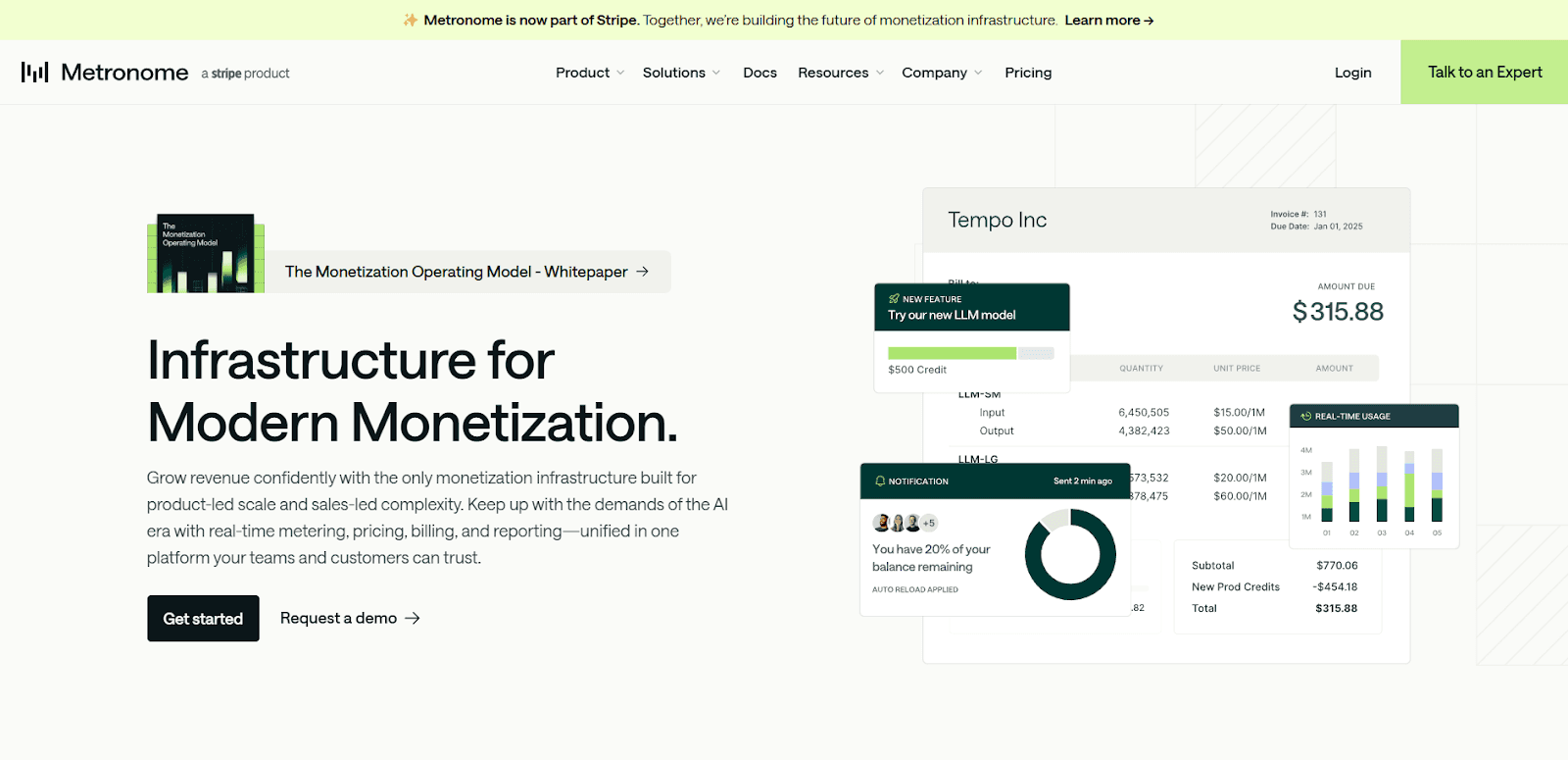
Metronome (acquired by Stripe)is a usage-based metering platform for SaaS and AI companies focused on metering high-volume usage data and turning it into invoices. As one of the alternatives to Orb, it lets teams stream events, define metrics and pricing, and then apply those rules across various pricing models.
Stripe has acquired Metronome, which means it fits most naturally within the Stripe ecosystem.
This limits flexibility for companies that want to use multiple payment gateways or avoid relying entirely on a single payment provider. Over time, this can create Stripe lock-in, making it harder for companies to switch payment infrastructure or implement multi-gateway payment strategies as they scale.
Key features
Event metering and billable metrics: Metronome ingests high-volume usage events and lets teams define billable metrics.
Flexible pricing and rate cards: It supports usage-based, subscription, and composite products, and handles tiers, minimums, overages, and dimensional pricing
Customer-facing usage and spend visibility: You can show real-time usage and spend data to your customers via dashboards, with configurable alerts and limits so that they can monitor and control consumption.
Best suited for
Best for teams that want a Stripe-native usage metering solution and plan to standardize on Stripe long-term. With Metronome now part of Stripe, it fits well inside that ecosystem, but is less suitable if you need vendor flexibility, cross-provider integrations, or frequent pricing experimentation.
Pricing
Metronome offers a free Starter plan for teams launching usage-based products. Custom enterprise pricing is available, but for that, you need to contact their sales team.
4. Chargebee
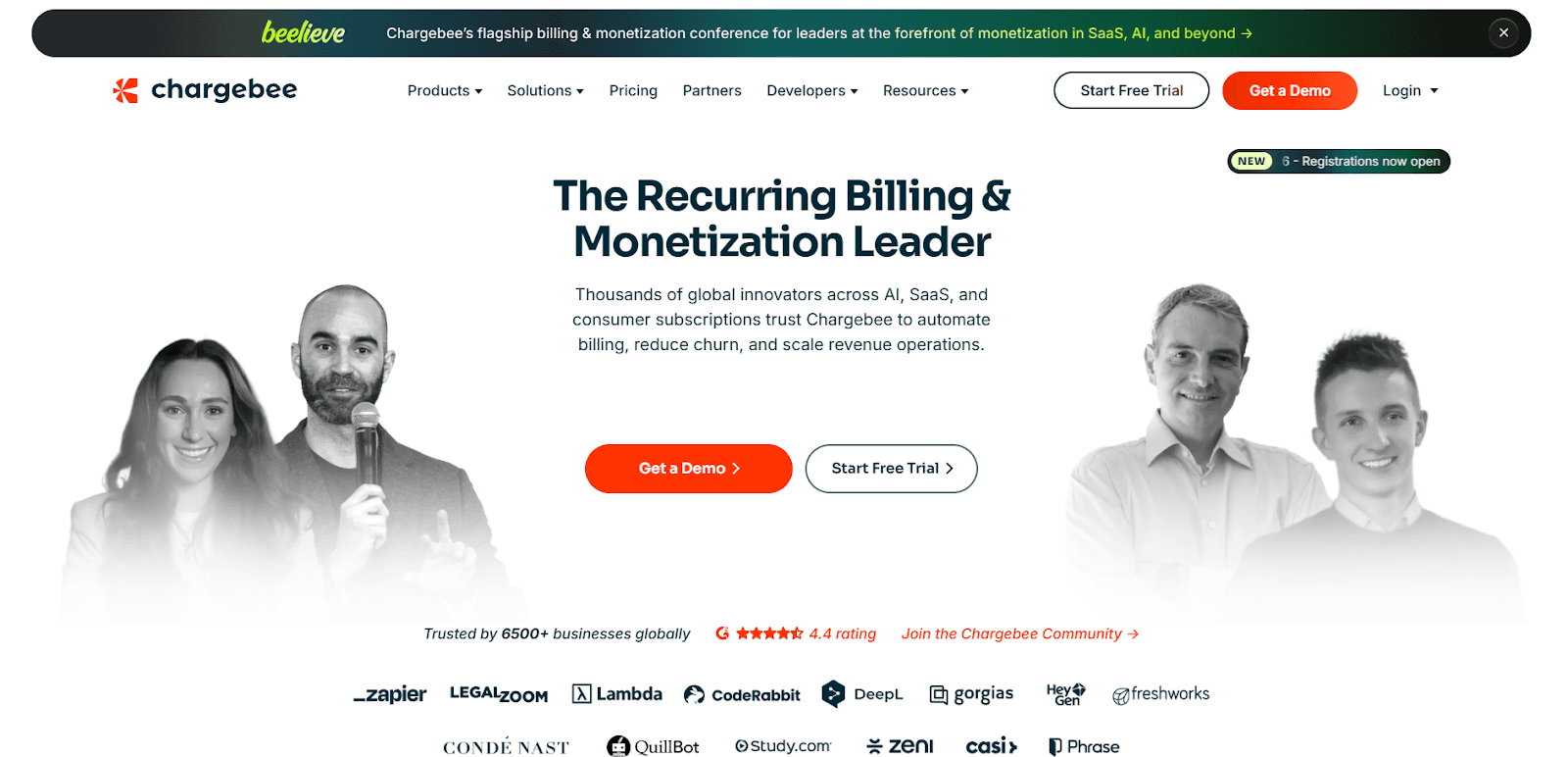
Among Orb alternatives, Chargebee is a subscription billing and revenue operations platform built primarily for SaaS companies managing seat based pricing.
Chargebee is widely adopted by mid-market and enterprise SaaS teams that operate on subscription-first models and need packaged billing workflows, revenue reporting, and integrations with CRMs and accounting systems.
While Chargebee has expanded into usage-based billing, its core architecture was built for seat-based traditional SaaS companies rather than AI-native ones. This means for AI-first products where pricing depends heavily on tokens, APIs, compute, or credits, this is where it starts to break because it was not originally built for usage-heavy monetization models.
Key features
Subscription lifecycle management: Chargebee handles trials, upgrades, downgrades, prorations, renewals, and cancellations, making it well-suited for companies running seat-based or plan-based SaaS offerings.
Hybrid billing: Supports metered add-ons layered on top of subscriptions. Teams can charge for usage, but consumption models typically operate as extensions of subscription plans rather than as first-class primitives.
Enterprise invoicing & revenue operations: Provides automated invoicing, tax handling, dunning, and integrations for revenue workflows. Commonly used alongside CRMs and accounting systems for quote-to-cash operations.
Integrations ecosystem: Native integrations with Stripe, CRMs like Salesforce, and accounting platforms such as NetSuite make it a familiar choice for enterprise RevOps stacks.
Best suited for enterprise teams that
Operate primarily on subscription-based SaaS models
Need mature invoicing and RevOps workflows
Rely heavily on CRM + accounting integrations
Run sales-led SaaS with predictable recurring revenue
Pricing
Chargebee pricing is tiered based on revenue and feature access, with enterprise plans negotiated through sales.
5. Lago
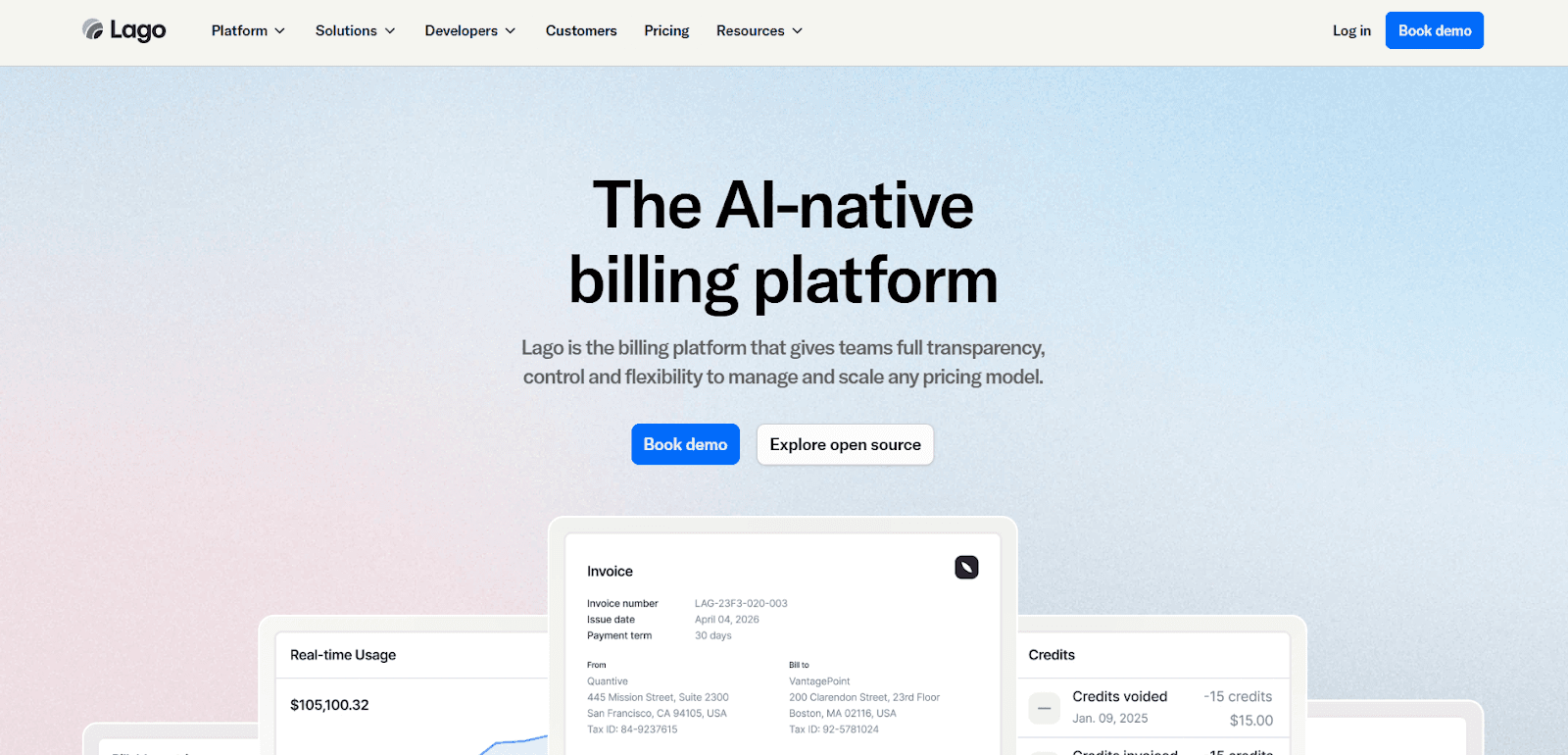
Lago is an open-source option among Orb alternatives for teams that want to self-host billing infrastructure. This makes it attractive for engineering teams that prefer managing billing inside their own stack.
However, it often falls short for companies running more complex monetization models. Lago does not support contract ramping, quote or renewal management, or account hierarchies for shared billing across organizations.
Credit workflows are also limited; there are no separate conversion rates for promotional credits, no invoice-backed checkout for credit top-ups, and no advanced balance alerts for spend thresholds.
Key features
Open-source: Lago can be self-hosted and cloud-hosted for maximum flexibility
Real-time usage tracking: You can track all the events in real-time for accurate billing
Flexible pricing: You get the flexibility to go with various pricing models to see what fits best
High-volume event ingestion: Lago can handle high volumes of events from metering to billing
Pricing
Lago offers custom pricing for its Business and Enterprise plans, depending on usage scale and deployment needs. For more information, contact their sales team.
Why Flexprice is one of the best Orb alternatives
Many teams start with usage metering platforms like Orb that focus primarily on processing usage events. But as pricing becomes more complex, many teams start evaluating Orb alternatives and eventually prioritize platforms with deeper pricing infrastructure. This is where Flexprice fits right in
Enterprise billing infrastructure built for developers
Most billing tools start as systems that convert usage events into invoices. But as pricing scales, billing becomes tightly connected to contracts, credits, and product behavior.
At that stage, billing stops being a finance-only tool and becomes core product infrastructure.
Flexprice is designed with this in mind. Instead of separating pricing logic from the product, it provides a billing architecture that engineers can integrate directly into their applications.
Usage metering, pricing configuration, credits, and invoicing operate as part of the same system rather than disconnected tools.
Because Flexprice is open-source and API-driven, teams can extend billing logic as their product grows without being constrained by rigid dashboard-based workflows.
Unified platform for usage billing, credits, subscriptions, and invoicing
Supports both consumption-based and traditional SaaS pricing models
Open-source components that allow customization and extension
APIs for integrating billing directly into product systems
Flexible architecture that adapts as pricing models evolve
Multi-PG integration capabilities
Many billing systems assume a single payment processor, which works early on but can become limiting as you scale globally. Flexprice supports multi-payment gateway integrations, allowing you to route transactions through different providers based on geography, reliability, or cost optimization.
This flexibility helps maintain control over payment infrastructure while avoiding long-term lock-in to a single processor ecosystem.
Integrate multiple payment gateways within the same billing system
Improve global payment coverage and reliability
Optimize payment performance across regions
Reduce dependency on a single payment provider
Works for both product-led and sales-led growth
Self-serve users might sign up through automated onboarding flows, while enterprise customers require negotiated contracts and custom pricing structures.
Flexprice supports both models within the same billing architecture. This allows teams to scale from early product-led growth to enterprise revenue without rebuilding billing infrastructure later.
Supports both self-serve subscription flows and custom enterprise billing setups
Custom contracts and negotiated pricing for enterprise deals
Support for account hierarchies and enterprise billing structures
Unified billing infrastructure across PLG and sales-led workflows
Built for AI native usage models
Monetization often depends on tokens, inference requests, compute time, or hybrid pricing models that combine subscriptions with consumption.
Flexprice supports these things by allowing teams to meter granular usage events and apply pricing logic across multiple consumption metrics.
This makes it easier for AI companies to align revenue with real product usage rather than forcing AI workloads into subscription-centric billing models.
Meter tokens, API calls, compute usage, and other consumption metrics
Support hybrid pricing models combining subscriptions and usage
Handle high-variance usage patterns common in AI workloads
Align pricing directly with real product consumption
Wallet first credit infrastructure
Flexprice includes a native credit wallet system that tracks credit balances through a ledger-backed architecture, ensuring both transparency for customers and auditability for finance teams.
Ledger-based wallet system for tracking credit balances
Support for prepaid balances and promotional credits
Recurring credit grants and automated top-ups
Predictable spending controls for customers
Pricing experimentation without engineering bottlenecks
Pricing rarely stays static in modern SaaS or AI companies. Teams often need to adjust pricing models, introduce new usage metrics, or experiment with packaging changes as the product grows.
Flexprice allows teams to iterate on pricing configurations without repeatedly modifying application code.
Rapid iteration on pricing models and usage metrics
Support for hybrid and consumption-based pricing structures
Ability to introduce new pricing logic without rebuilding billing systems
Safer rollout of pricing changes across customer segments
Built to handle high-volume usage events
Flexprice is built to process large volumes of usage events while maintaining deterministic billing logic and finance-ready reporting. Usage data flows through a consistent metering pipeline, ensuring that billing calculations remain accurate even as event volumes grow.
This architecture helps both engineering and finance teams maintain confidence in billing accuracy as the product scales.
Deterministic metering logic for consistent billing calculations
Scalable event ingestion for high-volume products
Finance-ready reporting and reconciliation workflows
Infrastructure designed to support growing usage workloads
Wrapping up
Usage-based billing has moved far beyond simply turning product events into invoices. As SaaS and AI products grow, pricing models often expand to include credits, prepaid balances, hybrid pricing, and contract-driven plans. At that point, billing stops being a background finance tool and starts becoming part of the product’s core infrastructure.
Orb still works well for teams that primarily need reliable usage metering and consumption billing. But when pricing models become more complex, or billing needs to integrate more deeply with product behavior, companies often start exploring Orb alternatives that offer greater flexibility and control.
Tools like Schematic, Metronome, Chargebee, and Lago each solve different parts of the monetization stack depending on whether your focus is entitlement management, Stripe-native billing, subscription workflows, or open-source deployment.
For teams building AI platforms, APIs, or usage-heavy SaaS products where pricing scales quickly, Flexprice offers a more adaptable foundation. Its developer-first architecture, credit-based billing system, and flexible pricing models make it easier to treat billing as infrastructure.
When pricing becomes part of the product, billing stops being just a tool and starts becoming infrastructure. So choose a platform that grows alongside the product rather than a system that limits how you monetize it.
What should AI companies consider before switching from Orb to another usage-based billing platform?
What are the benefits of using a specialized usage-based billing platform over a custom-built solution?
How does credit-based pricing work alongside usage-based billing?
Can usage-based billing work together with subscription pricing?
Why are credits becoming common in AI and API pricing models?