Ayush Parchure
Content Writer, Flexprice
Lago is one of the first open-source billing platforms built for usage-based pricing. It handles basic metering, event aggregation, and simple credit workflows well, and if you are getting started with open-source billing it is a solid foundation.
But as your AI or SaaS product scales, the gaps become harder to work around. Entitlements are coupled to subscriptions instead of operating as a flexible layer.
There is no parent-child account hierarchy for multi-entity billing. Pricing iteration requires creating new plans and migrating customers manually. And features like the customer portal and RBAC are gated behind the premium cloud plan rather than shipping in the open-source tier.
These are the reasons teams start looking for Lago alternatives like Flexprice that goes deeper on credits, enterprise contracts, and pricing experimentation. This guide covers the top options and where each fits depending on your billing complexity and go-to-market motion.
TL;DR
Lago is an open-source usage-based billing platform designed for event metering and developer-controlled billing infrastructure.
Many teams start with Lago for flexibility and self-hosting, but maintaining billing infrastructure can become operationally heavy as pricing models evolve.
Companies often look for Lago alternatives when they need better support for credit systems, enterprise contracts, and pricing experimentation.
Flexprice is built for AI and usage-heavy SaaS products, combining usage metering, credit wallets, contracts, and pricing configuration in one system.
Amberflo focuses on high-scale usage metering and cost governance, especially for AI and cloud workloads.
Metronome is a good option for teams that want usage billing tightly integrated with the Stripe ecosystem.
Chargebee works best for subscription first SaaS companies that need mature invoicing and RevOps workflows.
Orb provides a managed platform for developer-first usage billing with advanced pricing models.
The right Lago alternative depends on whether you prioritize developer control, AI-native pricing models, enterprise billing workflows, or Stripe-native infrastructure.
What is Lago?
Lago is an open-source usage-based billing platform designed for SaaS companies that want more control over billing infrastructure than tools like Stripe Billing typically provide. It focuses on event-based metering, where products send usage events that are aggregated into billable metrics and converted into invoices.
Teams can define custom metrics such as API calls, messages sent, or storage GB, track consumption against quotas, and apply pricing rules like overages, tiered pricing, or hybrid subscription + usage models.
The platform also includes a hosted admin dashboard for managing customers, plans, usage data, and invoices.
Because Lago is open source and self-hostable, it’s often used by developer-first companies that want to avoid vendor lock-in while maintaining control over their billing stack.
However, Lago’s architecture is primarily built around usage metering and subscription billing, which means companies with more complex monetization models, such as credit systems, flexible contract structures, or AI-specific pricing, may eventually need broader billing capabilities.
What Lago does well
Lago is widely used by teams that want a flexible billing system for event-based usage pricing. Because it is open source and built around usage events, developers can capture product activity and convert it into billable metrics without building a billing system from scratch.
This approach works well for companies running API platforms, infrastructure services, or usage-based SaaS products.
For teams evaluating Lago alternatives, it’s useful to understand where Lago performs well before deciding whether an alternative to Lago is necessary or not.
Event-based usage metering
Lago uses an event ingestion pipeline where teams send product usage events, such as API calls, compute jobs, or requests that are aggregated into billable metrics.
Open-source billing infrastructure
Lago is fully open source and self-hostable, giving engineering teams full control over deployment and billing logic while reducing vendor lock-in risk.
Support for simple usage and hybrid pricing models
Lago supports common SaaS pricing patterns like pay-as-you-go, subscription plus usage overages, tiered pricing, and volume-based billing.
Prepaid wallets and credit deductions
Companies can issue prepaid credits to customers and automatically deduct usage from those balances as product consumption occurs.
While Lago works well for these scenarios, many companies exploring Lago alternatives are usually looking for deeper monetization capabilities, especially around flexible pricing models, enterprise contracts, and advanced credit systems that go beyond basic usage billing.
When does it start to break?
As pricing strategies become more sophisticated, some companies begin to encounter limitations in how billing, pricing logic, and enterprise workflows are managed.
This is often the point where teams start researching an alternative to Lago that can support more advanced monetization patterns while reducing operational complexity.
Pricing experimentation becomes harder: Introducing new pricing metrics, packaging models, or hybrid pricing strategies often requires additional engineering work.
Credit systems for AI products become complex: AI platforms frequently rely on credit grants, token-based pricing, automated top-ups, and multiple credit pools that go beyond simple wallet deductions.
Contract ramping and negotiated pricing: Enterprise deals may involve phased pricing schedules, negotiated terms, or custom billing timelines that require more advanced contract management.
Entitlements and feature access control: Pricing frequently needs to interact with feature gating, quotas, and product access, which can be difficult to manage alongside billing rules.
Complex enterprise pricing structures: Minimum commitments, usage thresholds, and multi-layer pricing agreements can stretch basic billing architectures.
Signs you've outgrown Lago
Teams typically start looking for Lago alternatives when billing infrastructure begins affecting product flexibility or operational efficiency.
As monetization models grow more sophisticated, the billing system needs to support both engineering and finance workflows without creating additional operational overhead.
You prefer a managed monetization platform: Self-hosted systems require teams to manage infrastructure, upgrades, and reliability themselves.
Finance teams require stronger revenue controls: Audit trails, revenue recognition workflows, and compliance-ready reporting become increasingly important as companies scale.
Enterprise contracts require flexible pricing structures: Deals often involve negotiated terms, pricing ramps, and custom billing timelines.
Credit-based monetization becomes central: AI and API companies frequently rely on wallets, credit grants, token pricing, and multiple balance pools to control usage.
Account structures become more complex: B2B platforms often require parent-child accounts, shared credit pools, and consolidated invoicing across organizations.
Best Lago Alternatives for Usage-Based and Credit-Based Pricing in 2026
Flexprice
Amberflo
Metronome (Stripe)
Chargebee
Orb
Tool | Best for | Key features | Limitations |
Flexprice | AI and SaaS companies that need flexible usage billing, credits, and enterprise contract support |
| Newer ecosystem compared to long-established billing vendors and integration marketplaces. |
Amberflo | Cloud platforms and AI companies that need large-scale usage metering and cost visibility |
| Closed-source platform with no self-hosted deployment option. Enterprise contract and credit workflows are more limited. |
Metronome (Stripe) | SaaS and AI companies that want high-scale usage billing inside the Stripe ecosystem |
| Heavy dependency on Stripe infrastructure and limited flexibility for multi-gateway payment strategies. |
Chargebee | Subscription-first SaaS companies with mature revenue operations and billing workflows |
| Usage-based billing architecture is secondary to subscription models and can become complex for AI or API pricing. |
Orb | Developer-first SaaS and infrastructure companies running advanced usage-based pricing |
| Closed-source managed platform with no self-hosting option and pricing that is not publicly disclosed. |
1. Flexprice

Flexprice is enterprise-grade, open source usage based billing infrastructure for AI and SaaS companies. It can be deployed in your own VPC, on-prem, or on Flexprice's managed cloud.
While Lago mainly handles event collection and invoice creation, Flexprice serves as a complete monetization system. It integrates usage tracking, pricing setup, credit management, and invoicing into one platform.
This setup enables product teams to oversee how usage is priced, billed, and enforced without relying on multiple tools. The platform suits high-volume usage settings where billing connects closely to product activity. Teams can stream usage events like API calls, tokens, compute jobs, or feature use and turn them into billable metrics almost in real time.
This structure is especially valuable for AI products and infrastructure services with unpredictable usage patterns and frequently changing pricing models.
Flexprice also excels in its built-in credit system, setting it apart from other Lago alternatives. It features a ledger-based wallet system that tracks prepaid balances, credit allocations, and consumption across customer accounts.
This alone simplifies the implementation of credit-based pricing models that AI platforms often use, where customers buy credits and use them while running workloads or interacting with APIs.
For businesses considering an alternative to Lago, Flexprice offers better support for enterprise billing processes. Features such as hierarchical customer accounts, configurable pricing units, and integrated feature entitlements allow billing logic to connect directly with product access and contract terms. Rather than treating billing as a separate finance tool, Flexprice enables teams to handle monetization as part of their product infrastructure.
Key features where Flexprice leads Lago
MCP server / Agent-native billing
The only billing platform with a native MCP server. Connect Cursor, Claude Code, VS Code, or Windsurf directly to your billing dashboard and operate API actions through prompts. This allows developers and operators to query usage data, create plans, or manage billing actions directly from their development environment.
Outcome-based billing
Charge customers for resolved tickets, successful calls, or completed workflows instead of raw API usage. Useful for AI companies selling outcomes rather than compute. This makes pricing easier to align with measurable product value rather than infrastructure consumption.
Ramped contracts
Define pricing timelines that update automatically as contracts move from pilot stages to production phases. Pricing changes are applied on predefined dates without manual plan updates. This helps teams operationalize enterprise deals that scale usage and pricing over time.
Quotes and renewals
Built-in quote system with pricing lock-ins, approval workflows, and CRM sync with HubSpot or Salesforce included in the open-source tier. Sales teams can generate quotes and convert them into active billing configurations. This reduces manual coordination between sales, finance, and engineering.
Parent-child accounts
Parent accounts can manage multiple child accounts while maintaining separate usage visibility. This structure supports enterprise customers with multiple departments or internal teams.
Advanced credit workflows
Separate spend versus top-up conversion rates, multi-level low-balance alerts, and invoice-backed credit checkout. Companies can control how credits are purchased and consumed across different products or services. This enables structured credit monetization models commonly used in AI platforms.
Multi-pool credit and token infrastructure
Wallet hierarchies, per-model token pricing, and cross-model pricing for models like GPT-4 and GPT-4o. Different credit pools can be assigned to different workloads or product tiers. This helps teams manage multiple consumption units within the same billing system.
Pricing iterations
Version pricing plans, run staged rollouts, and test A/B pricing experiments without creating new billing plans. Historical pricing versions remain available for audit and comparison. This allows product teams to iterate on monetization strategies without breaking existing contracts.
Open-source feature completeness
Customer portal, RBAC, service accounts, CRM sync, commitment discounts, wallets, and entitlements are available in the open-source tier. Teams can deploy the full billing system without feature restrictions tied to paid tiers. This reduces dependency on proprietary feature gating.
Hybrid pricing models
Support subscription plus usage billing, committed usage contracts, and multi-metric pricing. Companies can combine fixed platform fees with variable consumption pricing. This supports SaaS models that mix recurring subscriptions with metered usage.
Full credit system
Prepaid wallets, recurring credit grants, rollover logic, real-time wallet synchronization, and automated top-ups. Credits can be issued manually or through automated billing workflows. Wallet balances update continuously as usage events are processed.
Granular usage filtering
Apply different pricing to models within the same event stream. Pricing rules can reference metadata attached to usage events. This enables multi-dimensional pricing without maintaining separate billing pipelines.
Feature entitlements
Manage feature access separately from pricing with per-customer overrides and experimentation support. Product teams can enforce limits, quotas, or feature availability directly through billing configuration. This keeps feature access synchronized with pricing plans and contracts.
Contract amendments
Maintain version history, audit trails, and renegotiation records across the lifecycle of a customer contract. Pricing changes and contract updates are recorded with timestamps and historical context. This allows finance and sales teams to track contract evolution over time.
Pros
Full-featured platform out of the box with metering, pricing configuration, credits, contracts, invoicing, and entitlements available without requiring multiple external tools.
AI-native billing architecture that supports tokens, credits, compute usage, and multi-metric pricing models commonly used in AI and API products.
No premium feature gating in the open-source tier, with capabilities like customer portal, RBAC, CRM sync, wallets, and entitlements included by default.
Native MCP server that allows developers to interact with billing systems directly from tools like Cursor, Claude Code, VS Code, or Windsurf.
Built to support complex enterprise billing workflows, including ramped contracts, hierarchical accounts, negotiated pricing structures, and hybrid monetization models.
Cons
The integration ecosystem is still growing compared to legacy billing vendors that have larger marketplaces and longer-established partner networks.
Pricing

Flexprice has two pricing tiers, along with an open-source tier.
Flexprice has two paid tiers:
1. Pay-as-you-go (pay $199 + 0.5% what you bill)
2. Enterprise (starts at $3,000/month with no revenue share)
Best Suited For
AI-native companies building APIs, agents, or model-driven products that rely on usage-based, credit-based, or outcome-based billing. Developer-first SaaS teams that want direct control over billing infrastructure instead of relying on rigid dashboards. Companies are scaling from product-led self-serve plans to sales-led enterprise deals that require contracts, credit systems, and flexible pricing models. Teams exploring Lago alternatives after hitting limits around pricing flexibility, AI billing models, or enterprise monetization workflows.
See how Simplismart scaled to 750+ pricing features and reclaimed 30% of daily engineering bandwidth with flexprice

2. Amberflo
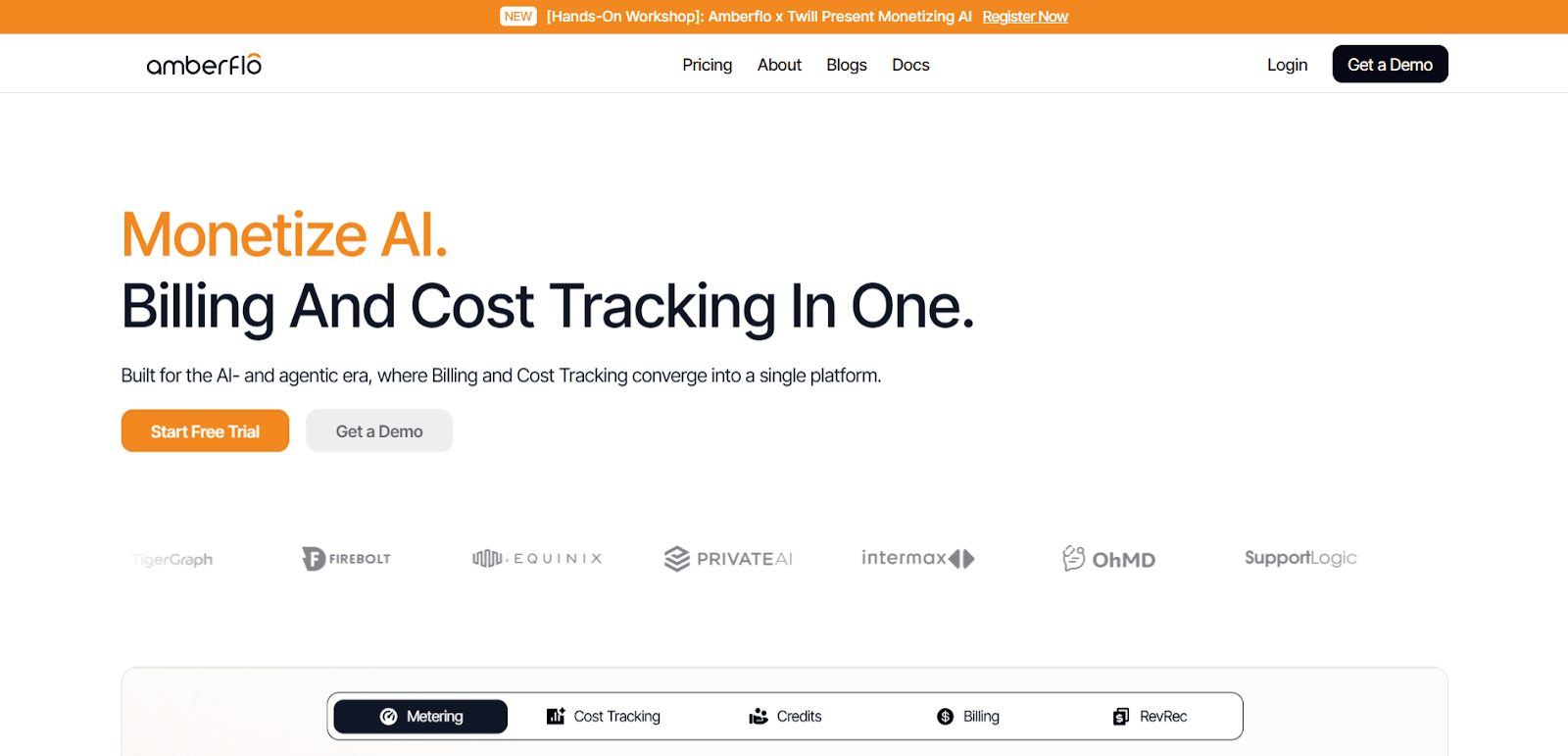
Amberflo, amongst other Lago alternatives, is a comprehensive platform for building and deploying usage-based pricing. It provides an easy way to meter usage, create flexible pricing plans, and generate real-time invoices from actual usage data. With its pre-built integrations, rich SDKs, and APIs, Amberflo makes it easy to deploy and consume usage-based pricing solutions, enabling companies to accelerate their growth.
Even with strong usage metering, Amberflo starts to show limits when billing needs to support more complex monetization models. The platform is closed-source and cloud-only, so teams cannot self-host or run billing infrastructure inside their own environment.
It also lacks capabilities like ramped contracts, multi-pool credit wallets, hierarchical accounts, and agent-native billing workflows that many AI and enterprise SaaS products require. As pricing models expand beyond simple usage billing, these gaps often push teams to consider more flexible billing platforms.
Key Features
AI Gateway and Governance: Unified gateway supporting 1,500+ LLM models with centralized access control and intelligent model routing.
Real-Time Usage Metering: Processes high-cardinality events such as API calls, tokens, and compute usage with accurate aggregation.
Flexible Pricing Models: Supports PAYG billing, prepaid credits with drawdown, and tiered usage pricing.
Automated Invoicing: Generates invoices directly from real-time consumption data.
Cost Guardrails and Budgets: Allows teams to set spending thresholds and trigger alerts for usage limits.
Pros
Real-time usage metering: Processes high-volume events with built-in deduplication and idempotency for accurate billing.
Developer-friendly APIs and SDKs: Make it easier for engineers to integrate usage metering without building custom pipelines.
Flexible pricing models: Supports pay-as-you-go, prepaid credits, and tiered usage pricing.
AI governance gateway: Provides centralized access and cost tracking across multiple LLM models.
Free entry tier: Allows startups to start metering usage before launching billing.
Cons
Narrow Product Scope: Often seen as a specialized metering and billing tool rather than a full financial platform with deeper reporting capabilities.
Usage Billing Learning Curve: Transitioning to usage-based pricing requires operational changes in sales strategy, pricing models, and revenue planning.
Limited Finance Features: Organizations needing advanced tax automation, accounting workflows, or enterprise finance tooling may require additional systems.
Organizational Stability Concerns: Some public employee reviews mention leadership and structural challenges that could influence long-term product direction.
Pricing
Plans start with a free 30-day tier supporting up to $10K billing volume and 10K events, followed by Startup ($99/month) and Growth ($599/month) plans that increase billing volume and event limits.
Best suited for
Amberflo is specifically built for modern cloud businesses and enterprises that are moving away from traditional flat-fee subscriptions toward usage-based or AI-driven business models.
3. Metronome (Stripe)
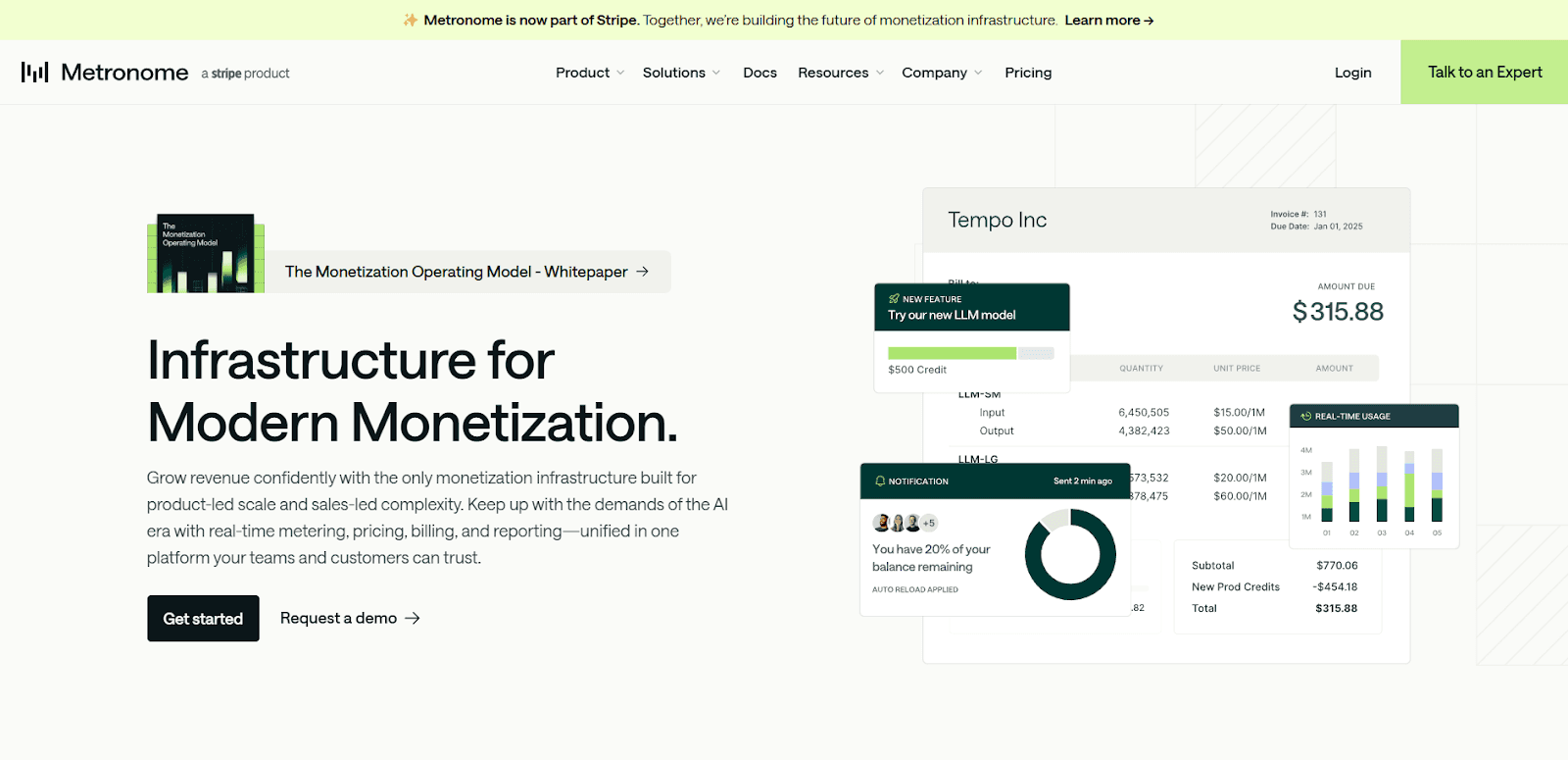
Metronome is a usage-based metering platform for SaaS and AI companies focused on metering high-volume usage data and turning it into invoices. As one of the alternatives to Lago, it lets teams stream events, define metrics and pricing, and then apply those rules across various pricing models.
Stripe has acquired Metronome, which means it fits most naturally within the Stripe ecosystem.
This limits flexibility for companies that want to use multiple payment gateways or avoid relying entirely on a single payment provider. Over time, this can create Stripe lock-in, making it harder for you to switch payment infrastructure or implement multi-gateway payment strategies as they scale.
Key features
Event metering and billable metrics: Metronome ingests high-volume usage events and lets teams define billable metrics.
Flexible pricing and rate cards: It supports usage-based, subscription, and composite products, and handles tiers, minimums, overages, and dimensional pricing
Customer-facing usage and spend visibility: You can show real-time usage and spend data to your customers via dashboards, with configurable alerts and limits so that they can monitor and control consumption.
Pros
Highly scalable usage metering: Built to process millions of usage events and track metrics like API calls, compute, or storage with high accuracy.
Developer-friendly architecture: Strong APIs and event-driven infrastructure make it easier for engineering teams to integrate billing directly into product workflows.
Flexible pricing models: Supports usage-based, hybrid, and tiered pricing structures for modern SaaS and AI products.
Strong support team: User reviews highlight responsive support and the ability of the team to understand complex processes quickly.
Cons
Engineering-heavy implementation: Integrating and maintaining metering pipelines can require significant engineering effort compared to more plug-and-play billing tools.
Focused primarily on metering: The platform is strong for usage tracking, but may require additional systems for broader finance operations.
Operational complexity with usage billing: Teams adopting usage-based pricing often face challenges around pricing strategy and cost predictability.
Pricing
Metronome offers a free Starter plan for teams launching usage-based products. Custom enterprise pricing is available, but for that, you need to contact their sales team.
Best suited for
Best for teams that want a Stripe-native usage metering solution and plan to standardize on Stripe long-term. With Metronome now part of Stripe, it fits well inside that ecosystem, but is less suitable if you need vendor flexibility, cross-provider integrations, or frequent pricing experimentation.
4. Chargebee

Chargebee is a subscription billing and revenue operations platform commonly used by SaaS companies managing recurring revenue, invoicing, and subscription lifecycles. As teams explore Lago alternatives or other billing platforms, Chargebee often appears in evaluations because of its mature subscription management features and integrations with CRM and accounting systems
However, Chargebee’s architecture is built primarily for subscription-first SaaS models. When companies begin adopting more complex consumption-based pricing or AI-native monetization, limitations start to appear.
Usage pricing is typically implemented through metered add-ons tied to subscription plans, which means pricing logic becomes distributed across plans, add-ons, and custom backend logic. For teams looking for an alternative to Lago that supports AI workloads, token pricing, or credit systems, this structure can be difficult to scale and iterate on.
Key features
Subscription lifecycle management: Handles trials, upgrades, downgrades, renewals, and cancellations for subscription-based SaaS products.
Hybrid billing support: Allows companies to combine recurring subscriptions with metered add-ons for usage pricing.
Automated invoicing and tax workflows: Generates invoices, manages taxes, and supports financial operations workflows.
CRM and accounting integrations: Integrates with tools like Salesforce, Stripe, and NetSuite for quote-to-cash processes.
Pros
Mature subscription billing platform: Well established for managing recurring SaaS subscriptions and lifecycle billing workflows.
Strong integration ecosystem: Connects with major CRM, accounting, and payment platforms commonly used by SaaS companies.
Revenue operations tooling: Supports invoicing, tax management, and financial workflows used by mid-market SaaS businesses.
Cons
No real credit wallet system: Promotional credits and credit notes exist, but there is no native wallet with recurring grants, top-ups, or per-feature credit consumption.
Complex usage pricing configuration: AI pricing models often require multiple add-ons, plans, and custom code as usage metrics increase.
Slow pricing experimentation: Pricing changes typically require duplicating plans or migrating customers rather than iterating through rules-based pricing.
No native feature entitlements: Product teams often manage feature access and limits in their own systems outside Chargebee.
Limited enterprise contract controls: Contract ramping, committed usage pricing, and per-customer pricing overrides usually require workarounds or custom logic.
Pricing
Chargebee pricing is typically tiered based on revenue and feature access, with enterprise plans negotiated through sales.
Best suited for
Best suited for SaaS companies running subscription-first revenue models that need mature invoicing, tax workflows, and CRM integrations. It works well for businesses with predictable recurring revenue, but can become restrictive for companies building AI or usage-heavy products that require more flexible monetization infrastructure or are evaluating Lago alternatives.
5. Orb
Orb is a usage-based billing platform built primarily for developer-first SaaS and infrastructure products that monetize through consumption. It focuses on ingesting product events such as API calls, compute usage, or storage metrics and converting them into billable charges in real time. Because of its event-driven architecture and flexible pricing models, Orb often appears when companies evaluate Lago alternatives or other billing tools designed for modern usage-based pricing.
However, Orb operates as a fully managed SaaS platform with a closed-source architecture and no self-hosted option. Companies cannot run the billing engine inside their own infrastructure or extend it beyond the platform boundaries. For teams searching for an alternative to Lago that provides deeper control over billing infrastructure, pricing experimentation, or deployment flexibility, this can become a limitation as products scale.
Key features
Event-based usage metering: Ingests raw usage events such as API calls, compute jobs, or storage metrics and converts them into billable usage.
Flexible pricing models: Supports tiered pricing, volume discounts, custom rate cards, and usage-based billing structures.
Credit and balance management: Provides prepaid and postpaid credit systems with support for multiple pricing units and credit pools.
Revenue simulations: Allows teams to test pricing changes against historical usage data before deploying new billing models.
Pros
Strong enterprise billing capabilities: Supports customer hierarchies, shared credits, contract commitments, and extended payment terms.
Advanced usage pricing infrastructure: Flexible charge models and real-time event processing for complex consumption billing.
Robust credit systems: Supports multiple credit pools, custom pricing units, and parent-child credit sharing.
Cons
Closed-source platform: No self-hosting option or ability to inspect and extend the billing engine.
High starting price: Plans start around $720 per month, with advanced integrations requiring higher tiers.
Limited payment gateway flexibility: Primarily built around Stripe with limited native support for regional payment providers.
No agent-native billing interface: Billing configuration must be done through the dashboard or APIs without MCP or agent workflow integration.
Pricing
Orb does not publicly list its pricing. If you want to know the cost, you need to contact the Orb sales team
Best suited for
Best suited for companies building usage-based SaaS or infrastructure products that want a managed billing platform with strong enterprise billing features and are comfortable operating inside the Stripe ecosystem while evaluating Lago alternatives.
Why is Flexprice the best Lago alternative for usage-based pricing and AI companies?
AI and API products have moved on from that simple subscription billing system, and at this time, credits, tokens, outcomes, enterprise contracts, and constant experimentation are necessary to discover the product's market fit.
This caused many platforms to run behind the usage metering, but only a few of them can support the full monetization stack required by AI companies. This was the main idea behind developing a complete billing tool like Flexprice, it give teams the ability to treat billing as part of the product architecture instead of a separate finance system.
1. Pricing iterations
Pricing is the one thing that rarely stays the same; you test the new model as the product evolves. But even a small change becomes painful for the teams, and it forces them to create duplicate plans or migrate customers manually.
Flexprice handles pricing iterations like a pro. With native price versioning, you can update a plan without breaking the one customers are already on. No messy plan duplication. You can switch your pricing plans or club more than one type of pricing model to create hybrid pricing.
Here you can update pricing while keeping previous versions intact, so existing customers remain on the plan they originally subscribed to.
It is easy to modify prices, limits, or even switch pricing models without creating duplicate plans every time a change is needed.
Gradually roll out new pricing to specific customer segments or only to new users instead of forcing changes across your entire user base.
Flexprice supports A/B pricing experiments so teams can test different pricing strategies in real conditions.
Flexprice maintains a full version history with audit trails so teams can track every pricing change over time.
2. MCP server and agent native billing
Flexprice is the first billing platform to ship with a native MCP server. This means developers can operate billing infrastructure through AI coding agents in the same way they interact with code. Tools like Cursor, Claude Code, VS Code Copilot, Gemini, or Windsurf can connect directly to the billing system and perform operational tasks through prompts instead of manual configuration.
Connect coding agents directly to the billing system through a native MCP server
Execute billing actions through prompts instead of navigating dashboards
Perform tasks like creating subscriptions, managing wallets, issuing invoices, or updating entitlements through MCP tools
Align billing workflows with AI-native development environments used by engineering teams
Lago does not support MCP servers or agent-native billing workflows
3. Outcome based billing
The old gen billing platforms charge you for usage volume, such as API calls and tokens, but Flexprice enables you with outcome-based billing so that you can price based on the results their product delivers. This approach allows pricing to be easier and aligns revenue with real customer value.
Charge customers for completed workflows instead of raw infrastructure usage
Bill based on resolved support tickets, successful API calls, or finished AI tasks
Support pricing models where value comes from outcomes rather than token consumption
Align billing with business results that customers actually care about
4. Enterprise contract modeling without custom builds
Enterprise pricing rarely follows a single flat plan. Deals often include phased pricing, commitments, and negotiated terms that change over time. Flexprice includes native tools for handling these contracts without forcing teams to build custom workflows or rely on spreadsheets.
Ramped contracts automatically update pricing as deals move from pilot to production phases
Built-in quote system with approval workflows and CRM synchronization with HubSpot or Salesforce
Committed usage pricing with configurable overage multipliers and automated true-up logic
Contract amendments tracked with full version history and audit trails
5. AI native credit and wallet infrastructure
AI products often rely mostly on credit systems so that token consumption and usage pricing can be managed efficiently. Flexprice makes this task easy for you with a wallet and credit infrastructure designed specifically for these models rather than adapting traditional SaaS billing.
Multiple credit pools with wallet hierarchies for different products or AI models
Dynamic token pricing for different models within the same usage stream
Separate conversion rates for purchased credits and promotional campaigns
Low-balance alerts with configurable thresholds and webhook notifications
Automatic wallet replenishment when invoices are paid
Credit balances can directly control feature access at runtime
6. Parent child accounts and credit pooling
You don't see enterprise customers operating in a single account. Large organizations require multiple departments or subsidiaries that share budgets but need separate usage visibility.
To separate usage visibility, Flexprice supports hierarchical account structures
Parent-child account hierarchies for multi-team and multi-entity organizations
Credit sharing across departments or business units
Consolidated invoice rollups for enterprise customers
Suitable for reseller platforms and companies managing multiple subsidiaries
7. Faster pricing iteration for AI teams
AI products can grow rapidly, and this leads to a change in pricing as teams experiment with monetization models.
Here, Flexprice allows teams to modify pricing structures without rebuilding plans or migrating customers.
Native pricing versioning that allows teams to update live plans
Staged rollouts to introduce pricing changes gradually across customer segments
A/B pricing experiments for testing different monetization strategies
Full version history with audit logs for every pricing change
Ability to switch pricing models without breaking existing subscriptions
8. Open source feature completeness
A crucial mistake most of the billing platform makes is that they restrict advanced capabilities behind premium tiers.
To counter this approach, Flexprice allows you to ship the full platform in its open-source edition so that teams can run the same feature set without artificial limits.
Customer portal included for self-serve billing visibility
RBAC and service accounts are available without paid upgrades
CRM integrations with HubSpot and Salesforce are included
Wallets, entitlements, and customer hierarchy are available in the open-source platform
Cloud offering focuses on hosting and support rather than locking in features
9. Managed infrastructure option
This makes Flexprice a unique choice because they give teams the choice between operating their own billing infrastructure or using a managed deployment.
This flexibility allows companies to control their architecture while still reducing operational overhead when needed.
Self-host the full platform on your own infrastructure
Run a managed cloud deployment without operating the billing stack
Avoid maintaining complex billing pipelines or infrastructure tuning
Keep engineering teams focused on building the product rather than maintaining billing systems
Wrapping up
Lago can be a good option for teams that want open source billing infrastructure and full control over their metering pipeline.
But as the pricing models start becoming more complex, many realize that running billing infrastructure is very different from running a product. Because running experiments takes longer, contracts require custom logic, and credit systems or AI pricing models quickly stretch the limits of a metering-focused platform.
That is usually the point where teams start looking seriously at Lago alternatives. We can see in this list that each platform solves a problem in a different way.
Amberflo focuses heavily on metering and AI cost governance. Metronome is a strong option for companies committed to the Stripe ecosystem. Chargebee works well for subscription-first SaaS companies with mature RevOps workflows. Orb provides a powerful managed platform for enterprise usage billing.
But for AI companies and modern SaaS platforms, where pricing, credits, and product behavior are tightly connected, this is where Flexprice offers the most complete approach.
It brings usage metering, credit infrastructure, enterprise contracts, and pricing experimentation into one platform so teams can focus on building their product instead of maintaining billing systems.
Products grow quietly, pricing grows with friction. The right billing system is the one that lets the first happen without the second.
What should AI companies consider before switching from an open-source billing platform like Lago to a managed solution?
How does lago compare to stripe billing for complex metering and subscription management?
Which billing platforms support credit-based pricing for AI and SaaS products?
Which billing solutions work best for generative AI startups with variable compute costs?
What are the top Lago alternatives for usage based pricing in 2026?