Table of Content

Table of Content

How to Choose Between Usage-Based Pricing and Subscription Pricing Before You Lock Yourself Into the Wrong Model

How to Choose Between Usage-Based Pricing and Subscription Pricing Before You Lock Yourself Into the Wrong Model

How to Choose Between Usage-Based Pricing and Subscription Pricing Before You Lock Yourself Into the Wrong Model

How to Choose Between Usage-Based Pricing and Subscription Pricing Before You Lock Yourself Into the Wrong Model

Feb 20, 2026

Feb 20, 2026

Feb 20, 2026

• 24 min read

• 24 min read

Ayush Parchure

Content Writing Intern, Flexprice

Critical Features to Look for in The Automated Billing Software For AI And SaaS

Everyone's moving to usage-based pricing. OpenAI, Anthropic, that new AI tool that just hit Product Hunt, does it. And if you're still on subscription-based pricing, there's a nagging feeling you're already behind, that you're leaving growth on the table by charging a flat fee in a world that's clearly moving toward pay-for-what-you-use.

But then you think about the sales call. The prospect asks, "So what will I actually pay this month?" and you don't have a clean answer. With usage-based pricing, you never do. Variable bills make buyers nervous. Nervous buyers stall. Stalled deals don't close.

So you're stuck, subscription-based pricing feels safe but dated, usage-based pricing feels modern but risky. 

The good news is you don't have to guess. Here's how to figure out which pricing model is actually right for your business.

One wrong move and you're stuck in a loop of rewriting contracts, rebuilding billing logic, and having awkward conversations with customers months from now. Yikes, no one wants that!

This isn't just another generic pros and cons list. 

We're going to walk you through every parameter that actually matters for your use case, like customer behavior, revenue predictability, implementation complexity, and expansion potential, so by the end, you'll know exactly which model fits your business. No guesswork. Just a clear framework to make the call with confidence.

TL;DR

  • Usage-based pricing monetizes consumption; subscription pricing monetizes access.

  • Use usage-based when value and cost scale with activity 

  • Use a subscription when the value is stable, and customers need budget predictability 

  • Usage-based drives automatic revenue expansion but reduces forecast predictability.

  • Subscription provides stable recurring revenue but requires manual upgrades.

  • Spiky or unpredictable usage → usage-based fits better.

  • Stable, forecastable usage → subscription fits better.

  • Usage-based requires strong metering, aggregation, and billing infrastructure.

  • Subscription is simpler to implement and manage operationally.

  • Horizontal growth (more seats) → subscription aligns naturally.

  • Vertical growth (more processing/workload) → usage-based aligns naturally.

  • Many AI/SaaS companies adopt hybrid models to combine predictability with scalable revenue.

  • The real risk isn’t choosing wrong; it’s locking into a billing infrastructure that prevents flexibility.

What Is Usage-Based Pricing?

Usage-based pricing, also known as pay-as-you-go pricing, is a model where customers pay according to their usage. The metric that is used to measure usage corresponds to how the customer can extract value from the product. 

Looking at current scenarios, we can see that usage-based pricing has become a prominent choice for customers within AI and SaaS, which is now replacing traditional subscription and seat-based pricing models.

How it actually works

  • Users start using the product without preloaded limits, and usage is tracked continuously. At the end of the billing cycle, customers receive an invoice based on the total consumption recorded during that period.

  • Charges are calculated using concrete units such as API calls, data stored, compute time, or events processed. As usage increases or decreases, costs scale proportionally, creating a direct link between consumption and spending.

  • Because billing follows usage, customers pay more during high-activity periods and less when usage drops. This makes usage-based pricing transparent, but can also introduce variability in monthly spend.

To get more information regarding the pay-as-you-go model, you can see how Simplismart scaled to 750+ pricing features and reclaimed 30% of daily engineering bandwidth with flexprice

Core usage metrics

These usage metrics define what customers actually pay for. It tells in which direction your revenue will scale and how you can make your billing more predictable. 

For AI and SaaS products, it acts like a unit that measures usage around every aspect of the product, like the number of API calls, tokens, compute time, storage used, and events triggered. 

  1. API calls

It actually measures every request or service your product makes using an API, and it is used because API calls are simple, discrete, and easy to meter in real time. They’re widely used for developer platforms, integrations, and backend services.

  1. Tokens processed

It is used in the measurement of the volume of text (input + output), which is processed by AI models, and then it is typically broken into tokens. 

Tokens are the unit that directly correlates with model inference cost, making this one of the most accurate value metrics for AI-native products. It works best for LLM-powered apps, chatbots, and content generation tools.

  1. Compute time

With the help of this metric, we can find the actual processing time that is consumed by workloads, and it is often tracked in seconds, minutes, or GPU hours. 

Compute time maps closely to infrastructure spend, especially for AI inference, training, and data processing pipelines. It is commonly used for AI infrastructure platforms, video/audio processing, and large-scale analytics.

  1. Storage used

We can accurately find how much data is stored over time, which is mostly measured in GB/month. It is used because storage is persistent and predictable, making it an easy add-on metric for many AI and  SaaS platforms. It is used across many platforms, like file-based products and data platforms.

  1. Events triggered

It is a discrete action inside your product; you can think of it as messages sent, workflows executed, or jobs completed. 

Event-based pricing closely reflects customer activity and business outcomes, making it intuitive for many workflow-driven tools. It is best for automation platforms, product analytics, and event-driven systems.

Types of usage-based pricing models

  1. Pure pay-as-you-go

Customers pay strictly for what they consume, with no upfront commitment, minimum spend, or bundled allowances. Billing happens after usage, and costs scale linearly with consumption. 

Example: Amazon Web Services (AWS) offers services like EC2, S3, and Lambda charge per second, per request, or per GB used, making it a canonical pay-as-you-go model.

  1. Tiered usage pricing

Per-unit prices decrease as usage crosses predefined thresholds. Customers pay more at lower volumes and receive discounted rates as their usage grows. 

Example: AssemblyAI (enterprise tiers) offers lower effective rates for customers processing large volumes of audio through negotiated tiers.

  1. Volume pricing

A single unit price applies to all usage based on the total volume consumed in a billing period. Once a customer reaches a certain volume tier, that rate is applied uniformly. 

Example: Zapier uses this to incentivize users to automate more tasks, lowering the cost per task as the volume increases.The higher the subscription tier and volume of tasks a customer commits to, the lower the cost per individual task. This encourages users to consolidate all their automation needs.

  1. Base+overage

Customers receive a base allowance included in their plan. Once that allowance is consumed, access does not become unlimited by default. Instead, customers can either purchase additional usage credits, upgrade to a higher tier, or wait until their next billing cycle for credits to reset. 

Example: Ahrefs Plans include monthly crawl credits and usage limits. When limits are reached, users must upgrade or wait for renewal rather than receiving unlimited access.

Benefits of usage-based pricing

  1. Lower barrier to entry

This model minimizes upfront costs so that customers can start small and scale according to their needs. This enables them to adopt the product without committing to high fixed fees.

  1. Greater pricing flexibility

Because pricing scales with actual usage, you can serve a wide range of customers from individual users to large enterprises, without forcing them into rigid plans. Usage data also helps teams continuously refine pricing to better match customer behavior.

  1. Improved customer retention

When customers pay only for what they use, pricing feels fair and transparent. This stronger alignment between cost and value builds trust, increases satisfaction, and reduces churn over time.

  1. Supports natural account expansion

As customers grow and derive more value from the product, usage increases organically. Revenue expands alongside adoption.

  1. Faster product adoption

They can start using your products immediately without any contracts or commitment to large fixed fees. This shortens sales cycles, accelerates onboarding, and removes friction for developers and early-stage teams who want to test real workloads before scaling.

  1. Stronger product feedback loops

Every unit of usage is measurable. This gives product teams continuous, real-world feedback on which features drive adoption and revenue. High-usage surfaces become clear investment priorities, while low-usage features are quickly exposed.

Drawbacks of usage-based pricing

  1. Unpredictable invoices

Usage-based pricing often leads to surprise bills when demand spikes or experiments run long. Even when customers get more value, sudden cost jumps feel like a loss of control. Finance teams escalate, trust erodes, and what started as “fair pricing” becomes invoice anxiety. 

  1. Unclear budgeting for customers

Because spending fluctuates month to month, forecasting becomes uncertain. CFOs struggle to commit budgets, and procurement pushes back on open-ended contracts. Customers start limiting usage not because they don’t need the product, but because they need predictability. 

  1. Pricing discourages product exploration

When every action has a visible cost, users become defensive. Experiments are slow, features are avoided, and engineers build workarounds to reduce metered events. Instead of driving growth, pricing starts acting like a tax on innovation.

  1. Usage doesn’t always equal value

High usage can signal inefficiency, not success, while low usage may still power mission-critical outcomes. When pricing tracks raw consumption instead of perceived value, customers start questioning fairness.

  1. Revenue becomes harder to forecast internally

While customers struggle with budgeting, so do vendors. Because revenue fluctuates with customer activity, finance teams lose the predictability of fixed subscriptions. 

Forecasting becomes probabilistic instead of deterministic, making cash flow planning, sales targets, and capacity planning harder.

What is subscription-based pricing?

Subscription pricing is a traditional style model where customers pay recurring fees at regular intervals. It allows customers to subscribe to a vendor’s offerings for a specific period of time in exchange for an agreed-upon set price. This pricing model is commonly used in various industries, including SaaS, cloud computing, media streaming, and subscription boxes. 

The subscription pricing model provides customers with ongoing value as they can continuously use the product or service over an extended period instead of making a one-time purchase. It offers several benefits, such as affordability, flexibility, and convenience for customers, as they can access the offering without the need for a large upfront investment. 

How it actually works

  • Customers choose a subscription plan that suits their needs and sign up, often providing payment details up front. This initiates the subscription, and customers are usually charged immediately for the first billing cycle.

  • After the initial payment, customers are charged regularly on a monthly, quarterly, annual, or at another interval specified by the service. The recurring payment ensures continued access to the service or product.

  • Subscribers gain access to the product or service as long as their subscription is active. This access is often continuous and uninterrupted, as long as the customer continues to pay the subscription fee.

  • Subscriptions continue with automatic renewals until the customer decides to cancel. Customers can typically manage their subscription preferences through a user portal and decide whether to upgrade, downgrade, or cancel entirely.

Types of subscription pricing models

  1. Flat-rate pricing

Customers pay a single fixed fee for full product access, regardless of usage or team size. This model prioritizes simplicity and predictable billing, making it attractive for small teams that want straightforward pricing without feature gates. Example: Basecamp offers a flat monthly price for unlimited users and projects under one account.

  1. Tiered plans

Pricing is organized into multiple tiers, like starter, pro, and enterprise, with each level unlocking more features, capacity, or support. This allows companies to serve different customer segments while encouraging upgrades as needs grow. Example: Notion uses tiered plans that scale by features, permissions, and collaboration capabilities.

  1. Per-user pricing

Customers are charged based on the number of active users (seats). Revenue grows as teams expand, making this model popular for collaboration and internal productivity tools. Example: Slack charges per active user per month, with costs increasing as organizations add teammates.

  1. Module-based pricing

Instead of bundling everything into one plan, products are sold as separate modules or clouds. Customers only pay for the functionality they need, enabling highly customized enterprise deployments. Example: Salesforce sells distinct products like Sales Cloud, Service Cloud, Marketing Cloud, etc., that customers purchase independently based on their requirements.

Benefits of subscription pricing 

  1. Continuous revenue stream 

Instead of relying solely on one-time purchases, companies generate recurring revenue on a regular basis, which can lead to more stability and better financial planning.  

  1. Data and insights 

Through subscription data, companies can analyze customer behavior, preferences, and usage patterns, enabling them to personalize offerings, tailor marketing efforts, and make data-driven business decisions. 

  1. Increased customer lifetime value

Retaining customers for longer translates to a higher CLTV. Subscription models encourage repeat purchases and continued engagement, maximizing the revenue generated from each customer over time. Loyal customers are also more likely to try new products or services offered by the business.

  1. Reduced customer acquisition costs 

Acquiring new customers is generally more expensive than retaining existing ones. By focusing on customer retention through a subscription model, businesses can significantly reduce their CAC and improve profitability.

  1. Scalability and growth

Subscription-based models’ predictable revenue and customer loyalty make it easier for businesses to scale and grow. With a stable foundation, businesses can confidently invest in expansion, new product development, and market penetration.

Drawbacks of subscription pricing

  1. Heavy users may be underpriced

Subscription plans charge fixed amounts regardless of consumption. Power users can generate significantly higher compute, storage, or support costs while paying the same as light users. This directly compresses margins.

  1. Light users may feel overcharged

Customers with minimal usage still pay full subscription fees. This creates a sense of unfairness and increases churn risk, especially for small teams or early-stage users. Where the funds are limited.

  1. Limited automatic expansion revenue

Revenue does not grow automatically with usage. Expansion requires manual upgrades, more seats, higher tiers, or sales intervention. This prevents continuous, product-led revenue growth.

  1. Weak alignment with infrastructure cost

Infrastructure expenses rise with customer activity, but subscription revenue remains flat unless plans change. This breaks cost-to-revenue alignment, especially for AI and usage-heavy products.

  1. Packaging complexity over time

To capture more value, companies add tiers, limits, feature gates, and bundles. Pricing becomes harder to manage and explain. Internal complexity increases steadily.

  1. Revenue growth depends on upgrades and renewals

Without usage-based expansion, revenue increases happen only through renewals, seat growth, or tier changes. Missed renewals directly impact topline growth.

Usage-based pricing vs. subscription-based pricing

Now that we’ve covered the strengths and limitations of both pricing models, it’s time to compare them directly. The table below breaks down how each model differs across different parameters

Parameter

Usage-Based Pricing

Subscription Pricing

Revenue predictability

Fluctuates month-to-month based on customer activity. Hard to forecast, especially early on. Finance teams struggle with projections.

Fixed recurring revenue. You know exactly what to expect each month. 

Revenue expansion

Grows organically as customers use more; no sales call needed. Revenue scales automatically with customer success for self-serve customers

Requires active intervention. Growth comes from new customers or convincing existing ones to upgrade tiers. Most customers stay on the same plan for months/years.

Customer activation

Low barrier to entry. Customers can start free/cheap and scale as they grow. Easier to convert initially.

Higher friction at signup. The customer pays upfront before seeing the value. A bigger commitment is required to start.

Time-to-value

Best for products like APIs, LLM calls, and image generation. Customers see value immediately and pay as they go.

Works better for complex products with longer onboarding. Upfront payment creates psychological commitment that drives adoption.

Freeloading risk

Lots of low-usage customers who try forever without converting to meaningful revenue.

Customers either commit and pay, or they don't sign up. It’s a binary decision.

Implementation complexity

Significantly harder. Requires real-time metering infrastructure, accurate aggregation, idempotency, and handling edge cases (partial months, refunds, credits). Billing logic deeply coupled to your app.

Relatively simple. Just need plan tiers, feature flags, and access control. Billing lives in the payment provider.

Technical requirements

Need a custom metering system, event tracking, rate limiting, and real-time calculations. Can't rely on Stripe alone, need infrastructure like Flexprice, Metronome, or custom build.

Standard payment integration. Webhook handling for subscription events. Minimal custom infrastructure needed.

Customer psychology

Feels fair, pay only for what you use. But customers fear bill shock and usage anxiety. Can lead to over-optimization that reduces your revenue.

Feels safe, customers know exactly what they'll pay. But heavy users feel ripped off, light users feel great.

Pricing changes

Harder to raise prices. Customers watch every bill and will notice it immediately. Need to communicate unit price changes carefully.

Easier to grandfather existing customers and raise prices for new signups. Annual plans lock in pricing for 12 months.

Best for (product type)

APIs, LLM/AI inference, compute/infrastructure, developer tools, products with spiky/seasonal usage, horizontal scaling (more data = more value).

Workflow tools, productivity apps, SaaS with steady usage, products requiring long onboarding, and mission-critical tools that need to always be on.

Best for (customer type)

Developers, technical buyers, and SMBs are comfortable with variable costs, customers with unpredictable/growing usage patterns.

Enterprises needing budget certainty, non-technical buyers, customers with predictable usage, and teams that want all you can get access.

Customer support load

Constant questions about why my bill is $X this month? Requires detailed usage breakdowns and transparency.

Customers know what they're paying. Support questions are about features, not billing surprises.

Downsell risk

Always present. Customers can reduce usage anytime, and your revenue drops immediately. No contract holds them.

Lower. Customers are locked into monthly/annual terms. Downgrades only happen at renewal or with explicit plan changes.

Which pricing model is right for your business?

After reviewing the core differences between usage-based pricing and subscription pricing, we now have a clear understanding of how each model operates. 

The real question, however, is which one aligns best with your product, cost structure, and customer behavior. Let’s examine the key factors that determine which pricing model is the right fit for your business. 

  1. Value delivery pattern

Does customer value stay relatively constant over time, or does it increase as usage increases?

Your answer determines whether subscription-based or usage-based pricing fits your product.

You can think of it as a gym membership versus an electricity bill. 

A gym charges a flat monthly fee whether you visit three times or thirty. But on the other hand, electricity bills are based on exactly how much you consume. Software works the same way.

When the value is stable, you go with subscription-based pricing.

Subscription pricing works best when customers receive continuous access to a product, and value doesn’t materially increase with every action. 

Once users are onboarded, they benefit from having the tool available at all times, even if daily activity fluctuates.

Characteristics

  • Customers rely on ongoing access rather than variable usage

  • Daily activity may fluctuate, but perceived value stays consistent

  • The product becomes embedded in business operations

When value scales with activity, you need to think about usage-based pricing.

Usage-based pricing is suitable when every unit of activity directly delivers value. Customers get more benefits as they make more API calls, process more data, or run more compute.

Here, pricing tracks consumption because value and cost both increase with usage.

Characteristics:

  • Each action produces measurable customer value

  • Infrastructure costs rise with customer activity

  • Customers naturally start small and expand over time

  • Revenue scales automatically as usage grows

  1. Usage predictability

Another critical factor in choosing a pricing model is usage predictability. Can customers reliably estimate how much they’ll use your product each month?

If usage is consistent and easy to forecast, fixed subscriptions make sense. If usage varies significantly or comes in bursts, usage-based pricing is the more practical option.

If you’re seeing stable usage, think subscription pricing.

Subscription pricing works best when customer activity follows a predictable pattern. Teams know roughly how many users they’ll have and how often the product will be used. 

This makes fixed monthly or annual contracts easy to justify internally. Finance teams prefer subscriptions because costs remain consistent regardless of short-term changes in activity.

Characteristics:

  • Customers can forecast usage with reasonable accuracy

  • Product access is continuous and required regardless of daily volume.

  • Budgets are planned quarterly or annually.

  • Buyers prioritize cost certainty over granular optimization.

  • Usage does not spike dramatically from month to month.

If you have low or spiky usage, think about usage-based pricing

Usage-based pricing is better suited for products where consumption is variable, unpredictable, or event-driven. 

Customers may have quiet periods followed by sudden bursts of activity, making fixed subscriptions inefficient. Here, charging based on actual usage prevents customers from paying for idle capacity.

Characteristics:

  • Monthly consumption varies significantly

  • Activity depends on external demand or workloads

  • Customers cannot accurately predict usage in advance

  • Paying a flat fee would result in frequent overpayment

  • Infrastructure costs rise only when customers are actively using the product

  1. Buyer psychology

Beyond product mechanics and cost structure, pricing decisions are heavily influenced by buyer psychology, specifically, how customers prefer to think about spending. 

Some buyers prioritize cost certainty. Others prioritize fairness and efficiency. This mindset plays a direct role in whether subscription or usage-based pricing feels natural.

If you’re seeing fixed cost preference, lean towards subscription pricing.

Subscription pricing works best for buyers who value budget stability over optimization. These customers prefer knowing their exact spend in advance, even if that means occasionally paying for unused capacity. This mindset is common among finance-led organizations and operational teams that plan budgets quarterly or annually.

Characteristics:

  • Buyers want a fixed monthly or annual expense

  • Budgets are approved ahead of time and rarely adjusted mid-cycle

  • Predictability matters more than granular cost efficiency

  • Procurement favors contracts with predefined pricing

  • Teams prefer always-on access without monitoring usage

If it’s Pay-for-what-you-use, then think of usage-based pricing.

Usage-based pricing fits buyers who prioritize cost alignment with actual consumption. These customers care about paying in proportion to activity and avoiding charges for idle capacity.

This mindset is common among technical teams and organizations operating variable workloads.

Characteristics:

  • Buyers want spending to reflect real usage

  • Teams actively optimize infrastructure and operating costs

  • Monthly demand is unpredictable or workload-driven

  • Customers expect pricing to scale with activity

  • Paying for unused capacity feels inefficient

  1. Product complexity

You need to ask yourself whether my product delivers value through a single core capability or across multiple dimensions. Because a simple product will price cleanly, whereas a complex product doesn’t.

Single core feature → subscription pricing

Subscription pricing works best when your product is centered around one primary value driver. Customers mainly pay for access to a capability, and usage variations don’t meaningfully change the value they receive. In these cases, fixed pricing keeps billing simple and easy to understand.

characteristics:

  • One dominant feature or workflow defines product value

  • Customers mainly care about access

  • Pricing can be expressed in seats, tiers, or feature bundles

  • Billing logic remains straightforward

Multiple dimensions → usage-based or hybrid pricing

When products combine multiple cost and value drivers, subscriptions alone struggle to capture real usage. If customers consume APIs, generate compute load, store data, and add users simultaneously, a single flat price no longer reflects reality. Here, usage-based or hybrid models provide better alignment between pricing, customer value, and infrastructure costs.

Characteristics:

  • Value comes from several dimensions, like API + storage + compute + seats

  • Infrastructure costs rise with customer activity

  • Different customers use different parts of the product unevenly

  • Pricing must adapt to how customers actually consume the product

  1. Growth motion

Before picking a pricing model, take a step back and look at how customers actually grow inside your product. Ask them, six months after they signed up, what changed? Did they add more teammates? Did they run more jobs? Or did both happen?

That answer tells you how your product grows, and it matters more than any pricing theory. Most of the successful accounts follow one of three growth patterns.

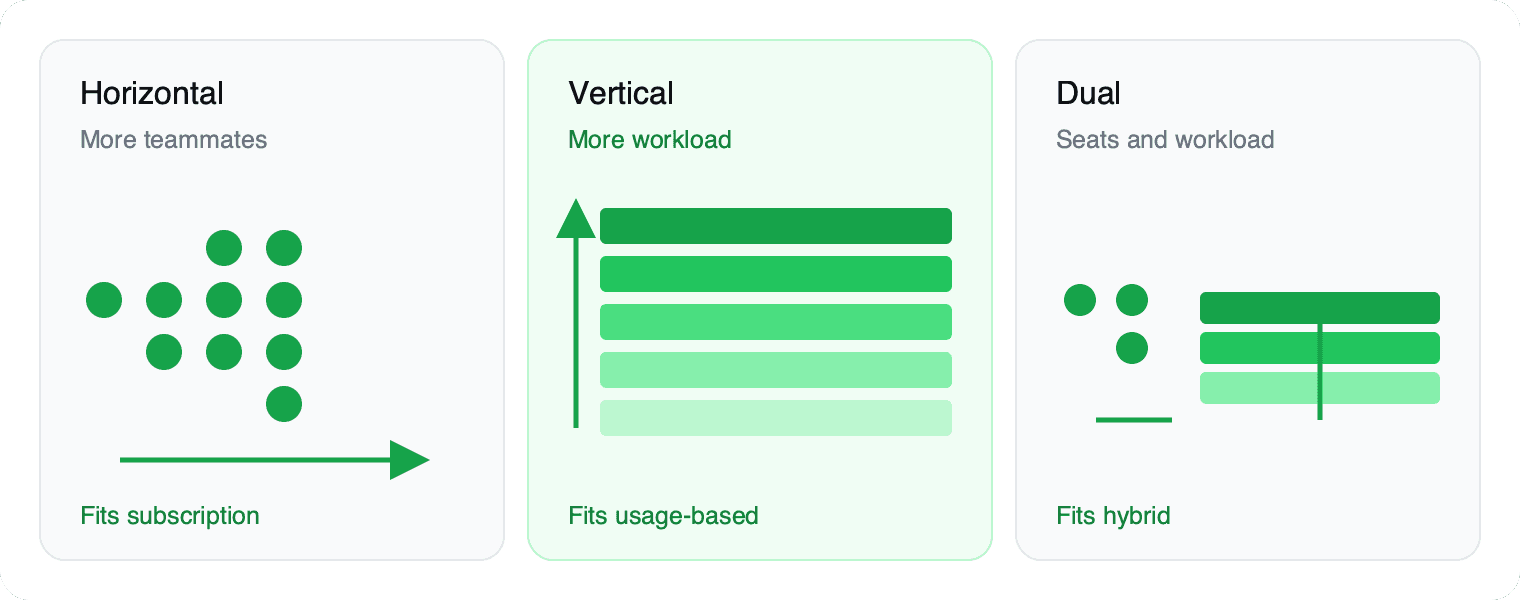
Horizontal growth 

In this pattern, value increases because more teammates adopt the product. The account grows horizontally. More people collaborate, create more dependencies, and integrate the tool into daily workflows. Nothing else needs to increase for value, to expand participation alone drives growth.

Common signs include:

  • Customers invite more users over time

  • Seat count grows steadily

  • Collaboration intensity increases

  • Value scales with access, not workload

Here, subscription pricing aligns naturally with your product. The customer is paying for access to a shared environment. Charging per action would introduce hesitation; users would start thinking before clicking. So companies price per seat or per workspace because value is tied to participation.

Vertical growth

In this pattern, the value increases because the system processes more work. The account grows vertically. The same team can generate significantly more outcomes by running more jobs, processing more data, or executing more AI tasks. Team size may remain constant while output multiplies.

Common signs include:

  • Task volume increases over time

  • API calls, compute, or processing expand

  • Infrastructure costs rise with activity

  • Team size stays relatively stable


Here, usage-based pricing fits. The customer is paying for work performed. Two customers with identical team sizes can generate very different values depending on how much they run the system. Flat pricing breaks because heavy usage creates cost and value simultaneously. Pricing must be attached to the volume processed.

Dual growth

Some products grow through both adoption and execution. Where people are the ones who initiate work, and the system performs work repeatedly. This value exists in two layers:

  • Access to the platform

  • Amount of work executed

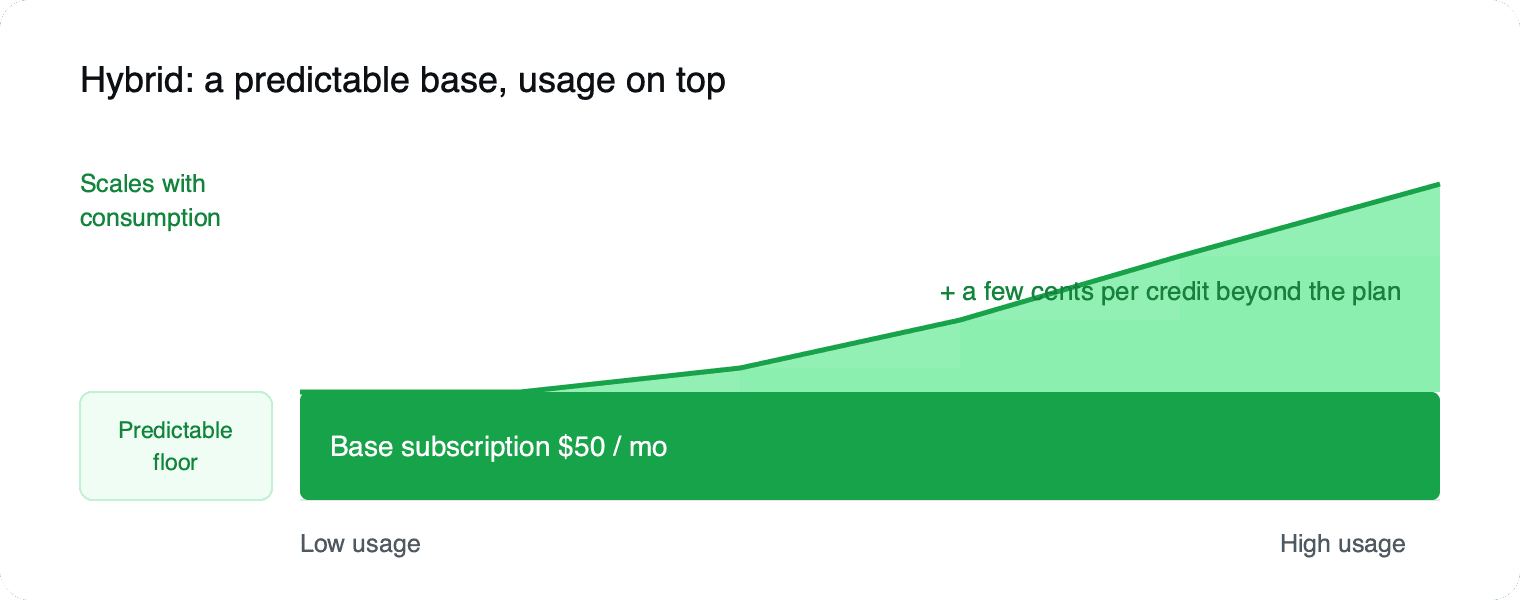
Customers want predictable budgets for access. Vendors need variable pricing for compute and processing. This naturally leads to hybrid pricing: a base subscription that you have from the start, and based on usage, you are charged.

  1. Billing infrastructure capability

Before you even think about usage-based pricing, ask yourself one hard question: Can you accurately measure what your customers actually use? And if the answer is yes, then usage-based pricing becomes a real option. 

But it only works if your billing infrastructure is ready. You need more than a payment gateway; you need systems that can track usage in real time, aggregate events reliably, apply pricing rules, and surface everything clearly to customers.

In practice, that means being able to support:

  • Real-time or near real-time usage metering

  • Reliable aggregation pipelines for billing periods

  • Pricing logic that handles tiers, minimums, and overages

  • Proper overage handling without breaking invoices

  • Transparent usage breakdowns so customers understand their bills

  • Dispute resolution when customers question charges

Without this foundation, usage-based pricing quickly turns into operational chaos. If you can’t do this yet, subscription pricing is the safer choice, and it clearly makes sense for your product.

Subscription models don’t require deep usage tracking. 

Most teams can launch with basic billing tools like fixed plans, seat counts, and feature access, which are enough to get you started. 

You don’t need event pipelines or custom metering systems. Your billing lives mostly inside your payment provider, and engineering complexity stays low. Here’s the simple rule:

  • If you can measure usage accurately, usage-based pricing works.

  • If you can’t, stick with subscriptions until your infrastructure catches up.

Why many SaaS companies adopt hybrid pricing

Hybrid pricing didn’t become popular by accident. Teams increasingly need systems that support a hybrid-based model, which includes usage-based and subscription-based models. It offers flexibility with predictability. 

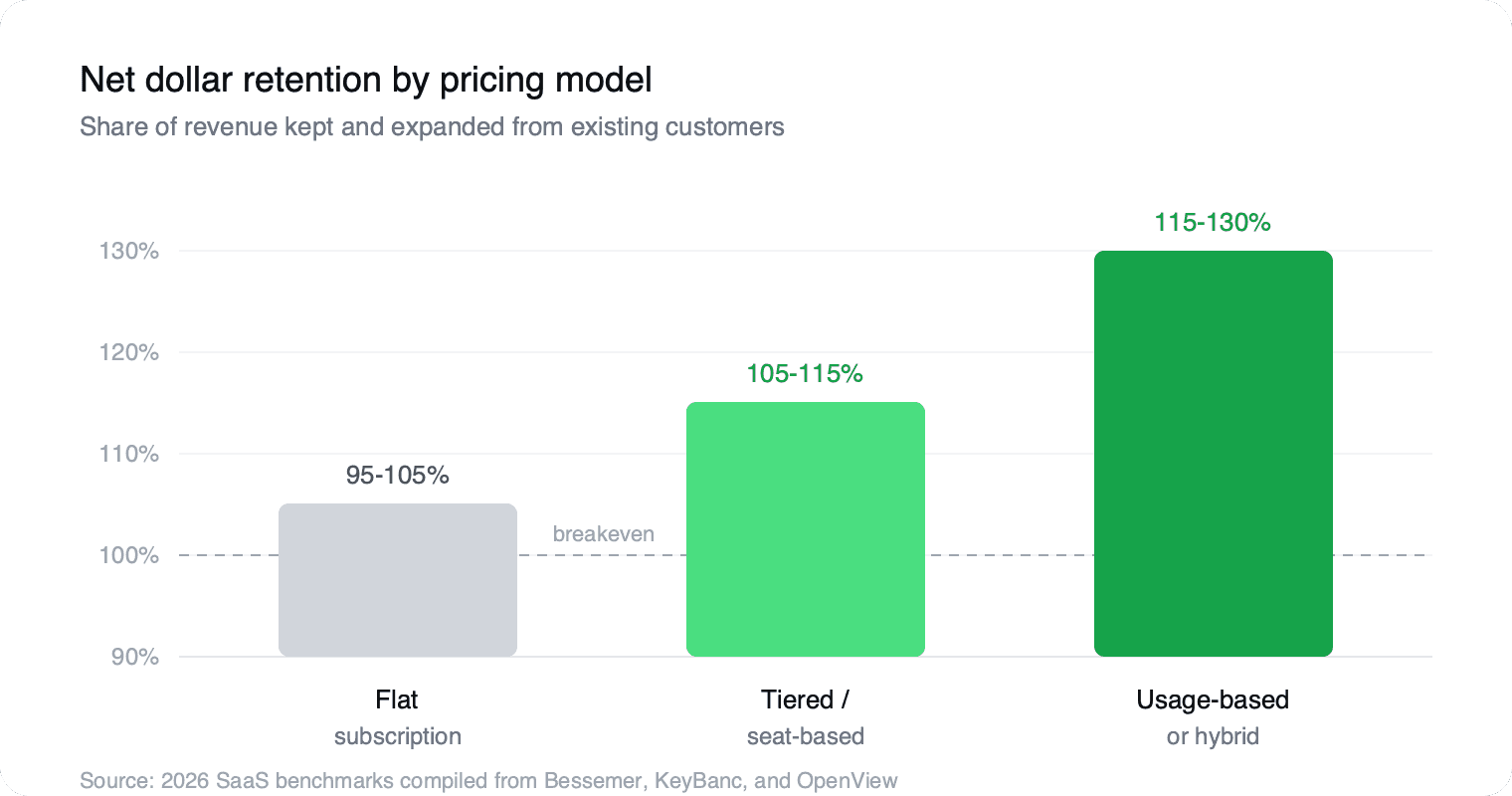
In fact, 46% of AI and SaaS companies now use hybrid pricing models, which helps them to deliver the highest median revenue growth, which simply outperforms pure subscription or pay-as-you-go approaches.

  • Subscription plans provide predictable, uninterrupted access to the product, allowing customers to pay a fixed monthly or annual fee without worrying about variable charges or surprise invoices. This model remains widely adopted because it simplifies budgeting, streamlines procurement, and reduces billing friction.

  • High-cost or high-value features scale best with consumption. That’s the reason why AI and SaaS companies use usage-based pricing, and 80% of customers report better value alignment when pricing increases only as usage grows.

  • The hybrid pricing model supports low-commitment self-serve entry while still enabling predictable enterprise contracts. This flexibility helps AI and SaaS companies adapt faster in a market. It is the most desirable type of model in recent years, which helps in growth and stability.

Maybe choosing the model is hard, but launching it shouldn’t be

By now, we can understand that there’s no universally “better” pricing model. There’s only what fits your product complexity, customer psychology, and growth stage right now.

If your product has:

  • one clean value metric

  • stable costs

  • and customers who prefer pay-for-what-you-use

Usage-based pricing is your best option.

If your product has:

  • Single-core feature

  • predictable infrastructure costs

  • buyers who require fixed pricing for budgeting

Subscription-based pricing is the better fit.

And if you’re scaling fast, selling to both self-serve and enterprise, or iterating pricing every quarter, the answer always remains hybrid.

The real mistake founders make isn’t choosing the “wrong” model. It’s getting themselves locked into the billing infrastructure that makes switching painful.

That’s why modern teams separate pricing logic from billing plumbing.

With Flexprice, launching a model doesn’t require months of custom work or irreversible decisions.

Here’s what “launch in a day” actually looks like in practice.

To launch usage-based pricing with Flexprice

  • Define your usage metric (API calls, tokens, events, seconds, etc.)

  • Instrument usage events once

  • Configure meters and rate cards

  • Let Flexprice aggregate, invoice, and bill automatically at the cycle end

No hard-coding prices into product logic. No custom invoicing pipelines.All of these without rebuilding your billing system again six months later.

The takeaway is simple.

Spend your time deciding how you want customers to experience value, not fighting billing complexity.

Which pricing model is right for your business?

After reviewing the core differences between usage-based pricing and subscription pricing, we now have a clear understanding of how each model operates. 

The real question, however, is which one aligns best with your product, cost structure, and customer behavior. Let’s examine the key factors that determine which pricing model is the right fit for your business. 

  1. Value delivery pattern

Does customer value stay relatively constant over time, or does it increase as usage increases?

Your answer determines whether subscription-based or usage-based pricing fits your product.

You can think of it as a gym membership versus an electricity bill. 

A gym charges a flat monthly fee whether you visit three times or thirty. But on the other hand, electricity bills are based on exactly how much you consume. Software works the same way.

When the value is stable, you go with subscription-based pricing.

Subscription pricing works best when customers receive continuous access to a product, and value doesn’t materially increase with every action. 

Once users are onboarded, they benefit from having the tool available at all times, even if daily activity fluctuates.

Characteristics

  • Customers rely on ongoing access rather than variable usage

  • Daily activity may fluctuate, but perceived value stays consistent

  • The product becomes embedded in business operations

When value scales with activity, you need to think about usage-based pricing.

Usage-based pricing is suitable when every unit of activity directly delivers value. Customers get more benefits as they make more API calls, process more data, or run more compute.

Here, pricing tracks consumption because value and cost both increase with usage.

Characteristics:

  • Each action produces measurable customer value

  • Infrastructure costs rise with customer activity

  • Customers naturally start small and expand over time

  • Revenue scales automatically as usage grows

  1. Usage predictability

Another critical factor in choosing a pricing model is usage predictability. Can customers reliably estimate how much they’ll use your product each month?

If usage is consistent and easy to forecast, fixed subscriptions make sense. If usage varies significantly or comes in bursts, usage-based pricing is the more practical option.

If you’re seeing stable usage, think subscription pricing.

Subscription pricing works best when customer activity follows a predictable pattern. Teams know roughly how many users they’ll have and how often the product will be used. 

This makes fixed monthly or annual contracts easy to justify internally. Finance teams prefer subscriptions because costs remain consistent regardless of short-term changes in activity.

Characteristics:

  • Customers can forecast usage with reasonable accuracy

  • Product access is continuous and required regardless of daily volume.

  • Budgets are planned quarterly or annually.

  • Buyers prioritize cost certainty over granular optimization.

  • Usage does not spike dramatically from month to month.

If you have low or spiky usage, think about usage-based pricing

Usage-based pricing is better suited for products where consumption is variable, unpredictable, or event-driven. 

Customers may have quiet periods followed by sudden bursts of activity, making fixed subscriptions inefficient. Here, charging based on actual usage prevents customers from paying for idle capacity.

Characteristics:

  • Monthly consumption varies significantly

  • Activity depends on external demand or workloads

  • Customers cannot accurately predict usage in advance

  • Paying a flat fee would result in frequent overpayment

  • Infrastructure costs rise only when customers are actively using the product

  1. Buyer psychology

Beyond product mechanics and cost structure, pricing decisions are heavily influenced by buyer psychology, specifically, how customers prefer to think about spending. 

Some buyers prioritize cost certainty. Others prioritize fairness and efficiency. This mindset plays a direct role in whether subscription or usage-based pricing feels natural.

If you’re seeing fixed cost preference, lean towards subscription pricing.

Subscription pricing works best for buyers who value budget stability over optimization. These customers prefer knowing their exact spend in advance, even if that means occasionally paying for unused capacity. This mindset is common among finance-led organizations and operational teams that plan budgets quarterly or annually.

Characteristics:

  • Buyers want a fixed monthly or annual expense

  • Budgets are approved ahead of time and rarely adjusted mid-cycle

  • Predictability matters more than granular cost efficiency

  • Procurement favors contracts with predefined pricing

  • Teams prefer always-on access without monitoring usage

If it’s Pay-for-what-you-use, then think of usage-based pricing.

Usage-based pricing fits buyers who prioritize cost alignment with actual consumption. These customers care about paying in proportion to activity and avoiding charges for idle capacity.

This mindset is common among technical teams and organizations operating variable workloads.

Characteristics:

  • Buyers want spending to reflect real usage

  • Teams actively optimize infrastructure and operating costs

  • Monthly demand is unpredictable or workload-driven

  • Customers expect pricing to scale with activity

  • Paying for unused capacity feels inefficient

  1. Product complexity

You need to ask yourself whether my product delivers value through a single core capability or across multiple dimensions. Because a simple product will price cleanly, whereas a complex product doesn’t.

Single core feature → subscription pricing

Subscription pricing works best when your product is centered around one primary value driver. Customers mainly pay for access to a capability, and usage variations don’t meaningfully change the value they receive. In these cases, fixed pricing keeps billing simple and easy to understand.

characteristics:

  • One dominant feature or workflow defines product value

  • Customers mainly care about access

  • Pricing can be expressed in seats, tiers, or feature bundles

  • Billing logic remains straightforward

Multiple dimensions → usage-based or hybrid pricing

When products combine multiple cost and value drivers, subscriptions alone struggle to capture real usage. If customers consume APIs, generate compute load, store data, and add users simultaneously, a single flat price no longer reflects reality. Here, usage-based or hybrid models provide better alignment between pricing, customer value, and infrastructure costs.

Characteristics:

  • Value comes from several dimensions, like API + storage + compute + seats

  • Infrastructure costs rise with customer activity

  • Different customers use different parts of the product unevenly

  • Pricing must adapt to how customers actually consume the product

  1. Growth motion

Before picking a pricing model, take a step back and look at how customers actually grow inside your product. Ask them, six months after they signed up, what changed? Did they add more teammates? Did they run more jobs? Or did both happen?

That answer tells you how your product grows, and it matters more than any pricing theory. Most of the successful accounts follow one of three growth patterns.

Horizontal growth 

In this pattern, value increases because more teammates adopt the product. The account grows horizontally. More people collaborate, create more dependencies, and integrate the tool into daily workflows. Nothing else needs to increase for value, to expand participation alone drives growth.

Common signs include:

  • Customers invite more users over time

  • Seat count grows steadily

  • Collaboration intensity increases

  • Value scales with access, not workload

Here, subscription pricing aligns naturally with your product. The customer is paying for access to a shared environment. Charging per action would introduce hesitation; users would start thinking before clicking. So companies price per seat or per workspace because value is tied to participation.

Vertical growth

In this pattern, the value increases because the system processes more work. The account grows vertically. The same team can generate significantly more outcomes by running more jobs, processing more data, or executing more AI tasks. Team size may remain constant while output multiplies.

Common signs include:

  • Task volume increases over time

  • API calls, compute, or processing expand

  • Infrastructure costs rise with activity

  • Team size stays relatively stable


Here, usage-based pricing fits. The customer is paying for work performed. Two customers with identical team sizes can generate very different values depending on how much they run the system. Flat pricing breaks because heavy usage creates cost and value simultaneously. Pricing must be attached to the volume processed.

Dual growth

Some products grow through both adoption and execution. Where people are the ones who initiate work, and the system performs work repeatedly. This value exists in two layers:

  • Access to the platform

  • Amount of work executed

Customers want predictable budgets for access. Vendors need variable pricing for compute and processing. This naturally leads to hybrid pricing: a base subscription that you have from the start, and based on usage, you are charged.

  1. Billing infrastructure capability

Before you even think about usage-based pricing, ask yourself one hard question: Can you accurately measure what your customers actually use? And if the answer is yes, then usage-based pricing becomes a real option. 

But it only works if your billing infrastructure is ready. You need more than a payment gateway; you need systems that can track usage in real time, aggregate events reliably, apply pricing rules, and surface everything clearly to customers.

In practice, that means being able to support:

  • Real-time or near real-time usage metering

  • Reliable aggregation pipelines for billing periods

  • Pricing logic that handles tiers, minimums, and overages

  • Proper overage handling without breaking invoices

  • Transparent usage breakdowns so customers understand their bills

  • Dispute resolution when customers question charges

Without this foundation, usage-based pricing quickly turns into operational chaos. If you can’t do this yet, subscription pricing is the safer choice, and it clearly makes sense for your product.

Subscription models don’t require deep usage tracking. 

Most teams can launch with basic billing tools like fixed plans, seat counts, and feature access, which are enough to get you started. 

You don’t need event pipelines or custom metering systems. Your billing lives mostly inside your payment provider, and engineering complexity stays low. Here’s the simple rule:

  • If you can measure usage accurately, usage-based pricing works.

  • If you can’t, stick with subscriptions until your infrastructure catches up.

Why many SaaS companies adopt hybrid pricing

Hybrid pricing didn’t become popular by accident. Teams increasingly need systems that support a hybrid-based model, which includes usage-based and subscription-based models. It offers flexibility with predictability. 

In fact, 46% of AI and SaaS companies now use hybrid pricing models, which helps them to deliver the highest median revenue growth, which simply outperforms pure subscription or pay-as-you-go approaches.

  • Subscription plans provide predictable, uninterrupted access to the product, allowing customers to pay a fixed monthly or annual fee without worrying about variable charges or surprise invoices. This model remains widely adopted because it simplifies budgeting, streamlines procurement, and reduces billing friction.

  • High-cost or high-value features scale best with consumption. That’s the reason why AI and SaaS companies use usage-based pricing, and 80% of customers report better value alignment when pricing increases only as usage grows.

  • The hybrid pricing model supports low-commitment self-serve entry while still enabling predictable enterprise contracts. This flexibility helps AI and SaaS companies adapt faster in a market. It is the most desirable type of model in recent years, which helps in growth and stability.

Maybe choosing the model is hard, but launching it shouldn’t be

By now, we can understand that there’s no universally “better” pricing model. There’s only what fits your product complexity, customer psychology, and growth stage right now.

If your product has:

  • one clean value metric

  • stable costs

  • and customers who prefer pay-for-what-you-use

Usage-based pricing is your best option.

If your product has:

  • Single-core feature

  • predictable infrastructure costs

  • buyers who require fixed pricing for budgeting

Subscription-based pricing is the better fit.

And if you’re scaling fast, selling to both self-serve and enterprise, or iterating pricing every quarter, the answer always remains hybrid.

The real mistake founders make isn’t choosing the “wrong” model. It’s getting themselves locked into the billing infrastructure that makes switching painful.

That’s why modern teams separate pricing logic from billing plumbing.

With Flexprice, launching a model doesn’t require months of custom work or irreversible decisions.

Here’s what “launch in a day” actually looks like in practice.

To launch usage-based pricing with Flexprice

  • Define your usage metric (API calls, tokens, events, seconds, etc.)

  • Instrument usage events once

  • Configure meters and rate cards

  • Let Flexprice aggregate, invoice, and bill automatically at the cycle end

No hard-coding prices into product logic. No custom invoicing pipelines.All of these without rebuilding your billing system again six months later.

The takeaway is simple.

Spend your time deciding how you want customers to experience value, not fighting billing complexity.

Which pricing model is right for your business?

After reviewing the core differences between usage-based pricing and subscription pricing, we now have a clear understanding of how each model operates. 

The real question, however, is which one aligns best with your product, cost structure, and customer behavior. Let’s examine the key factors that determine which pricing model is the right fit for your business. 

  1. Value delivery pattern

Does customer value stay relatively constant over time, or does it increase as usage increases?

Your answer determines whether subscription-based or usage-based pricing fits your product.

You can think of it as a gym membership versus an electricity bill. 

A gym charges a flat monthly fee whether you visit three times or thirty. But on the other hand, electricity bills are based on exactly how much you consume. Software works the same way.

When the value is stable, you go with subscription-based pricing.

Subscription pricing works best when customers receive continuous access to a product, and value doesn’t materially increase with every action. 

Once users are onboarded, they benefit from having the tool available at all times, even if daily activity fluctuates.

Characteristics

  • Customers rely on ongoing access rather than variable usage

  • Daily activity may fluctuate, but perceived value stays consistent

  • The product becomes embedded in business operations

When value scales with activity, you need to think about usage-based pricing.

Usage-based pricing is suitable when every unit of activity directly delivers value. Customers get more benefits as they make more API calls, process more data, or run more compute.

Here, pricing tracks consumption because value and cost both increase with usage.

Characteristics:

  • Each action produces measurable customer value

  • Infrastructure costs rise with customer activity

  • Customers naturally start small and expand over time

  • Revenue scales automatically as usage grows

  1. Usage predictability

Another critical factor in choosing a pricing model is usage predictability. Can customers reliably estimate how much they’ll use your product each month?

If usage is consistent and easy to forecast, fixed subscriptions make sense. If usage varies significantly or comes in bursts, usage-based pricing is the more practical option.

If you’re seeing stable usage, think subscription pricing.

Subscription pricing works best when customer activity follows a predictable pattern. Teams know roughly how many users they’ll have and how often the product will be used. 

This makes fixed monthly or annual contracts easy to justify internally. Finance teams prefer subscriptions because costs remain consistent regardless of short-term changes in activity.

Characteristics:

  • Customers can forecast usage with reasonable accuracy

  • Product access is continuous and required regardless of daily volume.

  • Budgets are planned quarterly or annually.

  • Buyers prioritize cost certainty over granular optimization.

  • Usage does not spike dramatically from month to month.

If you have low or spiky usage, think about usage-based pricing

Usage-based pricing is better suited for products where consumption is variable, unpredictable, or event-driven. 

Customers may have quiet periods followed by sudden bursts of activity, making fixed subscriptions inefficient. Here, charging based on actual usage prevents customers from paying for idle capacity.

Characteristics:

  • Monthly consumption varies significantly

  • Activity depends on external demand or workloads

  • Customers cannot accurately predict usage in advance

  • Paying a flat fee would result in frequent overpayment

  • Infrastructure costs rise only when customers are actively using the product

  1. Buyer psychology

Beyond product mechanics and cost structure, pricing decisions are heavily influenced by buyer psychology, specifically, how customers prefer to think about spending. 

Some buyers prioritize cost certainty. Others prioritize fairness and efficiency. This mindset plays a direct role in whether subscription or usage-based pricing feels natural.

If you’re seeing fixed cost preference, lean towards subscription pricing.

Subscription pricing works best for buyers who value budget stability over optimization. These customers prefer knowing their exact spend in advance, even if that means occasionally paying for unused capacity. This mindset is common among finance-led organizations and operational teams that plan budgets quarterly or annually.

Characteristics:

  • Buyers want a fixed monthly or annual expense

  • Budgets are approved ahead of time and rarely adjusted mid-cycle

  • Predictability matters more than granular cost efficiency

  • Procurement favors contracts with predefined pricing

  • Teams prefer always-on access without monitoring usage

If it’s Pay-for-what-you-use, then think of usage-based pricing.

Usage-based pricing fits buyers who prioritize cost alignment with actual consumption. These customers care about paying in proportion to activity and avoiding charges for idle capacity.

This mindset is common among technical teams and organizations operating variable workloads.

Characteristics:

  • Buyers want spending to reflect real usage

  • Teams actively optimize infrastructure and operating costs

  • Monthly demand is unpredictable or workload-driven

  • Customers expect pricing to scale with activity

  • Paying for unused capacity feels inefficient

  1. Product complexity

You need to ask yourself whether my product delivers value through a single core capability or across multiple dimensions. Because a simple product will price cleanly, whereas a complex product doesn’t.

Single core feature → subscription pricing

Subscription pricing works best when your product is centered around one primary value driver. Customers mainly pay for access to a capability, and usage variations don’t meaningfully change the value they receive. In these cases, fixed pricing keeps billing simple and easy to understand.

characteristics:

  • One dominant feature or workflow defines product value

  • Customers mainly care about access

  • Pricing can be expressed in seats, tiers, or feature bundles

  • Billing logic remains straightforward

Multiple dimensions → usage-based or hybrid pricing

When products combine multiple cost and value drivers, subscriptions alone struggle to capture real usage. If customers consume APIs, generate compute load, store data, and add users simultaneously, a single flat price no longer reflects reality. Here, usage-based or hybrid models provide better alignment between pricing, customer value, and infrastructure costs.

Characteristics:

  • Value comes from several dimensions, like API + storage + compute + seats

  • Infrastructure costs rise with customer activity

  • Different customers use different parts of the product unevenly

  • Pricing must adapt to how customers actually consume the product

  1. Growth motion

Before picking a pricing model, take a step back and look at how customers actually grow inside your product. Ask them, six months after they signed up, what changed? Did they add more teammates? Did they run more jobs? Or did both happen?

That answer tells you how your product grows, and it matters more than any pricing theory. Most of the successful accounts follow one of three growth patterns.

Horizontal growth 

In this pattern, value increases because more teammates adopt the product. The account grows horizontally. More people collaborate, create more dependencies, and integrate the tool into daily workflows. Nothing else needs to increase for value, to expand participation alone drives growth.

Common signs include:

  • Customers invite more users over time

  • Seat count grows steadily

  • Collaboration intensity increases

  • Value scales with access, not workload

Here, subscription pricing aligns naturally with your product. The customer is paying for access to a shared environment. Charging per action would introduce hesitation; users would start thinking before clicking. So companies price per seat or per workspace because value is tied to participation.

Vertical growth

In this pattern, the value increases because the system processes more work. The account grows vertically. The same team can generate significantly more outcomes by running more jobs, processing more data, or executing more AI tasks. Team size may remain constant while output multiplies.

Common signs include:

  • Task volume increases over time

  • API calls, compute, or processing expand

  • Infrastructure costs rise with activity

  • Team size stays relatively stable


Here, usage-based pricing fits. The customer is paying for work performed. Two customers with identical team sizes can generate very different values depending on how much they run the system. Flat pricing breaks because heavy usage creates cost and value simultaneously. Pricing must be attached to the volume processed.

Dual growth

Some products grow through both adoption and execution. Where people are the ones who initiate work, and the system performs work repeatedly. This value exists in two layers:

  • Access to the platform

  • Amount of work executed

Customers want predictable budgets for access. Vendors need variable pricing for compute and processing. This naturally leads to hybrid pricing: a base subscription that you have from the start, and based on usage, you are charged.

  1. Billing infrastructure capability

Before you even think about usage-based pricing, ask yourself one hard question: Can you accurately measure what your customers actually use? And if the answer is yes, then usage-based pricing becomes a real option. 

But it only works if your billing infrastructure is ready. You need more than a payment gateway; you need systems that can track usage in real time, aggregate events reliably, apply pricing rules, and surface everything clearly to customers.

In practice, that means being able to support:

  • Real-time or near real-time usage metering

  • Reliable aggregation pipelines for billing periods

  • Pricing logic that handles tiers, minimums, and overages

  • Proper overage handling without breaking invoices

  • Transparent usage breakdowns so customers understand their bills

  • Dispute resolution when customers question charges

Without this foundation, usage-based pricing quickly turns into operational chaos. If you can’t do this yet, subscription pricing is the safer choice, and it clearly makes sense for your product.

Subscription models don’t require deep usage tracking. 

Most teams can launch with basic billing tools like fixed plans, seat counts, and feature access, which are enough to get you started. 

You don’t need event pipelines or custom metering systems. Your billing lives mostly inside your payment provider, and engineering complexity stays low. Here’s the simple rule:

  • If you can measure usage accurately, usage-based pricing works.

  • If you can’t, stick with subscriptions until your infrastructure catches up.

Why many SaaS companies adopt hybrid pricing

Hybrid pricing didn’t become popular by accident. Teams increasingly need systems that support a hybrid-based model, which includes usage-based and subscription-based models. It offers flexibility with predictability. 

In fact, 46% of AI and SaaS companies now use hybrid pricing models, which helps them to deliver the highest median revenue growth, which simply outperforms pure subscription or pay-as-you-go approaches.

  • Subscription plans provide predictable, uninterrupted access to the product, allowing customers to pay a fixed monthly or annual fee without worrying about variable charges or surprise invoices. This model remains widely adopted because it simplifies budgeting, streamlines procurement, and reduces billing friction.

  • High-cost or high-value features scale best with consumption. That’s the reason why AI and SaaS companies use usage-based pricing, and 80% of customers report better value alignment when pricing increases only as usage grows.

  • The hybrid pricing model supports low-commitment self-serve entry while still enabling predictable enterprise contracts. This flexibility helps AI and SaaS companies adapt faster in a market. It is the most desirable type of model in recent years, which helps in growth and stability.

Maybe choosing the model is hard, but launching it shouldn’t be

By now, we can understand that there’s no universally “better” pricing model. There’s only what fits your product complexity, customer psychology, and growth stage right now.

If your product has:

  • one clean value metric

  • stable costs

  • and customers who prefer pay-for-what-you-use

Usage-based pricing is your best option.

If your product has:

  • Single-core feature

  • predictable infrastructure costs

  • buyers who require fixed pricing for budgeting

Subscription-based pricing is the better fit.

And if you’re scaling fast, selling to both self-serve and enterprise, or iterating pricing every quarter, the answer always remains hybrid.

The real mistake founders make isn’t choosing the “wrong” model. It’s getting themselves locked into the billing infrastructure that makes switching painful.

That’s why modern teams separate pricing logic from billing plumbing.

With Flexprice, launching a model doesn’t require months of custom work or irreversible decisions.

Here’s what “launch in a day” actually looks like in practice.

To launch usage-based pricing with Flexprice

  • Define your usage metric (API calls, tokens, events, seconds, etc.)

  • Instrument usage events once

  • Configure meters and rate cards

  • Let Flexprice aggregate, invoice, and bill automatically at the cycle end

No hard-coding prices into product logic. No custom invoicing pipelines.All of these without rebuilding your billing system again six months later.

The takeaway is simple.

Spend your time deciding how you want customers to experience value, not fighting billing complexity.

Frequently Asked Questions

Frequently Asked Questions

Frequently Asked Questions

What is usage based pricing?

What is usage based pricing?

What is usage based pricing?

What is usage based pricing?

What is usage based pricing?

What is subscription pricing?

What is subscription pricing?

What is subscription pricing?

What is subscription pricing?

What is subscription pricing?

What’s the difference between usage based and subscription pricing?

What’s the difference between usage based and subscription pricing?

What’s the difference between usage based and subscription pricing?

What’s the difference between usage based and subscription pricing?

What’s the difference between usage based and subscription pricing?

What are the advantages and disadvantages of usage based pricing?

What are the advantages and disadvantages of usage based pricing?

What are the advantages and disadvantages of usage based pricing?

What are the advantages and disadvantages of usage based pricing?

What are the advantages and disadvantages of usage based pricing?

What are the advantages and disadvantages of subscription pricing?

What are the advantages and disadvantages of subscription pricing?

What are the advantages and disadvantages of subscription pricing?

What are the advantages and disadvantages of subscription pricing?

What are the advantages and disadvantages of subscription pricing?

Ayush Parchure

Ayush Parchure

Ayush Parchure

Ayush is part of the content team at Flexprice, with a strong interest in AI, SaaS, and pricing. He loves breaking down complex systems and spends his free time gaming and experimenting with new cooking lessons.

Ayush is part of the content team at Flexprice, with a strong interest in AI, SaaS, and pricing. He loves breaking down complex systems and spends his free time gaming and experimenting with new cooking lessons.

Share it on:

Ship Usage-Based Billing with Flexprice

Summarize this blog on:

Ship Usage-Based Billing with Flexprice

Ship Usage-Based Billing with Flexprice

More insights on billing

More insights on billing

Table of Content

Table of Content

How to Choose Between Usage-Based Pricing and Subscription Pricing Before You Lock Yourself Into the Wrong Model

How to Choose Between Usage-Based Pricing and Subscription Pricing Before You Lock Yourself Into the Wrong Model

How to Choose Between Usage-Based Pricing and Subscription Pricing Before You Lock Yourself Into the Wrong Model

How to Choose Between Usage-Based Pricing and Subscription Pricing Before You Lock Yourself Into the Wrong Model

Feb 20, 2026

Feb 20, 2026

Feb 20, 2026

• 24 min read

• 24 min read

Ayush Parchure

Content Writing Intern, Flexprice

Critical Features to Look for in The Automated Billing Software For AI And SaaS

Everyone's moving to usage-based pricing. OpenAI, Anthropic, that new AI tool that just hit Product Hunt, does it. And if you're still on subscription-based pricing, there's a nagging feeling you're already behind, that you're leaving growth on the table by charging a flat fee in a world that's clearly moving toward pay-for-what-you-use.

But then you think about the sales call. The prospect asks, "So what will I actually pay this month?" and you don't have a clean answer. With usage-based pricing, you never do. Variable bills make buyers nervous. Nervous buyers stall. Stalled deals don't close.

So you're stuck, subscription-based pricing feels safe but dated, usage-based pricing feels modern but risky. 

The good news is you don't have to guess. Here's how to figure out which pricing model is actually right for your business.

One wrong move and you're stuck in a loop of rewriting contracts, rebuilding billing logic, and having awkward conversations with customers months from now. Yikes, no one wants that!

This isn't just another generic pros and cons list. 

We're going to walk you through every parameter that actually matters for your use case, like customer behavior, revenue predictability, implementation complexity, and expansion potential, so by the end, you'll know exactly which model fits your business. No guesswork. Just a clear framework to make the call with confidence.

TL;DR

  • Usage-based pricing monetizes consumption; subscription pricing monetizes access.

  • Use usage-based when value and cost scale with activity 

  • Use a subscription when the value is stable, and customers need budget predictability 

  • Usage-based drives automatic revenue expansion but reduces forecast predictability.

  • Subscription provides stable recurring revenue but requires manual upgrades.

  • Spiky or unpredictable usage → usage-based fits better.

  • Stable, forecastable usage → subscription fits better.

  • Usage-based requires strong metering, aggregation, and billing infrastructure.

  • Subscription is simpler to implement and manage operationally.

  • Horizontal growth (more seats) → subscription aligns naturally.

  • Vertical growth (more processing/workload) → usage-based aligns naturally.

  • Many AI/SaaS companies adopt hybrid models to combine predictability with scalable revenue.

  • The real risk isn’t choosing wrong; it’s locking into a billing infrastructure that prevents flexibility.

What Is Usage-Based Pricing?

Usage-based pricing, also known as pay-as-you-go pricing, is a model where customers pay according to their usage. The metric that is used to measure usage corresponds to how the customer can extract value from the product. 

Looking at current scenarios, we can see that usage-based pricing has become a prominent choice for customers within AI and SaaS, which is now replacing traditional subscription and seat-based pricing models.

How it actually works

  • Users start using the product without preloaded limits, and usage is tracked continuously. At the end of the billing cycle, customers receive an invoice based on the total consumption recorded during that period.

  • Charges are calculated using concrete units such as API calls, data stored, compute time, or events processed. As usage increases or decreases, costs scale proportionally, creating a direct link between consumption and spending.

  • Because billing follows usage, customers pay more during high-activity periods and less when usage drops. This makes usage-based pricing transparent, but can also introduce variability in monthly spend.

To get more information regarding the pay-as-you-go model, you can see how Simplismart scaled to 750+ pricing features and reclaimed 30% of daily engineering bandwidth with flexprice

Core usage metrics

These usage metrics define what customers actually pay for. It tells in which direction your revenue will scale and how you can make your billing more predictable. 

For AI and SaaS products, it acts like a unit that measures usage around every aspect of the product, like the number of API calls, tokens, compute time, storage used, and events triggered. 

  1. API calls

It actually measures every request or service your product makes using an API, and it is used because API calls are simple, discrete, and easy to meter in real time. They’re widely used for developer platforms, integrations, and backend services.

  1. Tokens processed

It is used in the measurement of the volume of text (input + output), which is processed by AI models, and then it is typically broken into tokens. 

Tokens are the unit that directly correlates with model inference cost, making this one of the most accurate value metrics for AI-native products. It works best for LLM-powered apps, chatbots, and content generation tools.

  1. Compute time

With the help of this metric, we can find the actual processing time that is consumed by workloads, and it is often tracked in seconds, minutes, or GPU hours. 

Compute time maps closely to infrastructure spend, especially for AI inference, training, and data processing pipelines. It is commonly used for AI infrastructure platforms, video/audio processing, and large-scale analytics.

  1. Storage used

We can accurately find how much data is stored over time, which is mostly measured in GB/month. It is used because storage is persistent and predictable, making it an easy add-on metric for many AI and  SaaS platforms. It is used across many platforms, like file-based products and data platforms.

  1. Events triggered

It is a discrete action inside your product; you can think of it as messages sent, workflows executed, or jobs completed. 

Event-based pricing closely reflects customer activity and business outcomes, making it intuitive for many workflow-driven tools. It is best for automation platforms, product analytics, and event-driven systems.

Types of usage-based pricing models

  1. Pure pay-as-you-go

Customers pay strictly for what they consume, with no upfront commitment, minimum spend, or bundled allowances. Billing happens after usage, and costs scale linearly with consumption. 

Example: Amazon Web Services (AWS) offers services like EC2, S3, and Lambda charge per second, per request, or per GB used, making it a canonical pay-as-you-go model.

  1. Tiered usage pricing

Per-unit prices decrease as usage crosses predefined thresholds. Customers pay more at lower volumes and receive discounted rates as their usage grows. 

Example: AssemblyAI (enterprise tiers) offers lower effective rates for customers processing large volumes of audio through negotiated tiers.

  1. Volume pricing

A single unit price applies to all usage based on the total volume consumed in a billing period. Once a customer reaches a certain volume tier, that rate is applied uniformly. 

Example: Zapier uses this to incentivize users to automate more tasks, lowering the cost per task as the volume increases.The higher the subscription tier and volume of tasks a customer commits to, the lower the cost per individual task. This encourages users to consolidate all their automation needs.

  1. Base+overage

Customers receive a base allowance included in their plan. Once that allowance is consumed, access does not become unlimited by default. Instead, customers can either purchase additional usage credits, upgrade to a higher tier, or wait until their next billing cycle for credits to reset. 

Example: Ahrefs Plans include monthly crawl credits and usage limits. When limits are reached, users must upgrade or wait for renewal rather than receiving unlimited access.

Benefits of usage-based pricing

  1. Lower barrier to entry

This model minimizes upfront costs so that customers can start small and scale according to their needs. This enables them to adopt the product without committing to high fixed fees.

  1. Greater pricing flexibility

Because pricing scales with actual usage, you can serve a wide range of customers from individual users to large enterprises, without forcing them into rigid plans. Usage data also helps teams continuously refine pricing to better match customer behavior.

  1. Improved customer retention

When customers pay only for what they use, pricing feels fair and transparent. This stronger alignment between cost and value builds trust, increases satisfaction, and reduces churn over time.

  1. Supports natural account expansion

As customers grow and derive more value from the product, usage increases organically. Revenue expands alongside adoption.

  1. Faster product adoption

They can start using your products immediately without any contracts or commitment to large fixed fees. This shortens sales cycles, accelerates onboarding, and removes friction for developers and early-stage teams who want to test real workloads before scaling.

  1. Stronger product feedback loops

Every unit of usage is measurable. This gives product teams continuous, real-world feedback on which features drive adoption and revenue. High-usage surfaces become clear investment priorities, while low-usage features are quickly exposed.

Drawbacks of usage-based pricing

  1. Unpredictable invoices

Usage-based pricing often leads to surprise bills when demand spikes or experiments run long. Even when customers get more value, sudden cost jumps feel like a loss of control. Finance teams escalate, trust erodes, and what started as “fair pricing” becomes invoice anxiety. 

  1. Unclear budgeting for customers

Because spending fluctuates month to month, forecasting becomes uncertain. CFOs struggle to commit budgets, and procurement pushes back on open-ended contracts. Customers start limiting usage not because they don’t need the product, but because they need predictability. 

  1. Pricing discourages product exploration

When every action has a visible cost, users become defensive. Experiments are slow, features are avoided, and engineers build workarounds to reduce metered events. Instead of driving growth, pricing starts acting like a tax on innovation.

  1. Usage doesn’t always equal value

High usage can signal inefficiency, not success, while low usage may still power mission-critical outcomes. When pricing tracks raw consumption instead of perceived value, customers start questioning fairness.

  1. Revenue becomes harder to forecast internally

While customers struggle with budgeting, so do vendors. Because revenue fluctuates with customer activity, finance teams lose the predictability of fixed subscriptions. 

Forecasting becomes probabilistic instead of deterministic, making cash flow planning, sales targets, and capacity planning harder.

What is subscription-based pricing?

Subscription pricing is a traditional style model where customers pay recurring fees at regular intervals. It allows customers to subscribe to a vendor’s offerings for a specific period of time in exchange for an agreed-upon set price. This pricing model is commonly used in various industries, including SaaS, cloud computing, media streaming, and subscription boxes. 

The subscription pricing model provides customers with ongoing value as they can continuously use the product or service over an extended period instead of making a one-time purchase. It offers several benefits, such as affordability, flexibility, and convenience for customers, as they can access the offering without the need for a large upfront investment. 

How it actually works

  • Customers choose a subscription plan that suits their needs and sign up, often providing payment details up front. This initiates the subscription, and customers are usually charged immediately for the first billing cycle.

  • After the initial payment, customers are charged regularly on a monthly, quarterly, annual, or at another interval specified by the service. The recurring payment ensures continued access to the service or product.

  • Subscribers gain access to the product or service as long as their subscription is active. This access is often continuous and uninterrupted, as long as the customer continues to pay the subscription fee.

  • Subscriptions continue with automatic renewals until the customer decides to cancel. Customers can typically manage their subscription preferences through a user portal and decide whether to upgrade, downgrade, or cancel entirely.

Types of subscription pricing models

  1. Flat-rate pricing

Customers pay a single fixed fee for full product access, regardless of usage or team size. This model prioritizes simplicity and predictable billing, making it attractive for small teams that want straightforward pricing without feature gates. Example: Basecamp offers a flat monthly price for unlimited users and projects under one account.

  1. Tiered plans

Pricing is organized into multiple tiers, like starter, pro, and enterprise, with each level unlocking more features, capacity, or support. This allows companies to serve different customer segments while encouraging upgrades as needs grow. Example: Notion uses tiered plans that scale by features, permissions, and collaboration capabilities.

  1. Per-user pricing

Customers are charged based on the number of active users (seats). Revenue grows as teams expand, making this model popular for collaboration and internal productivity tools. Example: Slack charges per active user per month, with costs increasing as organizations add teammates.

  1. Module-based pricing

Instead of bundling everything into one plan, products are sold as separate modules or clouds. Customers only pay for the functionality they need, enabling highly customized enterprise deployments. Example: Salesforce sells distinct products like Sales Cloud, Service Cloud, Marketing Cloud, etc., that customers purchase independently based on their requirements.

Benefits of subscription pricing 

  1. Continuous revenue stream 

Instead of relying solely on one-time purchases, companies generate recurring revenue on a regular basis, which can lead to more stability and better financial planning.  

  1. Data and insights 

Through subscription data, companies can analyze customer behavior, preferences, and usage patterns, enabling them to personalize offerings, tailor marketing efforts, and make data-driven business decisions. 

  1. Increased customer lifetime value

Retaining customers for longer translates to a higher CLTV. Subscription models encourage repeat purchases and continued engagement, maximizing the revenue generated from each customer over time. Loyal customers are also more likely to try new products or services offered by the business.

  1. Reduced customer acquisition costs 

Acquiring new customers is generally more expensive than retaining existing ones. By focusing on customer retention through a subscription model, businesses can significantly reduce their CAC and improve profitability.

  1. Scalability and growth

Subscription-based models’ predictable revenue and customer loyalty make it easier for businesses to scale and grow. With a stable foundation, businesses can confidently invest in expansion, new product development, and market penetration.

Drawbacks of subscription pricing

  1. Heavy users may be underpriced

Subscription plans charge fixed amounts regardless of consumption. Power users can generate significantly higher compute, storage, or support costs while paying the same as light users. This directly compresses margins.

  1. Light users may feel overcharged

Customers with minimal usage still pay full subscription fees. This creates a sense of unfairness and increases churn risk, especially for small teams or early-stage users. Where the funds are limited.

  1. Limited automatic expansion revenue

Revenue does not grow automatically with usage. Expansion requires manual upgrades, more seats, higher tiers, or sales intervention. This prevents continuous, product-led revenue growth.

  1. Weak alignment with infrastructure cost

Infrastructure expenses rise with customer activity, but subscription revenue remains flat unless plans change. This breaks cost-to-revenue alignment, especially for AI and usage-heavy products.

  1. Packaging complexity over time

To capture more value, companies add tiers, limits, feature gates, and bundles. Pricing becomes harder to manage and explain. Internal complexity increases steadily.

  1. Revenue growth depends on upgrades and renewals

Without usage-based expansion, revenue increases happen only through renewals, seat growth, or tier changes. Missed renewals directly impact topline growth.

Usage-based pricing vs. subscription-based pricing

Now that we’ve covered the strengths and limitations of both pricing models, it’s time to compare them directly. The table below breaks down how each model differs across different parameters

Parameter

Usage-Based Pricing

Subscription Pricing

Revenue predictability

Fluctuates month-to-month based on customer activity. Hard to forecast, especially early on. Finance teams struggle with projections.

Fixed recurring revenue. You know exactly what to expect each month. 

Revenue expansion

Grows organically as customers use more; no sales call needed. Revenue scales automatically with customer success for self-serve customers

Requires active intervention. Growth comes from new customers or convincing existing ones to upgrade tiers. Most customers stay on the same plan for months/years.

Customer activation

Low barrier to entry. Customers can start free/cheap and scale as they grow. Easier to convert initially.

Higher friction at signup. The customer pays upfront before seeing the value. A bigger commitment is required to start.

Time-to-value

Best for products like APIs, LLM calls, and image generation. Customers see value immediately and pay as they go.

Works better for complex products with longer onboarding. Upfront payment creates psychological commitment that drives adoption.

Freeloading risk

Lots of low-usage customers who try forever without converting to meaningful revenue.

Customers either commit and pay, or they don't sign up. It’s a binary decision.

Implementation complexity

Significantly harder. Requires real-time metering infrastructure, accurate aggregation, idempotency, and handling edge cases (partial months, refunds, credits). Billing logic deeply coupled to your app.

Relatively simple. Just need plan tiers, feature flags, and access control. Billing lives in the payment provider.

Technical requirements

Need a custom metering system, event tracking, rate limiting, and real-time calculations. Can't rely on Stripe alone, need infrastructure like Flexprice, Metronome, or custom build.

Standard payment integration. Webhook handling for subscription events. Minimal custom infrastructure needed.

Customer psychology

Feels fair, pay only for what you use. But customers fear bill shock and usage anxiety. Can lead to over-optimization that reduces your revenue.

Feels safe, customers know exactly what they'll pay. But heavy users feel ripped off, light users feel great.

Pricing changes

Harder to raise prices. Customers watch every bill and will notice it immediately. Need to communicate unit price changes carefully.

Easier to grandfather existing customers and raise prices for new signups. Annual plans lock in pricing for 12 months.

Best for (product type)

APIs, LLM/AI inference, compute/infrastructure, developer tools, products with spiky/seasonal usage, horizontal scaling (more data = more value).

Workflow tools, productivity apps, SaaS with steady usage, products requiring long onboarding, and mission-critical tools that need to always be on.

Best for (customer type)

Developers, technical buyers, and SMBs are comfortable with variable costs, customers with unpredictable/growing usage patterns.

Enterprises needing budget certainty, non-technical buyers, customers with predictable usage, and teams that want all you can get access.

Customer support load

Constant questions about why my bill is $X this month? Requires detailed usage breakdowns and transparency.

Customers know what they're paying. Support questions are about features, not billing surprises.

Downsell risk

Always present. Customers can reduce usage anytime, and your revenue drops immediately. No contract holds them.

Lower. Customers are locked into monthly/annual terms. Downgrades only happen at renewal or with explicit plan changes.

Which pricing model is right for your business?

After reviewing the core differences between usage-based pricing and subscription pricing, we now have a clear understanding of how each model operates. 

The real question, however, is which one aligns best with your product, cost structure, and customer behavior. Let’s examine the key factors that determine which pricing model is the right fit for your business. 

  1. Value delivery pattern

Does customer value stay relatively constant over time, or does it increase as usage increases?

Your answer determines whether subscription-based or usage-based pricing fits your product.

You can think of it as a gym membership versus an electricity bill. 

A gym charges a flat monthly fee whether you visit three times or thirty. But on the other hand, electricity bills are based on exactly how much you consume. Software works the same way.

When the value is stable, you go with subscription-based pricing.

Subscription pricing works best when customers receive continuous access to a product, and value doesn’t materially increase with every action. 

Once users are onboarded, they benefit from having the tool available at all times, even if daily activity fluctuates.

Characteristics

  • Customers rely on ongoing access rather than variable usage

  • Daily activity may fluctuate, but perceived value stays consistent

  • The product becomes embedded in business operations

When value scales with activity, you need to think about usage-based pricing.

Usage-based pricing is suitable when every unit of activity directly delivers value. Customers get more benefits as they make more API calls, process more data, or run more compute.

Here, pricing tracks consumption because value and cost both increase with usage.

Characteristics:

  • Each action produces measurable customer value

  • Infrastructure costs rise with customer activity

  • Customers naturally start small and expand over time

  • Revenue scales automatically as usage grows

  1. Usage predictability

Another critical factor in choosing a pricing model is usage predictability. Can customers reliably estimate how much they’ll use your product each month?

If usage is consistent and easy to forecast, fixed subscriptions make sense. If usage varies significantly or comes in bursts, usage-based pricing is the more practical option.

If you’re seeing stable usage, think subscription pricing.

Subscription pricing works best when customer activity follows a predictable pattern. Teams know roughly how many users they’ll have and how often the product will be used. 

This makes fixed monthly or annual contracts easy to justify internally. Finance teams prefer subscriptions because costs remain consistent regardless of short-term changes in activity.

Characteristics:

  • Customers can forecast usage with reasonable accuracy

  • Product access is continuous and required regardless of daily volume.

  • Budgets are planned quarterly or annually.

  • Buyers prioritize cost certainty over granular optimization.

  • Usage does not spike dramatically from month to month.

If you have low or spiky usage, think about usage-based pricing

Usage-based pricing is better suited for products where consumption is variable, unpredictable, or event-driven. 

Customers may have quiet periods followed by sudden bursts of activity, making fixed subscriptions inefficient. Here, charging based on actual usage prevents customers from paying for idle capacity.

Characteristics:

  • Monthly consumption varies significantly

  • Activity depends on external demand or workloads

  • Customers cannot accurately predict usage in advance

  • Paying a flat fee would result in frequent overpayment

  • Infrastructure costs rise only when customers are actively using the product

  1. Buyer psychology

Beyond product mechanics and cost structure, pricing decisions are heavily influenced by buyer psychology, specifically, how customers prefer to think about spending. 

Some buyers prioritize cost certainty. Others prioritize fairness and efficiency. This mindset plays a direct role in whether subscription or usage-based pricing feels natural.

If you’re seeing fixed cost preference, lean towards subscription pricing.

Subscription pricing works best for buyers who value budget stability over optimization. These customers prefer knowing their exact spend in advance, even if that means occasionally paying for unused capacity. This mindset is common among finance-led organizations and operational teams that plan budgets quarterly or annually.

Characteristics:

  • Buyers want a fixed monthly or annual expense

  • Budgets are approved ahead of time and rarely adjusted mid-cycle

  • Predictability matters more than granular cost efficiency

  • Procurement favors contracts with predefined pricing

  • Teams prefer always-on access without monitoring usage

If it’s Pay-for-what-you-use, then think of usage-based pricing.

Usage-based pricing fits buyers who prioritize cost alignment with actual consumption. These customers care about paying in proportion to activity and avoiding charges for idle capacity.

This mindset is common among technical teams and organizations operating variable workloads.

Characteristics:

  • Buyers want spending to reflect real usage

  • Teams actively optimize infrastructure and operating costs

  • Monthly demand is unpredictable or workload-driven

  • Customers expect pricing to scale with activity

  • Paying for unused capacity feels inefficient

  1. Product complexity

You need to ask yourself whether my product delivers value through a single core capability or across multiple dimensions. Because a simple product will price cleanly, whereas a complex product doesn’t.

Single core feature → subscription pricing

Subscription pricing works best when your product is centered around one primary value driver. Customers mainly pay for access to a capability, and usage variations don’t meaningfully change the value they receive. In these cases, fixed pricing keeps billing simple and easy to understand.

characteristics:

  • One dominant feature or workflow defines product value

  • Customers mainly care about access

  • Pricing can be expressed in seats, tiers, or feature bundles

  • Billing logic remains straightforward

Multiple dimensions → usage-based or hybrid pricing

When products combine multiple cost and value drivers, subscriptions alone struggle to capture real usage. If customers consume APIs, generate compute load, store data, and add users simultaneously, a single flat price no longer reflects reality. Here, usage-based or hybrid models provide better alignment between pricing, customer value, and infrastructure costs.

Characteristics:

  • Value comes from several dimensions, like API + storage + compute + seats

  • Infrastructure costs rise with customer activity

  • Different customers use different parts of the product unevenly

  • Pricing must adapt to how customers actually consume the product

  1. Growth motion

Before picking a pricing model, take a step back and look at how customers actually grow inside your product. Ask them, six months after they signed up, what changed? Did they add more teammates? Did they run more jobs? Or did both happen?

That answer tells you how your product grows, and it matters more than any pricing theory. Most of the successful accounts follow one of three growth patterns.

Horizontal growth 

In this pattern, value increases because more teammates adopt the product. The account grows horizontally. More people collaborate, create more dependencies, and integrate the tool into daily workflows. Nothing else needs to increase for value, to expand participation alone drives growth.

Common signs include:

  • Customers invite more users over time

  • Seat count grows steadily

  • Collaboration intensity increases

  • Value scales with access, not workload

Here, subscription pricing aligns naturally with your product. The customer is paying for access to a shared environment. Charging per action would introduce hesitation; users would start thinking before clicking. So companies price per seat or per workspace because value is tied to participation.

Vertical growth

In this pattern, the value increases because the system processes more work. The account grows vertically. The same team can generate significantly more outcomes by running more jobs, processing more data, or executing more AI tasks. Team size may remain constant while output multiplies.

Common signs include:

  • Task volume increases over time

  • API calls, compute, or processing expand

  • Infrastructure costs rise with activity

  • Team size stays relatively stable


Here, usage-based pricing fits. The customer is paying for work performed. Two customers with identical team sizes can generate very different values depending on how much they run the system. Flat pricing breaks because heavy usage creates cost and value simultaneously. Pricing must be attached to the volume processed.

Dual growth

Some products grow through both adoption and execution. Where people are the ones who initiate work, and the system performs work repeatedly. This value exists in two layers:

  • Access to the platform

  • Amount of work executed

Customers want predictable budgets for access. Vendors need variable pricing for compute and processing. This naturally leads to hybrid pricing: a base subscription that you have from the start, and based on usage, you are charged.

  1. Billing infrastructure capability

Before you even think about usage-based pricing, ask yourself one hard question: Can you accurately measure what your customers actually use? And if the answer is yes, then usage-based pricing becomes a real option. 

But it only works if your billing infrastructure is ready. You need more than a payment gateway; you need systems that can track usage in real time, aggregate events reliably, apply pricing rules, and surface everything clearly to customers.

In practice, that means being able to support:

  • Real-time or near real-time usage metering

  • Reliable aggregation pipelines for billing periods

  • Pricing logic that handles tiers, minimums, and overages

  • Proper overage handling without breaking invoices

  • Transparent usage breakdowns so customers understand their bills

  • Dispute resolution when customers question charges

Without this foundation, usage-based pricing quickly turns into operational chaos. If you can’t do this yet, subscription pricing is the safer choice, and it clearly makes sense for your product.

Subscription models don’t require deep usage tracking. 

Most teams can launch with basic billing tools like fixed plans, seat counts, and feature access, which are enough to get you started. 

You don’t need event pipelines or custom metering systems. Your billing lives mostly inside your payment provider, and engineering complexity stays low. Here’s the simple rule:

  • If you can measure usage accurately, usage-based pricing works.

  • If you can’t, stick with subscriptions until your infrastructure catches up.

Why many SaaS companies adopt hybrid pricing

Hybrid pricing didn’t become popular by accident. Teams increasingly need systems that support a hybrid-based model, which includes usage-based and subscription-based models. It offers flexibility with predictability. 

In fact, 46% of AI and SaaS companies now use hybrid pricing models, which helps them to deliver the highest median revenue growth, which simply outperforms pure subscription or pay-as-you-go approaches.

  • Subscription plans provide predictable, uninterrupted access to the product, allowing customers to pay a fixed monthly or annual fee without worrying about variable charges or surprise invoices. This model remains widely adopted because it simplifies budgeting, streamlines procurement, and reduces billing friction.

  • High-cost or high-value features scale best with consumption. That’s the reason why AI and SaaS companies use usage-based pricing, and 80% of customers report better value alignment when pricing increases only as usage grows.

  • The hybrid pricing model supports low-commitment self-serve entry while still enabling predictable enterprise contracts. This flexibility helps AI and SaaS companies adapt faster in a market. It is the most desirable type of model in recent years, which helps in growth and stability.

Maybe choosing the model is hard, but launching it shouldn’t be

By now, we can understand that there’s no universally “better” pricing model. There’s only what fits your product complexity, customer psychology, and growth stage right now.

If your product has:

  • one clean value metric

  • stable costs

  • and customers who prefer pay-for-what-you-use

Usage-based pricing is your best option.

If your product has:

  • Single-core feature

  • predictable infrastructure costs

  • buyers who require fixed pricing for budgeting

Subscription-based pricing is the better fit.

And if you’re scaling fast, selling to both self-serve and enterprise, or iterating pricing every quarter, the answer always remains hybrid.

The real mistake founders make isn’t choosing the “wrong” model. It’s getting themselves locked into the billing infrastructure that makes switching painful.

That’s why modern teams separate pricing logic from billing plumbing.

With Flexprice, launching a model doesn’t require months of custom work or irreversible decisions.

Here’s what “launch in a day” actually looks like in practice.

To launch usage-based pricing with Flexprice

  • Define your usage metric (API calls, tokens, events, seconds, etc.)

  • Instrument usage events once

  • Configure meters and rate cards

  • Let Flexprice aggregate, invoice, and bill automatically at the cycle end

No hard-coding prices into product logic. No custom invoicing pipelines.All of these without rebuilding your billing system again six months later.

The takeaway is simple.

Spend your time deciding how you want customers to experience value, not fighting billing complexity.

Which pricing model is right for your business?

After reviewing the core differences between usage-based pricing and subscription pricing, we now have a clear understanding of how each model operates. 

The real question, however, is which one aligns best with your product, cost structure, and customer behavior. Let’s examine the key factors that determine which pricing model is the right fit for your business. 

  1. Value delivery pattern

Does customer value stay relatively constant over time, or does it increase as usage increases?

Your answer determines whether subscription-based or usage-based pricing fits your product.

You can think of it as a gym membership versus an electricity bill. 

A gym charges a flat monthly fee whether you visit three times or thirty. But on the other hand, electricity bills are based on exactly how much you consume. Software works the same way.

When the value is stable, you go with subscription-based pricing.

Subscription pricing works best when customers receive continuous access to a product, and value doesn’t materially increase with every action. 

Once users are onboarded, they benefit from having the tool available at all times, even if daily activity fluctuates.

Characteristics

  • Customers rely on ongoing access rather than variable usage

  • Daily activity may fluctuate, but perceived value stays consistent

  • The product becomes embedded in business operations

When value scales with activity, you need to think about usage-based pricing.

Usage-based pricing is suitable when every unit of activity directly delivers value. Customers get more benefits as they make more API calls, process more data, or run more compute.

Here, pricing tracks consumption because value and cost both increase with usage.

Characteristics:

  • Each action produces measurable customer value

  • Infrastructure costs rise with customer activity

  • Customers naturally start small and expand over time

  • Revenue scales automatically as usage grows

  1. Usage predictability

Another critical factor in choosing a pricing model is usage predictability. Can customers reliably estimate how much they’ll use your product each month?

If usage is consistent and easy to forecast, fixed subscriptions make sense. If usage varies significantly or comes in bursts, usage-based pricing is the more practical option.

If you’re seeing stable usage, think subscription pricing.

Subscription pricing works best when customer activity follows a predictable pattern. Teams know roughly how many users they’ll have and how often the product will be used. 

This makes fixed monthly or annual contracts easy to justify internally. Finance teams prefer subscriptions because costs remain consistent regardless of short-term changes in activity.

Characteristics:

  • Customers can forecast usage with reasonable accuracy

  • Product access is continuous and required regardless of daily volume.

  • Budgets are planned quarterly or annually.

  • Buyers prioritize cost certainty over granular optimization.

  • Usage does not spike dramatically from month to month.

If you have low or spiky usage, think about usage-based pricing

Usage-based pricing is better suited for products where consumption is variable, unpredictable, or event-driven. 

Customers may have quiet periods followed by sudden bursts of activity, making fixed subscriptions inefficient. Here, charging based on actual usage prevents customers from paying for idle capacity.

Characteristics:

  • Monthly consumption varies significantly

  • Activity depends on external demand or workloads

  • Customers cannot accurately predict usage in advance

  • Paying a flat fee would result in frequent overpayment

  • Infrastructure costs rise only when customers are actively using the product

  1. Buyer psychology

Beyond product mechanics and cost structure, pricing decisions are heavily influenced by buyer psychology, specifically, how customers prefer to think about spending. 

Some buyers prioritize cost certainty. Others prioritize fairness and efficiency. This mindset plays a direct role in whether subscription or usage-based pricing feels natural.

If you’re seeing fixed cost preference, lean towards subscription pricing.

Subscription pricing works best for buyers who value budget stability over optimization. These customers prefer knowing their exact spend in advance, even if that means occasionally paying for unused capacity. This mindset is common among finance-led organizations and operational teams that plan budgets quarterly or annually.

Characteristics:

  • Buyers want a fixed monthly or annual expense

  • Budgets are approved ahead of time and rarely adjusted mid-cycle

  • Predictability matters more than granular cost efficiency

  • Procurement favors contracts with predefined pricing

  • Teams prefer always-on access without monitoring usage

If it’s Pay-for-what-you-use, then think of usage-based pricing.

Usage-based pricing fits buyers who prioritize cost alignment with actual consumption. These customers care about paying in proportion to activity and avoiding charges for idle capacity.

This mindset is common among technical teams and organizations operating variable workloads.

Characteristics:

  • Buyers want spending to reflect real usage

  • Teams actively optimize infrastructure and operating costs

  • Monthly demand is unpredictable or workload-driven

  • Customers expect pricing to scale with activity

  • Paying for unused capacity feels inefficient

  1. Product complexity

You need to ask yourself whether my product delivers value through a single core capability or across multiple dimensions. Because a simple product will price cleanly, whereas a complex product doesn’t.

Single core feature → subscription pricing

Subscription pricing works best when your product is centered around one primary value driver. Customers mainly pay for access to a capability, and usage variations don’t meaningfully change the value they receive. In these cases, fixed pricing keeps billing simple and easy to understand.

characteristics:

  • One dominant feature or workflow defines product value

  • Customers mainly care about access

  • Pricing can be expressed in seats, tiers, or feature bundles

  • Billing logic remains straightforward

Multiple dimensions → usage-based or hybrid pricing

When products combine multiple cost and value drivers, subscriptions alone struggle to capture real usage. If customers consume APIs, generate compute load, store data, and add users simultaneously, a single flat price no longer reflects reality. Here, usage-based or hybrid models provide better alignment between pricing, customer value, and infrastructure costs.

Characteristics:

  • Value comes from several dimensions, like API + storage + compute + seats

  • Infrastructure costs rise with customer activity

  • Different customers use different parts of the product unevenly

  • Pricing must adapt to how customers actually consume the product

  1. Growth motion

Before picking a pricing model, take a step back and look at how customers actually grow inside your product. Ask them, six months after they signed up, what changed? Did they add more teammates? Did they run more jobs? Or did both happen?

That answer tells you how your product grows, and it matters more than any pricing theory. Most of the successful accounts follow one of three growth patterns.

Horizontal growth 

In this pattern, value increases because more teammates adopt the product. The account grows horizontally. More people collaborate, create more dependencies, and integrate the tool into daily workflows. Nothing else needs to increase for value, to expand participation alone drives growth.

Common signs include:

  • Customers invite more users over time

  • Seat count grows steadily

  • Collaboration intensity increases

  • Value scales with access, not workload

Here, subscription pricing aligns naturally with your product. The customer is paying for access to a shared environment. Charging per action would introduce hesitation; users would start thinking before clicking. So companies price per seat or per workspace because value is tied to participation.

Vertical growth

In this pattern, the value increases because the system processes more work. The account grows vertically. The same team can generate significantly more outcomes by running more jobs, processing more data, or executing more AI tasks. Team size may remain constant while output multiplies.

Common signs include:

  • Task volume increases over time

  • API calls, compute, or processing expand

  • Infrastructure costs rise with activity

  • Team size stays relatively stable


Here, usage-based pricing fits. The customer is paying for work performed. Two customers with identical team sizes can generate very different values depending on how much they run the system. Flat pricing breaks because heavy usage creates cost and value simultaneously. Pricing must be attached to the volume processed.

Dual growth

Some products grow through both adoption and execution. Where people are the ones who initiate work, and the system performs work repeatedly. This value exists in two layers:

  • Access to the platform

  • Amount of work executed

Customers want predictable budgets for access. Vendors need variable pricing for compute and processing. This naturally leads to hybrid pricing: a base subscription that you have from the start, and based on usage, you are charged.

  1. Billing infrastructure capability

Before you even think about usage-based pricing, ask yourself one hard question: Can you accurately measure what your customers actually use? And if the answer is yes, then usage-based pricing becomes a real option. 

But it only works if your billing infrastructure is ready. You need more than a payment gateway; you need systems that can track usage in real time, aggregate events reliably, apply pricing rules, and surface everything clearly to customers.

In practice, that means being able to support:

  • Real-time or near real-time usage metering

  • Reliable aggregation pipelines for billing periods

  • Pricing logic that handles tiers, minimums, and overages

  • Proper overage handling without breaking invoices

  • Transparent usage breakdowns so customers understand their bills

  • Dispute resolution when customers question charges

Without this foundation, usage-based pricing quickly turns into operational chaos. If you can’t do this yet, subscription pricing is the safer choice, and it clearly makes sense for your product.

Subscription models don’t require deep usage tracking. 

Most teams can launch with basic billing tools like fixed plans, seat counts, and feature access, which are enough to get you started. 

You don’t need event pipelines or custom metering systems. Your billing lives mostly inside your payment provider, and engineering complexity stays low. Here’s the simple rule:

  • If you can measure usage accurately, usage-based pricing works.

  • If you can’t, stick with subscriptions until your infrastructure catches up.

Why many SaaS companies adopt hybrid pricing

Hybrid pricing didn’t become popular by accident. Teams increasingly need systems that support a hybrid-based model, which includes usage-based and subscription-based models. It offers flexibility with predictability. 

In fact, 46% of AI and SaaS companies now use hybrid pricing models, which helps them to deliver the highest median revenue growth, which simply outperforms pure subscription or pay-as-you-go approaches.

  • Subscription plans provide predictable, uninterrupted access to the product, allowing customers to pay a fixed monthly or annual fee without worrying about variable charges or surprise invoices. This model remains widely adopted because it simplifies budgeting, streamlines procurement, and reduces billing friction.

  • High-cost or high-value features scale best with consumption. That’s the reason why AI and SaaS companies use usage-based pricing, and 80% of customers report better value alignment when pricing increases only as usage grows.

  • The hybrid pricing model supports low-commitment self-serve entry while still enabling predictable enterprise contracts. This flexibility helps AI and SaaS companies adapt faster in a market. It is the most desirable type of model in recent years, which helps in growth and stability.

Maybe choosing the model is hard, but launching it shouldn’t be

By now, we can understand that there’s no universally “better” pricing model. There’s only what fits your product complexity, customer psychology, and growth stage right now.

If your product has:

  • one clean value metric

  • stable costs

  • and customers who prefer pay-for-what-you-use

Usage-based pricing is your best option.

If your product has:

  • Single-core feature

  • predictable infrastructure costs

  • buyers who require fixed pricing for budgeting

Subscription-based pricing is the better fit.

And if you’re scaling fast, selling to both self-serve and enterprise, or iterating pricing every quarter, the answer always remains hybrid.

The real mistake founders make isn’t choosing the “wrong” model. It’s getting themselves locked into the billing infrastructure that makes switching painful.

That’s why modern teams separate pricing logic from billing plumbing.

With Flexprice, launching a model doesn’t require months of custom work or irreversible decisions.

Here’s what “launch in a day” actually looks like in practice.

To launch usage-based pricing with Flexprice

  • Define your usage metric (API calls, tokens, events, seconds, etc.)

  • Instrument usage events once

  • Configure meters and rate cards

  • Let Flexprice aggregate, invoice, and bill automatically at the cycle end

No hard-coding prices into product logic. No custom invoicing pipelines.All of these without rebuilding your billing system again six months later.

The takeaway is simple.

Spend your time deciding how you want customers to experience value, not fighting billing complexity.

Which pricing model is right for your business?

After reviewing the core differences between usage-based pricing and subscription pricing, we now have a clear understanding of how each model operates. 

The real question, however, is which one aligns best with your product, cost structure, and customer behavior. Let’s examine the key factors that determine which pricing model is the right fit for your business. 

  1. Value delivery pattern

Does customer value stay relatively constant over time, or does it increase as usage increases?

Your answer determines whether subscription-based or usage-based pricing fits your product.

You can think of it as a gym membership versus an electricity bill. 

A gym charges a flat monthly fee whether you visit three times or thirty. But on the other hand, electricity bills are based on exactly how much you consume. Software works the same way.

When the value is stable, you go with subscription-based pricing.

Subscription pricing works best when customers receive continuous access to a product, and value doesn’t materially increase with every action. 

Once users are onboarded, they benefit from having the tool available at all times, even if daily activity fluctuates.

Characteristics

  • Customers rely on ongoing access rather than variable usage

  • Daily activity may fluctuate, but perceived value stays consistent

  • The product becomes embedded in business operations

When value scales with activity, you need to think about usage-based pricing.

Usage-based pricing is suitable when every unit of activity directly delivers value. Customers get more benefits as they make more API calls, process more data, or run more compute.

Here, pricing tracks consumption because value and cost both increase with usage.

Characteristics:

  • Each action produces measurable customer value

  • Infrastructure costs rise with customer activity

  • Customers naturally start small and expand over time

  • Revenue scales automatically as usage grows

  1. Usage predictability

Another critical factor in choosing a pricing model is usage predictability. Can customers reliably estimate how much they’ll use your product each month?

If usage is consistent and easy to forecast, fixed subscriptions make sense. If usage varies significantly or comes in bursts, usage-based pricing is the more practical option.

If you’re seeing stable usage, think subscription pricing.

Subscription pricing works best when customer activity follows a predictable pattern. Teams know roughly how many users they’ll have and how often the product will be used. 

This makes fixed monthly or annual contracts easy to justify internally. Finance teams prefer subscriptions because costs remain consistent regardless of short-term changes in activity.

Characteristics:

  • Customers can forecast usage with reasonable accuracy

  • Product access is continuous and required regardless of daily volume.

  • Budgets are planned quarterly or annually.

  • Buyers prioritize cost certainty over granular optimization.

  • Usage does not spike dramatically from month to month.

If you have low or spiky usage, think about usage-based pricing

Usage-based pricing is better suited for products where consumption is variable, unpredictable, or event-driven. 

Customers may have quiet periods followed by sudden bursts of activity, making fixed subscriptions inefficient. Here, charging based on actual usage prevents customers from paying for idle capacity.

Characteristics:

  • Monthly consumption varies significantly

  • Activity depends on external demand or workloads

  • Customers cannot accurately predict usage in advance

  • Paying a flat fee would result in frequent overpayment

  • Infrastructure costs rise only when customers are actively using the product

  1. Buyer psychology

Beyond product mechanics and cost structure, pricing decisions are heavily influenced by buyer psychology, specifically, how customers prefer to think about spending. 

Some buyers prioritize cost certainty. Others prioritize fairness and efficiency. This mindset plays a direct role in whether subscription or usage-based pricing feels natural.

If you’re seeing fixed cost preference, lean towards subscription pricing.

Subscription pricing works best for buyers who value budget stability over optimization. These customers prefer knowing their exact spend in advance, even if that means occasionally paying for unused capacity. This mindset is common among finance-led organizations and operational teams that plan budgets quarterly or annually.

Characteristics:

  • Buyers want a fixed monthly or annual expense

  • Budgets are approved ahead of time and rarely adjusted mid-cycle

  • Predictability matters more than granular cost efficiency

  • Procurement favors contracts with predefined pricing

  • Teams prefer always-on access without monitoring usage

If it’s Pay-for-what-you-use, then think of usage-based pricing.

Usage-based pricing fits buyers who prioritize cost alignment with actual consumption. These customers care about paying in proportion to activity and avoiding charges for idle capacity.

This mindset is common among technical teams and organizations operating variable workloads.

Characteristics:

  • Buyers want spending to reflect real usage

  • Teams actively optimize infrastructure and operating costs

  • Monthly demand is unpredictable or workload-driven

  • Customers expect pricing to scale with activity

  • Paying for unused capacity feels inefficient

  1. Product complexity

You need to ask yourself whether my product delivers value through a single core capability or across multiple dimensions. Because a simple product will price cleanly, whereas a complex product doesn’t.

Single core feature → subscription pricing

Subscription pricing works best when your product is centered around one primary value driver. Customers mainly pay for access to a capability, and usage variations don’t meaningfully change the value they receive. In these cases, fixed pricing keeps billing simple and easy to understand.

characteristics:

  • One dominant feature or workflow defines product value

  • Customers mainly care about access

  • Pricing can be expressed in seats, tiers, or feature bundles

  • Billing logic remains straightforward

Multiple dimensions → usage-based or hybrid pricing

When products combine multiple cost and value drivers, subscriptions alone struggle to capture real usage. If customers consume APIs, generate compute load, store data, and add users simultaneously, a single flat price no longer reflects reality. Here, usage-based or hybrid models provide better alignment between pricing, customer value, and infrastructure costs.

Characteristics:

  • Value comes from several dimensions, like API + storage + compute + seats

  • Infrastructure costs rise with customer activity

  • Different customers use different parts of the product unevenly

  • Pricing must adapt to how customers actually consume the product

  1. Growth motion

Before picking a pricing model, take a step back and look at how customers actually grow inside your product. Ask them, six months after they signed up, what changed? Did they add more teammates? Did they run more jobs? Or did both happen?

That answer tells you how your product grows, and it matters more than any pricing theory. Most of the successful accounts follow one of three growth patterns.

Horizontal growth 

In this pattern, value increases because more teammates adopt the product. The account grows horizontally. More people collaborate, create more dependencies, and integrate the tool into daily workflows. Nothing else needs to increase for value, to expand participation alone drives growth.

Common signs include:

  • Customers invite more users over time

  • Seat count grows steadily

  • Collaboration intensity increases

  • Value scales with access, not workload

Here, subscription pricing aligns naturally with your product. The customer is paying for access to a shared environment. Charging per action would introduce hesitation; users would start thinking before clicking. So companies price per seat or per workspace because value is tied to participation.

Vertical growth

In this pattern, the value increases because the system processes more work. The account grows vertically. The same team can generate significantly more outcomes by running more jobs, processing more data, or executing more AI tasks. Team size may remain constant while output multiplies.

Common signs include:

  • Task volume increases over time

  • API calls, compute, or processing expand

  • Infrastructure costs rise with activity

  • Team size stays relatively stable


Here, usage-based pricing fits. The customer is paying for work performed. Two customers with identical team sizes can generate very different values depending on how much they run the system. Flat pricing breaks because heavy usage creates cost and value simultaneously. Pricing must be attached to the volume processed.

Dual growth

Some products grow through both adoption and execution. Where people are the ones who initiate work, and the system performs work repeatedly. This value exists in two layers:

  • Access to the platform

  • Amount of work executed

Customers want predictable budgets for access. Vendors need variable pricing for compute and processing. This naturally leads to hybrid pricing: a base subscription that you have from the start, and based on usage, you are charged.

  1. Billing infrastructure capability

Before you even think about usage-based pricing, ask yourself one hard question: Can you accurately measure what your customers actually use? And if the answer is yes, then usage-based pricing becomes a real option. 

But it only works if your billing infrastructure is ready. You need more than a payment gateway; you need systems that can track usage in real time, aggregate events reliably, apply pricing rules, and surface everything clearly to customers.

In practice, that means being able to support:

  • Real-time or near real-time usage metering

  • Reliable aggregation pipelines for billing periods

  • Pricing logic that handles tiers, minimums, and overages

  • Proper overage handling without breaking invoices

  • Transparent usage breakdowns so customers understand their bills

  • Dispute resolution when customers question charges

Without this foundation, usage-based pricing quickly turns into operational chaos. If you can’t do this yet, subscription pricing is the safer choice, and it clearly makes sense for your product.

Subscription models don’t require deep usage tracking. 

Most teams can launch with basic billing tools like fixed plans, seat counts, and feature access, which are enough to get you started. 

You don’t need event pipelines or custom metering systems. Your billing lives mostly inside your payment provider, and engineering complexity stays low. Here’s the simple rule:

  • If you can measure usage accurately, usage-based pricing works.

  • If you can’t, stick with subscriptions until your infrastructure catches up.

Why many SaaS companies adopt hybrid pricing

Hybrid pricing didn’t become popular by accident. Teams increasingly need systems that support a hybrid-based model, which includes usage-based and subscription-based models. It offers flexibility with predictability. 

In fact, 46% of AI and SaaS companies now use hybrid pricing models, which helps them to deliver the highest median revenue growth, which simply outperforms pure subscription or pay-as-you-go approaches.

  • Subscription plans provide predictable, uninterrupted access to the product, allowing customers to pay a fixed monthly or annual fee without worrying about variable charges or surprise invoices. This model remains widely adopted because it simplifies budgeting, streamlines procurement, and reduces billing friction.

  • High-cost or high-value features scale best with consumption. That’s the reason why AI and SaaS companies use usage-based pricing, and 80% of customers report better value alignment when pricing increases only as usage grows.

  • The hybrid pricing model supports low-commitment self-serve entry while still enabling predictable enterprise contracts. This flexibility helps AI and SaaS companies adapt faster in a market. It is the most desirable type of model in recent years, which helps in growth and stability.

Maybe choosing the model is hard, but launching it shouldn’t be

By now, we can understand that there’s no universally “better” pricing model. There’s only what fits your product complexity, customer psychology, and growth stage right now.

If your product has:

  • one clean value metric

  • stable costs

  • and customers who prefer pay-for-what-you-use

Usage-based pricing is your best option.

If your product has:

  • Single-core feature

  • predictable infrastructure costs

  • buyers who require fixed pricing for budgeting

Subscription-based pricing is the better fit.

And if you’re scaling fast, selling to both self-serve and enterprise, or iterating pricing every quarter, the answer always remains hybrid.

The real mistake founders make isn’t choosing the “wrong” model. It’s getting themselves locked into the billing infrastructure that makes switching painful.

That’s why modern teams separate pricing logic from billing plumbing.

With Flexprice, launching a model doesn’t require months of custom work or irreversible decisions.

Here’s what “launch in a day” actually looks like in practice.

To launch usage-based pricing with Flexprice

  • Define your usage metric (API calls, tokens, events, seconds, etc.)

  • Instrument usage events once

  • Configure meters and rate cards

  • Let Flexprice aggregate, invoice, and bill automatically at the cycle end

No hard-coding prices into product logic. No custom invoicing pipelines.All of these without rebuilding your billing system again six months later.

The takeaway is simple.

Spend your time deciding how you want customers to experience value, not fighting billing complexity.

Frequently Asked Questions

Frequently Asked Questions

Frequently Asked Questions

What is usage based pricing?

What is usage based pricing?

What is usage based pricing?

What is usage based pricing?

What is usage based pricing?

What is subscription pricing?

What is subscription pricing?

What is subscription pricing?

What is subscription pricing?

What is subscription pricing?

What’s the difference between usage based and subscription pricing?

What’s the difference between usage based and subscription pricing?

What’s the difference between usage based and subscription pricing?

What’s the difference between usage based and subscription pricing?

What’s the difference between usage based and subscription pricing?

What are the advantages and disadvantages of usage based pricing?

What are the advantages and disadvantages of usage based pricing?

What are the advantages and disadvantages of usage based pricing?

What are the advantages and disadvantages of usage based pricing?

What are the advantages and disadvantages of usage based pricing?

What are the advantages and disadvantages of subscription pricing?

What are the advantages and disadvantages of subscription pricing?

What are the advantages and disadvantages of subscription pricing?

What are the advantages and disadvantages of subscription pricing?

What are the advantages and disadvantages of subscription pricing?

Ayush Parchure

Ayush Parchure

Ayush Parchure

Ayush is part of the content team at Flexprice, with a strong interest in AI, SaaS, and pricing. He loves breaking down complex systems and spends his free time gaming and experimenting with new cooking lessons.

Ayush is part of the content team at Flexprice, with a strong interest in AI, SaaS, and pricing. He loves breaking down complex systems and spends his free time gaming and experimenting with new cooking lessons.

Share it on:

Ship Usage-Based Billing with Flexprice

Summarize this blog on:

Ship Usage-Based Billing with Flexprice

Ship Usage-Based Billing with Flexprice

More insights on billing

More insights on billing