Aanchal Parmar
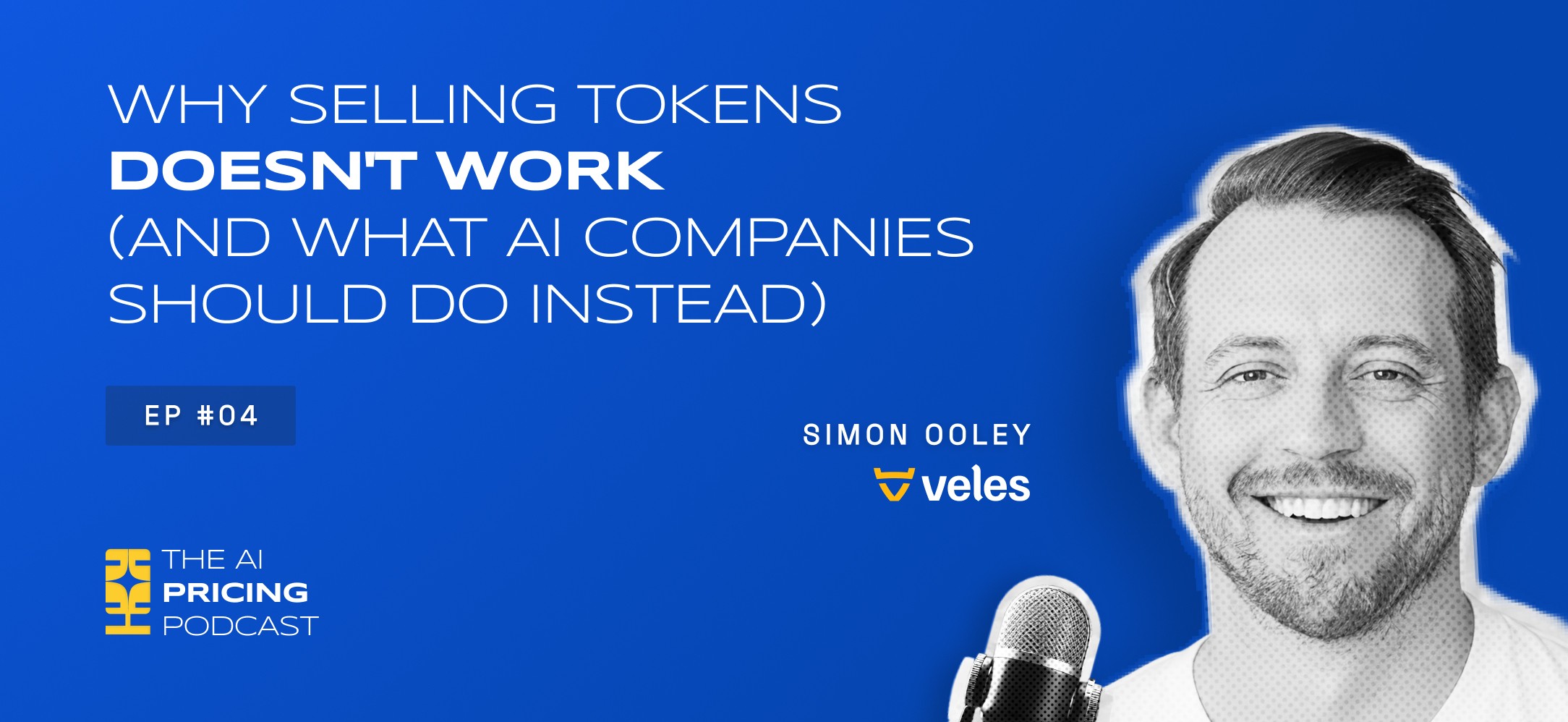
Aanchal ParmarWhy Selling Tokens Doesn't Work (And What AI Companies Should Do Instead) with Simon Ooley
Why Selling Tokens Doesn't Work (And What AI Companies Should Do Instead) with Simon Ooley
Feb 4, 2026
Feb 4, 2026
Feb 4, 2026
• 9 min read
• 9 min read


Aanchal Parmar
Product Marketing Manager, Flexprice


"5,000 tokens or 5 million tokens means nothing to a buyer, but the outcome they get with those tokens means everything."
That's Simon Ooley, CEO of Veles, describing a problem that's now unavoidable for anyone pricing AI products. The unit of sales has changed, but the way most companies sell hasn't caught up.
Tokens, credits, API calls these are infrastructure concepts. Buyers don't think in infrastructure. They think in outcomes, leads routed, contracts reviewed, reports generated.
When the pricing conversation starts with "you get X credits," it forces the buyer to do the translation work themselves. Most won't. They'll either undervalue the product or walk away confused.
Simon's answer to this is a framework he calls use case based sales. Instead of selling tokens or features, you sell the outcome the customer is trying to achieve and price against that.
It changes how deals get structured, how packaging works, and what your billing infrastructure needs to support.
This post breaks down the framework and what it takes to actually operationalize it.
The problem with selling AI products today
The packaging logic that worked for traditional SaaS assumed a stable relationship between product and use case. You buy a CRM to manage contacts.
You buy an HRIS to run payroll. The features are defined, the value is understood, and the price reflects that.
AI products don't work that way.
"The value of your AI products are not very clearly defined by your product and packaging anymore," Simon explains.
"If you buy any data provider or if you buy any cloud computing business, you're not buying a package that's well defined with value-add messaging in that package. You're just buying a bucket of credits or tokens."
This creates a justification problem. When a buyer is handed a quote for 50,000 credits, they have no reference point.
What does that get them?
How long will it last?
What happens when they run out?
The burden of value translation shifts entirely to the customer. It also creates a positioning problem. Products like n8n, Make, or even OpenAI's agent tools can automate almost anything which makes them almost impossible to pitch in a single sentence.
"It's almost impossible to tell one person what that product does for them because it could do anything," Simon says.
The result is that sales teams end up improvising, building spreadsheets outside the CPQ and creating one-off pricing models for each deal.
They explain the product differently depending on who they're talking to not because they're being strategic, but because the packaging gives them nothing to anchor on.
This is the gap use case based sales is designed to fill.
What is use case based sales?
The framework is simple in principle, instead of selling a product or a package, you sell the outcome the customer is trying to achieve.
"Use case-based sales takes into account all the old sales methodologies the MEDDIC, the Sandler selling all those things you can incorporate into this,"
Simon explains. "You're just reframing your product and packaging to the use case that the customer is looking to accomplish."
In practice, this means the sales conversation starts differently. Rather than walking through features or explaining credit tiers, the rep asks what the buyer is trying to get done.
Simon gives an example: "A customer comes to you and says, 'Hey, I'm looking to route inbound leads more effectively because we're not catching all of them and we could be making more money.' Okay, that is a fantastic use case. Let's build a model around that use case."
From there, the conversation shifts to scoping the outcome. What does success look like, what's the ROI, and what does it take to get there. Credits or tokens still exist, but they become a means to an end rather than the thing being sold.
"You're not buying a package that has X number of credits. You're buying the outcome of this use case. And to do that, we need to invest in this number of credits,"
Simon says. "The tokens are just an ancillary currency. It's not something that is our core package deliverable."
This reframe does two things. It makes the price easier to justify because it's tied to something concrete. And it makes the product easier to understand because the buyer isn't left guessing what their credits will actually get them.
Why does the outcome based selling approach works?
Every pricing model has a workaround. Seat licenses get shared
"you could sell five seats to a customer and then they can share all the passwords on one password and then there's 15 people using those five seats," Simon points out.
Credit systems get hoarded or gamed. Flat fees get arbitraged by heavy users.
Outcome based pricing is harder to manipulate because the incentive structure changes.
"Whatever pricing model you have, you can gamify it," Simon says. "But I think the closer you get to the desired outcome, the harder it's going to be to gamify and the easier it's going to be to justify that spend."
The logic is simple when spending more directly produces more of the thing the buyer wants, the conversation stops being about budget optimization and starts being about value capture.
Simon draws on cloud computing as a reference point.
"You're not going in there looking to spend $50,000. You're not setting a budget to say, okay, I'm only going to spend $50,000. If you need to compute more to deliver for your customers, you're going to spend more because that's the desired outcome."
The same principle applies to AI products when priced around outcomes. Less spend means less of the result. More spend means more. There's no arbitrage opportunity because the price and the value move together.
"Pricing, margin ideally goes up as they buy more, but then ROI goes up, their outcomes—everything is going in that direction," Simon explains. "And that's how you build that virality and that scale as a business."
This alignment also removes friction from expansion conversations. When the customer already understands that more investment equals more output, upsells stop feeling like negotiation and start feeling like a natural next step.
What changes across packaging, pricing, and compensation
Adopting use case based sales isn't just a messaging shift. It restructures how the go-to-market motion operates.
1. Packaging becomes use case-driven, not feature-driven
Traditional SaaS packaging lists features and caps. Use case-based packaging starts with what buyers are trying to accomplish and works backward to what that requires.
"The packages are not about the feature flags and the predefined outcomes," Simon says. "It's more about, hey, this is why people buy it here are the use cases they look to accomplish, not the features and functionality."
On a pricing page, this might look like: "Most companies in the startup space will buy 50,000 credits to accomplish this use case, this use case, this use case.
Most companies in the enterprise will spend five million credits to accomplish this use case, this use case, this use case." The packaging communicates what buyers can get done, not just what they get access to.
2. Pricing moves away from cost-plus logic
When your price is tied to the cost of the underlying model, you're exposed every time that cost shifts. And you're racing competitors to the bottom.
"Focus on the value you're providing," Simon advises. "Make sure your margin for cost is aligning with your financial model. But essentially, don't do cost-plus." When pricing reflects outcomes, model cost reductions improve margin instead of compressing price.
There's another layer here. Not all tokens are equal. "Every token spent on inbound is drastically more valuable than every token spent on outbound," Simon explains.
A use case that captures high-intent demand is worth more than one that automates routine tasks even if both consume the same credits.
3. Compensation rewards growth, not just acquisition
Traditional SaaS comp structures incentivize new logos. The rep closes the deal, gets paid, and moves on. What happens next is someone else's problem.
"Traditional SaaS is new logo. Bang. I'm just going to throw this deal in, throw the grenade over the fence to customer success,"
Simon says. "That pays out the individual contributor, but it doesn't pay out the business in the long term."
Use case-based selling changes this. Reps should be stack ranking use cases with each account, landing the most urgent ones first, and expanding over time.
"Any use cases that you've modeled out with them that they want to accomplish that aren't top of mind right now is the clearest path to white space upsell and cross-selling in the future."
The comp structure has to reflect that. "If you can tie compensation of your reps to consumption growth within an account, it's going to set everybody on the same path. Everyone aligns towards business growth."
What this demands from your billing infrastructure
Use case-based sales sounds good in theory. In practice, it falls apart if the billing layer can't keep up.
Simon describes what happens when it doesn't:
"We were just rebuilding all that logic in a Google spreadsheet or an Excel spreadsheet and doing all pricing and packaging outside of the CPQ which of course leads to discrepancies between the spreadsheet and the source of truth."
The result is reps quoting one thing, finance seeing another, and no one trusting the numbers.
It also makes onboarding painful.
"It was really difficult to train any new reps when they came on because it's like, hey, here's how you do this crazy click path in the CPQ, but also here's this spreadsheet and please don't click any cells but the ones that are highlighted in yellow or else you're going to break it."
To actually operationalize use case-based selling, billing infrastructure needs to support a few things:
Hybrid pricing models
Most AI companies aren't going pure consumption overnight.
"What's working the best today is package plus consumption or package plus usage," Simon says. "Hey, you're going to buy X number of seats plus you get this limit of credits, you can always buy more."
The billing system has to support that blend natively not through workarounds.
Real-time usage tracking
If reps are scoping deals around use cases and credit estimates, they need visibility into how those credits are actually being consumed.
So does the customer. Delayed or batch-based metering makes it impossible to have informed conversations about expansion.
Flexible entitlements
Different customers buy different use case bundles. The system has to support that without requiring engineering work every time a new configuration is sold.
Room to experiment
Pricing in AI is not settled. Companies need to test models, credit tiers, outcome-based pricing, hybrid structures without rebuilding their billing stack each time.
Legacy billing tools were built for subscription logic: fixed seats, annual contracts, predictable revenue. They weren't designed for the variability and experimentation AI pricing requires.
Tools like Flexprice exist specifically to close that gap built for real-time usage, credits, and pricing experimentation rather than retrofitting subscription infrastructure to do something it wasn't made for.
The direction AI pricing is headed
Simon's advice for founders thinking about pricing is blunt:
"Simplicity is key. Number one. Number two, focus on the desired outcome that you're looking to solve for your customer and have candid conversations about how much that use case is worth."
That's the core of use case-based sales. Not clever packaging. Not complex credit tiers. Just a clear answer to: what are you solving for them, and how do you price against that?
The companies that figure this out early have an advantage. They're not just selling differently they're building a revenue model that scales with customer value, aligns internal incentives, and doesn't collapse when foundation model costs shift.
"It's going to be more important than ever to really be modeling the right use cases for a business," Simon says. That's where the leverage is. Not in the tokens. In what the tokens accomplish.

What is use case based sales?
The framework is simple in principle, instead of selling a product or a package, you sell the outcome the customer is trying to achieve.
"Use case-based sales takes into account all the old sales methodologies the MEDDIC, the Sandler selling all those things you can incorporate into this,"
Simon explains. "You're just reframing your product and packaging to the use case that the customer is looking to accomplish."
In practice, this means the sales conversation starts differently. Rather than walking through features or explaining credit tiers, the rep asks what the buyer is trying to get done.
Simon gives an example: "A customer comes to you and says, 'Hey, I'm looking to route inbound leads more effectively because we're not catching all of them and we could be making more money.' Okay, that is a fantastic use case. Let's build a model around that use case."
From there, the conversation shifts to scoping the outcome. What does success look like, what's the ROI, and what does it take to get there. Credits or tokens still exist, but they become a means to an end rather than the thing being sold.
"You're not buying a package that has X number of credits. You're buying the outcome of this use case. And to do that, we need to invest in this number of credits,"
Simon says. "The tokens are just an ancillary currency. It's not something that is our core package deliverable."
This reframe does two things. It makes the price easier to justify because it's tied to something concrete. And it makes the product easier to understand because the buyer isn't left guessing what their credits will actually get them.
Why does the outcome based selling approach works?
Every pricing model has a workaround. Seat licenses get shared
"you could sell five seats to a customer and then they can share all the passwords on one password and then there's 15 people using those five seats," Simon points out.
Credit systems get hoarded or gamed. Flat fees get arbitraged by heavy users.
Outcome based pricing is harder to manipulate because the incentive structure changes.
"Whatever pricing model you have, you can gamify it," Simon says. "But I think the closer you get to the desired outcome, the harder it's going to be to gamify and the easier it's going to be to justify that spend."
The logic is simple when spending more directly produces more of the thing the buyer wants, the conversation stops being about budget optimization and starts being about value capture.
Simon draws on cloud computing as a reference point.
"You're not going in there looking to spend $50,000. You're not setting a budget to say, okay, I'm only going to spend $50,000. If you need to compute more to deliver for your customers, you're going to spend more because that's the desired outcome."
The same principle applies to AI products when priced around outcomes. Less spend means less of the result. More spend means more. There's no arbitrage opportunity because the price and the value move together.
"Pricing, margin ideally goes up as they buy more, but then ROI goes up, their outcomes—everything is going in that direction," Simon explains. "And that's how you build that virality and that scale as a business."
This alignment also removes friction from expansion conversations. When the customer already understands that more investment equals more output, upsells stop feeling like negotiation and start feeling like a natural next step.
What changes across packaging, pricing, and compensation
Adopting use case based sales isn't just a messaging shift. It restructures how the go-to-market motion operates.
1. Packaging becomes use case-driven, not feature-driven
Traditional SaaS packaging lists features and caps. Use case-based packaging starts with what buyers are trying to accomplish and works backward to what that requires.
"The packages are not about the feature flags and the predefined outcomes," Simon says. "It's more about, hey, this is why people buy it here are the use cases they look to accomplish, not the features and functionality."
On a pricing page, this might look like: "Most companies in the startup space will buy 50,000 credits to accomplish this use case, this use case, this use case.
Most companies in the enterprise will spend five million credits to accomplish this use case, this use case, this use case." The packaging communicates what buyers can get done, not just what they get access to.
2. Pricing moves away from cost-plus logic
When your price is tied to the cost of the underlying model, you're exposed every time that cost shifts. And you're racing competitors to the bottom.
"Focus on the value you're providing," Simon advises. "Make sure your margin for cost is aligning with your financial model. But essentially, don't do cost-plus." When pricing reflects outcomes, model cost reductions improve margin instead of compressing price.
There's another layer here. Not all tokens are equal. "Every token spent on inbound is drastically more valuable than every token spent on outbound," Simon explains.
A use case that captures high-intent demand is worth more than one that automates routine tasks even if both consume the same credits.
3. Compensation rewards growth, not just acquisition
Traditional SaaS comp structures incentivize new logos. The rep closes the deal, gets paid, and moves on. What happens next is someone else's problem.
"Traditional SaaS is new logo. Bang. I'm just going to throw this deal in, throw the grenade over the fence to customer success,"
Simon says. "That pays out the individual contributor, but it doesn't pay out the business in the long term."
Use case-based selling changes this. Reps should be stack ranking use cases with each account, landing the most urgent ones first, and expanding over time.
"Any use cases that you've modeled out with them that they want to accomplish that aren't top of mind right now is the clearest path to white space upsell and cross-selling in the future."
The comp structure has to reflect that. "If you can tie compensation of your reps to consumption growth within an account, it's going to set everybody on the same path. Everyone aligns towards business growth."
What this demands from your billing infrastructure
Use case-based sales sounds good in theory. In practice, it falls apart if the billing layer can't keep up.
Simon describes what happens when it doesn't:
"We were just rebuilding all that logic in a Google spreadsheet or an Excel spreadsheet and doing all pricing and packaging outside of the CPQ which of course leads to discrepancies between the spreadsheet and the source of truth."
The result is reps quoting one thing, finance seeing another, and no one trusting the numbers.
It also makes onboarding painful.
"It was really difficult to train any new reps when they came on because it's like, hey, here's how you do this crazy click path in the CPQ, but also here's this spreadsheet and please don't click any cells but the ones that are highlighted in yellow or else you're going to break it."
To actually operationalize use case-based selling, billing infrastructure needs to support a few things:
Hybrid pricing models
Most AI companies aren't going pure consumption overnight.
"What's working the best today is package plus consumption or package plus usage," Simon says. "Hey, you're going to buy X number of seats plus you get this limit of credits, you can always buy more."
The billing system has to support that blend natively not through workarounds.
Real-time usage tracking
If reps are scoping deals around use cases and credit estimates, they need visibility into how those credits are actually being consumed.
So does the customer. Delayed or batch-based metering makes it impossible to have informed conversations about expansion.
Flexible entitlements
Different customers buy different use case bundles. The system has to support that without requiring engineering work every time a new configuration is sold.
Room to experiment
Pricing in AI is not settled. Companies need to test models, credit tiers, outcome-based pricing, hybrid structures without rebuilding their billing stack each time.
Legacy billing tools were built for subscription logic: fixed seats, annual contracts, predictable revenue. They weren't designed for the variability and experimentation AI pricing requires.
Tools like Flexprice exist specifically to close that gap built for real-time usage, credits, and pricing experimentation rather than retrofitting subscription infrastructure to do something it wasn't made for.
The direction AI pricing is headed
Simon's advice for founders thinking about pricing is blunt:
"Simplicity is key. Number one. Number two, focus on the desired outcome that you're looking to solve for your customer and have candid conversations about how much that use case is worth."
That's the core of use case-based sales. Not clever packaging. Not complex credit tiers. Just a clear answer to: what are you solving for them, and how do you price against that?
The companies that figure this out early have an advantage. They're not just selling differently they're building a revenue model that scales with customer value, aligns internal incentives, and doesn't collapse when foundation model costs shift.
"It's going to be more important than ever to really be modeling the right use cases for a business," Simon says. That's where the leverage is. Not in the tokens. In what the tokens accomplish.
What is use case based sales?
The framework is simple in principle, instead of selling a product or a package, you sell the outcome the customer is trying to achieve.
"Use case-based sales takes into account all the old sales methodologies the MEDDIC, the Sandler selling all those things you can incorporate into this,"
Simon explains. "You're just reframing your product and packaging to the use case that the customer is looking to accomplish."
In practice, this means the sales conversation starts differently. Rather than walking through features or explaining credit tiers, the rep asks what the buyer is trying to get done.
Simon gives an example: "A customer comes to you and says, 'Hey, I'm looking to route inbound leads more effectively because we're not catching all of them and we could be making more money.' Okay, that is a fantastic use case. Let's build a model around that use case."
From there, the conversation shifts to scoping the outcome. What does success look like, what's the ROI, and what does it take to get there. Credits or tokens still exist, but they become a means to an end rather than the thing being sold.
"You're not buying a package that has X number of credits. You're buying the outcome of this use case. And to do that, we need to invest in this number of credits,"
Simon says. "The tokens are just an ancillary currency. It's not something that is our core package deliverable."
This reframe does two things. It makes the price easier to justify because it's tied to something concrete. And it makes the product easier to understand because the buyer isn't left guessing what their credits will actually get them.
Why does the outcome based selling approach works?
Every pricing model has a workaround. Seat licenses get shared
"you could sell five seats to a customer and then they can share all the passwords on one password and then there's 15 people using those five seats," Simon points out.
Credit systems get hoarded or gamed. Flat fees get arbitraged by heavy users.
Outcome based pricing is harder to manipulate because the incentive structure changes.
"Whatever pricing model you have, you can gamify it," Simon says. "But I think the closer you get to the desired outcome, the harder it's going to be to gamify and the easier it's going to be to justify that spend."
The logic is simple when spending more directly produces more of the thing the buyer wants, the conversation stops being about budget optimization and starts being about value capture.
Simon draws on cloud computing as a reference point.
"You're not going in there looking to spend $50,000. You're not setting a budget to say, okay, I'm only going to spend $50,000. If you need to compute more to deliver for your customers, you're going to spend more because that's the desired outcome."
The same principle applies to AI products when priced around outcomes. Less spend means less of the result. More spend means more. There's no arbitrage opportunity because the price and the value move together.
"Pricing, margin ideally goes up as they buy more, but then ROI goes up, their outcomes—everything is going in that direction," Simon explains. "And that's how you build that virality and that scale as a business."
This alignment also removes friction from expansion conversations. When the customer already understands that more investment equals more output, upsells stop feeling like negotiation and start feeling like a natural next step.
What changes across packaging, pricing, and compensation
Adopting use case based sales isn't just a messaging shift. It restructures how the go-to-market motion operates.
1. Packaging becomes use case-driven, not feature-driven
Traditional SaaS packaging lists features and caps. Use case-based packaging starts with what buyers are trying to accomplish and works backward to what that requires.
"The packages are not about the feature flags and the predefined outcomes," Simon says. "It's more about, hey, this is why people buy it here are the use cases they look to accomplish, not the features and functionality."
On a pricing page, this might look like: "Most companies in the startup space will buy 50,000 credits to accomplish this use case, this use case, this use case.
Most companies in the enterprise will spend five million credits to accomplish this use case, this use case, this use case." The packaging communicates what buyers can get done, not just what they get access to.
2. Pricing moves away from cost-plus logic
When your price is tied to the cost of the underlying model, you're exposed every time that cost shifts. And you're racing competitors to the bottom.
"Focus on the value you're providing," Simon advises. "Make sure your margin for cost is aligning with your financial model. But essentially, don't do cost-plus." When pricing reflects outcomes, model cost reductions improve margin instead of compressing price.
There's another layer here. Not all tokens are equal. "Every token spent on inbound is drastically more valuable than every token spent on outbound," Simon explains.
A use case that captures high-intent demand is worth more than one that automates routine tasks even if both consume the same credits.
3. Compensation rewards growth, not just acquisition
Traditional SaaS comp structures incentivize new logos. The rep closes the deal, gets paid, and moves on. What happens next is someone else's problem.
"Traditional SaaS is new logo. Bang. I'm just going to throw this deal in, throw the grenade over the fence to customer success,"
Simon says. "That pays out the individual contributor, but it doesn't pay out the business in the long term."
Use case-based selling changes this. Reps should be stack ranking use cases with each account, landing the most urgent ones first, and expanding over time.
"Any use cases that you've modeled out with them that they want to accomplish that aren't top of mind right now is the clearest path to white space upsell and cross-selling in the future."
The comp structure has to reflect that. "If you can tie compensation of your reps to consumption growth within an account, it's going to set everybody on the same path. Everyone aligns towards business growth."
What this demands from your billing infrastructure
Use case-based sales sounds good in theory. In practice, it falls apart if the billing layer can't keep up.
Simon describes what happens when it doesn't:
"We were just rebuilding all that logic in a Google spreadsheet or an Excel spreadsheet and doing all pricing and packaging outside of the CPQ which of course leads to discrepancies between the spreadsheet and the source of truth."
The result is reps quoting one thing, finance seeing another, and no one trusting the numbers.
It also makes onboarding painful.
"It was really difficult to train any new reps when they came on because it's like, hey, here's how you do this crazy click path in the CPQ, but also here's this spreadsheet and please don't click any cells but the ones that are highlighted in yellow or else you're going to break it."
To actually operationalize use case-based selling, billing infrastructure needs to support a few things:
Hybrid pricing models
Most AI companies aren't going pure consumption overnight.
"What's working the best today is package plus consumption or package plus usage," Simon says. "Hey, you're going to buy X number of seats plus you get this limit of credits, you can always buy more."
The billing system has to support that blend natively not through workarounds.
Real-time usage tracking
If reps are scoping deals around use cases and credit estimates, they need visibility into how those credits are actually being consumed.
So does the customer. Delayed or batch-based metering makes it impossible to have informed conversations about expansion.
Flexible entitlements
Different customers buy different use case bundles. The system has to support that without requiring engineering work every time a new configuration is sold.
Room to experiment
Pricing in AI is not settled. Companies need to test models, credit tiers, outcome-based pricing, hybrid structures without rebuilding their billing stack each time.
Legacy billing tools were built for subscription logic: fixed seats, annual contracts, predictable revenue. They weren't designed for the variability and experimentation AI pricing requires.
Tools like Flexprice exist specifically to close that gap built for real-time usage, credits, and pricing experimentation rather than retrofitting subscription infrastructure to do something it wasn't made for.
The direction AI pricing is headed
Simon's advice for founders thinking about pricing is blunt:
"Simplicity is key. Number one. Number two, focus on the desired outcome that you're looking to solve for your customer and have candid conversations about how much that use case is worth."
That's the core of use case-based sales. Not clever packaging. Not complex credit tiers. Just a clear answer to: what are you solving for them, and how do you price against that?
The companies that figure this out early have an advantage. They're not just selling differently they're building a revenue model that scales with customer value, aligns internal incentives, and doesn't collapse when foundation model costs shift.
"It's going to be more important than ever to really be modeling the right use cases for a business," Simon says. That's where the leverage is. Not in the tokens. In what the tokens accomplish.



Aanchal Parmar
Aanchal Parmar
Aanchal Parmar
Aanchal Parmar heads content marketing at Flexprice.io. She’s been in the content for seven years across SaaS, Web3, and now AI infra. When she’s not writing about monetization, she’s either signing up for a new dance class or testing a recipe that’s definitely too ambitious for a weeknight.
Share it on: