
Aanchal Parmar
Product Marketing Manager, Flexprice

Usage-based billing is a pricing model where customers pay for what they actually consume, whether that's API calls, tokens, compute minutes, or storage, instead of a fixed flat fee. AWS popularized it in 2006 with pay-as-you-go compute pricing.
Today it's the default across AI and developer tooling: in our June 2026 analysis of 50 AI products, 46 had a usage component somewhere in their pricing.
The model sounds simple on paper. Track usage, calculate a price, send an invoice but in reality is much more complex than this.
This guide covers all of it: the usage based pricing models, the mechanics, the real complexity underneath, and which categories of companies are running it today.
TL;DR
Usage-based billing charges customers based on actual consumption rather than a fixed fee, directly linking cost to value.
The five most common billing models are tiered pricing, prepaid credits, pay-per-use, overage fees, and volume-based pricing. Most AI tools stack two or three of these on a single pricing page.
Building it in production means solving three sequential problems: metering (capturing and trusting every event), rating (turning usage into a price), and invoicing (producing a statement customers can audit and trust).
As of June 2026, usage-based billing is near-universal in AI infrastructure, voice AI, and developer tooling. Flat per-seat pricing is increasingly rare in these categories.
What is usage based billing?
Usage based billing, also called metered billing, means you pay only for what you use for example, API calls, data storage, or compute time instead of paying a fixed flat fee. This model directly links your costs to the value you get from the product.
This pricing model is widely used and adapted by AI and SaaS companies because this not only gives relief to the customer but also to you as a company.
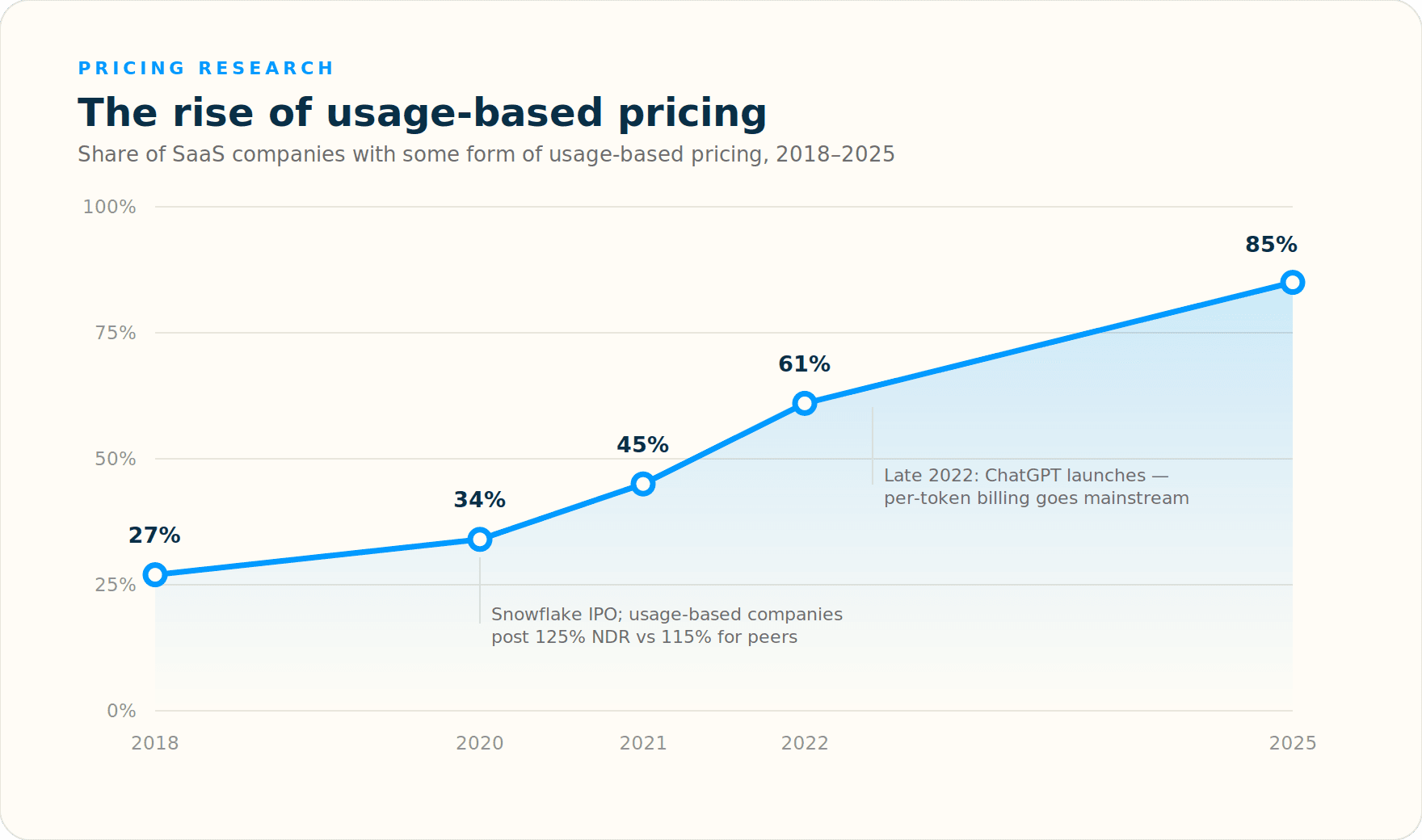
We got introduced to usage based billing for the first time when AWS popularized pay-as-you-go in 2006 and then SaaS adoption nearly doubled by 2022 and today every AI company has cemented its popularity.
How does usage based billing works?
If you dissect the process of usage based billing it’s kinda straightforward.
First you need to think of metering as in how are you going to track or monitor the data.
Next you need to apply the rating logic which is about how’re you going to calculate the data and there are ways to do this, people get real creative here.
Then it’s invoicing or billing where you aggregate the data in a statement (mostly this is monthly) and send it as a bill to the customer.
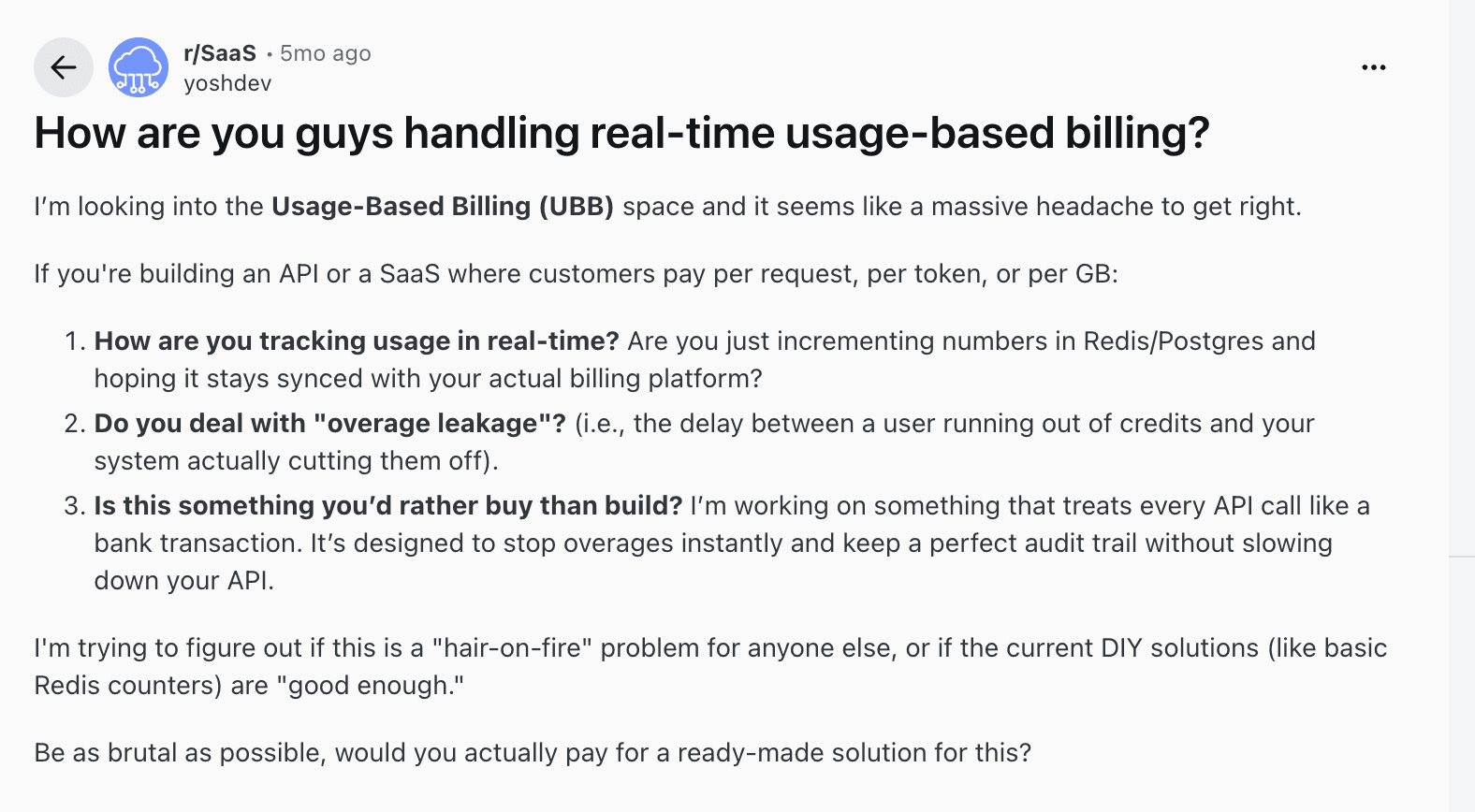
It looks extremely simple but people are losing their brains over this three step process. Because it looks simple on the surface, however when you try to implement and manage it, sadly it isn't.
What does it take to run usage-based billing in production?
I’ll do my best to explain at least 10% of the complexity of the entire process that goes in usage based billing.
Step 01: Metering
Look, metering has one job. It needs to capture every billable action as an event and decide whether to trust it.
Every time your customer's app does something that counts as billable, an API call, a token generated, a minute of voice, it fires an event. The event carries three things, who did it, when it happened, and what exactly happened.
Now here’s where it gets complicated! Before an event gets counted, it has to clear three questions:
Deduplication and idempotency
This means "Have I seen you before?" Networks retry. SDKs retry. Your customer's code retries. None of this is a bug, retrying failed requests is how reliable systems are built.
The same event can arrive twice, and if you count it twice, you just overcharged someone and that’s yikes.
So every event needs a unique fingerprint (an idempotency key), and your system has to check every incoming event against everything it has already seen. At a few billion events a month, that lookup alone is an engineering problem.
Event time vs arrival time.
Now this means "When did you actually happen?"
An event generated at 11:58 PM on the 31st might arrive at 12:04 AM on the 1st. Which month does it belong to?
You have to bill on event time (when it happened), not ingestion time (when it reached you). Which means a billing period is never really closed. There's always a late-arriving event showing up after you've tallied the numbers, and you need a policy for what happens then.
Ingestion at scale
This means, "Can I even handle you right now?" Your customer launches a new product and goes from 1 million events a day to 100 million overnight. And that’s when we say suffering from success.
An analytics tool can drop events under load and nobody dies. A billing system that drops events is losing revenue, and there's no error message for money you never knew you missed.
So every dropped, duplicated, or misplaced event is either revenue leakage or an angry customer. There is no "approximately correct" here.
Step 02: Rating
Rating means take the counted usage and turn it into a price.
This is where people get creative, and creativity is exactly what makes it painful. Before a number becomes a charge, it clears another set of questions.
Price resolution hierarchy
Enterprise customers have negotiated rates, old customers are grandfathered, and new signups get the current plan.
Pricing isn’t a simple lookup, it’s a resolution order. It will be contract override then customer-specific pricing and then plan default.
Tiered vs volume pricing
Tiered pricing splits one usage number into multiple charges. Volume pricing reprices the entire quantity when a threshold is crossed, so 1,000,001 units can cost less than 999,999. Your customers will notice.
Credits and commitments
Prepaid credits burn before anything hits the invoice, with expiry dates and burn priorities, so you're doing inventory accounting on money. Add monthly minimums and annual commits with true-ups, and rating one month depends on the whole year's position.
Decimal precision
When a token costs $0.000003 multiplied across a billion events, floating point math drifts by real money. You need fixed-point decimals and explicit rounding rules, because rounding per event vs per line item changes the invoice by thousands at scale.
Step 03- Invoicing
Invoicing is all about getting those $$$$. But before that the system needs to convert the usage into a statement that your customer can trust.
Proration
Every customer's cycle is anchored differently, and a mid-cycle upgrade splits one period into two, forcing proration on both the flat fee and the included usage allowance.
Dashboard-to-invoice consistency
Your customer watched a live usage dashboard all month. If the dashboard says 1,042,113 and the invoice says 1,041,997, you have a trust problem, even when the invoice is correct.
Auditability
A customer disputes their March invoice in June. You need to trace every line item back to the exact events that produced it and reproduce the same number months later. If you can't, the dispute goes their way.
The whole pipeline is four questions in order, trust it, count it, price it, prove it. Every billing horror story is a failure at one of those gates.
What are the most popular usage-based billing models?
In June 2026 I analyzed 50 AI and SaaS tool’s pricing pages across developer tools, voice AI, video AI, Martech, fintech, and AI infrastructure.
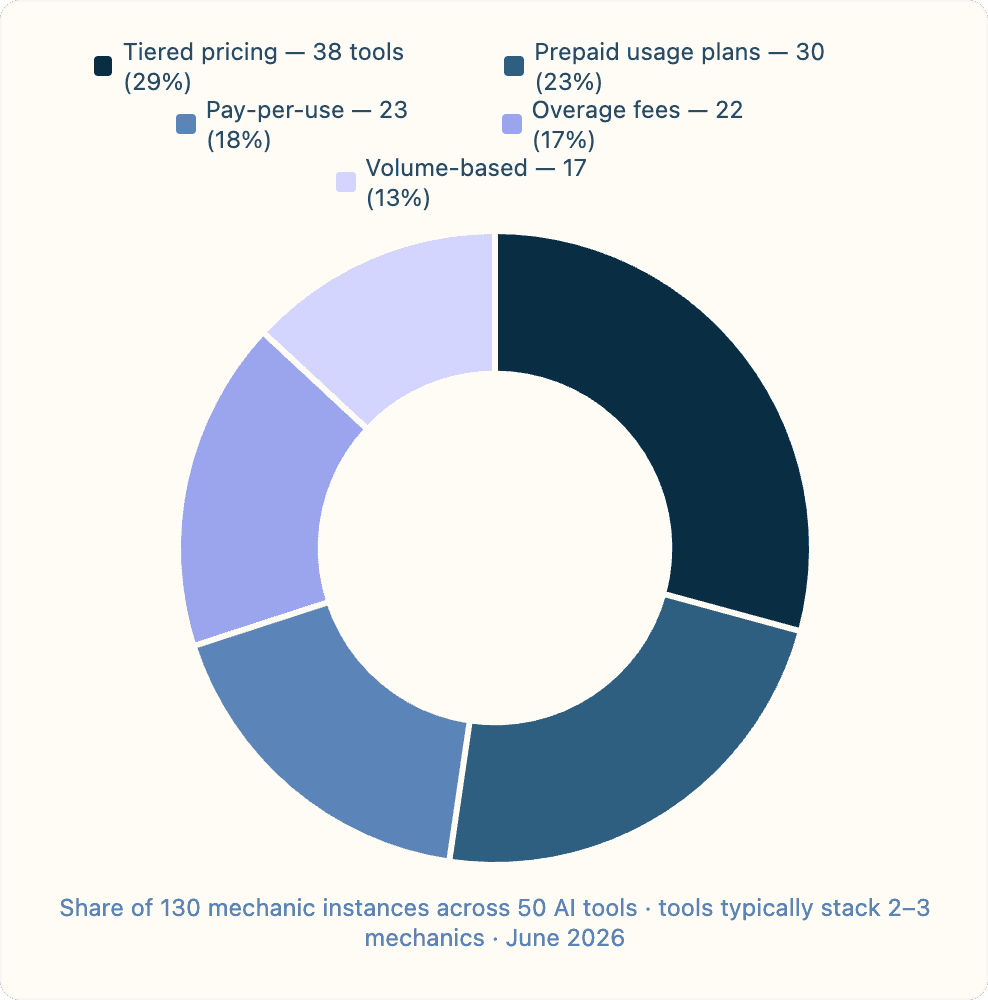
The five most popular usage-based billing models are tiered pricing, prepaid usage plans (credits), pay-per-use, overage fees, and volume-based pricing. And as per my analysis most products don't pick one, the typical AI tool stacks two to three of these mechanics in a single pricing page.
Tiered pricing
Tiered pricing is an usage based billing model where usage is packaged into multiple plans. And they usually look like Starter, Pro, Enterprise each with its own price, feature set, and usage allowance.
Cursor is a typical example, Pro at $20/month, Pro+ at $60, and Ultra at $200, each bundling a larger usage allowance. It suits products serving distinct customer segments, from hobbyists to teams, where buyers want a predictable monthly number before committing.
My pricing-page analysis found it in 38 of 50 AI tools which makes it the most common mechanic by a wide margin because the tier sets the buyer's budget while a usage meter runs underneath it.
Prepaid usage plans (credits)
Prepaid usage plans are a billing model where customers buy consumption upfront as a credit balance or monthly allowance that reduces as they use the product.
HeyGen's Creator plan, for example, includes 600 credits a month, and Vercel v0 bundles dollar-denominated credits into every tier.
They suit products where per-action compute costs vary widely like video generation, AI agents. And where vendors want to avoid bad debt and bill shock.
The analysis found it in 30 of 50 tools, near-universal in video AI (8 of 8), because credits decouple price from any raw unit and let vendors reprice models without changing the sticker.
Pay-per-use
Pay-per-use is a usage based billing model where customers are charged only for what they actually consume like per API call, per minute, per token with no subscription required.
Vapi charges $0.05 per call minute and Stripe Radar $0.02 per screened transaction. It suits developer-facing APIs and infrastructure, where usage scales directly with the customer's own production traffic and a subscription would only add friction.
Our analysis found it in 23 of 50 tools, concentrated exactly there all 8 AI infrastructure tools and 7 of 9 voice AI platforms. The closer a product sits to raw compute, the more likely it bills on pure usage based pricing.
Overage fees
Overage fees are charges for usage beyond a plan's included allowance, either auto-billed or sold as top-up packs.
Replit auto-bills usage past its included $25 monthly credits, while Runway sells extra credit packs on demand.
They suit plans that need to capture power users without forcing everyone onto a bigger tier. Our analysis found them in 22 of 50 tools, in two ways, soft overage (buy-more packs) and hard overage (auto-billing).
Hard overage draws the most backlash like Replit users report that they have received surprise $100–300 bills pushing many vendors toward prepaid wallets that simply deplete instead.
Volume-based pricing
Volume-based pricing is a usage based billing model where the unit price falls as consumption grows, through published rate tiers or negotiated commitments.
Bland AI's per-minute rate drops from $0.14 to $0.11 on higher plans, and Together AI discounts dedicated GPU clusters against commitments.
It suits high-volume and enterprise buyers willing to commit spend in exchange for better unit economics.
Our analysis found it in only 17 of 50 tools, the least visible mechanic, but misleadingly so most volume pricing hides behind "contact sales" as annual commits, especially in fintech (Plaid, Alloy) and AI infrastructure, rather than appearing on the public pricing page.
What are the benefits of using a usage based billing model?
First, you can forecast revenue more accurately because it moves in step with actual product usage, not just seat counts or annual contracts.
Second, you materially reduce your downside risk. A customer can never rack up 100 dollars of cost while sitting on a 50 dollar plan, because they only ever pay for what they actually consume.
Third, revenue scales with your infrastructure costs. As usage grows, both your cloud bill and your topline move together, which keeps margins more predictable at scale.
Finally, you get a much tighter price-value alignment. Customers pay in proportion to the value they extract, which cuts down on “we’re paying for something we don’t use” churn and makes expansion conversations feel like a rational trade, not a hard sell.
What are the challenges of using a usage based billing model?
The four biggest challenges of usage-based billing are building the metering and billing setup itself, handling complex invoicing, educating customers on how the pricing works, and preventing bill shock. None of them are reasons to avoid the model, but every company that adopts it runs into all four.
Managing the entire setup to track usage and bill people correctly
Before you can charge for usage, you have to capture it and ensure that every event is ingested reliably, deduplicated, and aggregated into something a rating engine can price.
Your billing is now only as good as your event pipeline. If a meter drops events, you leak revenue. If it double counts, you overcharge a customer and that’s a conversation I’m sure you don’t want to do.
Most teams underestimate this and end up with engineers spending quarters rebuilding metering instead of shipping products. Decide early whether this is infrastructure you want to own or buy. Because if you decide to own it you need to own the maintenance part of it as well.
Complex billing and invoicing
With usage and invoicing you are now handling proration on mid-cycle upgrades, credits that roll over, overage on top of a subscription floor, multiple meters with different units, and currency or tax rules layered on top.
Your finance team is answerable for this before your customers do. Closing the books gets slower, revenue recognition gets messy, and a single pricing change can mean weeks of billing logic work. The companies in our analysis running five or more meters, like LangSmith, have entire systems dedicated to getting this right.
Educating customers on the pricing model and their monthly invoice
If a customer cannot predict their bill, they will not trust it, and if they cannot read their invoice, they will dispute it.
That means your job does not end at the pricing page. You need calculators before the sale, live usage dashboards inside the product, and invoices with line items a non-technical buyer can actually follow.
Preventing the infamous bill shock for customers
One surprise bill can undo months of goodwill, and the angry screenshot ends up on social media with your logo on it.
Replit learned this the hard way when users started posting bills of $100 to $300 they never saw coming. The standard fixes are, spending alerts, hard caps customers can set themselves, and prepaid wallets that simply run out instead of auto-billing overage.
It is telling that the voice AI category, which bills pure usage, has almost no bill shock complaints because everyone uses prepaid balances. Design the safety rails before launch, not after the backlash.
Who uses usage-based billing?
Usage-based billing is now the default across AI and developer-facing software.
In our June 2026 analysis of 50 AI tools across six categories, 46 had a usage component somewhere in their pricing, and only 4 still sold flat per-seat plans with no meter at all.
What changes from category to category is not whether companies meter usage, but how they package it.
AI infrastructure companies
This is the purest usage-based category, all 8 infrastructure tools we analyzed bill on consumption. Modal and Replicate charge per GPU-second, Together AI and Fireworks charge per million tokens, and OpenRouter runs entirely on prepaid credits with a small take rate.
There are no seats anywhere. The buyer is a developer whose own traffic drives the cost, so the meter maps directly to value.
Voice AI platforms
Per-minute pricing is the category standard, used by 7 of the 9 voice tools we analyzed.
Vapi anchors at $0.05 per minute, Retell bills per second, and Deepgram charges $0.0043 per transcribed minute. Most pair this with prepaid wallets rather than overage, which is why the category sees so little bill shock.
Two vendors, Bland and Synthflow, even abandoned flat subscriptions in the past year to go fully usage-based.
AI coding and developer tools
Coding tools run hybrid models: a monthly subscription that includes a usage allowance, with overage on top.
Cursor bundles $20 of model usage into its $20 Pro plan, Replit includes $25 of credits, and GitHub Copilot moved every plan to usage-based AI credits in June 2026. Pure seat pricing survives only in niches like Tabnine and CodeRabbit.
Video AI products
Video AI wraps usage in prepaid credits, in all 8 of 8 tools we analyzed. Runway, HeyGen, Synthesia, and Luma all sell monthly credit allowances that deplete per second of generation, weighted by model quality. The category is also retreating from unlimited plans as GPU costs bite.
Martech and fintech companies
Martech platforms layer credits on a platform fee, like Clay's data credits or HubSpot's Breeze agents at $1 per qualified lead.
Fintech meters transactions: Stripe Radar charges $0.02 per screened transaction, Plaid bills per API call, and Sierra charges per resolved conversation. These two categories are also where outcome-based pricing, the next evolution of usage billing, is shipping first.
Is Usage-Based Billing the Right Model for Your SaaS?
Usage-based billing has moved from a niche pricing experiment to the default model across AI and developer tooling.
The data backs this up: 46 of the 50 AI products we analyzed in June 2026 meter usage in some form. The question for most companies today is not whether to adopt it, but how to implement it without the complexity eating your engineering roadmap.
The model works best when your product has a natural unit of consumption, your customers are developers or technical buyers who think in per-unit terms, and your infrastructure can support reliable event metering at scale.
When those three things are true, usage-based billing is the most honest pricing model you can run. Customers pay for what they get. Revenue grows as they grow. Expansion happens without a sales call.
The hard part is not the pricing logic. It is the pipeline underneath it. Metering that drops events leaks revenue silently.
Rating engines that cannot handle credits, overrides, and tiered thresholds produce invoices customers dispute. Dashboards that show different numbers than the invoice destroy trust that takes months to rebuild.
Most companies that struggle with usage-based billing do not have a pricing problem. They have an infrastructure problem.
If you are evaluating usage-based billing for your product, start by mapping your billable events before you touch your pricing page.
Know what you are metering, how you are handling duplicates, and what your invoice needs to prove before you go live. The pricing model you pick is only as good as the system behind it.
1. What is an example of usage-based billing?
What is the usage billing system?
What's the difference between usage-based billing and usage-based pricing?
Why does usage-based billing leak 4 to 9% of revenue?
How do I prevent bill shock for my customers?