
Ayush Parchure
Content Writer, Flexprice

Stripe's pricing page says 0.7% on top of payment processing for subscriptions, and most founders take that number at face value when they're sketching out a budget.
The bill you actually see six months in tells a different story, because Tax, Invoicing, fraud screening, disputes, and international card surcharges all stack on top in ways the homepage never really spells out.
The question isn't whether Stripe is good. The question is whether what you actually end up paying matches the shape of your business, especially if you're running an AI product or anything usage-heavy where Stripe's primitives start running out fast.
Every fee in this post comes from Stripe's pricing pages, and every limit comes from Stripe's own docs. By the end, you'll know whether Stripe is still your best call in 2026, or whether one of the alternatives now fits you better.
What people mean by Stripe subscription management
Half the founders evaluating Stripe blur three different things together, so let's separate them before you spend a dollar.
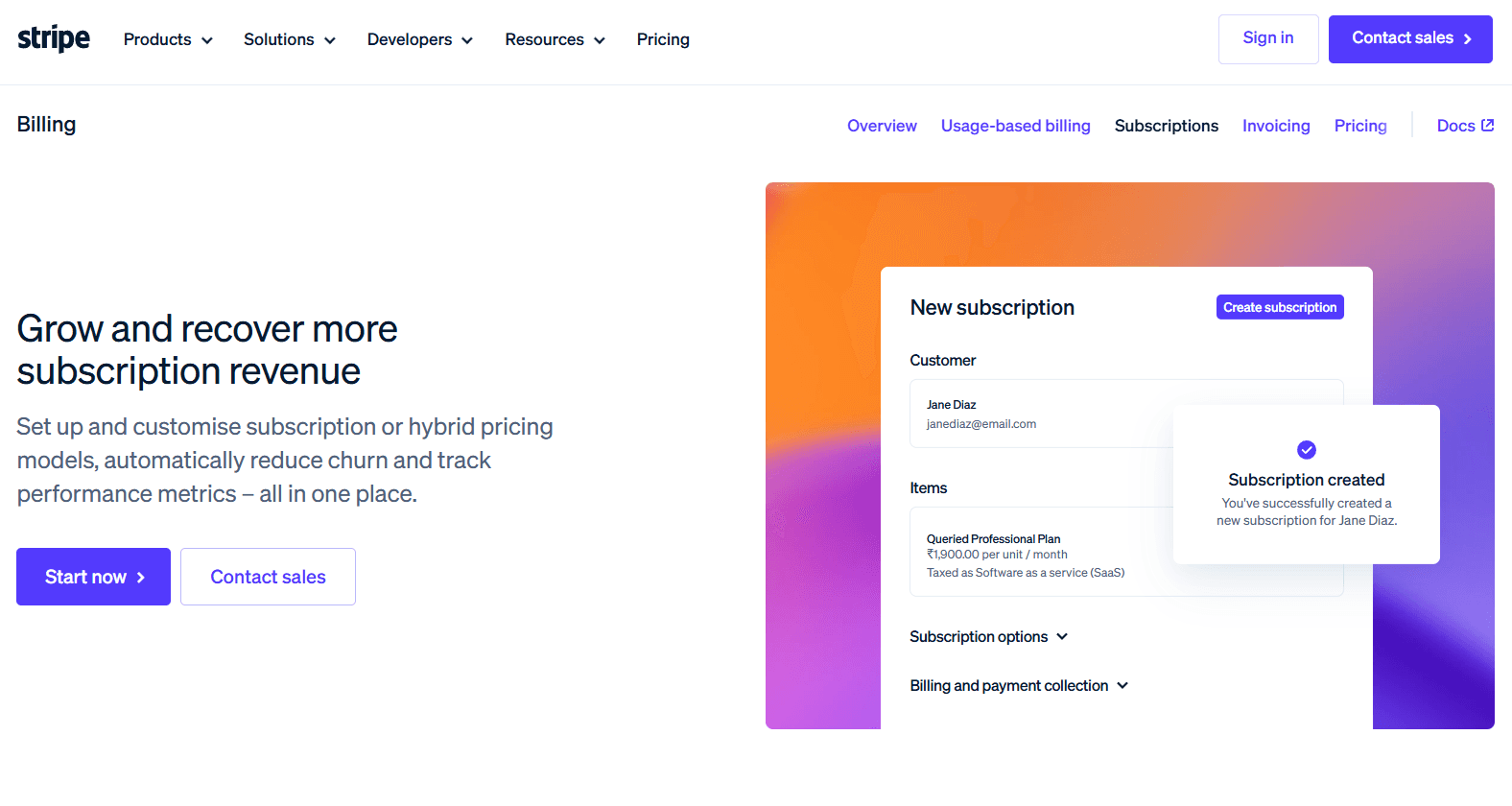
Stripe Billing is the paid product that runs your subscriptions. It covers recurring charges, usage metering, dunning, the customer portal, and quotes. A custom domain on your customer portal costs an extra $10 a month per the live Billing pricing page.
Stripe Subscriptions is the older API name. Stripe migrated existing Subscriptions users into the more expensive Billing product back in 2020, which kicked off a Hacker News thread that founders still link to.
Stripe Payments is the underlying card processor at 2.9% plus 30 cents on US domestic cards. You cannot use Billing without it. Payments and Billing show up as two separate fees on your statement.
One thing you should know before you read the cost section. In February 2026, Stripe acquired Metronome, the usage-billing platform that OpenAI and Anthropic were already running on. The Stripe Billing pricing page now redirects multi-dimensional usage rates and negotiated contracts to "Contact sales," which is Metronome territory.
That move tells you something about whether native Stripe Billing was ever built for the AI shape.
What you actually pay
Most evaluation pages stop at "2.9% plus 30 cents" and leave you to figure out the rest. Real subscription businesses pay more than that, and you should model the full stack before you sign.
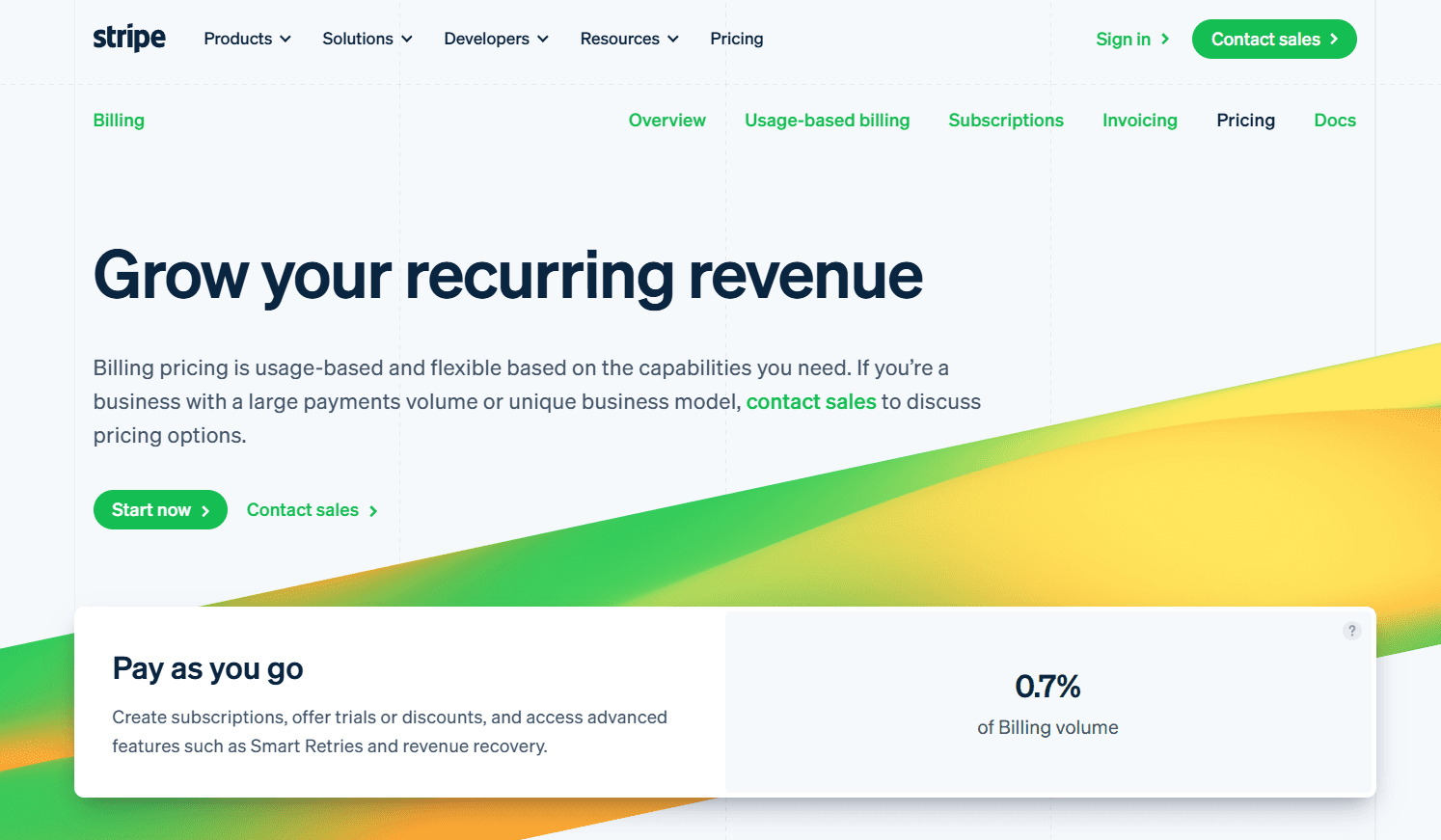
Stripe Billing's live pricing page shows one tier in 2026, called Pay as you go, at 0.7% of Billing volume
Source
Larger volume customers route to "Contact sales" above the 0.7% rate.
Underneath that, Stripe Payments charges 2.9% plus 30 cents on each successful US domestic transaction. International cards add 1.5%. Currency conversion adds another 1%. Manually entered cards add 0.5%.
The layers most teams forget to model
Once you start adding the products most subscription businesses actually need, the cost stack starts climbing in ways the homepage never makes obvious.
Stripe Tax costs 0.5% per transaction where you are registered to collect taxes. The API integration version costs $0.50 per transaction with 10 calculation calls included.
Stripe Invoicing comes in two tiers. Starter is 0.4% per paid invoice, and Plus (which adds quotes) is 0.5% per paid invoice.
Revenue Recognition runs 0.25% of volume, dropping to 0.2% once you're billing more than $100,000 a month.
Disputes carry a $15 charge per dispute received, and that fee is non-refundable. If you fight a dispute manually, Stripe applies an additional $15 counter-fee, which you only get back if you win. Smart Disputes (Stripe's AI auto-evidence product) charges 30% of the disputed amount if you win, and nothing if you lose.
Radar for Fraud Teams costs $0.02 per screened transaction on standard pricing. Adaptive Acceptance, the optional acceptance booster, adds 1% on top of accepted volume.
What you actually get for that 0.7%
The cost story is real, and the value story is real too. Here is what your Billing surcharge actually pays for:
Smart Retries, Stripe's machine-learning dunning engine, recovers 56% of failed recurring payments on average, and the AI-powered version recovers 9% more revenue than fixed-schedule retries.
The Customer Portal saves you from building self-serve account management yourself. Your customers update cards, cancel, switch plans, and view invoices on a Stripe-hosted page. The portal is included; only the custom domain ($10 a month) costs extra
Multi-phase subscription schedules let you set up trial-to-discount-to-renewal flows of up to 10 phases per subscription. If your contract pattern fits in 10 phases, this works; if it does not, the next section explains why.
Quotes now come bundled into the Pay as you go tier, so you can send a customer an estimate before turning it into a subscription.
Stripe Meters includes 100 million usage events a month at the 0.7% price. For most SaaS shapes, that headroom is plenty; for a high-throughput AI workload, it is not.
Recovery automations and invoice auto-reconciliation come bundled too, with three configurable retry and state automations plus auto-reconciliation for ACH and wire payments (helpful for B2B finance teams).
Where the 0.7% stops being worth it
The cost is one-half of the trade; the other half is what Stripe will actually let you build. For certain shapes (especially AI products and enterprise-contract heavy ones), the limits start hurting before the fee does.
The hard caps Stripe publishes in its own docs
Every limit below comes straight from Stripe's API and rate-limit documentation:
Live mode API limit: 100 operations per second globally, with a 25 requests per second default per endpoint.
Subscriptions API: 10 new invoices per subscription per minute, and 200 quantity updates per subscription per hour.
Subscription line items: capped at 20 per subscription.
Subscription schedule phases: capped at 10 current or future phases.
Meter events: the standard endpoint takes 1,000 events per second, and concurrency is limited to one call per customer per meter. If you need more throughput, you switch to Meter Event Streams (10,000 per second), and anything beyond that requires a sales conversation.

Why the 20-line-item cap hits AI products first
If you sell a multi-meter AI product, you almost certainly bill on more than 20 dimensions: input tokens, output tokens, image generations, function calls, vector operations, storage, embeddings, fine-tune storage, tool calls, and so on.
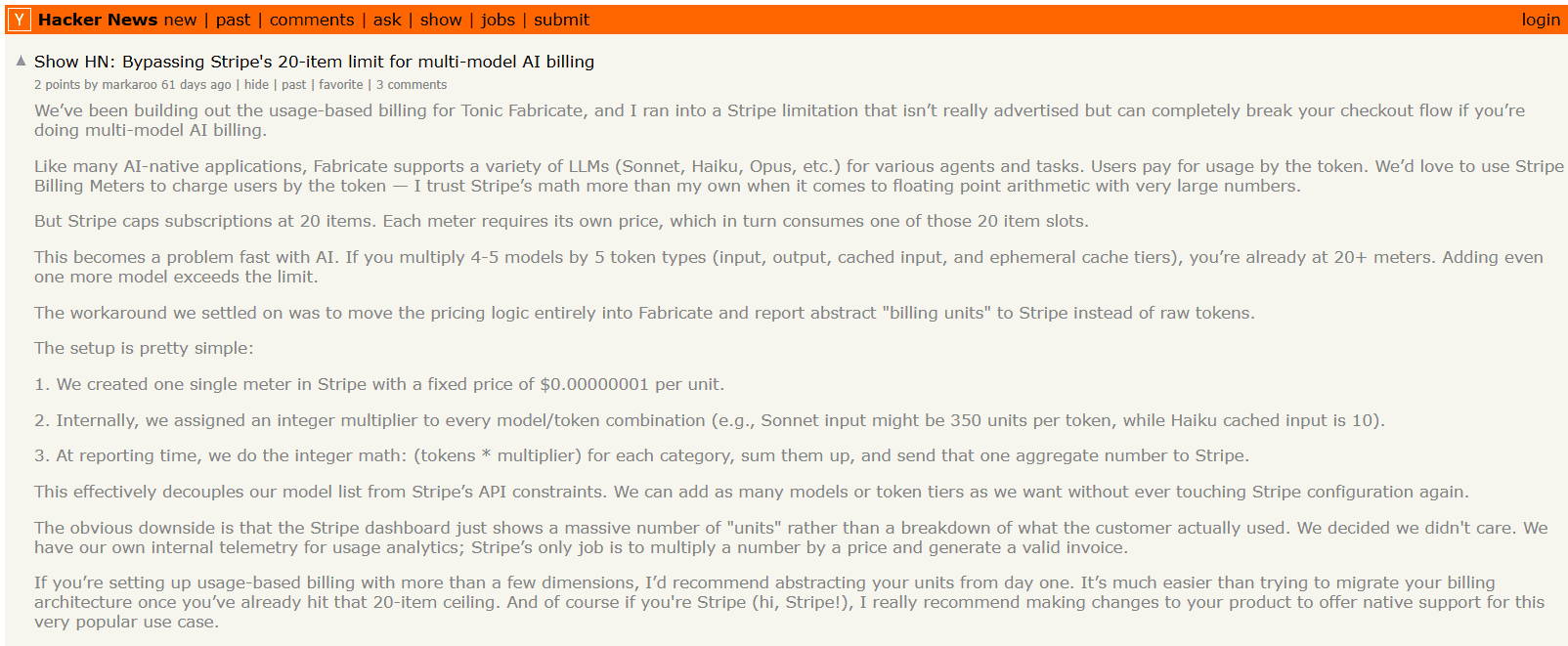
Stripe gives you 20 slots per subscription, and once you hit that ceiling, you have to split a single customer across multiple subscriptions, which splits your invoices, complicates your data model, and pushes the problem into your ops team.
The community workaround is documented in the Hacker News post:
The primitives that aren't in Stripe Billing
This list reads from Stripe's own documentation gaps, not a competitor pitch:
Ramped contracts get partial support through 10-phase schedules. If your enterprise deal looks like "$1,000 a month for the first 3 months, then $1,500 for 6 months, then $2,000 thereafter," you can model it. Anything more nuanced, or anything with mid-term changes, pushes you off native primitives.
Quote-to-renewal-to-amendment flow is not native. You can send quotes, but you cannot manage the full lifecycle from quote through renewal through mid-cycle amendment with version history, which is exactly what most enterprise sales motions need.
Committed usage with true-up gets partial support through credit grants, which are still in preview per stripe.com/billing/pricing. If a customer commits to 1 million API calls a month and burns through 1.2 million, you wire the overage logic yourself.
Parent-child customer hierarchies are not supported. A holding company with three subsidiaries that each have their own teams cannot share usage credits across the parent. You either create separate accounts and lose unified reporting, or you build the hierarchy yourself in your backend.
Granular usage filtering by dimension is partial. If you want to charge differently for GPT-4 input tokens versus GPT-4 Turbo input tokens versus image generations, you have to send separate event streams per variant, because Stripe does not filter on metadata inside a single event stream.
Rollover credits and custom-value credits are not supported natively. Stripe handles one-time and promotional credits well, but recurring grants with rollover caps and custom expiration logic need workarounds in your code.
Mid-term amendments with revision history are manual. When a customer renegotiates four months into a contract, Stripe shows you the current state, not the version history, and your finance team ends up rebuilding amendment trails in spreadsheets.
None of these gaps breaks Stripe for a card-charging, plan-based SaaS. They broke Stripe for the AI, agentic, and enterprise-contract shapes, which is the reason behind Stripe quietly outsourcing to Metronome in February.
What reviews say
Cost is one part of the picture. Sentiment is another, and the four big review sites tell different stories depending on who is writing.
G2's Stripe Billing (4.4 out of 5)
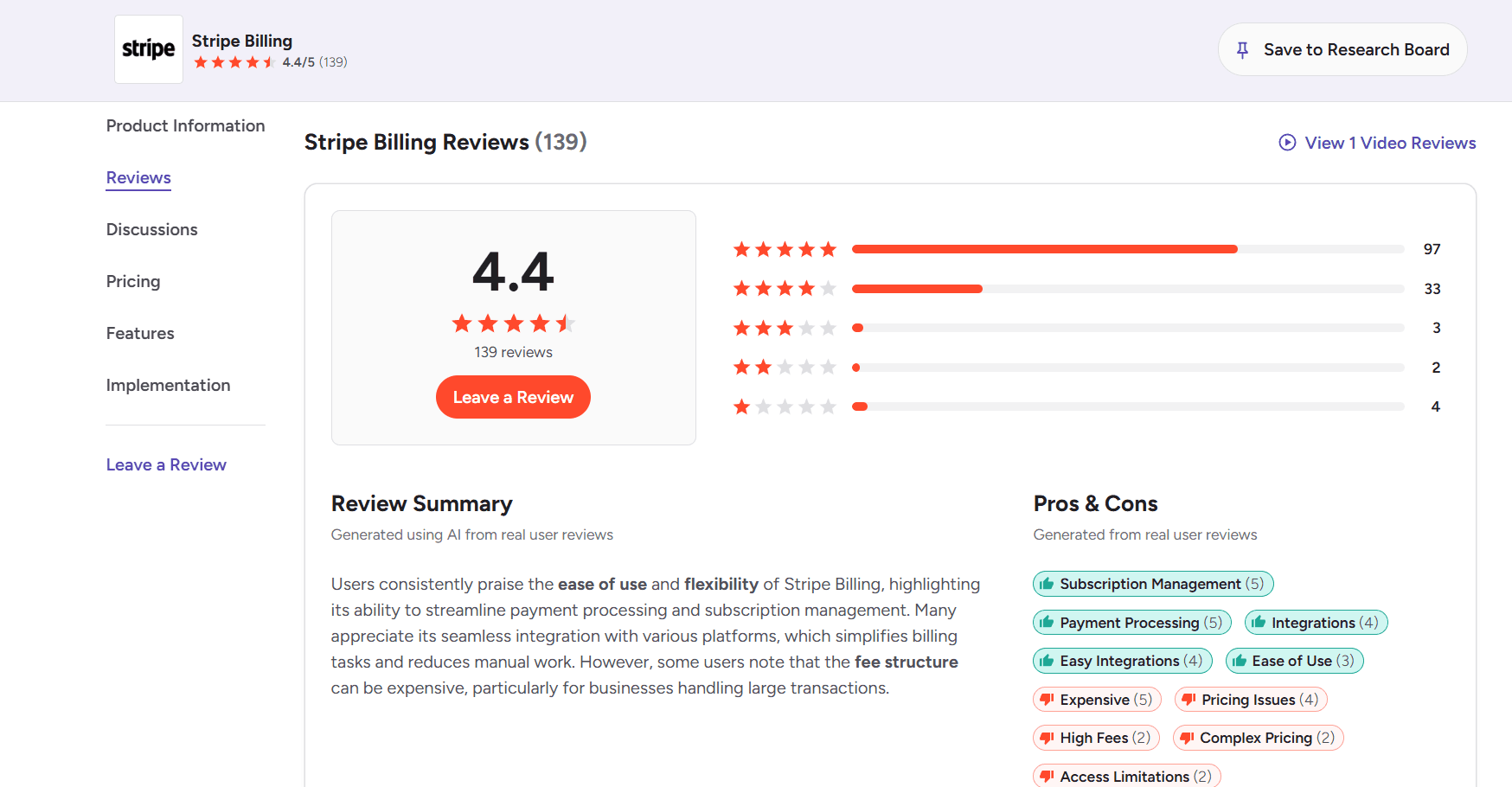
Reviewers consistently praise the developer experience, the documentation, and the API design as the best they can buy in this category.
The fee structure is expensive for businesses, especially with international transactions.
Additionally, customer support response times could be improved for faster issue resolution.
Capterra's Stripe Billing(4.7 out of 5)
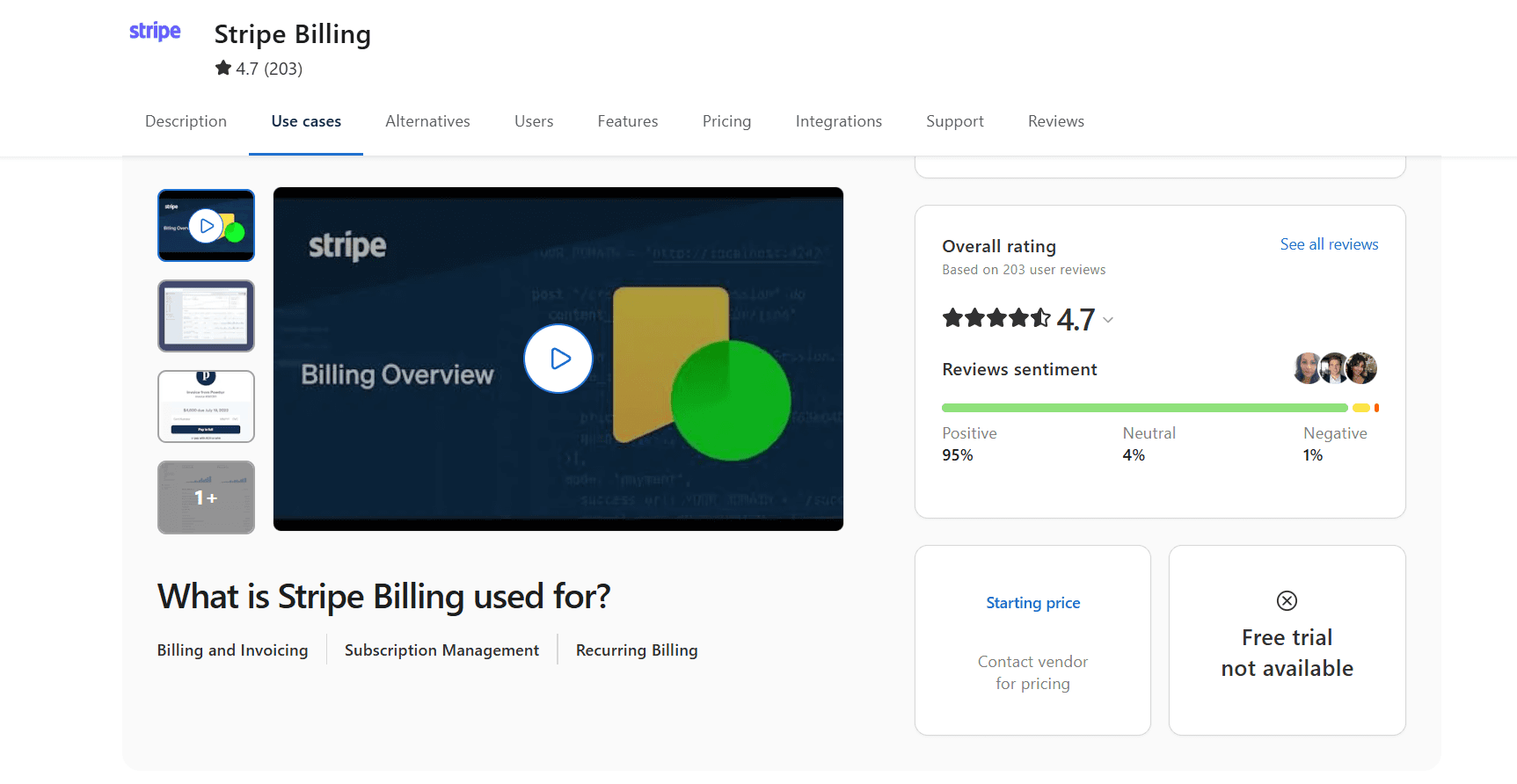
The interesting number is Capterra's Value for Money sub-score, which sits at 4.4 out of 5.
That is the lowest of the four sub-scores, Ease of Use, Customer Service, Features, and Value for Money, which validates the cost story with proof.
Gartner Peer Insights
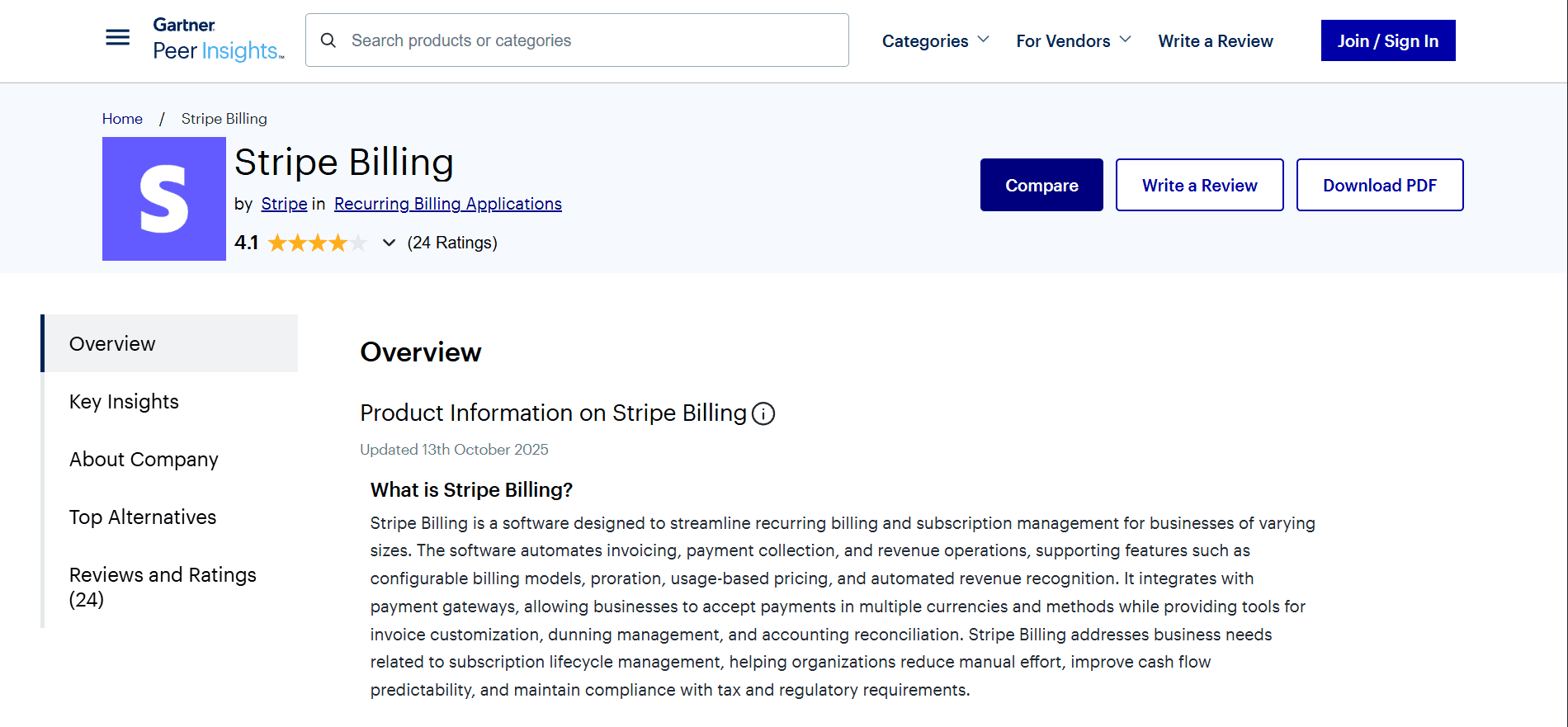
They give Stripe Billing 4.1 across 24 reviews on the Recurring Billing Applications market.
Reviewers praise the end-to-end experience and the financial reports, while raising concerns about fees being costly, support being slow, and reporting being lacking in depth.
What 2026 actually changed
Stripe shipped four things this year, and each one tells you something about whether subscription management on Stripe still fits your shape.
The Metronome acquisition in February closed Stripe's biggest billing gap. OpenAI, Anthropic, and a long list of AI companies were already on Metronome instead of Stripe Billing.
Stripe folded the company in, and the Billing pricing page now sends multi-dimensional rates and negotiated contracts to Metronome through a "Contact sales" link. Read that as a public admission that native Billing was not built for usage at AI scale.
The Agentic Commerce Suite, launched at Sessions 2026, gives AI agents native primitives to pay on a user's behalf. Launch partners included OpenAI, Perplexity, and Vapi.
AI token billing is now native, with meters and markup logic so AI resellers can price above their wholesale model cost without building a margin engine themselves.
Adaptive Pricing for subscriptions automatically presents prices in the customer's local currency, lifting international conversion without changing your underlying fees.
If you sell simple plans, none of this changes your answer. If you bill AI usage against committed contracts with hierarchies and ramps, the 2026 roadmap is telling you to expect Metronome and Metronome pricing soon.
The decision matrix for your specific shape
Your business shape | Should you stay on Stripe? | Why |
Pure ecommerce, one-time sales | Yes | Best card processor available, and you do not need the Billing surcharge |
Seat-based SaaS with simple plans | Yes | The 0.7% Billing fee is genuinely earned by Smart Retries and the customer portal |
Self-serve usage billing, low complexity | Maybe | 100M events a month are included, and Streams cover spikes |
Multi-meter usage billing, more than 20 dimensions | No | The 20-line-item cap and per-event filtering gaps force engineering workarounds |
Enterprise contracts with ramps and amendments | No | Native quote-to-amendment flow does not exist; you are in Metronome territory |
Parent-child or pooled-usage billing | No | Stripe customer model is flat |
Pick based on your shape, not on the logo on the homepage.
Where Flexprice specifically fits
Flexprice was built for the things where Stripe runs out of primitives, so here is the line-by-line alignment against the gaps from earlier in this post:
Ramped contracts: define custom price timelines that auto-update without manual phase setup, with no 10-phase ceiling to work around.
Committed usage with true-up: native commitments and automatic overage logic, so when a customer commits to 1 million API calls a month and uses 1.2 million, you bill the overage cleanly without writing the reconciliation logic yourself.
Parent-child hierarchies: org-level billing, shared credits, and unified usage roll-up across teams, which is exactly what your customers ask for the first month they expand from one team to three.
Granular usage filtering: send one unified event with metadata (model: gpt-4-turbo, tokens_out: 100), and Flexprice applies the right pricing automatically without you needing a separate event stream per model variant.
Rollover and custom-value credits: recurring grants, rollover with customizable caps, a unified wallet, and threshold-based auto-top-up.
Mid-term amendments with revision history: native versioning and revenue sync, so your finance team is not rebuilding amendment trails in spreadsheets every time a contract changes.
1 million plus meter events per second natively: no need to switch SDKs or fight rate limits to handle bursty AI inference traffic.
WizCommerce picked Flexprice specifically because Stripe could not model their contracts.
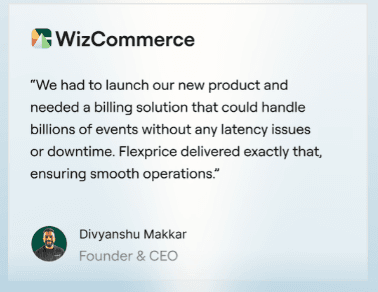
As Divyanshu Makkar, Founder & CEO of WizCommerce, put it: "We needed a billing solution that could handle billions of events without latency issues or downtime. Flexprice gave us the confidence to scale."
To get in-depth insights, see a full side-by-side comparison of Flexprice and Stripe
Wrapping up
If you sell card-charged, plan-based subscriptions to consumers or seat-based teams. The 0.7% Billing fee earns its keep through Smart Retries, the customer portal, multi-phase schedules, and a developer experience that nothing else matches in this category.
But if you bill AI or agentic usage on more than 20 dimensions, sell to enterprises with ramps and amendments, or run pooled-usage hierarchies. The fee is not your problem. The missing primitives are.
The 2026 Stripe roadmap is its own answer. Stripe acquired Metronome because native Billing was not built for the usage shape. Pick the tool that matches your contracts, not the logo on the homepage.
What should AI companies consider before switching from Stripe Billing to a platform built for usage-based AI pricing?
When does Stripe Billing stop being worth the cost?
How does Stripe Billing handle hybrid pricing models?
How does Stripe Billing handle AI pricing models?
How is Flexprice the best alternative to Stripe Billing?