
Ayush Parchure
Content Writer, Flexprice

There's no simple answer to how you can monetize an AI agent you've built, because the moment you try to price it, the cracks in the system start to show. AI agents are unpredictable by nature, one runs for pennies, another costs a fortune.
The real problem is that you have no real-time metering system to bill for it accurately. So you turn to a traditional billing platform, only to realize it was built for seat-based subscriptions, not token-level, usage-driven pricing.
Then, enterprise buyers come in expecting prepaid credits, wallets, and real-time balance visibility, which means bolting a credit ledger onto infrastructure that was never designed for it.
Some of the best AI and agentic monetization platforms like Flexprice handle everything……. Here are the best tools for agentic AI monetization in 2026, what each does well, and how to choose between them.
TL;DR
Agentic AI monetization means pricing AI products based on the work AI agents perform, not fixed subscriptions.
Traditional SaaS pricing breaks because AI agents create unpredictable usage and infrastructure costs.
AI companies typically charge based on tokens, API calls, compute time, workflows, or tasks completed.
Successful AI monetization requires real-time usage metering, flexible pricing models, and automated billing.
Flexprice provides an enterprise-grade full billing infrastructure designed for AI workloads, including credits, usage metering, and enterprise contracts.
Orb offers strong usage-based billing, but is closed source
Lago is open source and good for basic usage billing, but lacks deeper enterprise monetization capabilities.
Metronome focuses on raw event-based billing, but it was acquired by Stripe
OpenMeter provides real-time usage metering but typically acts as the tracking layer rather than a complete billing system.
What is agentic AI monetization?
Agentic AI monetization refers to the strategies and billing models used to generate revenue from AI systems that act autonomously, make decisions, and complete multi-step tasks without human intervention.
Unlike traditional SaaS that charges per seat, or generative AI that charges per token, agentic AI operates differently. One agent session can cost pennies, another can cost a fortune, depending on how many tools it calls, how many tokens it consumes, and how long it runs. That variability is exactly what makes standard billing infrastructure break down.
This is why agentic AI monetization demands a different approach, one built around usage-based pricing, real-time metering, and outcome-driven metrics that reflect what the agent actually did, not just what the user accessed.
Here are some common units AI companies usually monetize on:
Charging per API call or token processed
Charging per task completed by an AI agent
Using credits for AI workflows
Charging based on compute time or GPU usage
Charging per workflow or automation run
Why traditional SaaS pricing doesn’t work for AI agents
Traditional SaaS pricing was built for predictable software usage. But AI agents are just the opposite of predictable. A typical SaaS product might charge you $50 per user per month. Whether the user logs in twice or fifty times, the cost to the company barely changes. AI products don't behave that way.
Every AI interaction consumes real infrastructure resources like tokens, GPU compute, API calls, or workflow executions. That means cost scales directly with usage, and this is where traditional SaaS pricing starts to break down. The problems usually show up in a few key ways.
AI usage varies wildly across customers
In normal SaaS, two customers who are on the same plan often use the product in similar ways. But that's not the case with Agentic AI; when your customers work with AI agents, usage spikes unpredictably and can be all over the place.
For example, one customer might run 20 AI requests per day, but another might run:
50,000 agent tasks per day
Thousands of API calls
Massive token consumption
If both customers pay the same subscription fee, your revenue will hit rock bottom. That’s a fast way to burn money.
2. Compute costs that scale with usage
Each agentic AI action triggers a real computational cost; running a model means paying for:
GPU inference
Tokens processed
External API calls
Orchestration workflows
Unlike traditional SaaS, where serving an extra user almost costs nothing, AI agent workloads can scale linearly with usage. This means the more usage there is, the more infrastructure spending increases.
3. AI agents don’t perform fixed actions
Agents don’t follow a simple request-response pattern. A single user action might trigger:
Multiple LLM calls
Tool usage
External API requests
Multi-step workflows
One task could cost 10× more compute than another. That variability makes flat pricing completely disconnected from actual product cost.
4. Subscriptions alone create revenue leakage
AI agents, heavy users can generate massive infrastructure costs while paying the same price as light users.
The result:
High-usage customers become unprofitable
Companies subsidize power users
Pricing stops reflecting the value delivered
In short, you leak revenue while compute bills climb.
What Monetizing Agentic AI Actually Requires
Monetizing AI agents isn’t just about setting a price. You need infrastructure that can track usage, apply pricing rules, and convert product activity into revenue.
To make agentic AI monetization work in practice, companies typically need the following capabilities:
Usage metering
The system must capture product activity and convert it into measurable events.
This includes tracking things like tokens processed, compute time, API calls, or agent tasks so that every action performed by the AI can be measured and billed correctly.Flexible pricing models
AI products rarely rely on a single pricing model. The platform must support usage-based pricing, credit-based systems, subscriptions, or hybrid models where a base plan is combined with usage charges.Billing automation
Usage data must automatically convert into invoices, charges, and billing records. Without automation, teams often end up manually reconciling usage data with billing systems.Real-time usage tracking
Engineering and product teams need visibility into how much customers are consuming in real time. This helps monitor costs, enforce limits, and prevent unexpected usage spikes.Enterprise pricing support
Larger customers often require custom pricing, negotiated contracts, usage commitments, and invoicing workflows. The billing infrastructure must support these enterprise pricing arrangements.
Without these capabilities, companies often end up stitching together logs, scripts, spreadsheets, and internal tools just to monetize their AI products.
Top 5 billing software for agentic AI monetization in 2026
Flexprice
Orb
Lago
Metronome
Openmeter
Tool | Pros | Cons |
Flexprice |
|
|
Orb |
|
|
Lago |
|
|
Metronome |
|
|
OpenMeter |
|
|
1. Flexprice
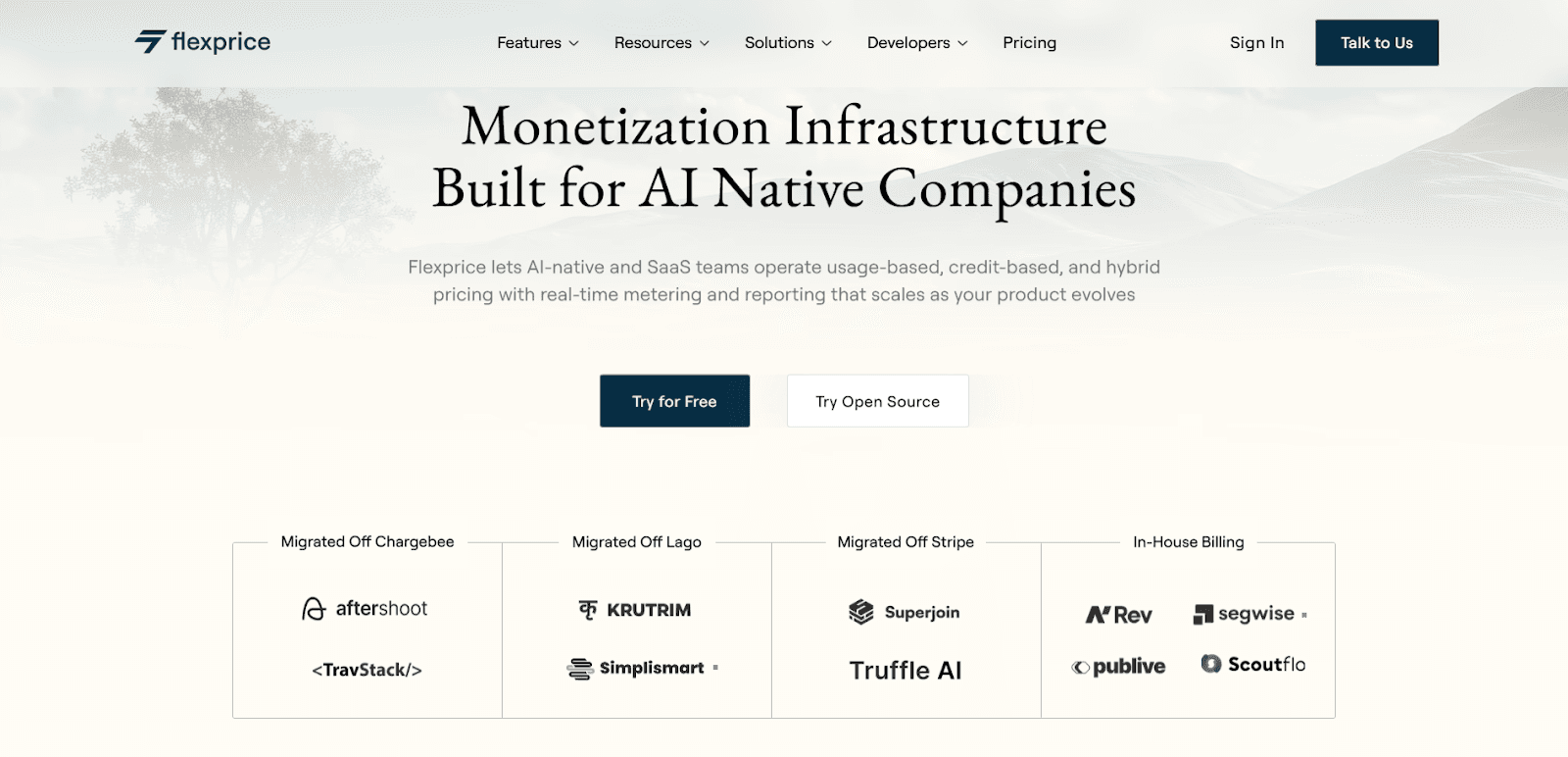
Flexprice is enterprise-grade, open source usage based billing infrastructure for AI and SaaS companies. It can be deployed in your own VPC, on-prem, or on Flexprice's managed cloud.
This clearly gives Flexprice an edge over others because most of them were built for simple SaaS subscriptions
This difference plays a major role in the AI industry because infrastructure products rarely map with subscription plans. Even a single workflow can trigger multiple model calls, variable compute usage, and different value outcomes for the customers.
Flexprice handles this by treating usage events as the core billing primitive. How does this work? You send product events, and the platform meters, aggregates, prices, and invoices automatically. It all happens smoothly because the metering engine is built on Go and Kafka, capable of processing 1M+ events per second, with a standalone collector that streams data from Kafka, webhooks, databases, and files.
Where Flexprice goes deeper than most billing platforms is its credit infrastructure. Instead of forcing companies to expose raw usage metrics like tokens or compute units, Flexprice allows products to monetize through credits and wallets. Teams can configure prepaid wallets, auto top-ups, rollover logic, low-balance alerts, and different credit pools tied to different product capabilities.
For example, a summarization task might cost 1 credit, while a complex research workflow costs 50 credits. Flexprice manages those conversions natively without requiring custom credit logic.
Flexprice also supports outcome-based billing, which is becoming increasingly important for agentic products. This lets pricing align with the value customers actually receive.
Beyond usage monetization, Flexprice includes the enterprise billing infrastructure needed to support larger customers. Teams can manage ramped contracts, commitment discounts, pricing versioning, contract amendments, and parent-child account hierarchies with credit pooling.
Flexprice also introduced the first MCP server in the billing category, allowing developers to connect tools like Cursor, Claude Code, VS Code, or Windsurf directly to the billing system and configure pricing through natural language prompts. Billing becomes part of the AI development workflow rather than a separate dashboard.
In short, Flexprice acts less like a traditional billing tool and more like a revenue infrastructure for usage-based and AI products, combining metering, pricing, contracts, and payments into a single platform.
Key features
Enterprise-grade billing infrastructure
Support for ramped contracts, commitment discounts, parent-child account hierarchies, credit pooling, and contract amendments with pricing versioning.
Real-time usage metering
High-throughput metering engine built on Go and Kafka, handling 1M+ events per second. Standalone event collector supports ingestion from Kafka, webhooks, databases, and files.
Credits and wallet infrastructure
Prepaid wallets, recurring credit grants, rollover rules, auto top-ups, low-balance alerts, and multi-pool credit systems that map credits to different product capabilities.
Outcome-based billing
Charge customers based on business outcomes such as completed workflows, resolved tickets, or successful calls instead of raw compute metrics.
Feature entitlements and access control
Flexible entitlement layer supporting boolean, metered, and trait-based permissions with per-customer overrides.
Pricing groups for complex catalogs
Organize prices and features into logical buckets such as Usage Pricing, Add-on Charges, GPU Costs, or AI Features. Groups flow across invoices, analytics, and the customer portal, making complex pricing catalogs easier to manage while keeping billing breakdowns clearer for customers.
MCP server for AI workflows
Native Model Context Protocol server that allows AI coding tools like Cursor or Claude Code to interact with the billing infrastructure through prompts.
Payments and CRM integrations
Multi-gateway support, including Stripe, Razorpay, Moyasar, and Nomod, along with bi-directional CRM sync with HubSpot, Salesforce, Zoho, and Pipedrive.
Parent-child account hierarchy
Manage multi-entity customers with parent-child billing relationships. Enterprises can organize multiple teams, subsidiaries, or workspaces under a single parent account while sharing credits, commitments, or invoices across accounts.
Pros
Purpose-built for agentic AI monetization with support for outcome-based, usage-based, and credit-based pricing models
Real-time usage metering designed to handle high-volume AI events like model calls, workflows, and compute usage
Flexible credit wallets with prepaid balances, auto top-ups, rollover logic, and multi-pool credit systems
Enterprise-ready billing with ramped contracts, commitment discounts, and parent-child account hierarchies
Developer-first APIs and event-based architecture for integrating billing directly into AI product workflows
Flexible pricing catalog with feature entitlements, pricing groups, and support for complex AI pricing structures
Cons
Newer ecosystem compared to legacy enterprise billing platforms
Teams opting for self-hosting must manage infrastructure themselves (managed cloud available)
Pricing
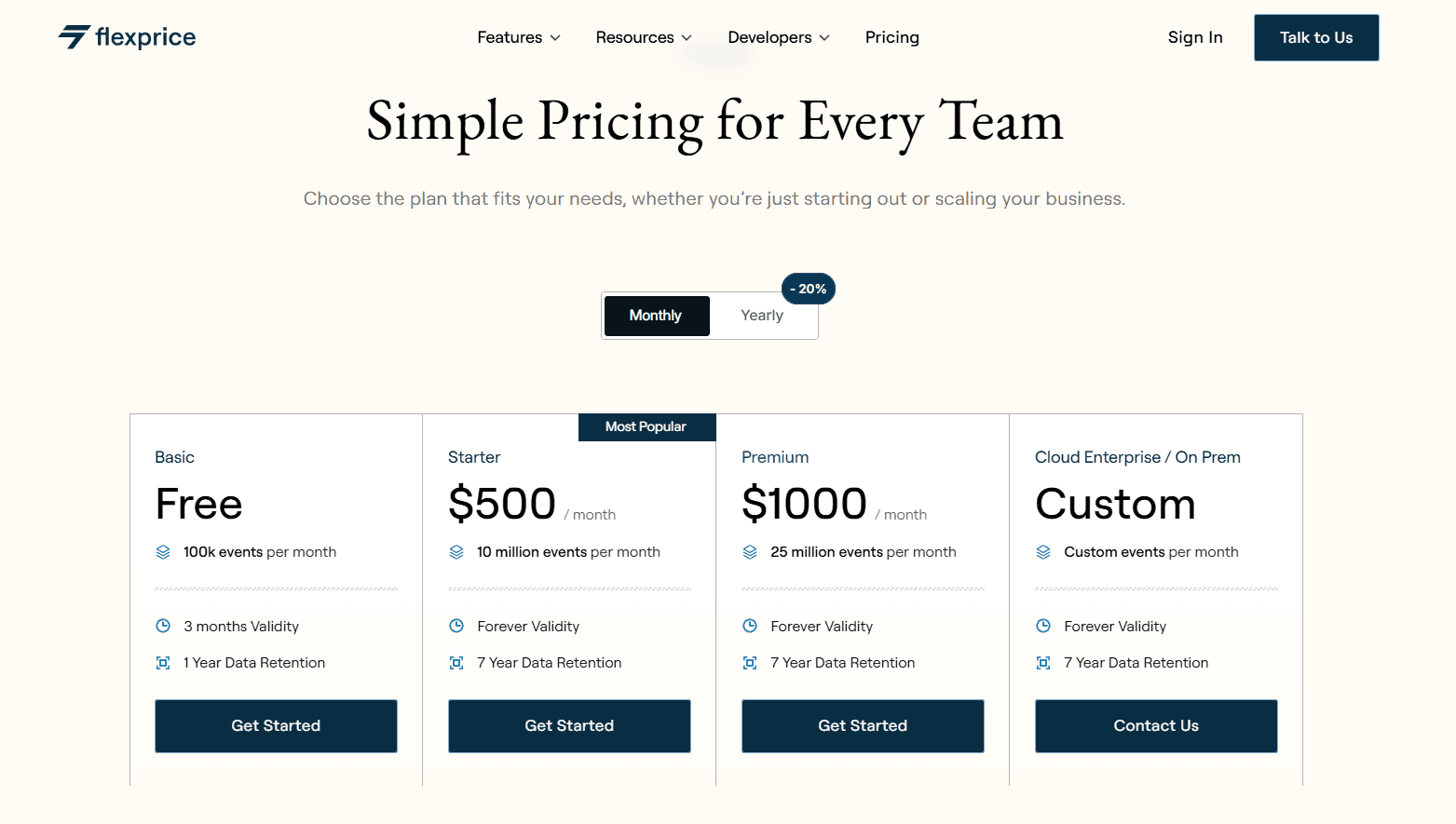
Flexprice offers 4 different pricing options apart from open source, which are:
Basic- free- 100k events per month
Build- $500 / month with 1 million events per month
Scale- $1000 / month with 5 million events per month
Mission critical- custom
2. Orb
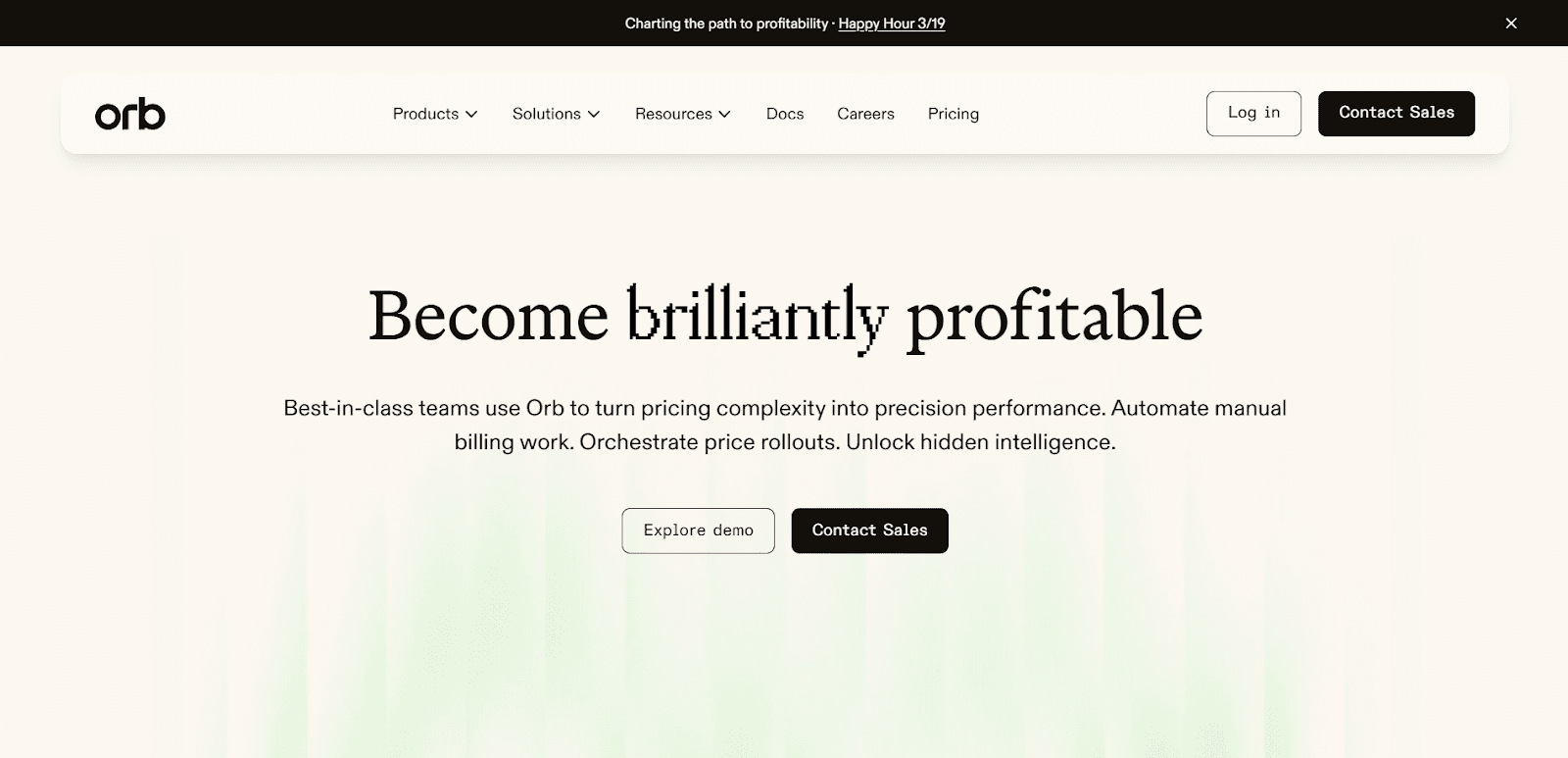
Orb is a developer-focused billing platform designed for companies that use usage-based pricing, especially for API and infrastructure products. For teams building AI Agents, Orb can meter usage events, calculate charges in real time, and support pricing models like tiered billing and prepaid credits.
However, Orb is less optimized for Agentic AI monetization, where pricing needs to reflect workflows, credits, or outcomes produced by AI Agents. The platform is closed source, primarily tied to Stripe for payments, and lacks native support for outcome-based pricing or agent-native billing workflows. Teams monetizing AI Agents through credits, task completion, or multi-step workflows often need more flexible billing infrastructure than Orb provides out of the box.
Key features
Real-time usage metering for APIs and AI agent activity
Flexible usage-based pricing, including tiered and volume models
Credit ledgers for prepaid usage and AI consumption tracking
Enterprise contracts with tiered commitments and account hierarchies
Revenue simulations to model pricing changes on historical usage data
Stripe-native payments and invoicing infrastructure
Pros
Strong usage-based billing infrastructure for API products and AI Agents
Real-time event ingestion designed for high-volume AI usage tracking
Flexible pricing models, including tiered, volume, and credit-based billing
Enterprise contract support with commitments, hierarchies, and custom rate cards
Cons
Closed-source platform with limited infrastructure transparency for Agentic AI monetization
Primarily dependent on Stripe for payments, limiting global payment flexibility
No native outcome-based billing for charging based on AI agent results or workflows
Lacks agent-native billing workflows such as MCP-based integrations
Higher starting cost, which can be restrictive for early-stage AI agent startups iterating on pricing
Pricing
Orb uses a usage-based pricing model tied to metered revenue volume. Exact pricing is not publicly listed and requires speaking with sales.
3. Lago
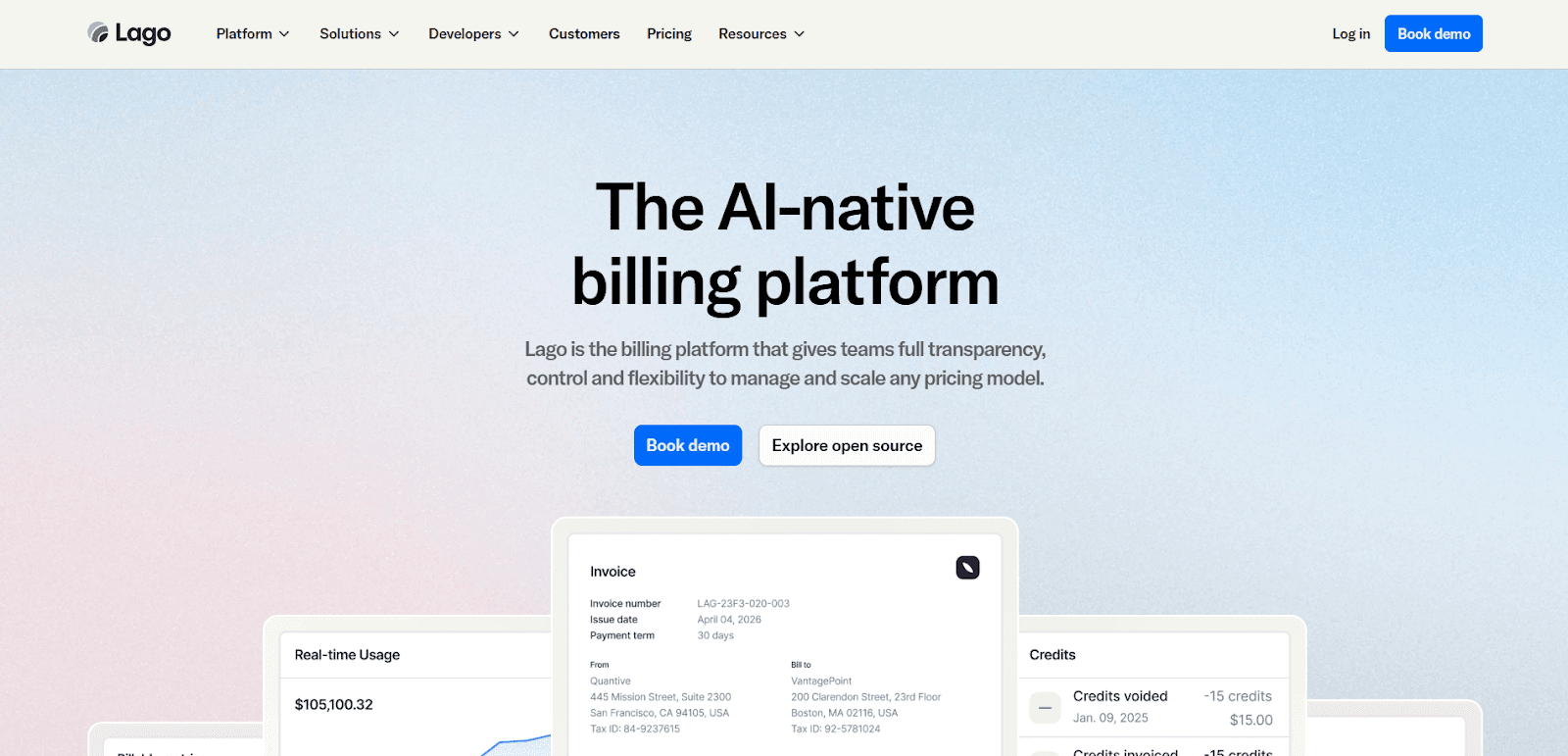
Lago is an open-source billing platform designed for usage-based pricing and developer-driven monetization. For teams building AI Agents, Lago can track usage events, aggregate consumption, and generate invoices based on activity such as API calls, compute usage, or AI agent operations.
However, Lago starts to show limitations for Agentic AI monetization as AI products grow more complex. While it supports basic usage and credit workflows, it lacks deeper infrastructure for pricing experimentation, enterprise contracts, advanced credit systems, and outcome-based pricing tied to AI Agent results. Teams monetizing AI Agents through workflows, credits, or business outcomes often need more flexible billing capabilities than Lago provides out of the box.
Key features
Open-source usage-based billing engine for APIs and AI Agents
Event metering and aggregation for tracking AI agent usage
Prepaid wallets for basic credit-based AI monetization models
Flexible pricing with tiered, volume, and usage-based charges
Event filtering to segment pricing across different AI models or usage types
Developer-friendly APIs for integrating billing into AI agent platforms
Pros
Open-source billing platform with transparency and customization for AI Agent monetization
Solid foundation for usage-based pricing and AI agent event metering
Basic credit wallet support for prepaid AI usage models
Flexible pricing models, including tiered and volume billing
Cons
Limited infrastructure for advanced Agentic AI monetization workflows
No native outcome-based billing for charging based on AI Agent results
Lacks parent-child account hierarchy for enterprise AI customers
Pricing iteration and experimentation require creating new plans manually
Some enterprise features, like the customer portal, are gated behind paid cloud plans
Pricing
Lago offers custom pricing for its Business and Enterprise plans, depending on usage scale and deployment needs. For more information, contact their sales team.
4 Metronome
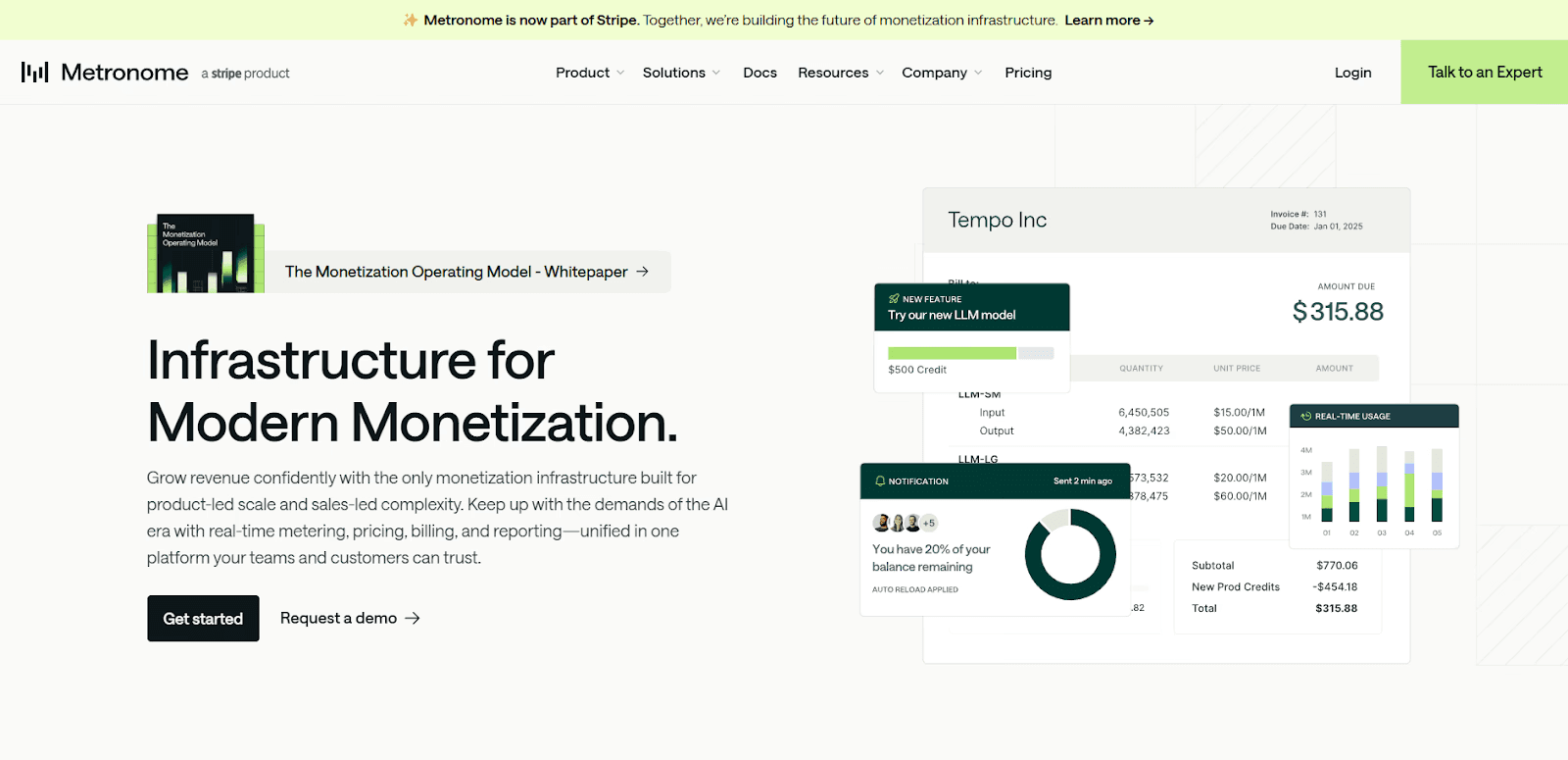
Metronome is a billing platform built around raw usage event processing, commonly used by API and infrastructure companies monetizing consumption. For teams building AI Agents, Metronome can ingest high-volume events and meter usage. Its architecture works well when monetization is tied directly to technical usage metrics.
Stripe has acquired Metronome, which means it fits most naturally within the Stripe ecosystem.
This limits Agentic AI monetization in pricing flexibility.
Metronome’s billing model is optimized for infrastructure-style consumption pricing, and pricing changes can require re-aggregation of usage data. Combined with its reliance on Stripe for payments, this makes rapid pricing experimentation and evolving AI agent pricing models harder as products grow.
Key features
Raw event ingestion for tracking AI Agent activity and API consumption
Usage-based billing engine designed for infrastructure and API monetization
High-volume event processing for large-scale AI workloads
Consumption-based pricing calculations tied to product usage
Developer-first APIs for embedding billing into AI platforms
Stripe-native payment collection and invoicing workflows
Pros
Strong raw-event architecture for tracking large volumes of AI Agent activity
Reliable usage-based billing for API and infrastructure products
Developer-friendly APIs designed for engineering teams building AI platforms
Well-suited for companies monetizing AI through pure consumption models
Cons
Pricing updates often require usage re-aggregation, slowing iteration
Heavy dependency on Stripe limits payment flexibility globally
Limited native support for Agentic AI monetization models like credits or outcomes
Not optimized for pricing tied to AI Agent workflows or business outcomes
Less adaptable for AI SaaS companies that frequently experiment with pricing
Pricing
Metronome offers a free Starter plan for teams launching usage-based products. Custom enterprise pricing is available, but for that, you need to contact their sales team.
5. OpenMeter
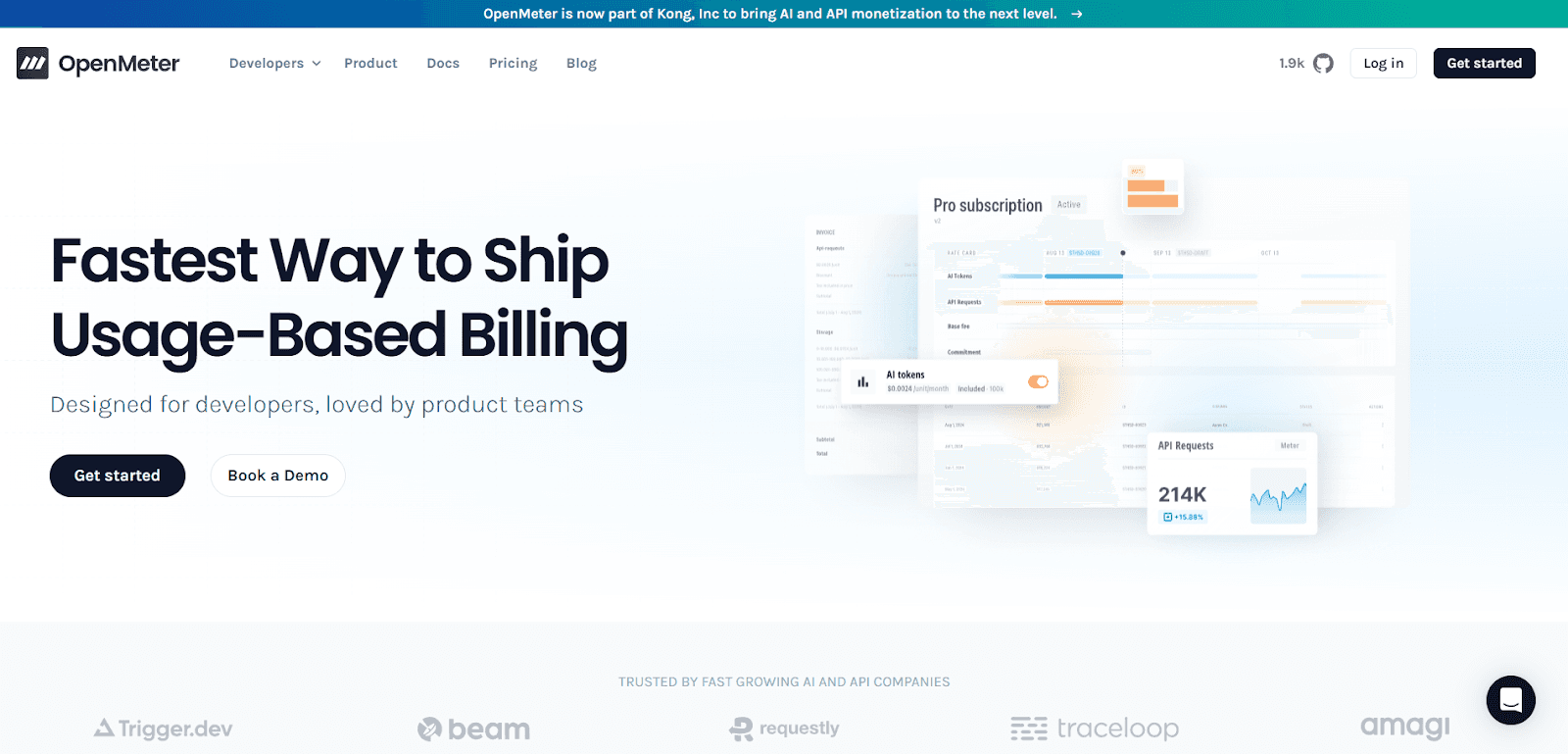
It is basically an open-source platform that is built to track real-time product usage for APIs, infrastructure services, and AI Agents. For companies monetizing AI Agent activity, OpenMeter provides the core metering layer that converts events like API calls, compute usage, or model interactions into measurable usage data.
But OpenMeter focuses primarily on usage metering and pricing calculations, not the full billing lifecycle. Teams often integrate external systems for payments, advanced credit workflows, and enterprise revenue operations. Compared to Flexprice, which bundles metering, credits, entitlements, and billing infrastructure into one platform, OpenMeter typically operates as the usage tracking layer within a larger monetization stack.
Key features
Real-time event metering for tracking AI Agent usage, API calls, and infrastructure consumption
Open-source deployment with self-hosting or managed cloud options
Product catalog with plans, subscriptions, and usage-based pricing models
Flexible pricing models, including per-unit, tiered, and volume pricing
Usage limits and entitlements for controlling AI Agent access or quotas
Event ingestion APIs and SDKs for integrating metering into AI platforms
Pros
Open-source usage metering platform with transparent infrastructure
Strong real-time event tracking for AI Agents and API consumption
Flexible pricing models built around usage events
Entitlements and quotas are useful for controlling AI feature access
Cons
Primarily focused on usage metering, not full billing infrastructure
Requires external systems for payments, contracts, and revenue workflows
Limited native support for advanced Agentic AI monetization models like outcome-based pricing
Less built-in support for enterprise billing features like complex contract workflows
Pricing
OpenMeter pricing is not publicly listed. You can contact their sales team for more information
How Flexprice is the ultimate solution for agentic AI monetization
Most AI billing tools were designed for a world where pricing was predictable. A user signs up, picks a plan, and gets charged on the first of the month. But agentic AI products don't work that way.
An AI agent might:
Process 200 tokens on one task, and for another process 50,000 tokens
Spin up compute for three seconds or run compute for three hours
The AI billing system needs to keep up with all of that in real time, without losing a single event along the way.
That's the problem Flexprice was built to solve. It's an enterprise billing platform designed from the ground up for the unpredictable, usage-heavy patterns that AI and agentic products generate.
Instead of being stuck with legacy subscription tools, Flexprice gives AI companies a metering and billing engine built for AI workloads.
Enterprise grade infrastructure that scales with you
Before getting into specific features, it's important to understand that Flexprice isn't just built for simpler use cases. It provides enterprise-grade infrastructure, including:
SOC II compliant infrastructure
Parent child accounts
AI Cost sheet
Sandbox and product env
20 billion+ API requests processed monthly
100k+ Events processed per second
This becomes critical when operating across enterprise customers with compliance requirements. Flexprice also includes:
Multi-SDK support so teams can send usage events from different programming languages
Native integrations with tools such as:
Stripe
Razorpay
HubSpot
QuickBooks
These integrations keep the billing system connected without requiring custom middleware.
Real-time usage metering for AI products
AI monetization depends on one critical capability, which is accurate usage tracking.
If a metering system batches events every hour and drops events under load, then companies either undercharge customers or spend weeks reconciling revenue at month-end.
Flexprice solves this by collecting usage events in real time.
Companies define what counts as a billable event, such as:
API calls
compute time
tokens processed by a language model
discrete agent tasks
Flexprice then:
aggregates these events
converts them into billable metrics automatically
This ensures there is no disconnect between product activity and billing data.
What this solves
Flexprice solves two common problems for AI companies:
Converts raw product activity into billable usage without building custom aggregation pipelines
Prevents revenue leakage caused by missed usage events
If an AI agent performs a complex task at 2 AM, that usage still gets captured and billed correctly. Flexprice is always tracking those events.
Supports every pricing model AI companies actually use
The AI industry has shown that no single pricing model works for every product. Companies often monetize in different ways, like:
Charging per token
Selling API requests
Pricing based on compute units
Charging based on agent outcomes
Flexprice supports multiple pricing models, including:
Usage-based pricing
Credit-based pricing
Seat-based pricing
Hybrid pricing models combining subscriptions with usage charges
This flexibility matters because when pricing is evolving, a company might start with per-token pricing and move to credit-based pricing for predictability, and later add seat-based pricing for team features
Flexprice allows teams to iterate on pricing without rebuilding billing infrastructure. With Flexprice, companies can run multiple pricing models simultaneously:
Price per token for language model APIs
Charge per request for agent endpoints
Bill per compute unit for GPU-heavy workloads
Charge per task for agent workflows
All of this within the same billing system feels like a dream, but Flexprice turns this into reality
Built-in credit system for AI usage
Credits have become a common pricing abstraction for AI products. They simplify complex usage patterns and give customers a unit they can budget around. However, building a credit system internally requires multiple components, such as:
Credit wallets
Top-up logic
Expiration rules
Conversion rate controls
Flexprice provides these capabilities out of the box.
Credit capabilities include
Prepaid credit wallets
Promotional credits
Credit expiration rules
Automatic wallet top-ups
What this enables is that companies can run free trials backed by promotional credits, provide limited-time trial balances, and allow enterprise customers to prepay for usage.
For example:
Promotional credits can expire after 14 days
Enterprise customers can prepay credits at negotiated rates
This simplifies procurement and improves cash flow predictability.
Automated billing and invoicing
Tracking usage is only half the job. The real challenge is converting that usage into actual revenue collection. Flexprice automates this step by turning usage data directly into invoices. system supports billing from:
Usage events
Subscription plans
Credit consumption
Flexprice also supports recurring billing cycles, one-off invoices for setup fees or enterprise agreements, manual payments, and credit notes for adjustments. This is not the end of the list; there are some additional billing capabilities Flexprice offers, like:
Invoice previews so customers can see upcoming charges
Enterprise invoicing workflows with contract-based pricing
This allows AI companies to bill customers accurately based on:
Tokens used
API calls
Compute hours
Agent tasks completed
All of these without any kind of manual reconciliation.
Feature entitlements and usage limits
Monetization also involves controlling product access based on pricing plans. Flexprice provides a feature entitlement system that links product capabilities directly to billing plans. Companies can define features per plan, usage limits per tier, and access controls for premium capabilities
Implementation teams do:
Limit API calls on starter plans
Allow higher usage thresholds on the premium tiers
Restrict advanced AI models to higher pricing tiers
For example:
A base plan might include access to a standard language model
A premium plan might unlock a more powerful model, higher rate limits, and priority processing
Flexprice allows these rules to be managed through billing configuration instead of application code.
Developer-first integration
Flexprice is designed primarily for engineering teams integrating billing into products.
Applications send usage events through SDKs, REST APIs, and gRPC endpoints
Once events are sent, Flexprice manages:
Metering
Aggregation
Pricing calculations
Invoice generation
Entitlement enforcement
Usage events can be sent from:
Backend services
APIs
Data pipelines
For example, backend services emit events directly, API gateways forward usage data, and then pipelines batch-send usage records. Once integrated, teams only need to send the right events.
Flexprice handles the rest of the billing pipeline.
Built for AI and agentic products
Flexprice is not a generic billing system adapted for usage pricing. It was designed specifically for AI and agentic product billing patterns. Core capabilities include:
Token metering
Compute usage tracking
API call counting
Agent task billing
These are built as native system capabilities, not add-on features. This makes Flexprice suitable for:
AI APIs
AI agents with unpredictable usage
Model platforms serving multiple customers
Usage-based SaaS products
The system is designed to handle variable workloads and high-frequency usage events typical in AI systems.
Open-source and self-hostable
Flexprice differs from many billing platforms by being fully open source. The entire codebase is available publicly and can be deployed on your own infrastructure. Deployment options include
Flexprice Cloud for hosted deployment
Self-hosting using Docker
Deployment on cloud providers such as AWS
Self-hosting allows companies to run billing systems within their own infrastructure for:
Data residency requirements
Compliance needs
Vendor lock-in concerns
This open-source model gives you full transparency into how billing logic works at every level. No black boxes. You can read the code, extend the system for custom requirements, and fork it if your use case demands something unique. And because the platform runs on your infrastructure, you're never in a position where a vendor pricing change or acquisition forces an emergency migration.
That kind of control matters when billing is the system that determines how you collect revenue.
Wrapping up
Agentic AI is changing how software creates value, and honestly, the old SaaS billing playbook just doesn’t cut it anymore. When your product runs AI agents that spin up compute, call models, and execute multi-step workflows, pricing stops being a simple monthly number.
It becomes a system that needs to track real work and convert it into revenue. That’s why companies building AI products are moving toward usage-aware monetization systems. The platforms we covered all approach this problem differently. Some focus on raw usage metering, others provide developer-first billing engines, and a few try to deliver the full revenue infrastructure needed for AI companies scaling from early experiments to enterprise contracts.
The real question isn’t which tool is the correct one. It’s which one actually fits how your product makes money.
If you’re running a straightforward API product, a usage billing engine might be enough. But if you’re building AI agents that trigger workflows, consume credits, and land enterprise customers with custom pricing, you’ll want something that can keep up with your product without duct tape and spreadsheets.
Because the truth is simple If your billing can’t keep up with your AI agents, your revenue will always lag behind your product.
So pick the stack that lets your team ship, experiment with pricing, and scale monetization without turning billing into a second startup inside your company.
Focus on building cool AI. Let the billing system handle the boring math.
What is agentic AI monetization and how is it different from traditional SaaS billing?
What are the most common pricing models for AI agents?
Why can't I use Stripe or a traditional billing platform to monetize AI agents?
How do credits and wallets work for AI agent billing?
What should I look for in a billing platform for my AI product?