
Aanchal Parmar5 Best No Code Usage Based Pricing Platforms for AI and SaaS in 2026
5 Best No Code Usage Based Pricing Platforms for AI and SaaS in 2026
Jan 26, 2026
Jan 26, 2026
Jan 26, 2026
• 19 mins
• 19 mins
• 19 mins

Aanchal Parmar
Aanchal Parmar
Aanchal Parmar
Product Marketing Manager, Flexprice


If you're running an AI company or SaaS and still manually calculating usage in spreadsheets, you're not just wasting time you're bleeding revenue.
In 2026, for AI companies looking for no code usage based pricing tools, platforms like Flexprice stand out because they're built for real-time usage, credits, and experimentation, not legacy subscription logic.
Traditional billing systems like Stripe, Chargebee or Maxio were designed for monthly subscriptions with predictable seat counts.
But the moment your pricing depends on API calls, AI tokens, compute minutes, or storage consumed, these platforms fall apart.
You need infrastructure that can meter granular usage, apply complex pricing rules, manage prepaid credits, and generate accurate invoices all without hardcoding billing logic into your application.
This guide breaks down the top no-code usage-based pricing tools built for modern SaaS and AI products. We've analyzed features, pricing models, real-world trade-offs, and customer feedback to help you choose the right platform.
TL;DR
No-code usage-based pricing tools let SaaS and AI companies meter consumption, manage credits, enforce entitlements, and generate invoices without hardcoding billing logic
63% of SaaS companies now use usage-based pricing, up from 45% in 2021, as AI products and API-first platforms shift from seat-based to consumption-based models
Critical capabilities include real-time usage metering, credit wallet systems, entitlement management, no vendor lock-in, pricing experimentation without engineering, and multi-entity billing
Traditional billing systems like Stripe and Chargebee were built for static subscriptions and break down when pricing depends on API calls, AI tokens, compute minutes, or storage consumed
Flexprice is open-source billing infrastructure purpose built for usage based pricing with real-time metering (60,000 events per second), native credit wallets, comprehensive entitlement management, and works with any payment gateway
Product and finance teams can configure pricing models, create plans, and launch experiments through visual interfaces without engineering bottlenecks or code deployments
Purpose-built infrastructure designed around usage-based pricing delivers better outcomes than platforms retrofitting usage capabilities onto legacy subscription logic
What is a no-code usage based pricing tool?
A no code usage based pricing tool is a billing infrastructure platform that lets you meter customer usage, apply pricing rules, manage credits and entitlements, and generate invoices without writing custom billing code or relying on engineering for every pricing change.
These platforms include entitlement management systems that control what features customers can access based on their plan, usage limits, and subscription tier.
No code usage based pricing tools sit between your product and your payment provider. Your application sends usage events (API calls, tokens processed, storage consumed), the billing platform meters that usage, applies your pricing logic, accounts for credits and discounts, and generates invoices.
Your payment provider then collects the funds.
The "no-code" component means product and finance teams can configure pricing models, create plans, set up entitlements, and experiment with new pricing through a visual interface not by writing SQL queries or deploying code changes.
Benefits of usage based pricing tools
Accurate revenue capture: Bill based on actual consumption, not arbitrary seat counts. This aligns price with value and prevents revenue leakage when customers use more than their plan includes.
Pricing experimentation: Test new pricing models, tiers, and packages without engineering bottlenecks. Launch experiments in days, not quarters.
Real-time visibility: Track usage and projected revenue as it happens, not at month-end. Customers see their consumption in real-time, reducing billing disputes and surprise invoices.
Credit and wallet management: Support prepaid credits, promotional credits, auto top-ups, and low-balance alerts critical for AI products where customers want predictable spend control.
Multi-entity billing: Handle parent-child account structures, invoice splits, and hierarchical billing for enterprise customers without custom code.
Developer productivity: Stop hardcoding billing logic into your application. Keep pricing configuration and entitlement management separate from product code so teams can move independently.
Top 5 no-code usage based pricing tools for AI and SaaS in 2026
Flexprice
Lago
Polar
Metronome (Acquired by Stripe)
Zenskar
1. Flexprice
Flexprice is an open source, no code usage based pricing tool built as billing infrastructure for modern SaaS, API-first, and AI-native products.
Unlike legacy enterprise billing software designed around static subscriptions and monthly invoices, Flexprice is purpose-built for usage-based pricing, metered billing, and volatile consumption patterns common in AI and developer platforms.
At its core, Flexprice acts as a programmable billing layer between your product and your payment gateway.
Your application emits usage events, Flexprice handles real-time usage metering, entitlement management, credit-based pricing logic, invoice generation, and billing automation while remaining decoupled from the payment provider to avoid vendor lock-in.
This architecture allows teams to change pricing independently of product code, enabling faster experimentation, cleaner subscription management, and scalable SaaS billing without hardcoding logic into your application.
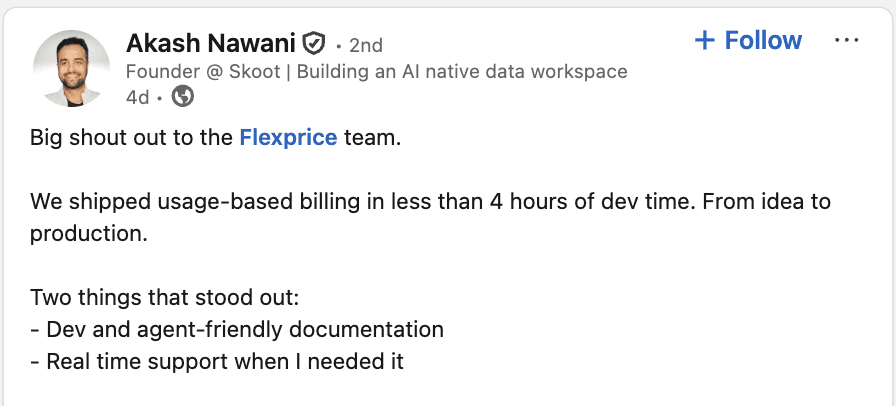
For example, see how founder of Skoot integrated Flexpice in just 4 hours of dev time.
Core features for usage based pricing
1. Real time Usage Metering for volatile workloads
Flexprice provides native real-time metering designed for volatile AI and SaaS workloads. Flexprice supports up to 60,000 events per second.
Teams can meter API calls, AI tokens, compute minutes, storage consumption, seats, or any custom usage event emitted by the product.
Usage is processed continuously and reflected instantly across dashboards and invoices. This gives AI and SaaS companies immediate visibility into consumption, supports mid-cycle usage reporting, and eliminates delays caused by batch-based billing systems.
2. Credit Wallets and Prepaid Credits for predictable spend
Flexprice includes a first-class credit wallet system that supports prepaid credits, promotional credits, and subscription-included credits. Each customer maintains a wallet ledger tracking credit issuance, consumption, expiration, and balance changes.
Credits are applied automatically during billing and can be bundled into subscriptions, sold as standalone packages, or used for trials and promotions. This enables credit-based pricing and predictable spend control, critical for AI monetization where customers want visibility and guardrails around usage.
3. Entitlement Management through features and usage limits
Flexprice supports entitlement management by separating feature access and usage enforcement from product code.
Teams can configure:
Feature entitlements to control access to product capabilities based on plan
Metered features with usage limits to enforce quotas and prevent overconsumption
Plan-level inclusions such as integrations, regions, or support tiers
These entitlements integrate directly with usage metering, allowing SaaS and AI companies to gate access, enforce limits, and align pricing with value delivered without hardcoding billing logic into the application.
4. Hybrid Pricing Models built for AI and SaaS reality
Flexprice supports multiple pricing models along with hybrid pricing model through dashboard-based configuration rather than custom development:
Subscription pricing
Usage-based and consumption based pricing
Hybrid pricing with included usage and overages
Credit-based pricing using prepaid credits and wallets
This reflects how AI and SaaS companies actually monetize—combining predictable base revenue with variable usage components while enabling continuous pricing experimentation.
5. Environment Isolation for Safe Pricing Changes
Flexprice supports environment isolation, allowing teams to test pricing models, usage rules, and entitlements in sandbox environments before deploying changes to production.
This reduces billing incidents and enables faster iteration especially important for AI companies that frequently adjust pricing as models and costs evolve.
6. Multi Entity and Hierarchical Billing for Enterprise SaaS
For B2B SaaS selling into enterprises, Flexprice supports multi-entity billing with parent-child account hierarchies. Usage can be tracked at the sub-account level while invoices can be consolidated or split across organizational structures without spreadsheets or manual reconciliation.
7. Invoicing, Billing Automation, and Usage Transparency
Flexprice handles invoice generation by combining subscription charges, usage charges, applied credits, and discounts into transparent, line-item invoices.
Proration is supported for mid-cycle changes, and invoices remain tightly linked to underlying usage events to reduce disputes.
While Flexprice integrates with payment gateways for collection, it keeps billing infrastructure and pricing logic independent of payment processing preserving flexibility and preventing long-term vendor lock-in.
Pros
Open-source billing with full transparency and extensibility
No vendor lock-in with payment gateways
You don't need to take engineering's help to make any pricing changes
Integrate Flexprice literally in hours
Built specifically for AI billing and API-first SaaS billing
Native support for real-time usage metering, credit wallets, and entitlements
Strong fit for product-led growth and fast pricing iteration
Developer-friendly APIs with no-code configuration for product and finance teams
Cons
Newer ecosystem compared to legacy enterprise billing platforms
Teams opting for self-hosting must manage infrastructure themselves (managed cloud available)
Pricing
Flexprice is free and open-source to self-host. Managed cloud options are available for teams that prefer hosted billing automation. Pricing scales with usage and avoids percentage-of-revenue fees.
Best for
AI companies monetizing tokens, inference calls, or compute usage
SaaS products
Teams requiring entitlement management without hardcoding logic
Companies avoiding payment gateway lock-in
Products operating with unpredictable or high-variance consumption
If you're running an AI company or SaaS and still manually calculating usage in spreadsheets, you're not just wasting time you're bleeding revenue.
In 2026, for AI companies looking for no code usage based pricing tools, platforms like Flexprice stand out because they're built for real-time usage, credits, and experimentation, not legacy subscription logic.
Traditional billing systems like Stripe, Chargebee or Maxio were designed for monthly subscriptions with predictable seat counts.
But the moment your pricing depends on API calls, AI tokens, compute minutes, or storage consumed, these platforms fall apart.
You need infrastructure that can meter granular usage, apply complex pricing rules, manage prepaid credits, and generate accurate invoices all without hardcoding billing logic into your application.
This guide breaks down the top no-code usage-based pricing tools built for modern SaaS and AI products. We've analyzed features, pricing models, real-world trade-offs, and customer feedback to help you choose the right platform.
TL;DR
No-code usage-based pricing tools let SaaS and AI companies meter consumption, manage credits, enforce entitlements, and generate invoices without hardcoding billing logic
63% of SaaS companies now use usage-based pricing, up from 45% in 2021, as AI products and API-first platforms shift from seat-based to consumption-based models
Critical capabilities include real-time usage metering, credit wallet systems, entitlement management, no vendor lock-in, pricing experimentation without engineering, and multi-entity billing
Traditional billing systems like Stripe and Chargebee were built for static subscriptions and break down when pricing depends on API calls, AI tokens, compute minutes, or storage consumed
Flexprice is open-source billing infrastructure purpose built for usage based pricing with real-time metering (60,000 events per second), native credit wallets, comprehensive entitlement management, and works with any payment gateway
Product and finance teams can configure pricing models, create plans, and launch experiments through visual interfaces without engineering bottlenecks or code deployments
Purpose-built infrastructure designed around usage-based pricing delivers better outcomes than platforms retrofitting usage capabilities onto legacy subscription logic
What is a no-code usage based pricing tool?
A no code usage based pricing tool is a billing infrastructure platform that lets you meter customer usage, apply pricing rules, manage credits and entitlements, and generate invoices without writing custom billing code or relying on engineering for every pricing change.
These platforms include entitlement management systems that control what features customers can access based on their plan, usage limits, and subscription tier.
No code usage based pricing tools sit between your product and your payment provider. Your application sends usage events (API calls, tokens processed, storage consumed), the billing platform meters that usage, applies your pricing logic, accounts for credits and discounts, and generates invoices.
Your payment provider then collects the funds.
The "no-code" component means product and finance teams can configure pricing models, create plans, set up entitlements, and experiment with new pricing through a visual interface not by writing SQL queries or deploying code changes.
Benefits of usage based pricing tools
Accurate revenue capture: Bill based on actual consumption, not arbitrary seat counts. This aligns price with value and prevents revenue leakage when customers use more than their plan includes.
Pricing experimentation: Test new pricing models, tiers, and packages without engineering bottlenecks. Launch experiments in days, not quarters.
Real-time visibility: Track usage and projected revenue as it happens, not at month-end. Customers see their consumption in real-time, reducing billing disputes and surprise invoices.
Credit and wallet management: Support prepaid credits, promotional credits, auto top-ups, and low-balance alerts critical for AI products where customers want predictable spend control.
Multi-entity billing: Handle parent-child account structures, invoice splits, and hierarchical billing for enterprise customers without custom code.
Developer productivity: Stop hardcoding billing logic into your application. Keep pricing configuration and entitlement management separate from product code so teams can move independently.
Top 5 no-code usage based pricing tools for AI and SaaS in 2026
Flexprice
Lago
Polar
Metronome (Acquired by Stripe)
Zenskar
1. Flexprice
Flexprice is an open source, no code usage based pricing tool built as billing infrastructure for modern SaaS, API-first, and AI-native products.
Unlike legacy enterprise billing software designed around static subscriptions and monthly invoices, Flexprice is purpose-built for usage-based pricing, metered billing, and volatile consumption patterns common in AI and developer platforms.
At its core, Flexprice acts as a programmable billing layer between your product and your payment gateway.
Your application emits usage events, Flexprice handles real-time usage metering, entitlement management, credit-based pricing logic, invoice generation, and billing automation while remaining decoupled from the payment provider to avoid vendor lock-in.
This architecture allows teams to change pricing independently of product code, enabling faster experimentation, cleaner subscription management, and scalable SaaS billing without hardcoding logic into your application.
For example, see how founder of Skoot integrated Flexpice in just 4 hours of dev time.

Core features for usage based pricing
1. Real time Usage Metering for volatile workloads
Flexprice provides native real-time metering designed for volatile AI and SaaS workloads. Flexprice supports up to 60,000 events per second.
Teams can meter API calls, AI tokens, compute minutes, storage consumption, seats, or any custom usage event emitted by the product.
Usage is processed continuously and reflected instantly across dashboards and invoices. This gives AI and SaaS companies immediate visibility into consumption, supports mid-cycle usage reporting, and eliminates delays caused by batch-based billing systems.
2. Credit Wallets and Prepaid Credits for predictable spend
Flexprice includes a first-class credit wallet system that supports prepaid credits, promotional credits, and subscription-included credits. Each customer maintains a wallet ledger tracking credit issuance, consumption, expiration, and balance changes.
Credits are applied automatically during billing and can be bundled into subscriptions, sold as standalone packages, or used for trials and promotions. This enables credit-based pricing and predictable spend control, critical for AI monetization where customers want visibility and guardrails around usage.
3. Entitlement Management through features and usage limits
Flexprice supports entitlement management by separating feature access and usage enforcement from product code.
Teams can configure:
Feature entitlements to control access to product capabilities based on plan
Metered features with usage limits to enforce quotas and prevent overconsumption
Plan-level inclusions such as integrations, regions, or support tiers
These entitlements integrate directly with usage metering, allowing SaaS and AI companies to gate access, enforce limits, and align pricing with value delivered without hardcoding billing logic into the application.
4. Hybrid Pricing Models built for AI and SaaS reality
Flexprice supports multiple pricing models along with hybrid pricing model through dashboard-based configuration rather than custom development:
Subscription pricing
Usage-based and consumption based pricing
Hybrid pricing with included usage and overages
Credit-based pricing using prepaid credits and wallets
This reflects how AI and SaaS companies actually monetize—combining predictable base revenue with variable usage components while enabling continuous pricing experimentation.
5. Environment Isolation for Safe Pricing Changes
Flexprice supports environment isolation, allowing teams to test pricing models, usage rules, and entitlements in sandbox environments before deploying changes to production.
This reduces billing incidents and enables faster iteration especially important for AI companies that frequently adjust pricing as models and costs evolve.
6. Multi Entity and Hierarchical Billing for Enterprise SaaS
For B2B SaaS selling into enterprises, Flexprice supports multi-entity billing with parent-child account hierarchies. Usage can be tracked at the sub-account level while invoices can be consolidated or split across organizational structures without spreadsheets or manual reconciliation.
7. Invoicing, Billing Automation, and Usage Transparency
Flexprice handles invoice generation by combining subscription charges, usage charges, applied credits, and discounts into transparent, line-item invoices.
Proration is supported for mid-cycle changes, and invoices remain tightly linked to underlying usage events to reduce disputes.
While Flexprice integrates with payment gateways for collection, it keeps billing infrastructure and pricing logic independent of payment processing preserving flexibility and preventing long-term vendor lock-in.
Pros
Open-source billing with full transparency and extensibility
No vendor lock-in with payment gateways
You don't need to take engineering's help to make any pricing changes
Integrate Flexprice literally in hours
Built specifically for AI billing and API-first SaaS billing
Native support for real-time usage metering, credit wallets, and entitlements
Strong fit for product-led growth and fast pricing iteration
Developer-friendly APIs with no-code configuration for product and finance teams
Cons
Newer ecosystem compared to legacy enterprise billing platforms
Teams opting for self-hosting must manage infrastructure themselves (managed cloud available)
Pricing
Flexprice is free and open-source to self-host. Managed cloud options are available for teams that prefer hosted billing automation. Pricing scales with usage and avoids percentage-of-revenue fees.
Best for
AI companies monetizing tokens, inference calls, or compute usage
SaaS products
Teams requiring entitlement management without hardcoding logic
Companies avoiding payment gateway lock-in
Products operating with unpredictable or high-variance consumption
If you're running an AI company or SaaS and still manually calculating usage in spreadsheets, you're not just wasting time you're bleeding revenue.
In 2026, for AI companies looking for no code usage based pricing tools, platforms like Flexprice stand out because they're built for real-time usage, credits, and experimentation, not legacy subscription logic.
Traditional billing systems like Stripe, Chargebee or Maxio were designed for monthly subscriptions with predictable seat counts.
But the moment your pricing depends on API calls, AI tokens, compute minutes, or storage consumed, these platforms fall apart.
You need infrastructure that can meter granular usage, apply complex pricing rules, manage prepaid credits, and generate accurate invoices all without hardcoding billing logic into your application.
This guide breaks down the top no-code usage-based pricing tools built for modern SaaS and AI products. We've analyzed features, pricing models, real-world trade-offs, and customer feedback to help you choose the right platform.
TL;DR
No-code usage-based pricing tools let SaaS and AI companies meter consumption, manage credits, enforce entitlements, and generate invoices without hardcoding billing logic
63% of SaaS companies now use usage-based pricing, up from 45% in 2021, as AI products and API-first platforms shift from seat-based to consumption-based models
Critical capabilities include real-time usage metering, credit wallet systems, entitlement management, no vendor lock-in, pricing experimentation without engineering, and multi-entity billing
Traditional billing systems like Stripe and Chargebee were built for static subscriptions and break down when pricing depends on API calls, AI tokens, compute minutes, or storage consumed
Flexprice is open-source billing infrastructure purpose built for usage based pricing with real-time metering (60,000 events per second), native credit wallets, comprehensive entitlement management, and works with any payment gateway
Product and finance teams can configure pricing models, create plans, and launch experiments through visual interfaces without engineering bottlenecks or code deployments
Purpose-built infrastructure designed around usage-based pricing delivers better outcomes than platforms retrofitting usage capabilities onto legacy subscription logic
What is a no-code usage based pricing tool?
A no code usage based pricing tool is a billing infrastructure platform that lets you meter customer usage, apply pricing rules, manage credits and entitlements, and generate invoices without writing custom billing code or relying on engineering for every pricing change.
These platforms include entitlement management systems that control what features customers can access based on their plan, usage limits, and subscription tier.
No code usage based pricing tools sit between your product and your payment provider. Your application sends usage events (API calls, tokens processed, storage consumed), the billing platform meters that usage, applies your pricing logic, accounts for credits and discounts, and generates invoices.
Your payment provider then collects the funds.
The "no-code" component means product and finance teams can configure pricing models, create plans, set up entitlements, and experiment with new pricing through a visual interface not by writing SQL queries or deploying code changes.
Benefits of usage based pricing tools
Accurate revenue capture: Bill based on actual consumption, not arbitrary seat counts. This aligns price with value and prevents revenue leakage when customers use more than their plan includes.
Pricing experimentation: Test new pricing models, tiers, and packages without engineering bottlenecks. Launch experiments in days, not quarters.
Real-time visibility: Track usage and projected revenue as it happens, not at month-end. Customers see their consumption in real-time, reducing billing disputes and surprise invoices.
Credit and wallet management: Support prepaid credits, promotional credits, auto top-ups, and low-balance alerts critical for AI products where customers want predictable spend control.
Multi-entity billing: Handle parent-child account structures, invoice splits, and hierarchical billing for enterprise customers without custom code.
Developer productivity: Stop hardcoding billing logic into your application. Keep pricing configuration and entitlement management separate from product code so teams can move independently.
Top 5 no-code usage based pricing tools for AI and SaaS in 2026
Flexprice
Lago
Polar
Metronome (Acquired by Stripe)
Zenskar
1. Flexprice
Flexprice is an open source, no code usage based pricing tool built as billing infrastructure for modern SaaS, API-first, and AI-native products.
Unlike legacy enterprise billing software designed around static subscriptions and monthly invoices, Flexprice is purpose-built for usage-based pricing, metered billing, and volatile consumption patterns common in AI and developer platforms.
At its core, Flexprice acts as a programmable billing layer between your product and your payment gateway.
Your application emits usage events, Flexprice handles real-time usage metering, entitlement management, credit-based pricing logic, invoice generation, and billing automation while remaining decoupled from the payment provider to avoid vendor lock-in.
This architecture allows teams to change pricing independently of product code, enabling faster experimentation, cleaner subscription management, and scalable SaaS billing without hardcoding logic into your application.
For example, see how founder of Skoot integrated Flexpice in just 4 hours of dev time.

Core features for usage based pricing
1. Real time Usage Metering for volatile workloads
Flexprice provides native real-time metering designed for volatile AI and SaaS workloads. Flexprice supports up to 60,000 events per second.
Teams can meter API calls, AI tokens, compute minutes, storage consumption, seats, or any custom usage event emitted by the product.
Usage is processed continuously and reflected instantly across dashboards and invoices. This gives AI and SaaS companies immediate visibility into consumption, supports mid-cycle usage reporting, and eliminates delays caused by batch-based billing systems.
2. Credit Wallets and Prepaid Credits for predictable spend
Flexprice includes a first-class credit wallet system that supports prepaid credits, promotional credits, and subscription-included credits. Each customer maintains a wallet ledger tracking credit issuance, consumption, expiration, and balance changes.
Credits are applied automatically during billing and can be bundled into subscriptions, sold as standalone packages, or used for trials and promotions. This enables credit-based pricing and predictable spend control, critical for AI monetization where customers want visibility and guardrails around usage.
3. Entitlement Management through features and usage limits
Flexprice supports entitlement management by separating feature access and usage enforcement from product code.
Teams can configure:
Feature entitlements to control access to product capabilities based on plan
Metered features with usage limits to enforce quotas and prevent overconsumption
Plan-level inclusions such as integrations, regions, or support tiers
These entitlements integrate directly with usage metering, allowing SaaS and AI companies to gate access, enforce limits, and align pricing with value delivered without hardcoding billing logic into the application.
4. Hybrid Pricing Models built for AI and SaaS reality
Flexprice supports multiple pricing models along with hybrid pricing model through dashboard-based configuration rather than custom development:
Subscription pricing
Usage-based and consumption based pricing
Hybrid pricing with included usage and overages
Credit-based pricing using prepaid credits and wallets
This reflects how AI and SaaS companies actually monetize—combining predictable base revenue with variable usage components while enabling continuous pricing experimentation.
5. Environment Isolation for Safe Pricing Changes
Flexprice supports environment isolation, allowing teams to test pricing models, usage rules, and entitlements in sandbox environments before deploying changes to production.
This reduces billing incidents and enables faster iteration especially important for AI companies that frequently adjust pricing as models and costs evolve.
6. Multi Entity and Hierarchical Billing for Enterprise SaaS
For B2B SaaS selling into enterprises, Flexprice supports multi-entity billing with parent-child account hierarchies. Usage can be tracked at the sub-account level while invoices can be consolidated or split across organizational structures without spreadsheets or manual reconciliation.
7. Invoicing, Billing Automation, and Usage Transparency
Flexprice handles invoice generation by combining subscription charges, usage charges, applied credits, and discounts into transparent, line-item invoices.
Proration is supported for mid-cycle changes, and invoices remain tightly linked to underlying usage events to reduce disputes.
While Flexprice integrates with payment gateways for collection, it keeps billing infrastructure and pricing logic independent of payment processing preserving flexibility and preventing long-term vendor lock-in.
Pros
Open-source billing with full transparency and extensibility
No vendor lock-in with payment gateways
You don't need to take engineering's help to make any pricing changes
Integrate Flexprice literally in hours
Built specifically for AI billing and API-first SaaS billing
Native support for real-time usage metering, credit wallets, and entitlements
Strong fit for product-led growth and fast pricing iteration
Developer-friendly APIs with no-code configuration for product and finance teams
Cons
Newer ecosystem compared to legacy enterprise billing platforms
Teams opting for self-hosting must manage infrastructure themselves (managed cloud available)
Pricing
Flexprice is free and open-source to self-host. Managed cloud options are available for teams that prefer hosted billing automation. Pricing scales with usage and avoids percentage-of-revenue fees.
Best for
AI companies monetizing tokens, inference calls, or compute usage
SaaS products
Teams requiring entitlement management without hardcoding logic
Companies avoiding payment gateway lock-in
Products operating with unpredictable or high-variance consumption
Get started with your billing today.
2. Lago
Lago is an open source billing platform that provides metering, usage-based billing, and invoicing for SaaS companies.
Lago positions itself as a developer-friendly alternative to proprietary billing solutions, offering transparency through open-source code and flexibility through self-hosting or cloud deployment.
The platform handles subscriptions, usage-based charges, prepaid credits, and invoicing workflows.
Key features
Usage Metering: Lago tracks customer usage through real-time event ingestion, supporting up to 15,000 events per second. You can define billable metrics by aggregating raw usage data with functions like count, sum, distinct, and weighted average.
Pricing Flexibility: The platform supports standard pricing, graduated pricing, package pricing, percentage-based pricing, and volume pricing. You can configure these through the UI or API.
Subscription Management: Lago manages subscription lifecycles including trials, upgrades, downgrades, proration, and renewals.
Prepaid Credits and Wallets: Customers can purchase prepaid credit packages that deduct from usage before invoicing.
Invoicing: The platform automatically generates invoices based on subscription charges and usage consumption, with support for grace periods and manual adjustments.
Integrations: Native integrations with Stripe, payment service providers, and accounting systems.
Pros
Open-source transparency: Full code visibility and ability to inspect, audit, and customize the platform.
Developer-oriented: Strong API-first design for teams comfortable with technical integrations.
Self-hosting option: Deploy on-premises or in your own cloud for data control and compliance needs.
Active development: Regular updates and feature releases from the team.
Cons
Complex setup process: Despite claims of being "easy to integrate," multiple customer reports indicate setup takes significantly longer than advertised. The platform requires substantial developer resources for deployment, configuration, and ongoing maintenance.
Inconsistent customer support: Reviews highlight difficulty communicating with the Lago team and struggles getting clear information about licensing upgrades. Some users praised technical support depth while others reported poor responsiveness and lack of transparency particularly around pricing and account management.
Limited payment gateway options: Narrower range of supported payment providers compared to competitors. Lack of support for regional payment methods like Alipay and WeChat limits options for companies operating in certain markets.
No advanced testing features: Missing simulation capabilities for testing billing scenarios or subscription lifecycles before deploying changes. This creates risk when implementing pricing updates.
Finance team friction: The platform is built for engineers, requiring SQL and coding knowledge to set up usage events and create billable metrics. Business, product, and finance users cannot manage pricing or contracts independently, creating bottlenecks and slowing experimentation.
No built-in revenue recognition: Teams need separate systems or custom builds for ASC 606/IFRS 15 compliance.
Pricing
Free self-hosted version with limited features. Cloud premium version starts around $1,000-$3,000 per month based on revenue tiers. Exact pricing requires contacting sales, it's not published on their website, which some reviewers cited as a transparency issue.
Best for
Startups with significant engineering bandwidth.
Early-stage companies with technical teams that can handle self-hosting, customization, and ongoing maintenance.
Not ideal for teams that need:
Fast, low-friction setup without heavy engineering involvement
Business-user-friendly pricing configuration
Responsive customer support and transparent communication
Advanced testing and simulation before launching pricing changes
3. Polar
Polar is an open-source designed for indie hackers, solo developers, and startups.
The platform acts as a Merchant of Record (MoR), handling not just billing and payments but also global tax compliance, product delivery, and license management.
Polar's value proposition centers on simplicity: developers can sell subscriptions, one-time products, or usage-based services globally without building complex billing infrastructure or worrying about international tax regulations.
Because Polar is the seller of record, it calculates, collects, and remits taxes across jurisdictions, delivering net payouts to merchants.
Key features
Flexible product catalog: Define digital products (courses, tools, SaaS) with one-time, subscription, usage-based, free, or pay-what-you-want pricing.
Subscription and usage billing: Handles renewals, proration, dunning, trials, metered charges, add-ons, and coupons.
Merchant of record tax handling: Polar acts as the seller, managing VAT, GST, sales tax calculation, collection, remittance, and compliance reporting globally.
Automated entitlements: Auto-deliver license keys, files, GitHub invites, or Discord roles immediately after purchase.
Multiple checkout options: Use checkout links, embeddable iframes, or APIs for fully custom flows.
Customer portal: Basic dashboard for customers to manage billing, view history, and access purchases.
Usage based billing: Event ingestion system where you send usage events from your application, create meters to represent that usage, and add metered prices to products.
Pros
Merchant-of-Record simplicity: Polar handles all global tax compliance, removing the burden from developers who want to sell internationally without dealing with VAT, GST, and multi-jurisdiction tax rules.
Developer-friendly integration: Minimal code required to get started, with framework adapters for Next.js, Laravel, and other popular tools.
Transparent pricing: 4% + $0.40 per transaction with no monthly fees or hidden charges. Simple, predictable cost structure.
Open-source: It provides transparency and community development.
Fast time-to-market: Developers can launch monetization quickly without building billing infrastructure.
Cons
Still evolving/in development: Polar was in beta as of late 2025, and users report that features are "still being added" and development is "somewhat slow." The platform is growing but not yet feature-complete compared to mature competitors.
Limited payment methods: Currently focused on card payments via Stripe Connect. Does not natively support PayPal, buy-now-pay-later options, or many regional payment methods. This limits conversion in markets where alternative payment methods are preferred.
Small community and ecosystem: As a relatively new platform, Polar has a smaller user base and fewer integrations compared to established players. For critical billing infrastructure, some teams may prefer proven stability.
Not built for complex enterprise workflows: Polar is optimized for indie developers and small teams. It lacks advanced features for enterprise-scale operations like complex contract management, hierarchical billing, or sophisticated revenue recognition.
Pricing
Standard plan: 4% + $0.40 per transaction. No monthly fees.
Enterprise: Custom pricing for larger companies.
Polar is priced 20% cheaper than other Merchant-of-Record alternatives according to their marketing materials.
Best for
Indie developers and solo creators: Building digital products, courses, or small SaaS tools who want simple global monetization with tax compliance handled automatically.
Startups with straightforward pricing: Companies with basic subscription or usage-based models that don't require complex contract negotiation or custom enterprise workflows.
Teams prioritizing speed over depth: Developers who want to launch monetization quickly without heavy configuration or enterprise-grade features.
Not ideal for:
Enterprise SaaS with complex pricing, hierarchical accounts, or sales-led contracts
Companies requiring advanced payment method diversity beyond card payments
Teams needing mature, battle-tested infrastructure with large support communities
4. Metronome (Acquired by Stripe)
Metronome is a usage-based billing platform originally built to help software companies meter consumption and generate accurate invoices for products priced on usage.
Founded by former Dropbox engineers, Metronome specialized in turning raw usage events (API calls, tokens, compute minutes) into billable metrics and supporting complex enterprise contracts.
In December 2025, Stripe announced a definitive agreement to acquire Metronome for approximately $1 billion, with the acquisition completed in January 2026. Metronome is now part of Stripe's product suite, integrated into Stripe Billing.
Key features
Event metering: Create billable metrics by defining how to meter and aggregate raw usage data. Metronome processes events and generates billing information.
Account hierarchy: Manage billing for multiple sub-accounts or business entities, supporting complex organizational structures.
Postpaid usage billing: Built for billing after consumption, ideal for infrastructure or API-based services charging by volume.
Custom pricing rules: Define logic for minimums, overages, and unit thresholds. However, implementing advanced hybrid models often requires custom workarounds.
Contract complexity management: Support for commit contracts with prepaid credits, minimum spends, and postpaid overages—valuable for enterprise SaaS.
Dimensional pricing: Vary rates by customer traits like geography, usage tier, or business segment.
Integrations: Native integrations with Stripe and cloud marketplaces like AWS and Azure. Custom integrations required for other systems.
Pros
Strong metering capabilities: Exceptional at tracking granular usage and converting events into billable metrics.
Enterprise contract support: Handles complex commit structures, minimums, and overages for sales-led enterprise deals.
Built for AI-era pricing: Used by OpenAI, Anthropic, Databricks, and Nvidia proven at scale for AI and infrastructure products.
Cons
Stripe vendor lock-in: Post-acquisition, Metronome users are now locked into Stripe's ecosystem and payment infrastructure. Even if you don't want Stripe as your primary payment gateway, you're forced to use it. You must adapt to Stripe's roadmap, timelines, and priorities rather than having an independent billing platform.
Stripe fees apply: You'll pay Stripe's payment processing fees on top of Metronome usage, even if you would prefer another gateway with better rates or regional support.
No self-serve signup: Metronome is sales-led. You cannot sign up and explore the platform immediately you need to book demos and go through enterprise sales cycles.
Developer-dependent configuration: Requires SQL and coding knowledge to set up usage events and billable metrics. Finance, product, and operations users cannot manage pricing independently, creating engineering bottlenecks.
Limited for non-technical teams: No in-app training, step-by-step wizards, or no-code builders for business users. Teams without technical fluency struggle.
Pricing
Pricing is not publicly listed. Metronome reportedly uses usage-based pricing, charging per 1,000 events ingested, plus a platform access fee and a percentage of what customers bill their end users. Exact percentages are not disclosed—you must contact sales.
Best for
Existing Stripe customers: Companies already using Stripe for payments who want deeper usage metering without switching platforms.
Not ideal for:
Teams avoiding vendor lock-in: If you want flexibility to use different payment gateways or switch providers without rearchitecting billing then metronome isn’t the right solution for you as it will lock you in with Stripe.
Companies in Stripe-restricted regions: If your target markets have limited Stripe support
Teams needing pricing agility: If product/finance teams need to experiment with pricing without engineering dependencies
Self-serve exploration: If you want to test the platform immediately without sales engagement
5. Zenskar
Zenskar is an AI-native order-to-cash platform designed for finance teams to automate billing, revenue recognition, collections, and SaaS metrics.
The platform differentiates itself by combining billing infrastructure with advanced revenue recognition, financial reporting, and AI-powered automation.
Unlike pure metering tools, Zenskar positions itself as a complete financial operations system for complex SaaS businesses, particularly those with sales-led enterprise contracts, multi-currency requirements, and sophisticated revenue recognition needs.
Key Features
AI-Powered contract ingestion: Automatically ingests customer contracts and extracts pricing, billing, and revenue terms using AI. Teams can review and adjust extracted terms before activating billing workflows.
Configurable pricing without heavy engineering: Allows finance and operations teams to configure complex pricing and billing logic through the UI, reducing reliance on developers for ongoing changes.
Decoupled usage metering: Ingest raw or aggregated usage through APIs, CSV uploads, or 100+ data warehouse connectors with high throughput. Aggregate data into billable metrics using no-code builders, SQL, or AI.
Real time monitoring: Track usage, entitlements, and invoice line items in real-time with automated alerts.
Advanced reporting: Off-the-shelf reports for MRR, ARR, LTV, revenue waterfall, DSO, plus AI-powered custom report generation.
Collections automation: Custom email templates, dunning sequences, collections dashboards, and automated reconciliation.
Pros
Complete finance automation: Goes beyond billing to include revenue recognition, collections, and financial reporting in one platform.
No-code flexibility: Business users can configure complex pricing models without engineering support.
AI-powered features: Contract ingestion, custom reporting, and conversational AI agent for queries and actions.
Enterprise-grade compliance: Built-in ASC 606/IFRS 15 revenue recognition with audit trails.
Multi-currency support: Global billing with localized payment options.
Cons
Sales-led, no self-serve trial: Zenskar does not offer an instant self-serve signup. Access typically requires booking demos and going through a sales-driven evaluation process, which can slow down early exploration.
Pricing not publicly listed: Pricing details are not available on the website. Teams must engage with sales to understand costs, making upfront comparison and budgeting harder.
Onboarding investment required: Initial setup and configuration take time, especially for complex contracts and workflows. Some users mention a few back-and-forths during onboarding before reaching a stable setup.
Feature complexity: The platform offers a broad feature set, which can feel overwhelming for new users. Reviewers note a learning curve early on, even though the flexibility becomes valuable as usage scales.
Pricing
Zenskar does not publicly list pricing. The platform reportedly does not charge a percentage of revenue and offers "generous usage and rate limits that grow with you."
All features are available across plans without gatekeeping. Contact sales for specific pricing.
Best For
Enterprise SaaS with complex contracts: Companies managing sales-led deals, custom pricing, multi-year commitments, and bespoke terms.
Finance teams needing compliance automation: Businesses requiring ASC 606/IFRS 15 revenue recognition with audit-ready documentation.
Teams consolidating billing and finance tools: Organizations wanting billing, revenue recognition, collections, and reporting in one platform instead of stitching together multiple systems.
Not ideal for:
Self-serve startups wanting immediate platform access without sales engagement
Companies with simple pricing that don't need advanced revenue recognition or enterprise features
Teams preferring transparent public pricing before committing to demos
How to choose the right no code usage based billing tool
Selecting a billing platform is not a decision to rush. The wrong choice creates vendor lock-in, limits pricing agility, and generates technical debt that compounds as you scale. Here's how to evaluate options:
1. Understand your pricing model complexity
Simple subscription + usage overages? Platforms like Polar or even Stripe Billing may suffice.
Credits, wallets, multi-tier usage, entitlement management? You need purpose-built infrastructure like Flexprice or Lago.
Enterprise contracts with commits, minimums, custom terms? Zenskar or Metronome (with Stripe lock-in) are designed for this.
2. Evaluate vendor lock in risk
Payment gateway dependency: Does the platform force you into a specific payment provider (Stripe, etc.)? This limits flexibility and negotiating leverage.
Data ownership: Can you export usage data, customer records, and billing history if you need to migrate? Open-source platforms provide this by default.
Roadmap control: If the vendor gets acquired (like Metronome), are you subject to the acquirer's priorities and timelines?
3. Assess team capabilities
Engineering-heavy teams: Can handle self-hosting and technical configuration (Lago).
Product/finance-led teams: Need no-code builders and visual interfaces (Flexprice, Zenskar).
Small teams with limited resources: Prefer managed solutions with minimal setup (Polar).
4. Consider pricing experimentation needs
How often will you change pricing?
If you're iterating frequently (common for AI products), you need a platform where business users can launch experiments without code deployments or engineering tickets.
5. Integration requirements
Does the platform integrate with your existing stack payment gateways, CRM, data warehouses, accounting systems?
Evaluate pre-built connectors vs. custom API work.
6. Revenue recognition and compliance
If you're subject to ASC 606/IFRS 15, you need built-in revenue recognition (Zenskar) or integration with accounting platforms. Metering-only tools leave this gap for you to fill.
7. Support and onboarding
Self-serve platforms: Expect to rely on documentation and community forums.
Sales-led platforms: Get white-glove onboarding but longer sales cycles.
Evaluate support responsiveness based on reviews and customer feedback.
Why are SaaS and AI companies choosing no code usage based pricing tools in 2026?
The shift from seat-based subscriptions to usage-based pricing has accelerated dramatically, particularly for AI and API-first products.
According to industry reports, 63% of SaaS companies now use or are actively testing usage-based pricing up from 45% in 2021.
This transition isn't theoretical. It's driven by fundamental changes in how software is consumed:
AI products have variable, unpredictable workloads. A customer might process 10,000 tokens one day and 10 million the next. Seat-based pricing makes no sense when consumption is non-linear.
Customers demand pricing aligned with value. Pay-as-you-go models reduce barriers to entry, improve conversion, and feel fairer because customers only pay for what they use.
Product-led growth requires flexible pricing. An individual contributor might start on a free trial, scale usage within their team, then upgrade to an enterprise plan. Billing systems need to handle this journey without friction.
Finance teams need real-time visibility. Spreadsheet-based usage tracking and manual invoice calculations don't scale. CFOs want dashboards showing consumption trends, projected revenue, and margin analysis updated in real-time.
Engineering teams are stretched thin. Building homegrown billing systems consumes months of developer time and creates ongoing maintenance burdens. Teams that built internal billing at companies like Qonto, Segment, and Algolia later ripped out those systems in favor of dedicated platforms because the complexity compounded.
No-code billing tools solve these problems by decoupling pricing logic from product code, enabling rapid experimentation, and providing finance teams with real-time data without requiring engineering resources for every change.
Why Flexprice is the best no code usage based pricing tool for SaaS and AI
Choosing billing infrastructure is a high-stakes decision. The platform you select will shape how fast you can launch pricing experiments, how accurately you capture revenue, and whether you're locked into vendor ecosystems that constrain your growth.
Read how Simplismart scaled to 750+ pricing features and reclaimed 30% of daily engineering bandwidth with flexprice
Flexprice was built specifically to solve the problems AI and API-first companies face with modern monetization:
1. Built for real-time usage and volatility
AI products don't have predictable consumption patterns. A customer might process 100 API calls today and 100,000 tomorrow.
Flexprice was designed for this reality. Real-time metering, immediate usage visibility, and credit wallets provide the infrastructure AI companies need not retrofitted subscription logic trying to handle usage as an afterthought.
2. No vendor lock in
Flexprice works with any payment provider. Use Stripe, Chargebee, Razorpay, or regional gateways you're not forced into a single vendor's ecosystem.
When Metronome was acquired by Stripe, users lost negotiating leverage and flexibility. Flexprice is open-source and independent. You control your billing infrastructure.
3. Credits and wallets as first class features
Most billing platforms added credits as an add-on feature. Flexprice designed the entire system around credit-based pricing from day one.
Prepaid credits, promotional credits, auto top-ups, expiration rules, and wallet transaction ledgers are native capabilities not hacks layered onto subscription logic.
4. Pricing agility without engineering bottlenecks
Product and finance teams can configure new plans, adjust pricing tiers, modify entitlements, and launch experiments through the visual interface.
Changes propagate automatically. You don't need to open engineering tickets, deploy code, or wait for sprint planning to test a pricing hypothesis.
5. Multi entity billing for enterprise customers
Enterprise deals involve parent-child account structures, consolidated invoicing, and usage roll-ups across subsidiaries. Flexprice handles this complexity natively—without spreadsheets or custom code.
6. Open source transparency
You can inspect the code, audit billing logic, and contribute to development. No black-box vendor systems where you're guessing how invoices are calculated. Full transparency builds trust with customers and finance teams.
7. Self serve deployment
Start immediately without sales calls or lengthy procurement cycles. Sign up, integrate, and launch. No gatekeeping, no enterprise sales cycles for basic access.
8. Developer friendly integration
Clean APIs, comprehensive documentation, and separation between pricing configuration and product code. Your engineering team integrates once, then product and finance teams manage pricing independently.
Wrapping up
Usage-based pricing is no longer optional for AI and API-first products; it's the default monetization model for companies that want to align price with value, reduce conversion friction, and scale efficiently.
But implementing usage-based pricing without the right infrastructure creates chaos. Spreadsheet-based billing, hardcoded pricing logic, manual invoice generation, and inconsistent usage tracking lead to revenue leakage, billing disputes, and engineering bottlenecks that slow your entire company.
The platforms covered in this guide represent different approaches to solving these For AI companies, API-first platforms, and usage-heavy SaaS products that need real-time metering, credit-based pricing, rapid experimentation, and no vendor lock-in, Flexprice delivers the infrastructure you need to monetize effectively without constraints.
The right billing platform doesn't just process invoices it enables your entire pricing strategy. Choose infrastructure built for the volatility, complexity, and experimentation modern products require.
Frequently Asked Questions (FAQ)
1. What is a no-code usage-based pricing tool?
A no-code usage-based pricing tool is billing infrastructure that meters customer consumption, manages credits and entitlements, and generates invoices without requiring custom code.
These platforms sit between your product and payment provider, tracking usage events like API calls, AI tokens, or compute minutes, then applying pricing logic and producing invoices. The "no-code" component means product and finance teams can configure pricing models, create plans, and experiment with new pricing through visual interfaces without engineering dependencies or code deployments.
2. Why do AI companies need usage-based pricing tools?
AI products have volatile, unpredictable consumption patterns where a customer might process 10,000 tokens one day and 10 million the next. Traditional seat-based pricing doesn't align with this reality.
AI companies need real-time usage metering to track token consumption, credit wallet systems for predictable spend control, and entitlement management to gate features based on usage limits.
Purpose-built billing infrastructure designed for consumption volatility captures revenue accurately and enables pricing experimentation without engineering bottlenecks.
3. What's the difference between usage-based billing and subscription billing?
Subscription billing charges fixed recurring fees regardless of usage, typically based on seats or plan tiers. Usage-based billing charges customers based on actual consumption API calls, tokens processed, storage used, or compute minutes.
Many modern SaaS and AI companies use hybrid pricing that combines both: a base subscription fee with included usage allowances plus overages for additional consumption.
This aligns pricing with value delivered and reduces barriers to entry while maintaining predictable base revenue.
4. How does Flexprice avoid vendor lock-in compared to other billing platforms?
Flexprice is open-source and works with any payment provider including Stripe, Chargebee, Razorpay, and regional gateways. The platform keeps billing logic and pricing configuration independent from payment processing, so you're not forced into a single vendor's ecosystem.
In contrast, platforms like Metronome (acquired by Stripe) lock users into Stripe's payment infrastructure and roadmap. Flexprice's architecture lets you switch payment gateways or use multiple providers without rearchitecting your billing system.
5. Can non-technical teams manage pricing without engineering using these tools?
It depends on the platform. Flexprice offers no-code pricing builders where product and finance teams can configure plans, adjust pricing tiers, and launch experiments through visual interfaces without engineering involvement.
However, platforms like Lago and Metronome require SQL knowledge and coding skills to set up usage events and create billable metrics, creating bottlenecks where business users cannot manage pricing independently.
Evaluate whether the platform supports self-service configuration for non-technical teams or requires developers for every pricing change.

6. Do I need engineering resources to launch usage-based pricing?
With no-code usage-based pricing tools like Flexprice, you can launch metered billing without significant engineering resources.
While initial integration requires developer involvement to connect your product's usage events to the billing platform, ongoing pricing management happens through visual interfaces.
Product and finance teams can configure pricing models, adjust tiers, manage entitlements, and experiment with credit-based pricing without opening engineering tickets.
However, platforms requiring SQL or custom code for billable metrics (like Lago or Metronome) create ongoing engineering dependencies that slow pricing experimentation and increase resource requirements.
2. Lago
Lago is an open source billing platform that provides metering, usage-based billing, and invoicing for SaaS companies.
Lago positions itself as a developer-friendly alternative to proprietary billing solutions, offering transparency through open-source code and flexibility through self-hosting or cloud deployment.
The platform handles subscriptions, usage-based charges, prepaid credits, and invoicing workflows.
Key features
Usage Metering: Lago tracks customer usage through real-time event ingestion, supporting up to 15,000 events per second. You can define billable metrics by aggregating raw usage data with functions like count, sum, distinct, and weighted average.
Pricing Flexibility: The platform supports standard pricing, graduated pricing, package pricing, percentage-based pricing, and volume pricing. You can configure these through the UI or API.
Subscription Management: Lago manages subscription lifecycles including trials, upgrades, downgrades, proration, and renewals.
Prepaid Credits and Wallets: Customers can purchase prepaid credit packages that deduct from usage before invoicing.
Invoicing: The platform automatically generates invoices based on subscription charges and usage consumption, with support for grace periods and manual adjustments.
Integrations: Native integrations with Stripe, payment service providers, and accounting systems.
Pros
Open-source transparency: Full code visibility and ability to inspect, audit, and customize the platform.
Developer-oriented: Strong API-first design for teams comfortable with technical integrations.
Self-hosting option: Deploy on-premises or in your own cloud for data control and compliance needs.
Active development: Regular updates and feature releases from the team.
Cons
Complex setup process: Despite claims of being "easy to integrate," multiple customer reports indicate setup takes significantly longer than advertised. The platform requires substantial developer resources for deployment, configuration, and ongoing maintenance.
Inconsistent customer support: Reviews highlight difficulty communicating with the Lago team and struggles getting clear information about licensing upgrades. Some users praised technical support depth while others reported poor responsiveness and lack of transparency particularly around pricing and account management.
Limited payment gateway options: Narrower range of supported payment providers compared to competitors. Lack of support for regional payment methods like Alipay and WeChat limits options for companies operating in certain markets.
No advanced testing features: Missing simulation capabilities for testing billing scenarios or subscription lifecycles before deploying changes. This creates risk when implementing pricing updates.
Finance team friction: The platform is built for engineers, requiring SQL and coding knowledge to set up usage events and create billable metrics. Business, product, and finance users cannot manage pricing or contracts independently, creating bottlenecks and slowing experimentation.
No built-in revenue recognition: Teams need separate systems or custom builds for ASC 606/IFRS 15 compliance.
Pricing
Free self-hosted version with limited features. Cloud premium version starts around $1,000-$3,000 per month based on revenue tiers. Exact pricing requires contacting sales, it's not published on their website, which some reviewers cited as a transparency issue.
Best for
Startups with significant engineering bandwidth.
Early-stage companies with technical teams that can handle self-hosting, customization, and ongoing maintenance.
Not ideal for teams that need:
Fast, low-friction setup without heavy engineering involvement
Business-user-friendly pricing configuration
Responsive customer support and transparent communication
Advanced testing and simulation before launching pricing changes
3. Polar
Polar is an open-source designed for indie hackers, solo developers, and startups.
The platform acts as a Merchant of Record (MoR), handling not just billing and payments but also global tax compliance, product delivery, and license management.
Polar's value proposition centers on simplicity: developers can sell subscriptions, one-time products, or usage-based services globally without building complex billing infrastructure or worrying about international tax regulations.
Because Polar is the seller of record, it calculates, collects, and remits taxes across jurisdictions, delivering net payouts to merchants.
Key features
Flexible product catalog: Define digital products (courses, tools, SaaS) with one-time, subscription, usage-based, free, or pay-what-you-want pricing.
Subscription and usage billing: Handles renewals, proration, dunning, trials, metered charges, add-ons, and coupons.
Merchant of record tax handling: Polar acts as the seller, managing VAT, GST, sales tax calculation, collection, remittance, and compliance reporting globally.
Automated entitlements: Auto-deliver license keys, files, GitHub invites, or Discord roles immediately after purchase.
Multiple checkout options: Use checkout links, embeddable iframes, or APIs for fully custom flows.
Customer portal: Basic dashboard for customers to manage billing, view history, and access purchases.
Usage based billing: Event ingestion system where you send usage events from your application, create meters to represent that usage, and add metered prices to products.
Pros
Merchant-of-Record simplicity: Polar handles all global tax compliance, removing the burden from developers who want to sell internationally without dealing with VAT, GST, and multi-jurisdiction tax rules.
Developer-friendly integration: Minimal code required to get started, with framework adapters for Next.js, Laravel, and other popular tools.
Transparent pricing: 4% + $0.40 per transaction with no monthly fees or hidden charges. Simple, predictable cost structure.
Open-source: It provides transparency and community development.
Fast time-to-market: Developers can launch monetization quickly without building billing infrastructure.
Cons
Still evolving/in development: Polar was in beta as of late 2025, and users report that features are "still being added" and development is "somewhat slow." The platform is growing but not yet feature-complete compared to mature competitors.
Limited payment methods: Currently focused on card payments via Stripe Connect. Does not natively support PayPal, buy-now-pay-later options, or many regional payment methods. This limits conversion in markets where alternative payment methods are preferred.
Small community and ecosystem: As a relatively new platform, Polar has a smaller user base and fewer integrations compared to established players. For critical billing infrastructure, some teams may prefer proven stability.
Not built for complex enterprise workflows: Polar is optimized for indie developers and small teams. It lacks advanced features for enterprise-scale operations like complex contract management, hierarchical billing, or sophisticated revenue recognition.
Pricing
Standard plan: 4% + $0.40 per transaction. No monthly fees.
Enterprise: Custom pricing for larger companies.
Polar is priced 20% cheaper than other Merchant-of-Record alternatives according to their marketing materials.
Best for
Indie developers and solo creators: Building digital products, courses, or small SaaS tools who want simple global monetization with tax compliance handled automatically.
Startups with straightforward pricing: Companies with basic subscription or usage-based models that don't require complex contract negotiation or custom enterprise workflows.
Teams prioritizing speed over depth: Developers who want to launch monetization quickly without heavy configuration or enterprise-grade features.
Not ideal for:
Enterprise SaaS with complex pricing, hierarchical accounts, or sales-led contracts
Companies requiring advanced payment method diversity beyond card payments
Teams needing mature, battle-tested infrastructure with large support communities
4. Metronome (Acquired by Stripe)
Metronome is a usage-based billing platform originally built to help software companies meter consumption and generate accurate invoices for products priced on usage.
Founded by former Dropbox engineers, Metronome specialized in turning raw usage events (API calls, tokens, compute minutes) into billable metrics and supporting complex enterprise contracts.
In December 2025, Stripe announced a definitive agreement to acquire Metronome for approximately $1 billion, with the acquisition completed in January 2026. Metronome is now part of Stripe's product suite, integrated into Stripe Billing.
Key features
Event metering: Create billable metrics by defining how to meter and aggregate raw usage data. Metronome processes events and generates billing information.
Account hierarchy: Manage billing for multiple sub-accounts or business entities, supporting complex organizational structures.
Postpaid usage billing: Built for billing after consumption, ideal for infrastructure or API-based services charging by volume.
Custom pricing rules: Define logic for minimums, overages, and unit thresholds. However, implementing advanced hybrid models often requires custom workarounds.
Contract complexity management: Support for commit contracts with prepaid credits, minimum spends, and postpaid overages—valuable for enterprise SaaS.
Dimensional pricing: Vary rates by customer traits like geography, usage tier, or business segment.
Integrations: Native integrations with Stripe and cloud marketplaces like AWS and Azure. Custom integrations required for other systems.
Pros
Strong metering capabilities: Exceptional at tracking granular usage and converting events into billable metrics.
Enterprise contract support: Handles complex commit structures, minimums, and overages for sales-led enterprise deals.
Built for AI-era pricing: Used by OpenAI, Anthropic, Databricks, and Nvidia proven at scale for AI and infrastructure products.
Cons
Stripe vendor lock-in: Post-acquisition, Metronome users are now locked into Stripe's ecosystem and payment infrastructure. Even if you don't want Stripe as your primary payment gateway, you're forced to use it. You must adapt to Stripe's roadmap, timelines, and priorities rather than having an independent billing platform.
Stripe fees apply: You'll pay Stripe's payment processing fees on top of Metronome usage, even if you would prefer another gateway with better rates or regional support.
No self-serve signup: Metronome is sales-led. You cannot sign up and explore the platform immediately you need to book demos and go through enterprise sales cycles.
Developer-dependent configuration: Requires SQL and coding knowledge to set up usage events and billable metrics. Finance, product, and operations users cannot manage pricing independently, creating engineering bottlenecks.
Limited for non-technical teams: No in-app training, step-by-step wizards, or no-code builders for business users. Teams without technical fluency struggle.
Pricing
Pricing is not publicly listed. Metronome reportedly uses usage-based pricing, charging per 1,000 events ingested, plus a platform access fee and a percentage of what customers bill their end users. Exact percentages are not disclosed—you must contact sales.
Best for
Existing Stripe customers: Companies already using Stripe for payments who want deeper usage metering without switching platforms.
Not ideal for:
Teams avoiding vendor lock-in: If you want flexibility to use different payment gateways or switch providers without rearchitecting billing then metronome isn’t the right solution for you as it will lock you in with Stripe.
Companies in Stripe-restricted regions: If your target markets have limited Stripe support
Teams needing pricing agility: If product/finance teams need to experiment with pricing without engineering dependencies
Self-serve exploration: If you want to test the platform immediately without sales engagement
5. Zenskar
Zenskar is an AI-native order-to-cash platform designed for finance teams to automate billing, revenue recognition, collections, and SaaS metrics.
The platform differentiates itself by combining billing infrastructure with advanced revenue recognition, financial reporting, and AI-powered automation.
Unlike pure metering tools, Zenskar positions itself as a complete financial operations system for complex SaaS businesses, particularly those with sales-led enterprise contracts, multi-currency requirements, and sophisticated revenue recognition needs.
Key Features
AI-Powered contract ingestion: Automatically ingests customer contracts and extracts pricing, billing, and revenue terms using AI. Teams can review and adjust extracted terms before activating billing workflows.
Configurable pricing without heavy engineering: Allows finance and operations teams to configure complex pricing and billing logic through the UI, reducing reliance on developers for ongoing changes.
Decoupled usage metering: Ingest raw or aggregated usage through APIs, CSV uploads, or 100+ data warehouse connectors with high throughput. Aggregate data into billable metrics using no-code builders, SQL, or AI.
Real time monitoring: Track usage, entitlements, and invoice line items in real-time with automated alerts.
Advanced reporting: Off-the-shelf reports for MRR, ARR, LTV, revenue waterfall, DSO, plus AI-powered custom report generation.
Collections automation: Custom email templates, dunning sequences, collections dashboards, and automated reconciliation.
Pros
Complete finance automation: Goes beyond billing to include revenue recognition, collections, and financial reporting in one platform.
No-code flexibility: Business users can configure complex pricing models without engineering support.
AI-powered features: Contract ingestion, custom reporting, and conversational AI agent for queries and actions.
Enterprise-grade compliance: Built-in ASC 606/IFRS 15 revenue recognition with audit trails.
Multi-currency support: Global billing with localized payment options.
Cons
Sales-led, no self-serve trial: Zenskar does not offer an instant self-serve signup. Access typically requires booking demos and going through a sales-driven evaluation process, which can slow down early exploration.
Pricing not publicly listed: Pricing details are not available on the website. Teams must engage with sales to understand costs, making upfront comparison and budgeting harder.
Onboarding investment required: Initial setup and configuration take time, especially for complex contracts and workflows. Some users mention a few back-and-forths during onboarding before reaching a stable setup.
Feature complexity: The platform offers a broad feature set, which can feel overwhelming for new users. Reviewers note a learning curve early on, even though the flexibility becomes valuable as usage scales.
Pricing
Zenskar does not publicly list pricing. The platform reportedly does not charge a percentage of revenue and offers "generous usage and rate limits that grow with you."
All features are available across plans without gatekeeping. Contact sales for specific pricing.
Best For
Enterprise SaaS with complex contracts: Companies managing sales-led deals, custom pricing, multi-year commitments, and bespoke terms.
Finance teams needing compliance automation: Businesses requiring ASC 606/IFRS 15 revenue recognition with audit-ready documentation.
Teams consolidating billing and finance tools: Organizations wanting billing, revenue recognition, collections, and reporting in one platform instead of stitching together multiple systems.
Not ideal for:
Self-serve startups wanting immediate platform access without sales engagement
Companies with simple pricing that don't need advanced revenue recognition or enterprise features
Teams preferring transparent public pricing before committing to demos
How to choose the right no code usage based billing tool
Selecting a billing platform is not a decision to rush. The wrong choice creates vendor lock-in, limits pricing agility, and generates technical debt that compounds as you scale. Here's how to evaluate options:
1. Understand your pricing model complexity
Simple subscription + usage overages? Platforms like Polar or even Stripe Billing may suffice.
Credits, wallets, multi-tier usage, entitlement management? You need purpose-built infrastructure like Flexprice or Lago.
Enterprise contracts with commits, minimums, custom terms? Zenskar or Metronome (with Stripe lock-in) are designed for this.
2. Evaluate vendor lock in risk
Payment gateway dependency: Does the platform force you into a specific payment provider (Stripe, etc.)? This limits flexibility and negotiating leverage.
Data ownership: Can you export usage data, customer records, and billing history if you need to migrate? Open-source platforms provide this by default.
Roadmap control: If the vendor gets acquired (like Metronome), are you subject to the acquirer's priorities and timelines?
3. Assess team capabilities
Engineering-heavy teams: Can handle self-hosting and technical configuration (Lago).
Product/finance-led teams: Need no-code builders and visual interfaces (Flexprice, Zenskar).
Small teams with limited resources: Prefer managed solutions with minimal setup (Polar).
4. Consider pricing experimentation needs
How often will you change pricing?
If you're iterating frequently (common for AI products), you need a platform where business users can launch experiments without code deployments or engineering tickets.
5. Integration requirements
Does the platform integrate with your existing stack payment gateways, CRM, data warehouses, accounting systems?
Evaluate pre-built connectors vs. custom API work.
6. Revenue recognition and compliance
If you're subject to ASC 606/IFRS 15, you need built-in revenue recognition (Zenskar) or integration with accounting platforms. Metering-only tools leave this gap for you to fill.
7. Support and onboarding
Self-serve platforms: Expect to rely on documentation and community forums.
Sales-led platforms: Get white-glove onboarding but longer sales cycles.
Evaluate support responsiveness based on reviews and customer feedback.
Why are SaaS and AI companies choosing no code usage based pricing tools in 2026?
The shift from seat-based subscriptions to usage-based pricing has accelerated dramatically, particularly for AI and API-first products.
According to industry reports, 63% of SaaS companies now use or are actively testing usage-based pricing up from 45% in 2021.
This transition isn't theoretical. It's driven by fundamental changes in how software is consumed:
AI products have variable, unpredictable workloads. A customer might process 10,000 tokens one day and 10 million the next. Seat-based pricing makes no sense when consumption is non-linear.
Customers demand pricing aligned with value. Pay-as-you-go models reduce barriers to entry, improve conversion, and feel fairer because customers only pay for what they use.
Product-led growth requires flexible pricing. An individual contributor might start on a free trial, scale usage within their team, then upgrade to an enterprise plan. Billing systems need to handle this journey without friction.
Finance teams need real-time visibility. Spreadsheet-based usage tracking and manual invoice calculations don't scale. CFOs want dashboards showing consumption trends, projected revenue, and margin analysis updated in real-time.
Engineering teams are stretched thin. Building homegrown billing systems consumes months of developer time and creates ongoing maintenance burdens. Teams that built internal billing at companies like Qonto, Segment, and Algolia later ripped out those systems in favor of dedicated platforms because the complexity compounded.
No-code billing tools solve these problems by decoupling pricing logic from product code, enabling rapid experimentation, and providing finance teams with real-time data without requiring engineering resources for every change.
Why Flexprice is the best no code usage based pricing tool for SaaS and AI
Choosing billing infrastructure is a high-stakes decision. The platform you select will shape how fast you can launch pricing experiments, how accurately you capture revenue, and whether you're locked into vendor ecosystems that constrain your growth.
Read how Simplismart scaled to 750+ pricing features and reclaimed 30% of daily engineering bandwidth with flexprice
Flexprice was built specifically to solve the problems AI and API-first companies face with modern monetization:
1. Built for real-time usage and volatility
AI products don't have predictable consumption patterns. A customer might process 100 API calls today and 100,000 tomorrow.
Flexprice was designed for this reality. Real-time metering, immediate usage visibility, and credit wallets provide the infrastructure AI companies need not retrofitted subscription logic trying to handle usage as an afterthought.
2. No vendor lock in
Flexprice works with any payment provider. Use Stripe, Chargebee, Razorpay, or regional gateways you're not forced into a single vendor's ecosystem.
When Metronome was acquired by Stripe, users lost negotiating leverage and flexibility. Flexprice is open-source and independent. You control your billing infrastructure.
3. Credits and wallets as first class features
Most billing platforms added credits as an add-on feature. Flexprice designed the entire system around credit-based pricing from day one.
Prepaid credits, promotional credits, auto top-ups, expiration rules, and wallet transaction ledgers are native capabilities not hacks layered onto subscription logic.
4. Pricing agility without engineering bottlenecks
Product and finance teams can configure new plans, adjust pricing tiers, modify entitlements, and launch experiments through the visual interface.
Changes propagate automatically. You don't need to open engineering tickets, deploy code, or wait for sprint planning to test a pricing hypothesis.
5. Multi entity billing for enterprise customers
Enterprise deals involve parent-child account structures, consolidated invoicing, and usage roll-ups across subsidiaries. Flexprice handles this complexity natively—without spreadsheets or custom code.
6. Open source transparency
You can inspect the code, audit billing logic, and contribute to development. No black-box vendor systems where you're guessing how invoices are calculated. Full transparency builds trust with customers and finance teams.
7. Self serve deployment
Start immediately without sales calls or lengthy procurement cycles. Sign up, integrate, and launch. No gatekeeping, no enterprise sales cycles for basic access.
8. Developer friendly integration
Clean APIs, comprehensive documentation, and separation between pricing configuration and product code. Your engineering team integrates once, then product and finance teams manage pricing independently.
Wrapping up
Usage-based pricing is no longer optional for AI and API-first products; it's the default monetization model for companies that want to align price with value, reduce conversion friction, and scale efficiently.
But implementing usage-based pricing without the right infrastructure creates chaos. Spreadsheet-based billing, hardcoded pricing logic, manual invoice generation, and inconsistent usage tracking lead to revenue leakage, billing disputes, and engineering bottlenecks that slow your entire company.
The platforms covered in this guide represent different approaches to solving these For AI companies, API-first platforms, and usage-heavy SaaS products that need real-time metering, credit-based pricing, rapid experimentation, and no vendor lock-in, Flexprice delivers the infrastructure you need to monetize effectively without constraints.
The right billing platform doesn't just process invoices it enables your entire pricing strategy. Choose infrastructure built for the volatility, complexity, and experimentation modern products require.
Frequently Asked Questions (FAQ)
1. What is a no-code usage-based pricing tool?
A no-code usage-based pricing tool is billing infrastructure that meters customer consumption, manages credits and entitlements, and generates invoices without requiring custom code.
These platforms sit between your product and payment provider, tracking usage events like API calls, AI tokens, or compute minutes, then applying pricing logic and producing invoices. The "no-code" component means product and finance teams can configure pricing models, create plans, and experiment with new pricing through visual interfaces without engineering dependencies or code deployments.
2. Why do AI companies need usage-based pricing tools?
AI products have volatile, unpredictable consumption patterns where a customer might process 10,000 tokens one day and 10 million the next. Traditional seat-based pricing doesn't align with this reality.
AI companies need real-time usage metering to track token consumption, credit wallet systems for predictable spend control, and entitlement management to gate features based on usage limits.
Purpose-built billing infrastructure designed for consumption volatility captures revenue accurately and enables pricing experimentation without engineering bottlenecks.
3. What's the difference between usage-based billing and subscription billing?
Subscription billing charges fixed recurring fees regardless of usage, typically based on seats or plan tiers. Usage-based billing charges customers based on actual consumption API calls, tokens processed, storage used, or compute minutes.
Many modern SaaS and AI companies use hybrid pricing that combines both: a base subscription fee with included usage allowances plus overages for additional consumption.
This aligns pricing with value delivered and reduces barriers to entry while maintaining predictable base revenue.
4. How does Flexprice avoid vendor lock-in compared to other billing platforms?
Flexprice is open-source and works with any payment provider including Stripe, Chargebee, Razorpay, and regional gateways. The platform keeps billing logic and pricing configuration independent from payment processing, so you're not forced into a single vendor's ecosystem.
In contrast, platforms like Metronome (acquired by Stripe) lock users into Stripe's payment infrastructure and roadmap. Flexprice's architecture lets you switch payment gateways or use multiple providers without rearchitecting your billing system.
5. Can non-technical teams manage pricing without engineering using these tools?
It depends on the platform. Flexprice offers no-code pricing builders where product and finance teams can configure plans, adjust pricing tiers, and launch experiments through visual interfaces without engineering involvement.
However, platforms like Lago and Metronome require SQL knowledge and coding skills to set up usage events and create billable metrics, creating bottlenecks where business users cannot manage pricing independently.
Evaluate whether the platform supports self-service configuration for non-technical teams or requires developers for every pricing change.

6. Do I need engineering resources to launch usage-based pricing?
With no-code usage-based pricing tools like Flexprice, you can launch metered billing without significant engineering resources.
While initial integration requires developer involvement to connect your product's usage events to the billing platform, ongoing pricing management happens through visual interfaces.
Product and finance teams can configure pricing models, adjust tiers, manage entitlements, and experiment with credit-based pricing without opening engineering tickets.
However, platforms requiring SQL or custom code for billable metrics (like Lago or Metronome) create ongoing engineering dependencies that slow pricing experimentation and increase resource requirements.
2. Lago
Lago is an open source billing platform that provides metering, usage-based billing, and invoicing for SaaS companies.
Lago positions itself as a developer-friendly alternative to proprietary billing solutions, offering transparency through open-source code and flexibility through self-hosting or cloud deployment.
The platform handles subscriptions, usage-based charges, prepaid credits, and invoicing workflows.
Key features
Usage Metering: Lago tracks customer usage through real-time event ingestion, supporting up to 15,000 events per second. You can define billable metrics by aggregating raw usage data with functions like count, sum, distinct, and weighted average.
Pricing Flexibility: The platform supports standard pricing, graduated pricing, package pricing, percentage-based pricing, and volume pricing. You can configure these through the UI or API.
Subscription Management: Lago manages subscription lifecycles including trials, upgrades, downgrades, proration, and renewals.
Prepaid Credits and Wallets: Customers can purchase prepaid credit packages that deduct from usage before invoicing.
Invoicing: The platform automatically generates invoices based on subscription charges and usage consumption, with support for grace periods and manual adjustments.
Integrations: Native integrations with Stripe, payment service providers, and accounting systems.
Pros
Open-source transparency: Full code visibility and ability to inspect, audit, and customize the platform.
Developer-oriented: Strong API-first design for teams comfortable with technical integrations.
Self-hosting option: Deploy on-premises or in your own cloud for data control and compliance needs.
Active development: Regular updates and feature releases from the team.
Cons
Complex setup process: Despite claims of being "easy to integrate," multiple customer reports indicate setup takes significantly longer than advertised. The platform requires substantial developer resources for deployment, configuration, and ongoing maintenance.
Inconsistent customer support: Reviews highlight difficulty communicating with the Lago team and struggles getting clear information about licensing upgrades. Some users praised technical support depth while others reported poor responsiveness and lack of transparency particularly around pricing and account management.
Limited payment gateway options: Narrower range of supported payment providers compared to competitors. Lack of support for regional payment methods like Alipay and WeChat limits options for companies operating in certain markets.
No advanced testing features: Missing simulation capabilities for testing billing scenarios or subscription lifecycles before deploying changes. This creates risk when implementing pricing updates.
Finance team friction: The platform is built for engineers, requiring SQL and coding knowledge to set up usage events and create billable metrics. Business, product, and finance users cannot manage pricing or contracts independently, creating bottlenecks and slowing experimentation.
No built-in revenue recognition: Teams need separate systems or custom builds for ASC 606/IFRS 15 compliance.
Pricing
Free self-hosted version with limited features. Cloud premium version starts around $1,000-$3,000 per month based on revenue tiers. Exact pricing requires contacting sales, it's not published on their website, which some reviewers cited as a transparency issue.
Best for
Startups with significant engineering bandwidth.
Early-stage companies with technical teams that can handle self-hosting, customization, and ongoing maintenance.
Not ideal for teams that need:
Fast, low-friction setup without heavy engineering involvement
Business-user-friendly pricing configuration
Responsive customer support and transparent communication
Advanced testing and simulation before launching pricing changes
3. Polar
Polar is an open-source designed for indie hackers, solo developers, and startups.
The platform acts as a Merchant of Record (MoR), handling not just billing and payments but also global tax compliance, product delivery, and license management.
Polar's value proposition centers on simplicity: developers can sell subscriptions, one-time products, or usage-based services globally without building complex billing infrastructure or worrying about international tax regulations.
Because Polar is the seller of record, it calculates, collects, and remits taxes across jurisdictions, delivering net payouts to merchants.
Key features
Flexible product catalog: Define digital products (courses, tools, SaaS) with one-time, subscription, usage-based, free, or pay-what-you-want pricing.
Subscription and usage billing: Handles renewals, proration, dunning, trials, metered charges, add-ons, and coupons.
Merchant of record tax handling: Polar acts as the seller, managing VAT, GST, sales tax calculation, collection, remittance, and compliance reporting globally.
Automated entitlements: Auto-deliver license keys, files, GitHub invites, or Discord roles immediately after purchase.
Multiple checkout options: Use checkout links, embeddable iframes, or APIs for fully custom flows.
Customer portal: Basic dashboard for customers to manage billing, view history, and access purchases.
Usage based billing: Event ingestion system where you send usage events from your application, create meters to represent that usage, and add metered prices to products.
Pros
Merchant-of-Record simplicity: Polar handles all global tax compliance, removing the burden from developers who want to sell internationally without dealing with VAT, GST, and multi-jurisdiction tax rules.
Developer-friendly integration: Minimal code required to get started, with framework adapters for Next.js, Laravel, and other popular tools.
Transparent pricing: 4% + $0.40 per transaction with no monthly fees or hidden charges. Simple, predictable cost structure.
Open-source: It provides transparency and community development.
Fast time-to-market: Developers can launch monetization quickly without building billing infrastructure.
Cons
Still evolving/in development: Polar was in beta as of late 2025, and users report that features are "still being added" and development is "somewhat slow." The platform is growing but not yet feature-complete compared to mature competitors.
Limited payment methods: Currently focused on card payments via Stripe Connect. Does not natively support PayPal, buy-now-pay-later options, or many regional payment methods. This limits conversion in markets where alternative payment methods are preferred.
Small community and ecosystem: As a relatively new platform, Polar has a smaller user base and fewer integrations compared to established players. For critical billing infrastructure, some teams may prefer proven stability.
Not built for complex enterprise workflows: Polar is optimized for indie developers and small teams. It lacks advanced features for enterprise-scale operations like complex contract management, hierarchical billing, or sophisticated revenue recognition.
Pricing
Standard plan: 4% + $0.40 per transaction. No monthly fees.
Enterprise: Custom pricing for larger companies.
Polar is priced 20% cheaper than other Merchant-of-Record alternatives according to their marketing materials.
Best for
Indie developers and solo creators: Building digital products, courses, or small SaaS tools who want simple global monetization with tax compliance handled automatically.
Startups with straightforward pricing: Companies with basic subscription or usage-based models that don't require complex contract negotiation or custom enterprise workflows.
Teams prioritizing speed over depth: Developers who want to launch monetization quickly without heavy configuration or enterprise-grade features.
Not ideal for:
Enterprise SaaS with complex pricing, hierarchical accounts, or sales-led contracts
Companies requiring advanced payment method diversity beyond card payments
Teams needing mature, battle-tested infrastructure with large support communities
4. Metronome (Acquired by Stripe)
Metronome is a usage-based billing platform originally built to help software companies meter consumption and generate accurate invoices for products priced on usage.
Founded by former Dropbox engineers, Metronome specialized in turning raw usage events (API calls, tokens, compute minutes) into billable metrics and supporting complex enterprise contracts.
In December 2025, Stripe announced a definitive agreement to acquire Metronome for approximately $1 billion, with the acquisition completed in January 2026. Metronome is now part of Stripe's product suite, integrated into Stripe Billing.
Key features
Event metering: Create billable metrics by defining how to meter and aggregate raw usage data. Metronome processes events and generates billing information.
Account hierarchy: Manage billing for multiple sub-accounts or business entities, supporting complex organizational structures.
Postpaid usage billing: Built for billing after consumption, ideal for infrastructure or API-based services charging by volume.
Custom pricing rules: Define logic for minimums, overages, and unit thresholds. However, implementing advanced hybrid models often requires custom workarounds.
Contract complexity management: Support for commit contracts with prepaid credits, minimum spends, and postpaid overages—valuable for enterprise SaaS.
Dimensional pricing: Vary rates by customer traits like geography, usage tier, or business segment.
Integrations: Native integrations with Stripe and cloud marketplaces like AWS and Azure. Custom integrations required for other systems.
Pros
Strong metering capabilities: Exceptional at tracking granular usage and converting events into billable metrics.
Enterprise contract support: Handles complex commit structures, minimums, and overages for sales-led enterprise deals.
Built for AI-era pricing: Used by OpenAI, Anthropic, Databricks, and Nvidia proven at scale for AI and infrastructure products.
Cons
Stripe vendor lock-in: Post-acquisition, Metronome users are now locked into Stripe's ecosystem and payment infrastructure. Even if you don't want Stripe as your primary payment gateway, you're forced to use it. You must adapt to Stripe's roadmap, timelines, and priorities rather than having an independent billing platform.
Stripe fees apply: You'll pay Stripe's payment processing fees on top of Metronome usage, even if you would prefer another gateway with better rates or regional support.
No self-serve signup: Metronome is sales-led. You cannot sign up and explore the platform immediately you need to book demos and go through enterprise sales cycles.
Developer-dependent configuration: Requires SQL and coding knowledge to set up usage events and billable metrics. Finance, product, and operations users cannot manage pricing independently, creating engineering bottlenecks.
Limited for non-technical teams: No in-app training, step-by-step wizards, or no-code builders for business users. Teams without technical fluency struggle.
Pricing
Pricing is not publicly listed. Metronome reportedly uses usage-based pricing, charging per 1,000 events ingested, plus a platform access fee and a percentage of what customers bill their end users. Exact percentages are not disclosed—you must contact sales.
Best for
Existing Stripe customers: Companies already using Stripe for payments who want deeper usage metering without switching platforms.
Not ideal for:
Teams avoiding vendor lock-in: If you want flexibility to use different payment gateways or switch providers without rearchitecting billing then metronome isn’t the right solution for you as it will lock you in with Stripe.
Companies in Stripe-restricted regions: If your target markets have limited Stripe support
Teams needing pricing agility: If product/finance teams need to experiment with pricing without engineering dependencies
Self-serve exploration: If you want to test the platform immediately without sales engagement
5. Zenskar
Zenskar is an AI-native order-to-cash platform designed for finance teams to automate billing, revenue recognition, collections, and SaaS metrics.
The platform differentiates itself by combining billing infrastructure with advanced revenue recognition, financial reporting, and AI-powered automation.
Unlike pure metering tools, Zenskar positions itself as a complete financial operations system for complex SaaS businesses, particularly those with sales-led enterprise contracts, multi-currency requirements, and sophisticated revenue recognition needs.
Key Features
AI-Powered contract ingestion: Automatically ingests customer contracts and extracts pricing, billing, and revenue terms using AI. Teams can review and adjust extracted terms before activating billing workflows.
Configurable pricing without heavy engineering: Allows finance and operations teams to configure complex pricing and billing logic through the UI, reducing reliance on developers for ongoing changes.
Decoupled usage metering: Ingest raw or aggregated usage through APIs, CSV uploads, or 100+ data warehouse connectors with high throughput. Aggregate data into billable metrics using no-code builders, SQL, or AI.
Real time monitoring: Track usage, entitlements, and invoice line items in real-time with automated alerts.
Advanced reporting: Off-the-shelf reports for MRR, ARR, LTV, revenue waterfall, DSO, plus AI-powered custom report generation.
Collections automation: Custom email templates, dunning sequences, collections dashboards, and automated reconciliation.
Pros
Complete finance automation: Goes beyond billing to include revenue recognition, collections, and financial reporting in one platform.
No-code flexibility: Business users can configure complex pricing models without engineering support.
AI-powered features: Contract ingestion, custom reporting, and conversational AI agent for queries and actions.
Enterprise-grade compliance: Built-in ASC 606/IFRS 15 revenue recognition with audit trails.
Multi-currency support: Global billing with localized payment options.
Cons
Sales-led, no self-serve trial: Zenskar does not offer an instant self-serve signup. Access typically requires booking demos and going through a sales-driven evaluation process, which can slow down early exploration.
Pricing not publicly listed: Pricing details are not available on the website. Teams must engage with sales to understand costs, making upfront comparison and budgeting harder.
Onboarding investment required: Initial setup and configuration take time, especially for complex contracts and workflows. Some users mention a few back-and-forths during onboarding before reaching a stable setup.
Feature complexity: The platform offers a broad feature set, which can feel overwhelming for new users. Reviewers note a learning curve early on, even though the flexibility becomes valuable as usage scales.
Pricing
Zenskar does not publicly list pricing. The platform reportedly does not charge a percentage of revenue and offers "generous usage and rate limits that grow with you."
All features are available across plans without gatekeeping. Contact sales for specific pricing.
Best For
Enterprise SaaS with complex contracts: Companies managing sales-led deals, custom pricing, multi-year commitments, and bespoke terms.
Finance teams needing compliance automation: Businesses requiring ASC 606/IFRS 15 revenue recognition with audit-ready documentation.
Teams consolidating billing and finance tools: Organizations wanting billing, revenue recognition, collections, and reporting in one platform instead of stitching together multiple systems.
Not ideal for:
Self-serve startups wanting immediate platform access without sales engagement
Companies with simple pricing that don't need advanced revenue recognition or enterprise features
Teams preferring transparent public pricing before committing to demos
How to choose the right no code usage based billing tool
Selecting a billing platform is not a decision to rush. The wrong choice creates vendor lock-in, limits pricing agility, and generates technical debt that compounds as you scale. Here's how to evaluate options:
1. Understand your pricing model complexity
Simple subscription + usage overages? Platforms like Polar or even Stripe Billing may suffice.
Credits, wallets, multi-tier usage, entitlement management? You need purpose-built infrastructure like Flexprice or Lago.
Enterprise contracts with commits, minimums, custom terms? Zenskar or Metronome (with Stripe lock-in) are designed for this.
2. Evaluate vendor lock in risk
Payment gateway dependency: Does the platform force you into a specific payment provider (Stripe, etc.)? This limits flexibility and negotiating leverage.
Data ownership: Can you export usage data, customer records, and billing history if you need to migrate? Open-source platforms provide this by default.
Roadmap control: If the vendor gets acquired (like Metronome), are you subject to the acquirer's priorities and timelines?
3. Assess team capabilities
Engineering-heavy teams: Can handle self-hosting and technical configuration (Lago).
Product/finance-led teams: Need no-code builders and visual interfaces (Flexprice, Zenskar).
Small teams with limited resources: Prefer managed solutions with minimal setup (Polar).
4. Consider pricing experimentation needs
How often will you change pricing?
If you're iterating frequently (common for AI products), you need a platform where business users can launch experiments without code deployments or engineering tickets.
5. Integration requirements
Does the platform integrate with your existing stack payment gateways, CRM, data warehouses, accounting systems?
Evaluate pre-built connectors vs. custom API work.
6. Revenue recognition and compliance
If you're subject to ASC 606/IFRS 15, you need built-in revenue recognition (Zenskar) or integration with accounting platforms. Metering-only tools leave this gap for you to fill.
7. Support and onboarding
Self-serve platforms: Expect to rely on documentation and community forums.
Sales-led platforms: Get white-glove onboarding but longer sales cycles.
Evaluate support responsiveness based on reviews and customer feedback.
Why are SaaS and AI companies choosing no code usage based pricing tools in 2026?
The shift from seat-based subscriptions to usage-based pricing has accelerated dramatically, particularly for AI and API-first products.
According to industry reports, 63% of SaaS companies now use or are actively testing usage-based pricing up from 45% in 2021.
This transition isn't theoretical. It's driven by fundamental changes in how software is consumed:
AI products have variable, unpredictable workloads. A customer might process 10,000 tokens one day and 10 million the next. Seat-based pricing makes no sense when consumption is non-linear.
Customers demand pricing aligned with value. Pay-as-you-go models reduce barriers to entry, improve conversion, and feel fairer because customers only pay for what they use.
Product-led growth requires flexible pricing. An individual contributor might start on a free trial, scale usage within their team, then upgrade to an enterprise plan. Billing systems need to handle this journey without friction.
Finance teams need real-time visibility. Spreadsheet-based usage tracking and manual invoice calculations don't scale. CFOs want dashboards showing consumption trends, projected revenue, and margin analysis updated in real-time.
Engineering teams are stretched thin. Building homegrown billing systems consumes months of developer time and creates ongoing maintenance burdens. Teams that built internal billing at companies like Qonto, Segment, and Algolia later ripped out those systems in favor of dedicated platforms because the complexity compounded.
No-code billing tools solve these problems by decoupling pricing logic from product code, enabling rapid experimentation, and providing finance teams with real-time data without requiring engineering resources for every change.
Why Flexprice is the best no code usage based pricing tool for SaaS and AI
Choosing billing infrastructure is a high-stakes decision. The platform you select will shape how fast you can launch pricing experiments, how accurately you capture revenue, and whether you're locked into vendor ecosystems that constrain your growth.
Read how Simplismart scaled to 750+ pricing features and reclaimed 30% of daily engineering bandwidth with flexprice
Flexprice was built specifically to solve the problems AI and API-first companies face with modern monetization:
1. Built for real-time usage and volatility
AI products don't have predictable consumption patterns. A customer might process 100 API calls today and 100,000 tomorrow.
Flexprice was designed for this reality. Real-time metering, immediate usage visibility, and credit wallets provide the infrastructure AI companies need not retrofitted subscription logic trying to handle usage as an afterthought.
2. No vendor lock in
Flexprice works with any payment provider. Use Stripe, Chargebee, Razorpay, or regional gateways you're not forced into a single vendor's ecosystem.
When Metronome was acquired by Stripe, users lost negotiating leverage and flexibility. Flexprice is open-source and independent. You control your billing infrastructure.
3. Credits and wallets as first class features
Most billing platforms added credits as an add-on feature. Flexprice designed the entire system around credit-based pricing from day one.
Prepaid credits, promotional credits, auto top-ups, expiration rules, and wallet transaction ledgers are native capabilities not hacks layered onto subscription logic.
4. Pricing agility without engineering bottlenecks
Product and finance teams can configure new plans, adjust pricing tiers, modify entitlements, and launch experiments through the visual interface.
Changes propagate automatically. You don't need to open engineering tickets, deploy code, or wait for sprint planning to test a pricing hypothesis.
5. Multi entity billing for enterprise customers
Enterprise deals involve parent-child account structures, consolidated invoicing, and usage roll-ups across subsidiaries. Flexprice handles this complexity natively—without spreadsheets or custom code.
6. Open source transparency
You can inspect the code, audit billing logic, and contribute to development. No black-box vendor systems where you're guessing how invoices are calculated. Full transparency builds trust with customers and finance teams.
7. Self serve deployment
Start immediately without sales calls or lengthy procurement cycles. Sign up, integrate, and launch. No gatekeeping, no enterprise sales cycles for basic access.
8. Developer friendly integration
Clean APIs, comprehensive documentation, and separation between pricing configuration and product code. Your engineering team integrates once, then product and finance teams manage pricing independently.
Wrapping up
Usage-based pricing is no longer optional for AI and API-first products; it's the default monetization model for companies that want to align price with value, reduce conversion friction, and scale efficiently.
But implementing usage-based pricing without the right infrastructure creates chaos. Spreadsheet-based billing, hardcoded pricing logic, manual invoice generation, and inconsistent usage tracking lead to revenue leakage, billing disputes, and engineering bottlenecks that slow your entire company.
The platforms covered in this guide represent different approaches to solving these For AI companies, API-first platforms, and usage-heavy SaaS products that need real-time metering, credit-based pricing, rapid experimentation, and no vendor lock-in, Flexprice delivers the infrastructure you need to monetize effectively without constraints.
The right billing platform doesn't just process invoices it enables your entire pricing strategy. Choose infrastructure built for the volatility, complexity, and experimentation modern products require.
Frequently Asked Questions (FAQ)
1. What is a no-code usage-based pricing tool?
A no-code usage-based pricing tool is billing infrastructure that meters customer consumption, manages credits and entitlements, and generates invoices without requiring custom code.
These platforms sit between your product and payment provider, tracking usage events like API calls, AI tokens, or compute minutes, then applying pricing logic and producing invoices. The "no-code" component means product and finance teams can configure pricing models, create plans, and experiment with new pricing through visual interfaces without engineering dependencies or code deployments.
2. Why do AI companies need usage-based pricing tools?
AI products have volatile, unpredictable consumption patterns where a customer might process 10,000 tokens one day and 10 million the next. Traditional seat-based pricing doesn't align with this reality.
AI companies need real-time usage metering to track token consumption, credit wallet systems for predictable spend control, and entitlement management to gate features based on usage limits.
Purpose-built billing infrastructure designed for consumption volatility captures revenue accurately and enables pricing experimentation without engineering bottlenecks.
3. What's the difference between usage-based billing and subscription billing?
Subscription billing charges fixed recurring fees regardless of usage, typically based on seats or plan tiers. Usage-based billing charges customers based on actual consumption API calls, tokens processed, storage used, or compute minutes.
Many modern SaaS and AI companies use hybrid pricing that combines both: a base subscription fee with included usage allowances plus overages for additional consumption.
This aligns pricing with value delivered and reduces barriers to entry while maintaining predictable base revenue.
4. How does Flexprice avoid vendor lock-in compared to other billing platforms?
Flexprice is open-source and works with any payment provider including Stripe, Chargebee, Razorpay, and regional gateways. The platform keeps billing logic and pricing configuration independent from payment processing, so you're not forced into a single vendor's ecosystem.
In contrast, platforms like Metronome (acquired by Stripe) lock users into Stripe's payment infrastructure and roadmap. Flexprice's architecture lets you switch payment gateways or use multiple providers without rearchitecting your billing system.
5. Can non-technical teams manage pricing without engineering using these tools?
It depends on the platform. Flexprice offers no-code pricing builders where product and finance teams can configure plans, adjust pricing tiers, and launch experiments through visual interfaces without engineering involvement.
However, platforms like Lago and Metronome require SQL knowledge and coding skills to set up usage events and create billable metrics, creating bottlenecks where business users cannot manage pricing independently.
Evaluate whether the platform supports self-service configuration for non-technical teams or requires developers for every pricing change.

6. Do I need engineering resources to launch usage-based pricing?
With no-code usage-based pricing tools like Flexprice, you can launch metered billing without significant engineering resources.
While initial integration requires developer involvement to connect your product's usage events to the billing platform, ongoing pricing management happens through visual interfaces.
Product and finance teams can configure pricing models, adjust tiers, manage entitlements, and experiment with credit-based pricing without opening engineering tickets.
However, platforms requiring SQL or custom code for billable metrics (like Lago or Metronome) create ongoing engineering dependencies that slow pricing experimentation and increase resource requirements.

Aanchal Parmar
Aanchal Parmar
Aanchal Parmar
Aanchal Parmar
Aanchal Parmar heads content marketing at Flexprice.io. She’s been in the content for seven years across SaaS, Web3, and now AI infra. When she’s not writing about monetization, she’s either signing up for a new dance class or testing a recipe that’s definitely too ambitious for a weeknight.
Share it on: