
Ayush Parchure
Content Writer, Flexprice

Top 10 Reasons to Avoid Chargebee for Your Usage-Based Billing in 2026
You're paying Chargebee to handle billing. Volume keeps climbing. Finance is debugging schemas, engineering is debugging late events, and sales is blocked on a price change for the third time this quarter. Sound familiar?
Chargebee runs subscription billing for over 6,500 SaaS and AI companies. The platform does its job well at what it was built for. The problem starts when you push usage-first AI workloads through a billing engine that was designed for monthly seats and annual renewals.
This post is not a hit piece. Every claim below comes from Chargebee's own docs, public review sites, or named customer quotes.
If you want a balanced take, our pillar covers what Chargebee is, what it costs, and where it shines. This post is about the question: when does Chargebee stop working for usage-based billing, especially for AI companies and what should you use instead?
Here are 10 reasons.
TL;DR
Chargebee runs subscription billing for 6,500+ SaaS and AI companies and does subscriptions well, but usage-first AI workloads break specific seams in the engine
Chargebee launched in 2011 and built its product for subscriptions. Usage-based billing got layered on later, and the seams show
Chargebee runs two parallel usage-based billing products that do not interoperate, so you have to pick one
Chargebee aggregates usage in batches with a one-period look-back, so you cannot show real-time credit balances or block abuse mid-session
Chargebee has no native credit wallet, so AI products end up building one outside the platform
Entitlements live outside Chargebee, and the glue code drifts every time pricing changes
Hybrid pricing creates SKU explosion. Every dimension becomes a new metered feature or addon
Pricing iteration on Chargebee runs in 3 to 4-month cycles, not weeks
Chargebee has no ramped contracts, no committed usage, and no credit pooling
0.75% overage fee scales with your revenue and never improves with tier. Total cost of ownership lands at 1.2 to 1.4 percent of ARR
Chargebee is closed source. You cannot inspect billing logic, and migration risk compounds with every plan and add-on you add
Chargebee has no MCP server and no outcome-based billing primitive
Renewal pressure scales with usage growth. Reddit and Trustpilot document migration threats, 10x price jumps, and 3x renewal asks
Net-net: Chargebee fits subscription-first SaaS. Usage-first AI products need a usage-first stack like Flexprice
Chargebee is built for subscriptions, not usage based pricing
Chargebee's homepage describes the product as "a subscription billing and revenue management platform." That positioning comes from Chargebee, not from us.
Chargebee launched in 2011. For its first decade, the product solved subscription problems: trial flows, dunning, proration on plan changes, and ASC 606. The team did that job well. Gartner named them a Magic Quadrant Leader two years running.

But the usage-based billing arrived later. Each new pricing model is layered on top of the original subscription engine. That works fine for adding seats. It leaks at specific seams when you push token streams, GPU minutes, or agent workflows through it.
Top 10 reasons usage-first teams leave Chargebee
1. Chargebee runs two parallel usage-based billing products
You probably did not realize Chargebee runs two parallel usage-based billing products. Most teams find out during implementation.
The first one is called Metered Billing. The newer one is called Advanced Usage-Based Billing.
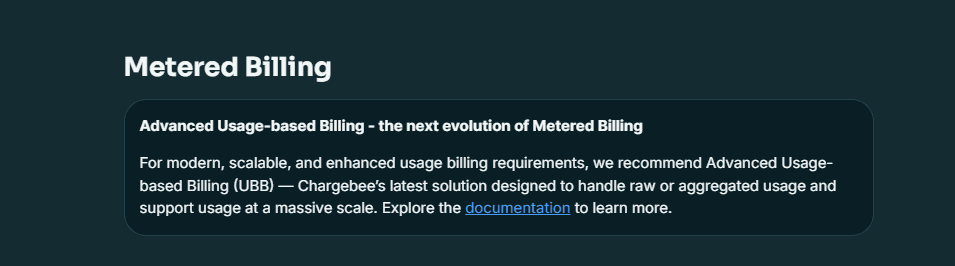
Open the Chargebee docs page for Metered Billing. The first banner reads:
"Advanced Usage-based Billing - the next evolution of Metered Billing. For modern, scalable, and enhanced usage billing requirements, we recommend Advanced Usage-based Billing (UBB), Chargebee's latest solution designed to handle raw or aggregated usage and support usage at a massive scale."
Read the next paragraph, and you find this:
"Metered Billing is an older usage-based billing offering that is best suited for businesses that send aggregated usage data, handle low-volume usage, and require multi-frequency billing within a single subscription."’
If your billing platform sits on its second iteration of the core primitive you depend on, your migration risk has two layers before you even consider switching vendors.
2. Chargebee aggregates usage in batches
Two limits sit underneath Chargebee's metered architecture, and both bite AI workloads.
The first is the look-back window. Anything that arrives outside that window does not count toward the next renewal cycle.
If a backfill runs late, a Kafka topic replays after an outage, or a customer dispute needs historical correction, you cannot fix the invoice. You file a ticket and write a credit note manually.
The second is the proration gap. Mid-cycle plan changes do not invoice metered components until the cycle closes.
Now look at how Chargebee describes its own architecture. The marketing page says "near-real-time aggregation." That word "near" gives it away. The design is an async queue plus batched writes. That works for accounting. It breaks for product surfaces:
You cannot show a customer their real-time credit balance
You cannot enforce a hard usage cap mid-session
You cannot block abuse in the moment it happens
If a customer just burned 50,000 inference calls in 10 seconds, Chargebee cannot tell you. You build a real-time entitlement layer on top, and now you run two systems for one job.
Real-time aggregation is not a nice-to-have for AI products. It is the floor.
3. Chargebee has no native credit wallet or entitlement engine
Most AI products run on three primitives: credits, entitlements, and outcomes. Chargebee handles none of them natively.
Credits. Chargebee has two things called "credits." Promotional credits are invoice offsets that auto-apply to the next bill. Refundable credit notes are financial corrections. Neither is a product entitlement.
What you do not get inside Chargebee:
A per-account wallet that your customer can see
Recurring monthly grants tied to a plan
Per-feature consumption rules
Rollover with expiry
Auto top-ups when the balance gets low
Webhook alerts at low-balance thresholds
Entitlements. Chargebee bills for plans and usage. It does not answer "can this tenant do this action right now?" That logic lives in your own database or feature-flag system, and it drifts every time a Chargebee plan changes.
Segwise spent 3 weeks building credit-based pricing on a non-usage-first stack. They moved to Flexprice and shipped it in 3 days. They now track 100+ enterprise customers with zero manual intervention.

4. Entitlements live outside Chargebee
Most AI products do not just sell access. They sell limits. 10 credits. 50 video minutes. 100 API calls per day. 30 seconds of generative output. Each plan offers a different mix, and the product enforces those limits in real time.
Chargebee does not manage feature-level entitlements. It bills for plans and usage, but the question "can this tenant do this action right now?" is not something Chargebee answers.
So teams build entitlements in their own database or feature-flag system. They map Chargebee plans to internal feature bundles. They write glue code to keep the two in sync when pricing changes.
This is a common source of bugs:
A customer gets charged for a plan, but their feature limits do not update
A pricing change goes live in Chargebee, but the entitlement sync lags by hours
The billing system and the product drift apart, and debugging the gap becomes a maintenance burden
You end up running an entitlement engine on the side. Chargebee does not.
5. Pricing iteration in Chargebee is painfully slow
AI companies iterate on pricing constantly. You launch a model, watch usage patterns, adjust rates, test new packaging, and repeat. This needs to happen weekly, not quarterly.
In Chargebee, every pricing experiment runs the same checklist:
Duplicate plans or addons
Adjust slabs and tiers
Map new metered features
Migrate customers from old plans to new ones
Grandfather existing customers on legacy pricing
Coordinate the rollout across Product, Engineering, Finance, and sometimes Chargebee support
There is no native price versioning. No staged rollouts where you test a change on 10% of customers first. No A/B pricing experiments. No way to override pricing per contract without spinning up a one-off plan variant.
The model is SKU-led configuration, not rules-based pricing. Sales gets blocked by engineering. Engineering gets blocked by finance. Teams report 3 to 4 months on Chargebee without shipping a single new pricing experiment.
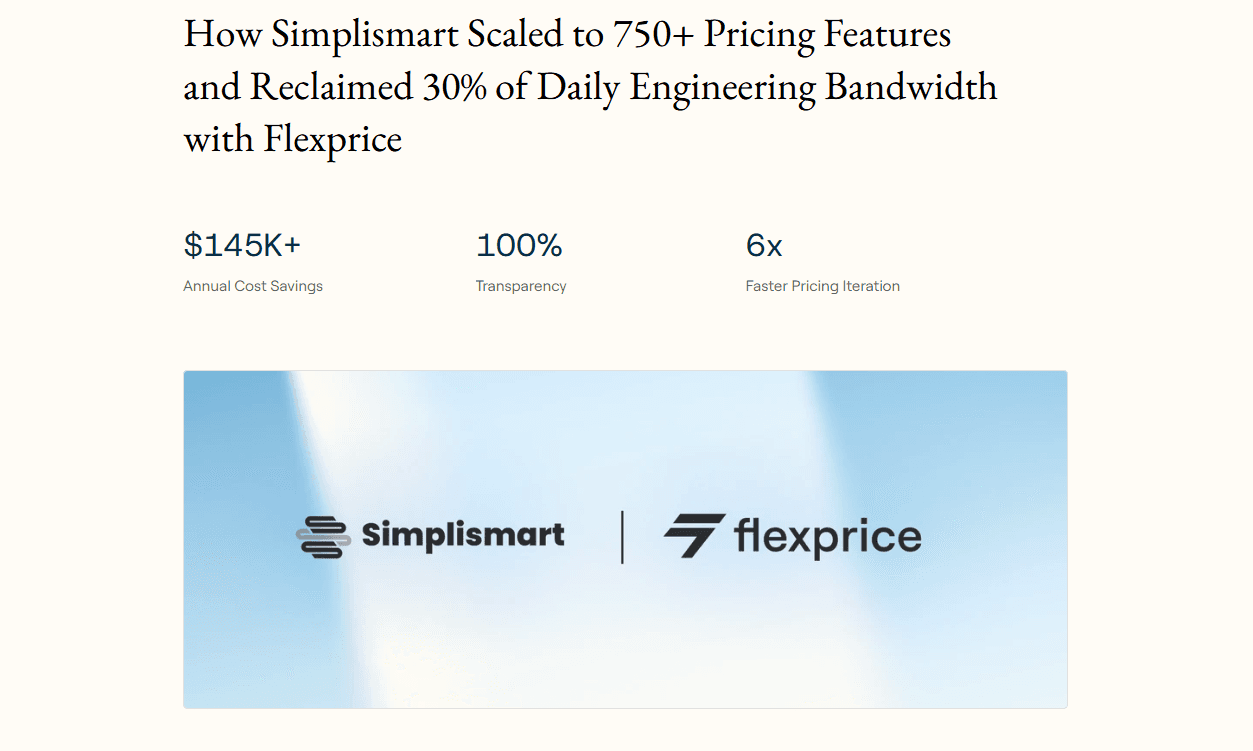
Simplismart hit this exact wall. After moving to Flexprice they iterate 6x faster, run 750+ pricing features, reclaimed 30% of daily engineering bandwidth, and saved $145K+ annually.
6. Chargebee has no ramped contracts or committed usage
Enterprise AI deals are not flat subscriptions. They have structure. A typical deal looks like this:
$1,000/month for a 3-month pilot
$1,500/month for the next 6 months as usage scales
$2,000/month after that, with a commitment of 1M API calls per month and a 1.5x overage rate
Chargebee does not support ramped contracts. There is no way to define a price timeline that auto-updates as a customer moves through phases. You manually create multiple plans, schedule changes via custom backend logic, and coordinate the migration each time a phase ends.
Chargebee also does not support committed usage volumes. If a customer commits to 1M API calls per month at a discounted rate with overage pricing above that, you are building commitment tracking, overage calculation, and true-up logic in your own backend.
There is no credit pooling either. When an enterprise team wants credits shared across departments, Chargebee cannot handle it. Each subscription is standalone.
For AI companies moving upmarket, these are not edge cases. They are the standard deal structure enterprise customers expect.
7. 0.75% overage scales with revenue and never improves with tier
Chargebee's pricing page lists three tiers:
Starter: free up to $250K cumulative billing
Performance: $599/month, $100K monthly cap, plus 0.75% overage above the cap
Enterprise: custom, same 0.75% overage rate
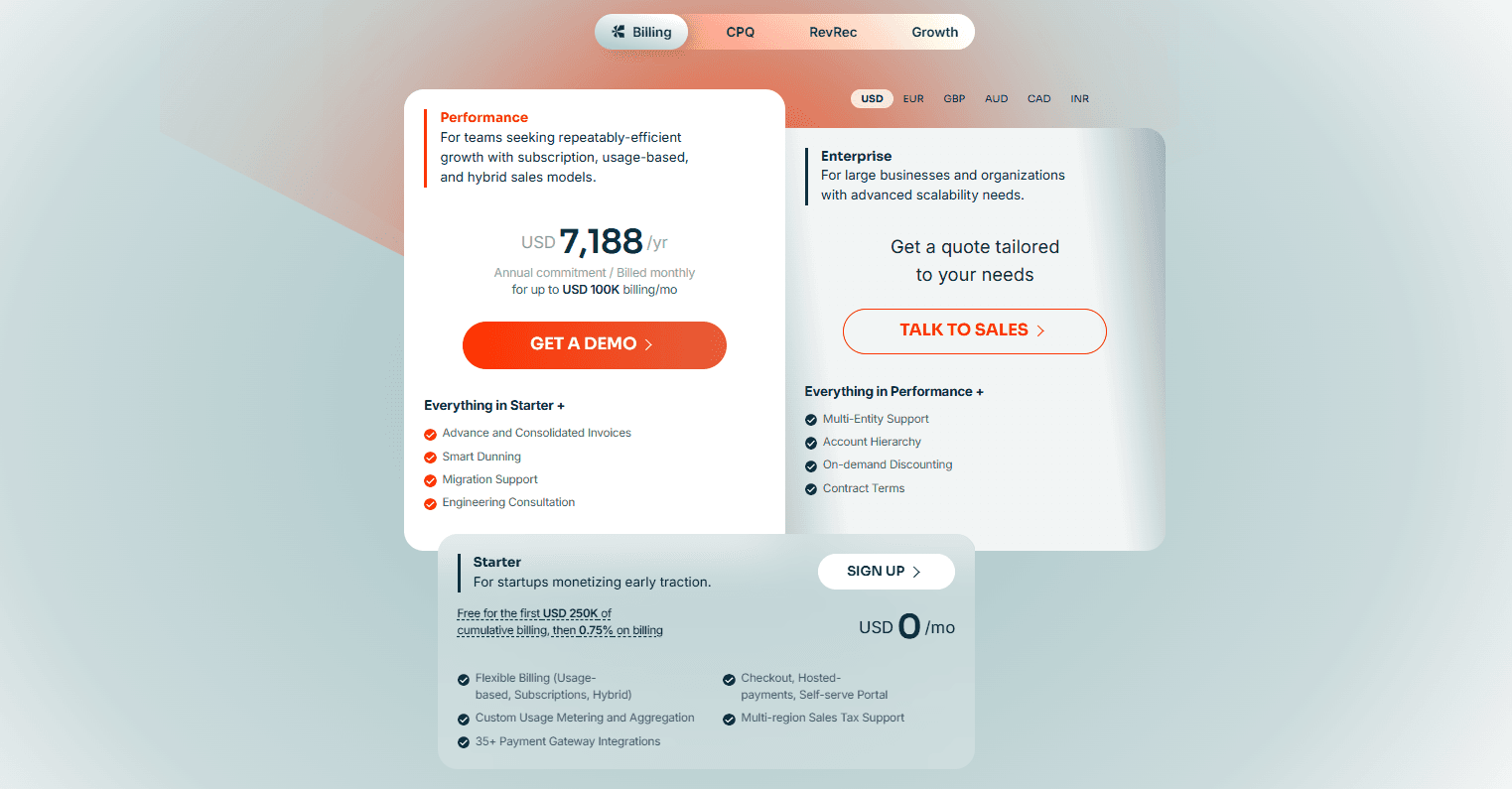
Two things to notice:
The 0.75% overage rate does not improve with a higher tier. Upgrading buys you more cap, not a lower effective rate.
The starter is cumulative, not annual. Once you cross $250K in lifetime billings, you do not cross back.
Run the math on a real $2M ARR usage-first SaaS. Performance costs $7,188 per year. Above the $1.2M monthly cap, you pay roughly $9K in overage. Add CPQ, RevRec, and Receivables, and the total cost of ownership lands at 1.2 to 1.4 percent of ARR.
The structural problem is simple. Chargebee's revenue scales with your billings. A viral product week doubles your bill. Their costs do not.
Gated essentials sit on top:
Offline payments
Advance invoices
Chargeback automation
Account hierarchy
Multi-entity support
All of these live behind Performance or Enterprise. Read the feature matrix before you sign.
8. Chargebee is closed source with no exit path
Chargebee is a closed-source, managed SaaS. There is no self-hosting option. No way to inspect billing logic. No way to debug edge cases at the engine level.
This matters more than it sounds.
When a customer disputes an invoice and you need to trace exactly how credits were calculated, you cannot read the code.
When your pricing model evolves in a direction Chargebee has not prioritized, you cannot extend the engine. You file a feature request and wait.
Migration risk also compounds over time. The more plans, addons, coupons, custom rules, and tax exemptions you build in Chargebee, the harder it becomes to leave.
Your billing history, pricing rules, and customer configurations are locked in a proprietary system.
One acquisition, one pricing change, one roadmap shift, and you have nothing to push back with.
9. Chargebee has no MCP server or outcome-based billing
If you are building AI products, two capabilities increasingly matter: agent-native tooling and outcome-based pricing. Chargebee has neither.
Flexprice ships with an MCP server. You can connect Cursor, Claude Code, VS Code, Gemini, or Windsurf directly to your billing dashboard. Every billing operation is an MCP tool that AI assistants can call. A non-technical founder can configure pricing through prompts.
An engineer can spin up a new pricing tier from their coding environment.
Flexprice also supports outcome-based billing natively. Charge for resolved tickets, successful calls, or completed workflows. Not raw tokens or API calls.
Chargebee has neither. No MCP server. No outcome-based billing primitive. Configuration requires the dashboard or direct API calls. Metered billing tracks raw usage, not business results.
For AI companies building the next generation of products, the billing platform should match the ambition.
10. Chargebee's renewal pressure scales with your usage growth
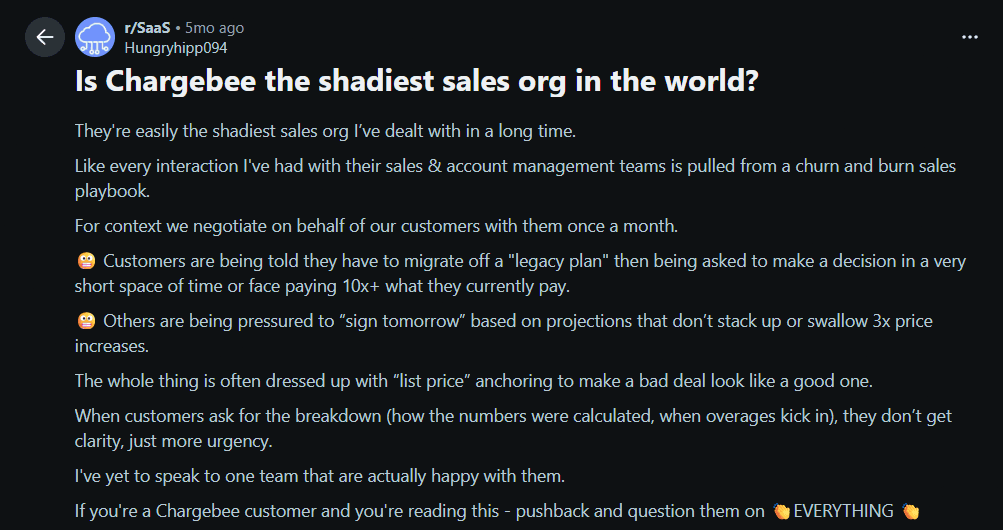
Search "Chargebee" on Reddit, and you find a thread titled "Is Chargebee the shadiest sales org in the world?"
The pattern customers describe:
Migration pressure off legacy plans, with short decision windows
Threats of 10x price jumps if you do not move on time
3x renewal asks anchored against inflated list prices nobody actually pays
"Sign tomorrow" urgency on projections that do not add up
Trustpilot adds the cancellation pattern. People canceled, got confirmation, and got charged again. Refund resistance from support followed.
This matters specifically for usage-based billing. Subscription-first SaaS billings are predictable, so renewal exposure stays flat. Usage-first AI billings spike on every viral month, model launch, or enterprise pilot.
Each spike resets your renewal exposure because the more revenue you push through Chargebee, the higher they anchor your next renewal.
Switching cost compounds the problem. Every plan, addon, coupon, custom rule, and tax exemption you configure makes the migration heavier. Chargebee knows this. Their renewal team knows this.
When to leave Chargebee for usage-based billing
You do not have to leave Chargebee for everything. You probably should leave it for usage-based billing if three or more of these apply to you:
Your top 10 customers will hit the 5,000-usage cap on any active subscription this year
Your product economy runs on credits, where customers buy packs, burn credits per feature, and top up when low
You need real-time entitlement checks because your product surface depends on knowing whether a tenant can do X right now
You ship pricing changes more than once per quarter, and engineering has become the bottleneck
Your enterprise deals require ramped contracts, committed usage with overage factors, or credit pooling across parent-child accounts
You bill on outcomes already, or you want to. Resolved tickets, completed workflows, and had successful calls
You want open-source transparency, self-hosting, or auditable billing logic
Your last two renewal conversations with Chargebee felt adversarial
If three of these landed, here is how Flexprice closes the gaps.
How Flexprice beats Chargebee on usage-based billing
We built Flexprice for the workload that Chargebee was not designed to run. Six places that show up most:
Credit wallets as a core primitive
Flexprice ships credits as a first-class billing concept. Recurring monthly grants tied to plans. Per-feature consumption rules. Rollover with configurable expiry. Auto top-ups with invoice-backed checkout.
Low-balance webhook alerts at multiple thresholds. Your customer sees a real wallet. Your product checks balances in real time. Your finance team gets clean credit accounting that separates promotional from paid credits.
Multi-metric pricing in one event stream
Send one unified event stream with any combination of metrics. Tokens, GPU minutes, storage, and seats. Define billable metrics once and attach them to plans, credits, or contracts.
Filter within events by metadata to price GPT-4 differently from GPT-4o without creating new SKUs. One event stream, one billable metric, different prices based on properties.
Native ramped contracts and committed usage
Define price timelines that auto-update as customers move from pilot to scaled phases. Configure overage factors of 1.5x, 1.0x, or 0.8x. Set windowed commitments with hourly buckets.
Pool credits across parent-child accounts. None of that requires custom backend logic or coordinated migrations.
Real-time entitlements are built into the model
Flexprice manages entitlements as part of the core billing model. Features can be boolean, config, or metered.
Your app queries "can this tenant do X right now" via API. Per-customer overrides and dynamic experiments work without changing the underlying plan. No glue code. No drift between billing and product.
Pricing iteration in minutes
Native price versioning. Staged rollouts. A/B pricing across customer segments. Full audit history. You change what you want, target who you want, and control when it applies. Pricing experiments ship in minutes instead of months.
Open source, real throughput, transparent pricing
Flexprice is fully open source. 3,500+ stars on GitHub, 61+ contributors. Self-host on your own infrastructure. Flexprice processes upto 1M events per second.
Pricing is predictable and not revenue-share. No "contact sales for these features."
NurtureV runs roughly 70 paid actions and constant pricing experiments. Their take: "For any new and lean team building anything serious, it is a must-have and a no-brainer."
See the full feature comparison: Flexprice vs Chargebee.
Wrapping up
Chargebee is a strong subscription billing platform. If your product is usage-first, your billing should be too.
Flexprice is enterprise-grade, open source usage based billing infrastructure for AI and SaaS companies. It can be deployed in your own VPC, on-prem, or on Flexprice's managed cloud.
Flexprice lets AI-native and SaaS teams operate usage-based, credit-based, and hybrid pricing with real-time metering and reporting that scales as your product evolves.
So choose your billing stack wisely.
Does Chargebee support usage-based billing?
Why is pricing iteration slow in Chargebee?
What is the difference between Chargebee Metered Billing and Advanced UBB?
Is Chargebee a good fit for AI startups?
What is the best Chargebee alternative for usage-based billing?