
Ayush Parchure
Content Writer, Flexprice

Chargebee is a subscription billing and revenue management platform. It runs recurring-revenue operations for 6,500+ SaaS and AI companies across 180 countries.
You're here because your pricing is getting complicated. Maybe you're layering usage or AI billing on top of subscriptions. Maybe finance wants ASC 606 out of engineering's hands.
This post covers what Chargebee does in 2026, what it actually costs, where customers praise it, and where they push back. By the end, you'll know if it fits your stack.
TL;DR
Chargebee is a subscription billing and revenue management platform serving 6,500+ SaaS and AI companies across 180 countries.
Founded in Chennai in 2011, now dual-HQ'd in SF and Chennai, with $470M+ raised and a 2025 Gartner Magic Quadrant Leader title.
Automates the full recurring-revenue loop: signup, plan assignment, payments, invoicing, dunning, and ASC 606/IFRS 15 revenue recognition.
Ships seven modules (Billing, CPQ, Receivables, Retention, RevRec, Payments, Growth) with 60+ native integrations and 35+ payment gateways.
Best fit for finance-led, subscription-first B2B SaaS (Series B+) that need multi-entity accounting, CPQ, and compliant RevRec.
Pricing: Starter free up to $250K cumulative billing, Performance at $599/mo, Enterprise custom, plus a 0.75% overage fee that doesn't improve on higher tiers.
Real-world TCO typically lands at 1.2 to 1.4% of ARR once overages and add-on modules stack up.
Reviewers praise the flexible subscription engine, deep docs, global payments coverage, and finance-headcount savings from automation.
Common complaints: surprise overage fees, complex UI, slower support at the Performance tier, gated essential features, and aggressive renewal motions.
Weaker fit for AI-native, usage-first, credit-native, or open-source-preferring teams, where Flexprice, Orb, or Stripe+Flexprice tend to ship faster.
What is Chargebee?
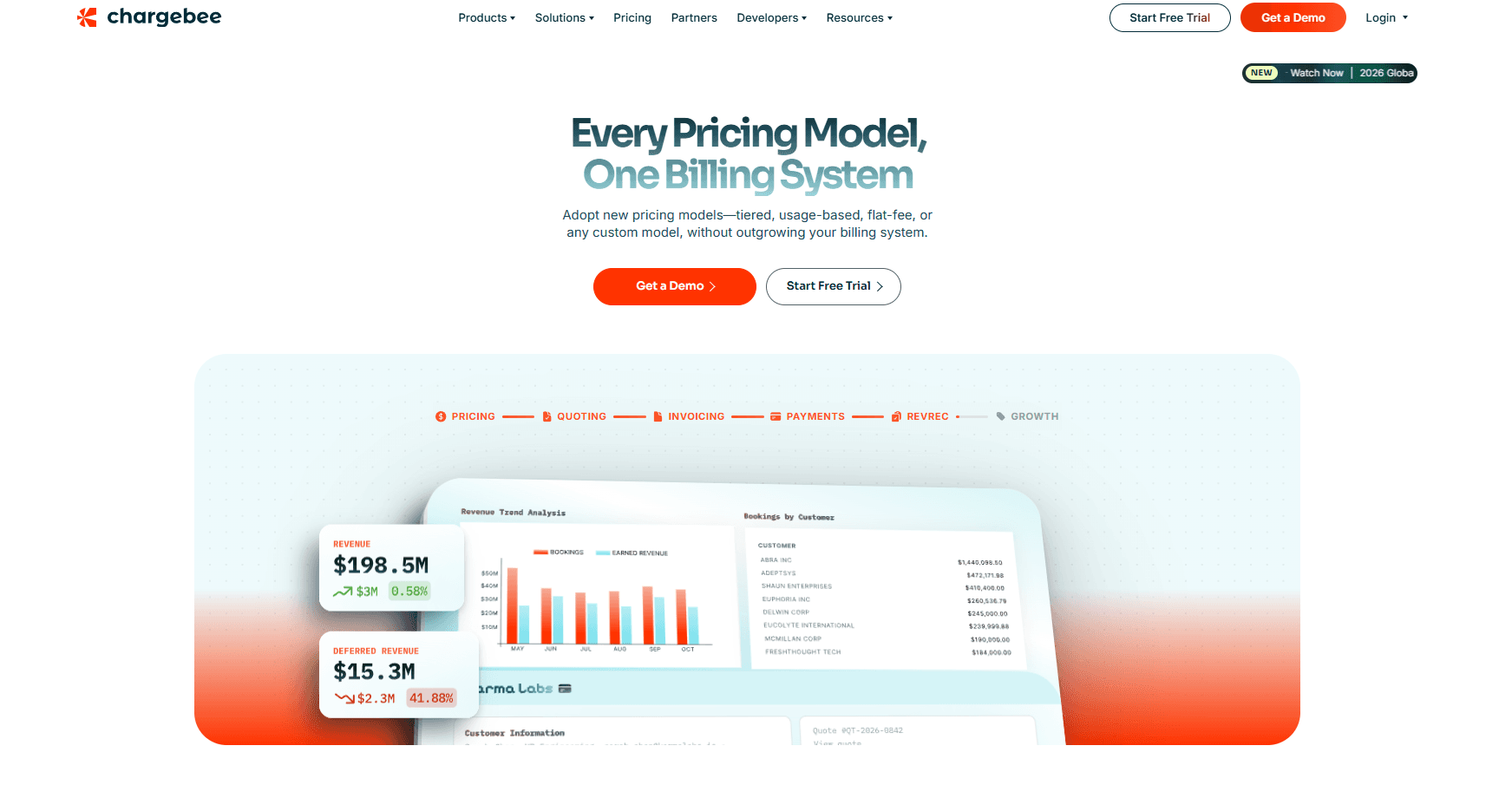
Chargebee is a subscription billing and revenue management platform. It's built for B2B SaaS, AI, and any business that charges customers on a recurring basis. It runs plan changes, invoicing, tax, dunning, and revenue recognition so your team doesn't rebuild that machinery in-house.
The company started in Chennai in 2011. It now runs dual HQs in San Francisco and Chennai, with 1,000+ employees and over $470M raised from Tiger Global, Accel, Sapphire, Insight, and Sequoia. In 2025, Gartner named it a Magic Quadrant Leader for Recurring Billing Applications, its second year in that position.
Recurring revenue looks simple on a spreadsheet. You bill someone monthly and collect the money. In practice, every upgrade, downgrade, trial, currency, failed card, tax jurisdiction, and contract amendment becomes a branch in your code.
Chargebee pulls that branching out of your engineering backlog so finance can own billing logic without filing Jira tickets.
Your existing users sign in at app.chargebee.com through the standard Chargebee login. If you're evaluating the platform for the first time, this is what you're actually looking at.
How Chargebee works, from signup to revenue recognition
Chargebee automates the full recurring-revenue lifecycle. A customer signs up, Chargebee bills them, collects the money, retries the failures, and files the revenue correctly. Here's the loop in six steps.
Sign up and checkout. A customer signs up through Chargebee's hosted checkout, a self-serve portal, or your own UI via API.
Plan and pricing assignment. Chargebee applies the subscription, add-ons, trials, coupons, or usage meters from your product catalog.
Payment processing. The card, ACH, wallet, or regional method routes through one of 35+ supported payment gateways.
Recurring billing. Chargebee generates invoices on schedule. Monthly, annual, usage-based, hybrid, or one-off. It handles proration when customers change plans mid-cycle.
Retention and dunning. Failed payments trigger smart retries, in-app cancellation flows, and retention offers before the customer churns.
Revenue recognition. Billed revenue flows into ASC 606 and IFRS 15 reports and syncs to QuickBooks, NetSuite, Xero, or Sage Intacct.
Chargebee packages its product into seven modules: Billing, CPQ, Receivables, Retention, Revenue Recognition, Payments, and Growth. Most teams start with Billing. CPQ and RevRec are where mid-market and enterprise accounts land.
For non-standard stacks, Chargebee ships 60+ native integrations (Salesforce, HubSpot, NetSuite, QuickBooks, Xero, Avalara, Slack, Zapier) plus a REST Chargebee API for custom work. If your finance stack isn't on the integration list, you'll build the last mile yourself.
Who should use Chargebee
Chargebee is built for subscription-first B2B SaaS companies, typically Series B to growth stage. The finance team wants to own billing without a dedicated billing-engineering squad. Chargebee is also the natural home for companies that need multi-entity accounting, ASC 606 compliance, and sales-led motions with CPQ.
A sample of its customer logo wall, sorted by category:
Horizontal SaaS: Zapier, Freshworks, Typeform, LegalZoom
AI and ML: DeepL, NextBillion AI, Kommunicate
Media and publishing: Condé Nast, RightNow Media
Commerce and consumer: Pret A Manger, SlideBean, Brevo
Fintech and trading: FX Replay, TradeIdeas, Codat
Chargebee is rarely the first pick for pure usage-based billing products. AI inference APIs, observability tools, and cloud infrastructure need pricing that moves in real time against event streams, not on a batch schedule. We'll come back to that pattern below.
Chargebee's core features in 2026
Chargebee splits its feature footprint across five practical groups. Here's what you get when you sign up today.
Subscription management. Hybrid pricing puts subscriptions, usage, and one-time charges on a single invoice. You get tiered, volume, and stairstep models, grandfathered plans, coupons, trials, gift subs, and automatic proration on upgrades and downgrades. This is Chargebee for subscription management, the core product every customer starts with.
Billing, invoicing, and payments.
Chargebee ships hosted checkout and a self-serve customer portal, both brandable. It routes payments through 35+ gateways including Stripe, Adyen, Braintree, Razorpay, and GoCardless. Multi-currency and multi-region tax handling covers EU VAT, UK MTD, Indian GST, and US sales tax (via Avalara). Advance and consolidated invoicing, smart dunning, and retry logic come standard.
The CPQ module syncs to Salesforce and HubSpot, runs approval workflows, and supports multi-product and multi-year ramped quotes. Revenue Recognition handles ASC 606 and IFRS 15, journal entry mapping, SSP analysis, and expense amortization. The Receivables module tracks collections and recovery.
Analytics and reporting. Chargebee ships 150+ pre-built metrics. MRR growth, churn, and leakage reports, a custom report builder, and deferred revenue reporting. Real-time dashboards are table stakes. The depth sits in cohort and waterfall reports.
What's new in 2026: AI and usage billing. Chargebee has pushed hard into AI monetization this year. Schemaless usage ingestion lets you add new metrics without reworking pipelines. Aggregation runs in near real time on billions of events. The platform now supports billing on tokens, API calls, agent workflows, and outcomes directly.
Chargebee's own 2025 State of Recurring Revenue and Monetization Report claims 80% of companies adding AI are also evolving their pricing, and that AI plus hybrid pricing correlates with 2× growth.
Whether Chargebee's usage engine keeps up with a real-time AI workload is the question you need to test in your own evaluation. Flexprice and Orb have been shipping against that spec for longer, and the gap shows up in aggregation latency and pricing-iteration speed.
Chargebee pricing in 2026
Chargebee prices on billing processed, not seats. The Billing product has three plan tiers. Other modules (CPQ, RevRec, Receivables, Retention) sell separately.
Plan | Monthly fee | Billing cap | Overage | Best for |
Starter | $0 | Free up to $250K cumulative billing | 0.75% on billing above $250K | Pre-revenue and early-stage |
Performance | $599/mo ($7,188/yr) | Up to $100K/month billing | 0.75% over cap | Growth-stage SaaS with advanced invoices and smart dunning |
Enterprise | Custom | Custom | Custom | Multi-entity, account hierarchy, contract terms |
CPQ, RevRec, Receivables, and Retention each price as separate modules after a sales call. CPQ Lite is free for the first 50 quotes if you're on Billing. Growth and Retention Starter are free for Billing customers.
Enterprise tiers scale with active subscribers.
Here's how the math plays out on a real P&L. A $2M ARR SaaS on the Performance plan pays $7,188/yr for the plan fee, plus 0.75% overage on the $1.2M it bills above the plan cap. That's roughly $9,000/yr in overage. Layer in RevRec at the enterprise tier and CPQ, and the real total lands closer to 1.2 to 1.4% of ARR.
An independent UniBee review cites a Chargebee customer: "We're effectively paying 1.4% of revenue for billing infrastructure."
Two pricing details catch teams off guard:
The $250K Starter threshold is cumulative, not annual. Once you cross it, you can't cross back. The free tier isn't refillable.
Overage fees don't decrease on higher plans. Upgrading to Performance or Enterprise doesn't buy you a better rate per dollar overflown.
What real customers say about Chargebee
Chargebee is well-reviewed across the major platforms. Here's the snapshot before we get into what reviewers actually say.
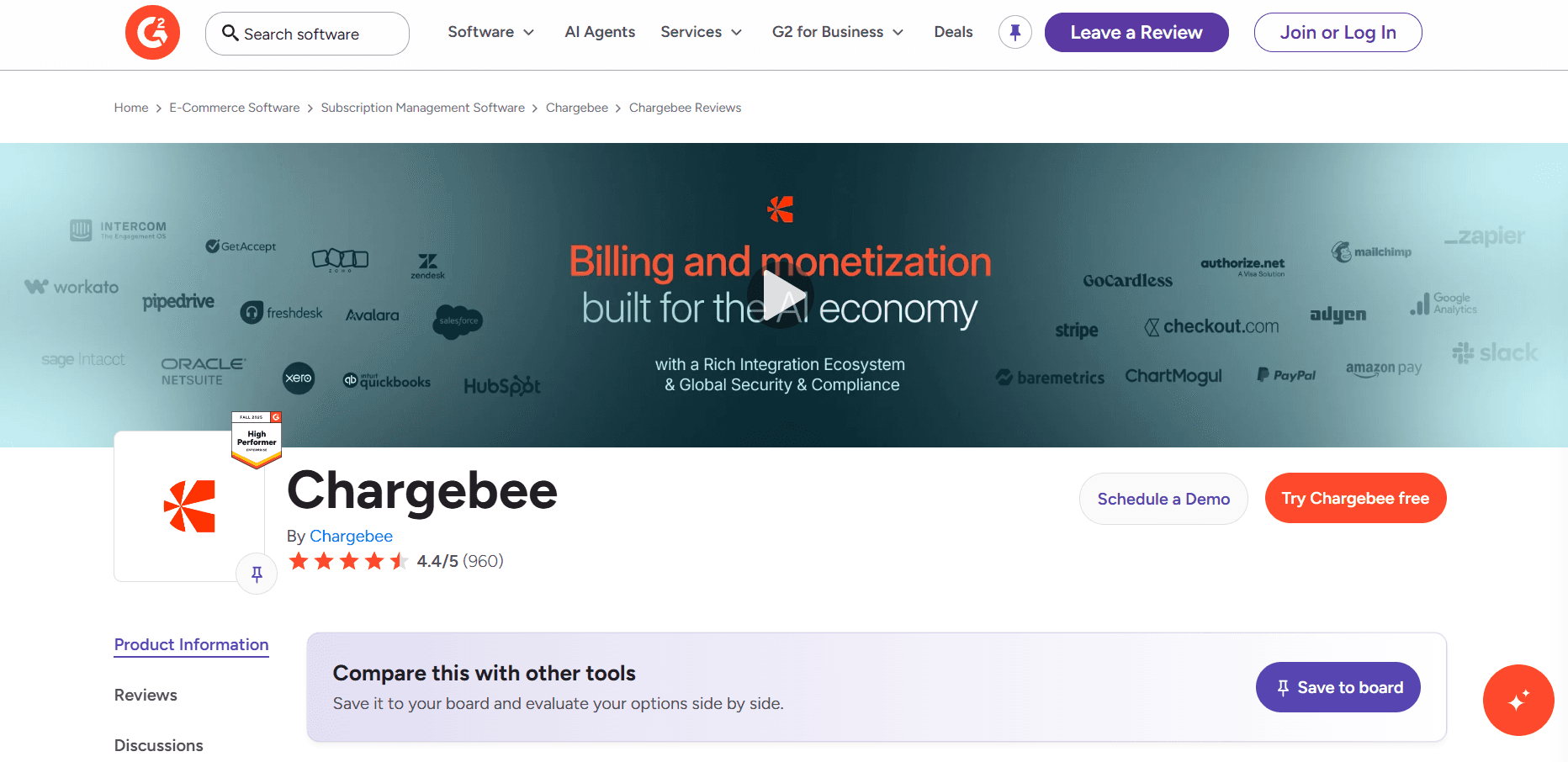
Chargebee across the major review platforms
G2: 4.4 / 5 (995+ reviews)
Capterra: 4.3 / 5 (95 reviews), value-for-money 3.9
TrustRadius: 8.3 / 10 (77 reviews)
Gartner Peer Insights: 4.3 / 5 (41 reviews, Recurring Billing Applications)
5 things reviewers consistently praise
1. The subscription engine is flexible. Reviewers across G2, TrustRadius, and Gartner call out Chargebee's hybrid pricing as the reason they picked it over Stripe or Recurly. You can run subscriptions, usage, and one-time charges on a single invoice. Grandfathered plans, tiered and volume pricing, stairstep models, trials, coupons, and gift subs all work out of the box. If your product catalog has ever been a tangle of edge cases, this is the feature that flattens it.
2. Documentation is deep and actually useful. This shows up repeatedly in G2 reviews and community threads. The API reference covers edge cases that most competitors hand-wave. New engineers get to a working webhook in hours, not days. One TrustRadius reviewer calls the docs "the best in the category."
3. Global payments coverage is broad. 35+ supported gateways, plus multi-currency and multi-region tax handling (EU VAT, UK MTD, Indian GST, US sales tax via Avalara) mean a single Chargebee account runs billing in most markets without a second integration. Teams that have stitched this together manually are Chargebee's loudest advocates.
4. Automation replaces real finance headcount. Multiple reviewers quantify the benefit. Less manual invoicing, fewer reconciliation errors, dunning runs itself, and recurring-revenue reporting stops being a spreadsheet exercise. A few G2 reviewers put it in dollar terms: "saved us from hiring a billing analyst."
5. CPQ and RevRec are the stickiness at scale. Once you reach mid-market, the add-on modules pull their weight. CPQ syncs cleanly with Salesforce and HubSpot. Revenue Recognition handles ASC 606 and IFRS 15, so your auditor stops flagging deferred revenue schedules. These are the features customers say would be hardest to replace if they moved off Chargebee.
8 things reviewers push back on for Chargebee
1. Overage fees arrive without warning. This is the single loudest complaint across Reddit, TrustRadius, and UniBee. Customers report 0.75% overage fees landing six months after the fact, with no mid-period alert when they crossed the $250K Starter cap or the Performance $100K/month cap. One reviewer describes "over $12K/month in overage on a $3K/month contract with zero heads-up." Budget accordingly and set your own internal alerts.
2. The UI is complex and often counterintuitive. Multiple reviewers call the admin console "painful to use." UniBee cites a customer who needs 20 minutes and three support articles to pull a simple refund report. Gartner reviewers flag non-standard reporting as a regular friction point. You'll onboard a new finance hire and still spend a week showing them where things live.
3. Support quality drops at the Performance tier. Basic tickets resolve quickly. Past standard flows, speed degrades. UniBee quotes one customer who hit a Friday billing break and got a Tuesday morning response. If billing sits on your critical path, negotiate a secondary escalation line into your contract.
4. You still need engineering for anything custom. Chargebee markets itself as finance-owned billing. In practice, reviewers report that custom tax rules, unusual proration logic, and bespoke webhooks kick back to engineering. It's the same complaint Chargebee uses against Stripe, now showing up in Chargebee's own reviews.
5. Essential features sit behind the paywall. Offline payments, advance invoices, chargeback automation, account hierarchy, and multi-entity support all gate to Performance or Enterprise. If your Starter plan runs into one of these, you're upgrading, not configuring your way around it. Read the feature matrix on the pricing page before you sign.
6. Search and reporting can be slow. TrustRadius and Gartner reviewers flag performance issues inside the admin app. "Searching for accounts sometimes times out." Custom reports take longer to build than the dashboards suggest. Not a dealbreaker on its own, but if your team lives inside billing tooling, it compounds.
7. Tax handling has gaps. A Gartner reviewer flags "zero support for tax exemption laws by state," a blocker for US non-profits and certain resellers. International VAT works. US state-level exemption handling is thinner than the documentation implies.
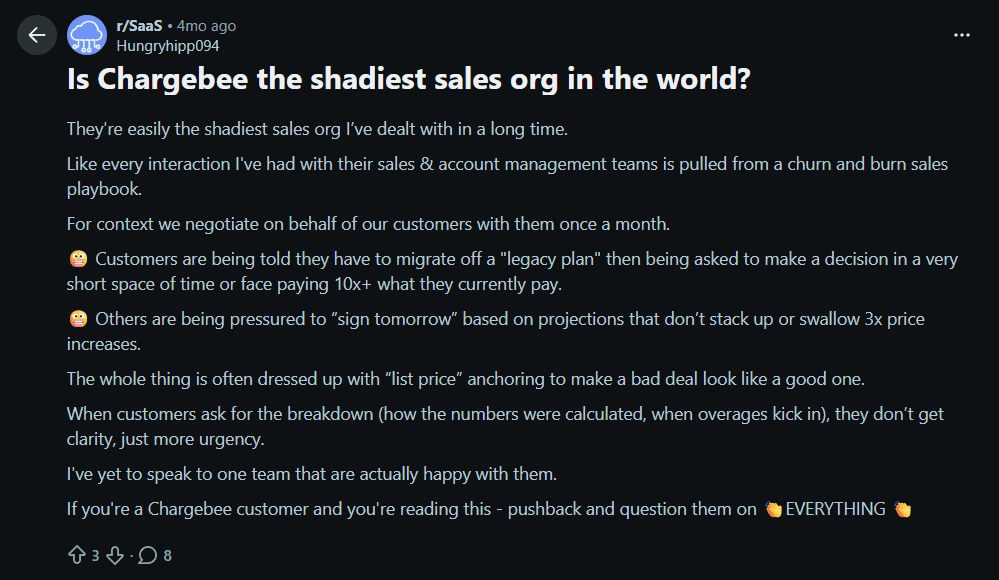
8. The renewal motion is aggressive. This is the cluster of complaints that travels furthest. The Reddit r/SaaS thread "Is Chargebee the shadiest sales org in the world?" alleges short decision windows, 3× price jumps anchored against inflated list prices, and migration pressure off legacy plans
How Chargebee compares to Flexprice, Stripe, Paddle, Orb, and
Chargebee sits in a crowded category. Here's how it stacks up against the four platforms teams most often shortlist against it.
Platform | Model | Best for | Watch out for |
Chargebee | Subscription-first, multi-module | Finance-led B2B SaaS, multi-entity, CPQ, and RevRec | Overage math, UI complexity, renewal pressure |
Flexprice | Usage-first, open source | AI products, real-time metering, credit-native pricing | Self-hosted option needs ops maturity |
Stripe Billing | Payments-first, billing bolt-on | Developer-led teams, sub-$1M ARR, simple subs | Engineering-heavy for complex billing, SQL-heavy reporting |
Paddle | Merchant of record | Global SaaS that wants tax and compliance handled | Less flexible for complex enterprise pricing |
Orb | Usage-native, event-first | Mid-market data and infra products | Newer, narrower feature set than Chargebee |
In one line: Chargebee fits subscription-first products with a finance-team buyer. If your product is usage-first and your engineering team is the buyer, the newer platforms like Flexprice or a Stripe plus Flexprice combo will ship faster.
For the deeper comparisons, see Flexprice vs Chargebee vs Stripe and our Top 5 Chargebee alternatives for 2026.
When Chargebee isn't the right fit for AI and SaaS companies
Chargebee is a strong software for the workload it's designed for. It's worth naming the cases where that workload doesn't match. Moving onto Chargebee and then back off again is expensive.
Chargebee may fight you if:
You're AI-native and your pricing needs to move against real event streams (tokens, API calls, agent runs) in real time, not in batch.
You need credit-native pricing from day one. Prepaid balances, rollovers, top-ups, expiry rules. Not as a bolt-on.
You want to iterate pricing weekly instead of on quarterly engineering cycles.
You want open-source control. Inspectable billing logic, a self-hosting option, or embedded billing inside your existing backend instead of replacing it.
You're pre-$250K billed and want a stack you won't outgrow at the first threshold.
These are the patterns Flexprice was built for. It's usage-first, event-driven, credit-native billing for AI and modern SaaS. It augments Stripe or Chargebee rather than replacing them, handles 20bn+ events per month in production, and is open source if you want to self-host.
If that sounds closer to your profile than Chargebee's subscription-first model, check out how Flexprice compares to Chargebee.
If you're a finance-led subscription business, the rest of this post still applies. Chargebee is likely your right pick.
What are the cons of Chargebee?
Is chargebee the right choice for usage based billing?
What's the difference between Chargebee and Flexprice?
Is Chargebee good for AI startups?
What are the best Chargebee alternatives?