
Ayush Parchure
Content Writer, Flexprice
Choosing a subscription pricing model is one of the hardest early calls a SaaS team makes. Usage-based, tiered, flat-rate, per-seat, the terms get thrown around constantly, but rarely with a clear breakdown of how they differ or which fits a specific business.
One advisor pushes usage-based, another insists on flat-rate, and the decision made in week one starts looking permanent by month six.
This guide lays out the most common subscription pricing models: flat-rate, tiered, per-seat, usage-based, freemium, and hybrid, with the brands proving each one at scale, so the right choice becomes obvious.
TL;DR
Six subscription pricing models, each with a sweet spot and a breaking point:
Flat-rate: One price for all. Fits early-stage, single-use-case SaaS. Breaks when heavy users eat your margin.
Per seat: Priced per user. Fits team tools. Breaks with seat sharing and AI agents replacing seats.
Tiered: Per-unit price drops with volume. Fits when unit economics improve at scale. Breaks at tier-crossings and rate-card versioning.
Usage-based: Pay per token, call, or minute. The default for AI and infra. Breaks with forecast drift and bill shock.
Credits / prepaid: Buy upfront, burn down. Loved by enterprise procurement. Breaks on revenue recognition, expiry, and rollovers
Hybrid (base + usage): Platform fee plus metered overage. Where most AI SaaS lands. Breaks when one invoice has to reconcile two pricing engines
Three questions that decide the right fit: Can finance forecast it in under 10 minutes? Can you change pricing in days, not a quarter? Can your billing system run the logic today?
Before switching: re-price your book on real data, pilot one cohort, and make sure a real customer can read the invoice back to you.
Bottom line: The best model isn't the most advanced, it's the one you can run reliably every month without a spreadsheet sprint. Fix the billing foundation first, then pick the shape.
What are subscription pricing models?
A subscription pricing model is the rule that decides what a customer pays, how often they pay it, and what triggers a charge. That is the whole definition.
The shape of that rule does a lot of work, though. It decides how clean your forecast looks next Friday. It decides how fast you can explain an invoice over email. And it decides how much billing logic your engineers carry inside your product code versus how much a platform handles for you.
You can change the rule later. Every SaaS team does. But the first version you pick sets the default for how your revenue moves, how your customers read your bills, and how finance closes the month.
So pick a SaaS subscription pricing model that you can run today, with some room left to grow into the one you want. Almost every AI SaaS team you meet picks from these six subscription pricing models below:
The six models at a glance
Flat rate: one price, one product, same for every customer. Common in early-stage SaaS with one clear use case.
Per seat: A price per user or per license. Common in team tools like Slack, Notion, and Figma.
Tiered: Tiered pricing is a strategy that businesses use to set the costs of products or services based on the different levels or quantities that customers purchase. The more a customer buys, the less they pay per unit.
Usage-based: The customer pays for what they use. API calls, tokens, minutes, jobs, events. Common in AI SaaS and infrastructure.
Credit or prepaid: The customer buys credits up front. Credits burn down as they use the product. Common with AI copilots and enterprise budgets.
Hybrid pricing: A platform fee every month, plus metered usage on top. Common once a SaaS crosses mid-market and starts selling to enterprises.
The six subscription pricing models, with a decision lens
In this section, we’ve broken down each pricing model into
How the model actually works
When is it the right choice for your business
When can this model stop being enough or break for you
1. Flat rate pricing
Flat rate pricing is basically one price, one product, one plan. Every customer pays the same monthly or annual fee regardless of usage, seats, or features consumed. The invoice is a single line item, the same line every month, for every logo in your book.
When is it the right choice for your business?
Flat‑rate pricing only really works when you have one clear use case, one buyer type, a short sales cycle, and a product whose cost to serve doesn’t change with how customers use it.
Early-stage SaaS selling a focused utility, calendar tools, single-purpose productivity apps, and early B2C products live here because the feature surface is small and the customer base is small enough to price by instinct.
If you are an AI product, a flat rate rarely fits your use case. Inference, tokens, and GPU time move with every prompt. A price that cannot absorb that variance is a margin leak waiting to show up at close.
For an AI product, think of two customers on the same flat plan.
- Customer A is a small startup sending 10,000 prompts a month.
- Customer B is an enterprise sending 10 million prompts a month.
Both pay you $1,000 per month on a flat plan.
Every prompt costs you real money: inference time, tokens, GPU minutes. Customer B might cost you $2,000–$3,000 in GPU and infra, while Customer A costs you $50. Under flat pricing, you earn a small profit on A and lose money on B, even though they’re both on the “same” $1,000 plan.
So here your costs scale with usage, but the flat price doesn’t. Over time, heavy users quietly turn into a margin leak because you never charge more, no matter how much they use.
When can this model stop being enough or break for you
These three signals tell you that you’ve outgrown flat rate:
A customer running 5M requests pays the same $99 as a customer running 5,000 requests. Your cost-to-serve on the heavy account eats the margin on the light one.
An enterprise buyer asks for a custom agreement, an exception, or a commitment. A one-SKU catalog has nowhere to put it.
Upsell has no lever. There is no tier to move up to, no meter to expand, no seat to add. MRR per account is capped on the day they sign.
2. Per seat pricing
Per seat pricing is when you charge per user, per license, or per active account. The math is seat count × per-seat price, prorated for mid-cycle adds and removes.
When is it the right choice for your business?
Per-seat works when every named user gets clear, direct value from logging in. Think collaboration tools, internal platforms, shared workspaces, and any product with a named-user login model. The pricing page explains itself, more people, more seats, more cost.
Seat-based pricing is most effective when your product’s value scales with headcount, particularly in environments where manual tasks outweigh automated workflows.
When can this model stop being enough or break for you
Per-seat breaks in four ways, and the fourth is the one hurting AI products right now:
Seat sharing: One paid login is shared by a whole team, so your revenue stalls while real usage climbs.
Value no longer tied to seats: You ship a much more powerful product, but because the price is “$X per seat,” customers pay the same even if they’re getting 5–10x more value.
Flat revenue from flat headcount: A customer sits at 20 paid users for three years. Their team’s activity and dependence on your product triple, but revenue is capped because it’s tied to seats, not usage.
Agents replacing seats: A customer runs 5 human users and 20 AI agents or automated workflows that drive most of the API calls. The seat count (5) no longer reflects where value and cost sit (mostly in those agents), so per-seat pricing stops telling the truth about the account.
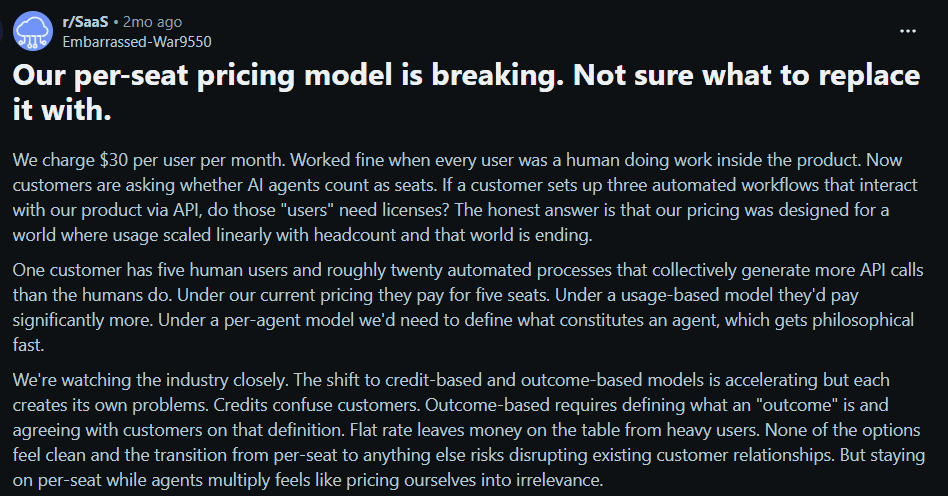
You can see this example, where a founder on Reddit summed it up in one line: "Staying on per-seat while agents multiply feels like pricing ourselves into irrelevance."
When one customer runs five human users alongside twenty automated processes, the seat count stops telling the truth about the value delivered.
3. Tiered pricing
Tiered pricing is when you charge different per-unit rates at different volume bands instead of one flat rate. As customers buy more, they move through those bands (tiers), and each higher tier has a lower price per unit than the previous one.
There are a few ways tiered pricing can be structured. For example, a company might offer a 10% discount for purchases of $100 or more, a 20% discount for purchases of $200 or more, and a 30% discount for purchases of $300 or more.
Or, a company might offer free shipping for orders over $50, and discounts on future purchases for customers who spend a certain amount in a single transaction.
When is it the right choice for your business
Tiered pricing fits when three things are true:
Your unit economics improve as customers grow. For example, you spread inference over batched requests, or storage cost per GB drops at higher volumes. If your cost per unit does not fall with scale, a volume discount just burns margin.
You charge on a single metric that customers already understand: tokens, API calls, minutes, rows, events, or GB. One meter, one rate card.
Your customers use the product at very different scales. You have many small accounts and a few very large ones. Tiered pricing is built for that mix.
For an AI SaaS founder, it is the right choice when you want to give enterprise buyers a volume discount without writing custom contracts every time. A published tiered rate card does the discounting for you, holds up in procurement review, and saves sales time.
When can this model stop being enough or break for you
First, at tier crossings. Imagine a customer who usually sits at 480 units in tier 2 and then spikes to 520 units in tier 3. They cross one threshold, get a lower per‑unit price on those extra units, and if your discounts are aggressive you can actually earn less total revenue for that period. Every time a big customer crosses a tier, your forecast jumps. The larger your top accounts, the more each crossing moves the number.
Second, when you version the rate card. You launch a new tier structure for new customers, but you keep old customers on the legacy rates. Now your billing system has to track multiple versions of the same meter per customer, and remember exactly which version applied in which period. Two versions quickly become three, then seven, and each one adds permanent complexity to billing and reporting.
4. Usage based pricing
Usage-based pricing means you charge customers based on how much they actually use the product.
You track a usage metric API calls, tokens in and out, audio minutes, GB processed, GPU‑minutes, rows synced, jobs run and the bill is simply: usage volume × price per unit, summed for the billing period. Teams often pair this with a minimum, a committed amount, or a tiered rate card so revenue is less volatile month to month.
When is it the right choice for your business?
Usage-based is the default for AI SaaS, infrastructure, and any product where cost to serve grows with customer activity. It works best when three things line up:
Your cost and the customer's value both move with the same metric.
You can measure that metric accurately, in real time, down to each event.
The customer has a clear idea of what drives their bill (tokens, calls, minutes) before they read the invoice.
If all three hold up, usage-based pricing is the most honest model on this list: you charge what you cost, and the customer pays for what they got.
When can this model stop being enough or break for you
Forecast drift. Usage is customer behavior, not a signed contract. A pure usage book comes with big error bars every month, and those error bars grow as your top accounts grow.
Silent revenue leakage, meter drops 3% of events, custom overage rate never makes it into the rater. None of this shows up on a dashboard because the chart still goes up. It shows up when finance compares billed revenue against committed revenue at quarter-end.
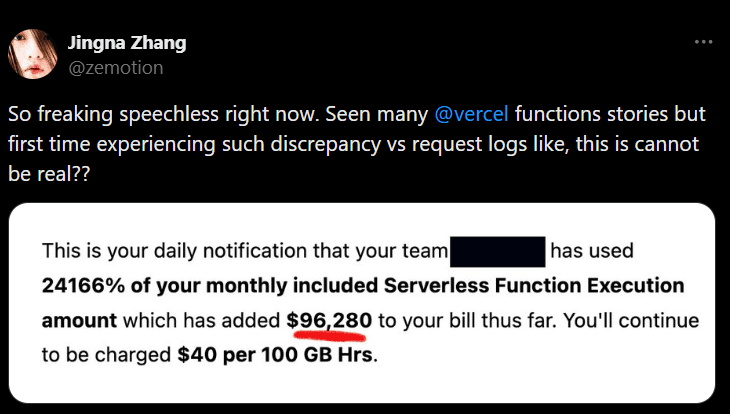
Usage based pricing also comes with a bill shock, and it is not a theoretical risk. In June 2024, the artist social app Cara went viral and got hit with a $96,280 bill from Vercel for serverless function invocations alone, after traffic spiked to 56 million invocations a day.
5. Credit based pricing
Credit based pricing means customers pay for a block of usage up front, then use it over time.
They buy a credit bundle (for example, $10,000 or $50,000 per year), and every time they use the product, you subtract from that balance. When the wallet hits zero, they either top up, auto‑refill, or their usage stops.
You can tie one credit to whatever unit makes sense for your product: tokens, runs, generations, minutes, or any other clear usage metric.
When is it the right choice for your business
Credits fit three situations:
AI workloads with variable usage, where the customer wants a hard ceiling on spend.
Enterprise deals with fixed budgets, where procurement needs a known PO number and finance wants to block overage unless a second PO is raised.
Products with a trial-to-paid motion that need a non-time-based free tier (for example, 1,000 free credits instead of 14 days).
Procurement teams like credits because the purchase order is a known number. The buyer's finance team likes credits because spending cannot go over the agreed limit without a new PO.
When can this model stop being enough or break for you
Revenue recognition: Credits sold sit as deferred revenue until used. If your system cannot track grants, burn, and expiry per customer, deferred revenue becomes a rough estimate.
Expiry enforcement: If credits expire on paper but your system does not enforce it, revenue sits on the balance sheet forever. Your auditor will find this before you do.
Top-ups, rollovers, and mid-contract changes. Each one adds billing logic you will maintain forever.
Segwise, a creative analytics platform for mobile and D2C performance marketers, is the real-world example here. Their model was a credit wallet per customer, annual credit bundles issued upfront and billed monthly, plus 1,000 free credits for trials.
That setup broke ChargeBee and Stripe Billing because both assume self-serve invoicing, not committed wallets. Segwise spent three weeks building a credit system in-house, and it still shipped with no UI, no load testing, and no documentation.
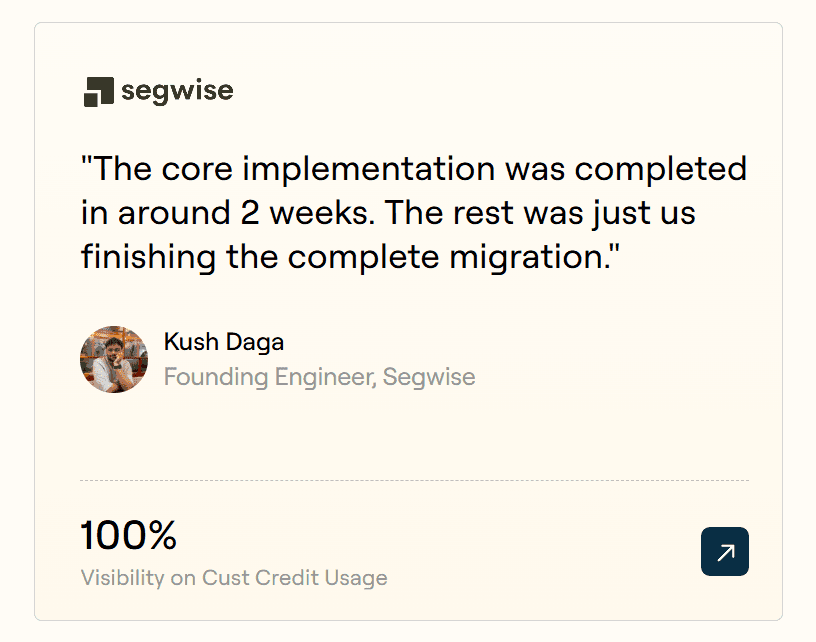
Founding Engineer Kush Daga said it plainly: "Our core product isn't credits. We build ad analysis and generation tech, not billing infrastructure."
But after moving to Flexprice, they tracked 100+ enterprise customers with zero engineers on credit infrastructure and full visibility into credit burn. The core implementation took about two weeks.
6. Hybrid pricing, base plus usage
Hybrid pricing (base + overage) is a billing model where you pay a fixed fee every billing period to get started, and that fee includes a set amount of usage. Once you go over that included amount, you pay extra for each additional unit you use.
It has two parts:
A base fee that covers a built-in volume of usage
An overage rate that kicks in only after you exceed that volume
Example: A plan costs $2,000 per month and includes 1 million API calls. If you use 1.2 million calls, you pay $2,000 plus the cost of the extra 200,000 calls at whatever the overage rate is, say $0.001 per call, so $200 extra, bringing the total to $2,200.
The key terms in any hybrid pricing contract are:
Base fee - the flat recurring charge
Included volume - how much usage is covered before overages start
Overage rate - the per-unit price once you exceed included volume
Commit discounts - lower rates if you commit to a longer term or higher volume upfront
Caps or minimums - guardrails that either limit how high your bill can go or set a floor on what you must pay regardless of usage
The model is common in API-based products, cloud services, and SaaS platforms because it gives customers cost predictability at baseline usage while letting them scale up without switching plans.
When is it the right choice for your business?
Most AI SaaS and infrastructure companies land here after their first pricing change, for good reasons. It gives you:
A predictable floor (the platform fee) that matches how enterprise procurement approves spend.
Fair upside when the customer grows, because the meter captures the growth without a new contract.
A clean story for the board: committed ARR on one axis, usage growth on the other.
If you sell to mid-market or enterprise, expect to land here within 18 months, even if you started somewhere else.
When can this model stop being enough or break for you
Hybrid is the model where homegrown billing systems fail most often, because both halves have to stay in sync across three problem areas:
One invoice, two pricing engines. The flat side and the metered side have to match on the same invoice line structure, the same billing period, and the same proration rules.
Included-volume tracking. Resets, carry-forward, and rollover rules for the included volume get complex fast, especially when a customer changes plan mid-cycle.
Multi-step proration. When a customer upgrades mid-cycle, you prorate both the base fee and the included volume at the same time, against usage that is already partly consumed.
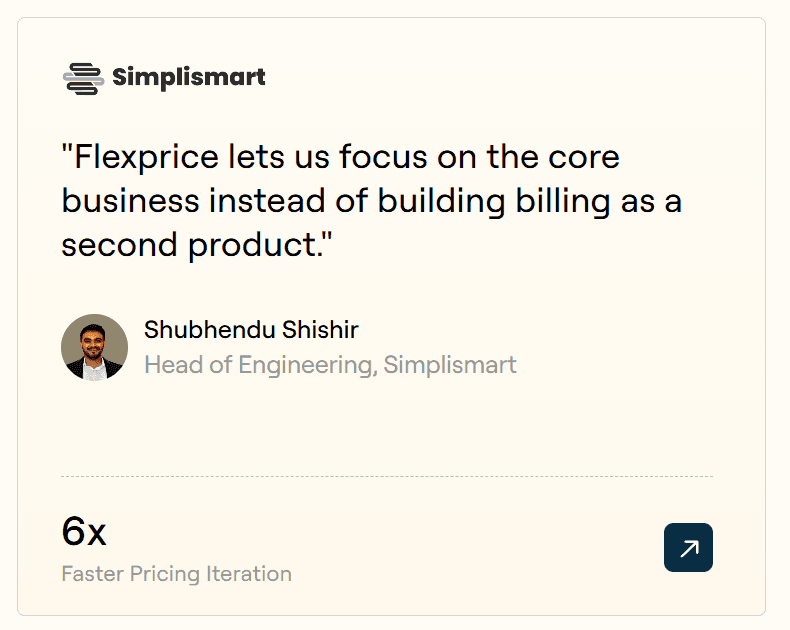
Simplismart here is the real-world example. Their hybrid setup combines usage (tokens, audio minutes, megapixels, GPU-minutes), prepaid credit wallets with automatic blocking, committed-use subscriptions on top, and per-customer enterprise pricing.
They first tried building on Lago; it took them 1.5 to 2 months, used 20–30% of their daily engineering time, and still broke under heavy load.
But after migrating to Flexprice, integration took 3 to 4 days; they got back around 30% of engineering time, cut pricing iteration time from 3-4 days down to 15-40 minutes, and today run 750+ pricing features through the platform.
The questions that decide which model fits your business
You can read all the theories you want. The model still has to survive three questions before you commit.
Can finance forecast revenue from this model?
Every model can be forecast. The question is how much noise sits inside the forecast.
Flat-rate and per-seat models are the easiest to forecast. Customer counts and seat counts change slowly, and you can count them exactly.
Tiered pricing is harder to forecast. The variable is which tier your customers land in, and that distribution shifts more often than you expect.
Usage-based, credit, and hybrid pricing are the hardest to forecast. Your forecast is only as accurate as your usage data. If your system misses 2% of usage events, your forecast is off by 2% every single month.
Here is the rule of thumb: If finance cannot explain last month's revenue movement without caveats, the data layer is not ready for a complex pricing model. That is not a reason to pick a simpler model. It is a reason to fix the data layer before you pick a more complex one.
Can the team change pricing without a rebuild?
Pricing is a living system. You will change it. The only real question is how painful each change is.
Ask yourself this: can we add a new tier, a new meter, a new guardrail in days, not a quarter? If the answer is no, you are not picking between subscription pricing models. You are picking between engineering backlogs.
When billing logic lives inside product code, every pricing change is an engineering project. Every new plan needs a sprint. Every pricing experiment needs a review. When billing logic lives inside a billing platform, the same change is a config change that a finance or RevOps person can make in an afternoon.
Can the billing system hold the logic today?
The best pricing model on paper becomes the wrong model if your systems cannot run it.
Before you commit to anything complex, check whether your infrastructure can handle the hard parts:
metering usage accurately
prorating mid-cycle changes
managing credits and wallets
calculating tax
handling failed payments
versioning plans over time
and maintaining a clean audit trail from every usage event to the final invoice.
These are not bonus features you add later. They are the baseline for running any modern SaaS pricing model without a manual cleanup process at the end of every month.
If any of those pieces live in a spreadsheet today, a more complex pricing model will multiply the pain, not solve it. Fix the foundation first, then pick the model.
What breaks when billing cannot support your model
You do not usually find out that your billing system cannot support your pricing model in a dramatic moment. You find out quietly, in three ways.
Revenue leakage from silent billing gaps
Events that never reach an invoice. A webhook fails, a meter drops 3% of requests, and those requests never get billed. No one notices because the chart still goes up.
Overages that were in the contract but never made it into the rater. Sales closed a deal with a $0.0015 rate on overage tokens, but the billing system rates at the default $0.001. Every month, you leave $0.0005 per token on the table. Across 50 million tokens, that is $25,000 a month.
Seat adds that sits in a Slack message, not in the system of record. The account manager remembers to update it at renewal. The three months in between are revenue you will never collect.
These gaps compound quietly. They stay invisible until you prep for a board meeting, pull the data, and realize your billed revenue does not match your committed revenue. By then, the credibility hit is already done.
Disputes that start as support tickets
A customer disputes a charge. Support asks engineering to pull the event log. Engineering asks finance to pull the contract. No one on the team has one view of the truth, so the customer waits three days for an answer that starts with "we think."
That moment erodes trust. Not the dispute itself. The hesitation. Do it three times with the same customer, and they start shopping for a new vendor at renewal. Do it across your book and churn follows.
The fix is not more support training. It is a shared trail from event to invoice that anyone on the team can read. Support should open a bill and see which events fed which line, without paging an engineer.
Forecasts that need manual fixes every month
Finance pulls usage from the data warehouse
Sales pulls commits from the CRM
Product pulls plan changes from a dashboard.
Someone merges the three into a spreadsheet every Monday. The forecast is late. It is wrong in a different way each month. The CFO stops trusting it, asks for a second version, and now two people build parallel forecasts. A single billing platform removes the merge step.
How Flexprice solves this problem is easy to understand; it carries the plan, the meter, the commitment, and the invoice in one place, so the forecast is a query, not a three-day project. That change alone gives finance a full week back every month.
Once you know what can break, the last step is testing a model before you switch to it.
How to test a pricing model before you commit
You would not ship a product feature without testing it. Do not ship a pricing change without testing it either.
Model the revenue impact on your current book
Take three to six months of real usage and customer data. Then re-price every account under the new model, line by line. Compare the total and the distribution. Flag every customer whose bill would move up or down by more than 20%. Those customers are not a spreadsheet problem. They are your conversation list. You will call each of them before you change their plan.
If half your book moves by more than 20%, the new model is not a tweak you need. You need migration in this case.
Run it on a segment before a full rollout
Pick one cohort :
New customers only
One region
One plan tier
Keep the old model live for everyone else, because you need a control group.
Watch three signals for 60 to 90 days. Billing accuracy, measured by how often the invoice matches expectations without a human fix. Support ticket volume on billing-related tickets. And net revenue per customer, compared to the control group.
If all three signals hold, roll the new model out in waves. If any of them regress, you have a data problem or a pricing problem, and either way, you want to know before a full rollout.
Check if the bill reads clean to a real customer
Send a draft invoice to a friendly customer. Ask them to explain it back to you in their own words.
If they cannot, the model is too heavy, or the invoice is. Either way, the fix happens now, before launch, not after your first support spike. A bill a customer cannot read is a ticket you have not received yet.
Wrapping up
The best model is not the most advanced one. It is the one your team can run reliably, every month, without a spreadsheet sprint.
Predictability, flexibility, and clarity are not trade-offs. They are guardrails. A good subscription pricing model respects all three.
Pick the model your billing system can support today, with room to grow into the one you want tomorrow. Most AI SaaS teams land on a hybrid subscription pricing model because it pairs a predictable floor with fair upside without forcing a rebuild later.
That path works for you, too, as long as your billing system carries both parts cleanly.
Before you switch, run the test. Re-price your book. Pilot one cohort. Check that the invoice reads clean to a real customer.
If any of those three feel shaky, fix the foundation before you change the pricing page.
Flexprice is the enterprise-grade monetization Infrastructure built specifically to run every one of these subscription pricing models, flat-rate, per seat, tiered, usage-based, credits, and hybrid, on one system with the guardrails finance needs. If billing is slowing down your next pricing decision, that is a system problem, not a pricing problem.
What are the common subscription pricing models for SaaS?
How does usage-based pricing work, and when does it break?
What is credit-based pricing and who should use it?
Should a SaaS startup start with flat-rate, per-seat, or usage-based pricing?
How do you choose a subscription pricing model without breaking billing?