Ayush Parchure
Content Writer, Flexprice
If you're running an AI or SaaS company on flat pricing, two things are probably happening quietly. Your power users are eating into your margins, and your sales team is cutting custom discounts to close enterprise deals that should be growing your revenue, not capping it.
The market has already moved on, with 61% of SaaS companies that are running some form of usage-based billing. But just knowing about usage-based billing software doesn't tell you why it matters specifically for AI and SaaS.
This blog post covers both AI and SaaS with real examples, customer stories, and the data that shows what happens to companies that don't make the move.
TL;DR
Usage-based billing scales each customer's invoice with their actual consumption, replacing rigid flat pricing
61% of SaaS companies already run some form of it, and Gartner expects 70% of businesses to prefer it over per-seat by 2026
For SaaS, it lifts NRR by 5 to 15 percentage points, lowers the entry barrier for new customers, and gives sales the flexibility to close enterprise deals without margin-killing discounts
For AI, it protects already-tight 52% gross margins from heavy users, handles unpredictable agentic workloads, and tracks costs across multiple AI models
Companies sticking to flat pricing eventually face the same fate as Cursor and Anthropic, capping limits, refunding customers, and triggering public backlash
Building usage-based billing in-house is harder than it looks, which is why most teams pick platforms like Flexprice
What is usage-based billing software?
Usage-based billing software is the system that measures how much each customer consumes, prices that consumption, and turns it into an invoice they can actually trust.
It sits between your product events and your customer's invoice. Every API call, message, minute, or token your product processes flows into the software, gets metered, gets priced, and shows up on the bill at the end of every billing cycle.
If you want to dig deeper into how all of this works, we've broken it down in our usage-based billing guide.
Pros and cons of usage-based billing software
Pros
Customers only pay for what they have actually used, so pricing here feels fair.
New customers can start small instead of directly jumping onto a big plan upfront, which lowers the barrier to trying you out.
You can tweak pricing by segment, tier, or sales channel without rewriting your billing logic every time.
Your costs and revenue stay in sync because the heavy users driving up your infrastructure bill are the same ones that will help you generate more revenue.
Cons
Revenue gets noisier and harder to forecast, since two customers on the same plan can land in totally different MRR buckets in the same month.
A sudden usage spike can produce an invoice that shocks the customer, which is why spend caps and real-time alerts are non-negotiable.
Churn is harder to spot here because customers don't always cancel, they just quietly use less, and this causes a dip in your revenue.
Building the metering, aggregation, and invoicing layer in-house quietly eats engineering hours that should be going into your actual product.
Why usage-based billing software is important for SaaS companies
SaaS pricing used to run mostly on per-seat and subscription models back then, and it worked just fine. But your product today generates its value mostly through workflows, automation, and consumption, which is why SaaS companies are moving away from these pricing models.
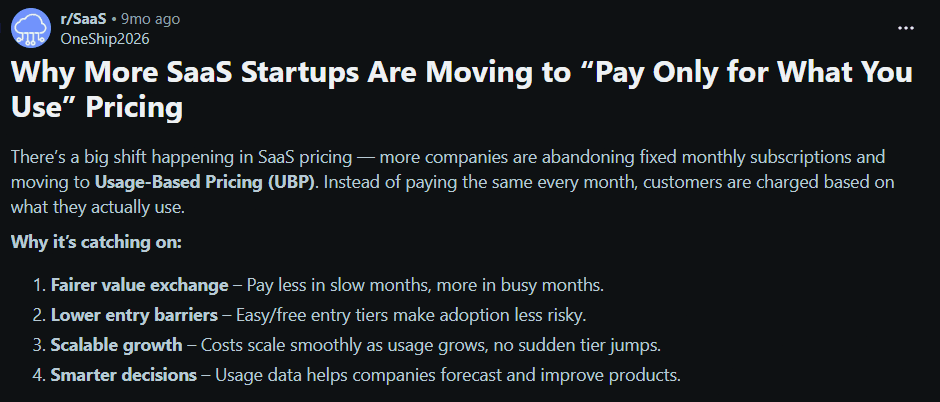
Around 61% of SaaS companies now run some form of usage-based pricing. Founders are also noticing the same shift in real time. Here's how one Reddit thread broke it down recently.
Aligns with customers' values
Think of this like a customer who is paying for 100 seats but only uses 40 of them. Every month, they're paying for seats no one is using, and by the time renewal comes around, they already feel overcharged.
Usage-based billing fixes this because the customer now only pays for what they actually use. When their team has a quiet month, their bill goes down with them, and when they use more, their bill goes up, but they're happy to pay because they're getting more value out of your product.
The whole market here is migrating towards usage-based pricing; see how Gartner predicts that 70% of businesses will prefer usage-based pricing over per-seat by 2026.
Drives NRR growth
Here's where things start getting interesting because most SaaS companies track growth through net revenue retention, or NRR, which is basically how much you keep earning from existing customers each year.
And usage-based pricing turns out to be one of the most reliable ways to increase that number. Optifai's 2026 benchmark study calls usage-based pricing one of the expansion levers for mid-market SaaS, and finds it can lift NRR by 5 to 15 percentage points on its own.
The reason is pretty simple, and it comes down to how each model handles growth:
With flat pricing, nothing grows until sales picks up the phone and run an upsell
But with usage-based pricing, your revenue just grows whenever a customer uses more
Lowers the entry barrier
Flat plans put a weird burden on new customers, because they have to commit to a tier before they even know if your product fits or not.
What usage-based pricing does is it takes that pressure off entirely, so a new customer can just:
Sign up in a couple of minutes
Drop in a credit card
Run $5 of usage on a Saturday afternoon
Decide for themselves whether you're worth coming back to
That self-serve loop helps you quietly change how acquisition usually works. For example, a developer might run their first $7 invoice without ever talking to sales, and that same account can grow into a $400 monthly bill six months later. The first invoice here does all the convincing.
Gives pricing flexibility
With usage-based billing, you can change pricing without requiring extensive engineering effort. On the same product, you can run all of these:
A tiered plan in the US
A volume plan in Europe
A hybrid base plus overage for enterprise
A flat per-call rate for developers
46% of SaaS companies already run hybrid models, because no single pricing model works for every customer.
With the help of usage-based billing, pricing experiments take days, not quarters. You can drop a meter on Monday, push a $0.005 per-call rate on Tuesday, and have real data by Friday, without frustrating your engineers.
But flexibility also comes with a price, because if you use more pricing models, you have more ways of revenue leakage. LeakShield's 2026 research found that tiered SaaS leaks around 3 to 6% of revenue, and usage-based companies leak 4 to 9%
Why usage-based billing software is important for AI companies
AI billing works differently from SaaS billing, because here every customer interaction has a real compute cost behind it.
This is why usage-based billing isn’t optional for AI companies but a necessity; it’s the only thing that saves their economics from breaking. Here are the five reasons why usage-based billing matters for AI companies.
1. Handles unpredictable usage
AI is wildly unpredictable in comparison to SaaS usage, because in this case, a customer might run 10,000 inference calls one week and 200,000 the next, especially in the form of agentic workflow, where a single user action costs 5 to 20 sequential model calls
If you're still stuck on flat pricing, this unpredictable usage will eat up all of your margins. But if you go with usage-based pricing, the bill scales with their usage, so they share the volatility too.
Usage-based billing helps AI companies charge their customer appropriately based on usage, so each week's usage might vary, like $80 in week one, $1000 week two, all on the same plan.
2. Protects your margins from power users
AI margins are way tighter than most people can imagine here is the report from ICONIQ's January 2026 State of AI that shows what's actually happening underneath:
AI gross margins are averaging around 52% in 2026, up from 45% in 2025 and 41% in 2024
Inference costs alone eat 23% of revenue at scaling-stage AI companies, before you've paid for engineering, sales, or anything else
That 23% is exactly what makes flat pricing so risky. Imagine a customer paying you $499 a month who suddenly uses 10x more than you expected. Your margin can flip from healthy to negative overnight, and there's nothing you can really do about it.
Usage-based billing fixes this because the bill grows with their consumption. The heavy users end up paying more, and your numbers stay where they should.
3. Tracks costs across multiple AI models
Most AI products don't just run on one model anymore. According to ICONIQ, the average AI builder now uses 3.1 model providers, up from 2.8 just six months ago. The reason is simple: GPT-4o, Claude Sonnet, and Gemini all have different strengths and very different prices.
Cursor is a great example of how this looks in practice. Their routing system picks the cheapest model that can actually handle each task:
Quick code completions, cheap models
Complex multi-file edits get routed to more capable (and more expensive) ones
The whole thing happens behind the scenes, so the user never has to think about it
But if your billing system can only meter one model at a time, you're flying blind on costs. Usage-based billing software tracks every model separately, so you know what each request actually costs you, and how much margin you've got left on each customer.
4. Transparency in consumption
AI customers worry about surprise bills, and honestly, they're right to. With flat plans, they can't really tell whether they're getting the value they paid for, or whether the AI company quietly tightened limits to control its own costs.
Usage-based billing flips this completely because now every dollar billed traces back to a specific event the customer triggered, which means:
They can see exactly what their usage costs them, in real time
Bill shock turns into bill awareness
You spot a customer about to churn because their usage is dropping, weeks before they actually leave
5. Aligns pricing with what customers actually value
This one matters more for AI than for almost any other category. With AI products, the customer's usage is the value they're getting from you. The moments where value actually gets delivered look like this:
Each query answered
Each document generated
Each task automated
When your pricing reflects that usage, your revenue aligns directly with the value the customer derives from your product, and both sides can see that exchange happening in real numbers.
Sierra is a good example of this. They only charge their customers when their AI agent actually resolves an issue; if it doesn't solve the problem, the customer doesn't pay.
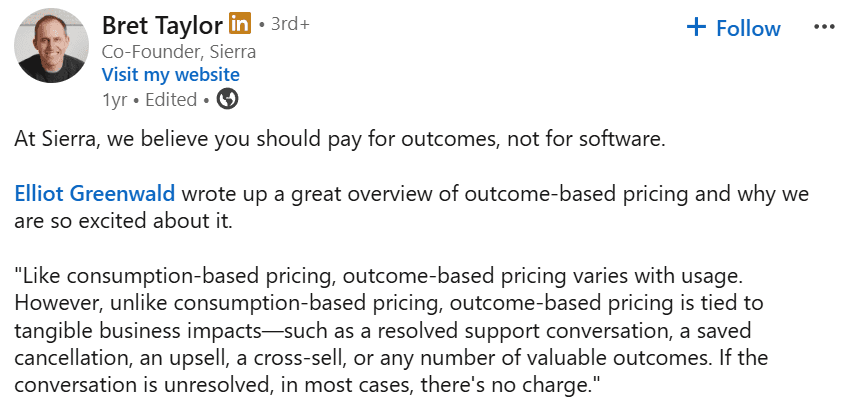
Recent market data backs this up:
Outcome-based AI pricing has jumped from 2% to 18% of AI companies in just six months.
37% of AI companies plan to change their pricing model in the next 12 months.
What happens to companies that stay on flat pricing
So far, we've talked about why usage-based billing is an important and right move for AI and SaaS companies. But there's a flip side worth seeing, which tells what actually happens to the companies that stay on flat pricing while everyone else moves on.
AI companies start losing money on heavy users
The tricky thing about flat pricing in AI is that power users always show up eventually.
Cursor is the perfect example. They started out with effectively unlimited fast requests on their Pro plan, but over time, this stopped working for them. First, they had to cap usage at 500 fast requests per month, and then they moved to a $20-credit model instead. Each round of tightening triggered a fresh wave of customer pushback.
You can see here that the CEO of Cursor, Michael Truell, ended up publicly apologizing for the rollout, and the company started refunding affected customers.
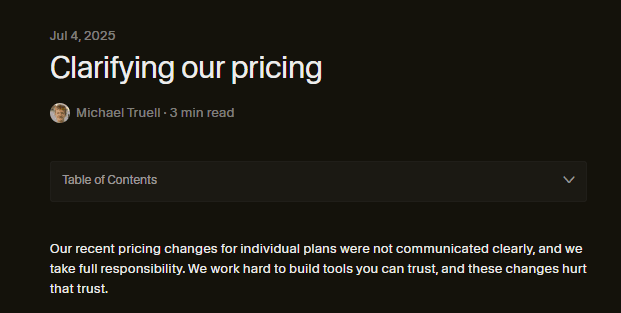
The same pattern can be noticed across other AI products. For example, you can see how Anthropic unveiled new rate limits specifically to curb Claude Code power users in July 2025, because users were running it 24/7.

Every request costs real money to serve, but flat pricing keeps your revenue locked. A $499 plan might handle 2 or 3 times more usage than expected, but at 10x, you start losing margin, and at 50x, you're basically paying your most active customers to keep using your product.
SaaS companies struggle to close flexible enterprise deals
Enterprise buyers in 2026 aren't interested in simple flat pricing anymore. Their procurement teams walk into the room with pretty specific demands:
Committed spend with discounted overages
Usage tiers that step down at volume
Rollover credits for unused capacity
Custom invoicing schedules
If your billing system can't handle this kind of flexibility, your sales team has to get creative. They end up cutting custom flat-rate discounts just to get the contract signed. The deal closes, but a real chunk of expansion revenue walks out the door with it.
This is exactly what usage-based billing solved for Simplismart. They're an AI infrastructure platform serving enterprise customers across BFSI, healthcare, and tech, and every deal they closed came with custom terms. Each pricing change used to mean code changes, PR reviews, and deployment cycles.
After moving to Flexprice, they got the kind of usage-based infrastructure they could never have built themselves: real-time metering for any usage type, credit wallets for prepaid plans, and per-customer pricing overrides that go live with no engineering involvement.
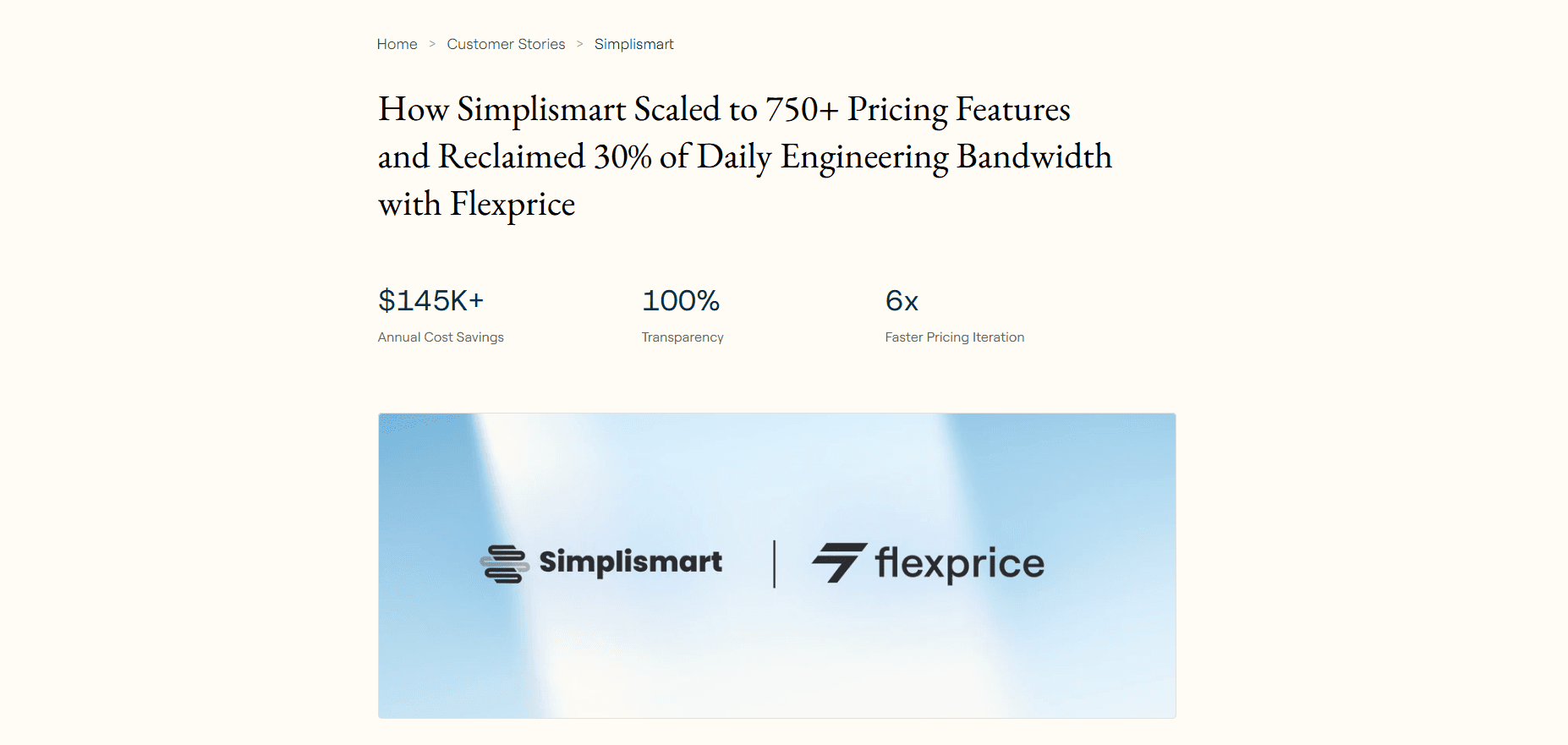
What used to take 3 to 4 days takes 15 to 40 minutes, and they've shipped pricing iterations 6x faster while saving $145K+ a year.
As Shubhendu Shishir, their Head of Engineering, puts it: "Flexprice lets us focus on the core business instead of building billing as a second product."
Wrapping up
Usage-based billing has stopped being a competitive edge and started becoming a baseline expectation. AI companies, trying to protect their margins and SaaS companies keeping up with enterprise procurement demands, are making the switch, and 61% of SaaS companies have already done so.
The ones sticking to flat pricing are quietly losing customers, margin, or both.
Of course, building all of this billing infrastructure yourself is rarely as simple as it sounds. That's exactly why most teams just go with Flexprice instead.
Flexprice is enterprise-grade, open source usage based billing infrastructure for AI and SaaS companies. It can be deployed in your own VPC, on-prem, or on Flexprice's managed cloud.
Why is usage-based billing important for AI companies?
What's the difference between usage-based billing and subscription billing?
How does usage-based billing improve net revenue retention?
What happens to AI companies that stay on flat pricing?
What features should enterprise-grade usage-based billing software have?