
Manish Choudhary
CEO & Co-founder, Flexprice

Hi there. If you're reading this, you're probably building something in AI. And at some point in that journey, someone in the room asked:
How do we actually charge for this?
I've been in that room more times than I can count.
Before Flexprice, I was working a full-time job and running my own consultancy on the side. That consultancy eventually turned into an agency and we were working with quite a few companies, helping them figure out their pricing.
We got pretty good at it. We could design a great pricing model, sit across the table from a founder and map out exactly how they should charge, what the tiers should look like, where the value metric was.
And then they'd go try to configure it into their billing system.
That's where things fell apart every single time. Conventional billing systems are extremely stubborn when it comes to configuration.
They are hardcoded in ways that nobody tells you upfront, which means if you want to make any meaningful change, you need to go really out of your way to make it happen.
And that's not ideal when you're moving fast. The infrastructure that's supposed to enable you becomes the exact reason you can't move ahead.
And that's exactly the moment when I decided to go down this rabbit hole and realized there's a much bigger problem in the industry ahead of us.
I'm talking about sometime around 2022. All you could hear was ChatGPT and how AI was going to disrupt everything. And it did. Along with a gazillion other things, it disrupted pricing.
Because quite a few companies started popping up in the AI space, people started building on top of LLMs, and LLMs brought token based pricing.
More and more companies started seeing that charging on the basis of seats wasn't really going to work for them and they started leaning towards consumption based pricing.
Let me put some perspective on that for you.
In 2018 barely 27% of global companies were charging on the basis of consumption in any form. By 2021 that number shot up to 45%. And in 2022 it crossed 61%, which is three fifths of all SaaS companies.
But here's the twister.
Conventional billing tools, the ones that had been around for ages, were built under one single assumption, that SaaS companies only need to change their pricing maybe once a year.
And that billing is basically what you do for ecommerce companies. Nobody built them with real time consumption in mind.
Think about what a single LLM API call actually generates. At minimum two billable events, input tokens and output tokens. Now do the math on that. A platform processing 100,000 API calls per hour is generating 200,000+ billing events per hour.
Conventional billing tools built for monthly invoices and per-seat subscriptions cannot ingest that volume in real time. They were never designed to.
Which means most of these companies that wanted to charge on the basis of usage had no choice but to bolt their own systems on top of these billing tools.
More engineering work, more tech debt, more things to maintain.
Intercom put it plainly when they finally moved away from their old model, saying that their legacy pricing had created "a disconnect where employees saw the company screwing customers."
So what was supposed to make their job easier actually just made it harder.
So I kept burning the midnight oil trying to understand why nobody had solved this yet. And the deeper I went, the more I understood why. Because it has quite a few levels of complexity.
Some companies sold through a PLG motion, some through sales, and some had both running at the same time. And once you add enterprise contracts into that mix, it is very easy for a human brain to explode. Not literally. But close.
That's what made me want to solve this for space.
And that's how we launched Flexprice.
Now if you join all the dots, there is a very clear reason why usage is becoming the source of truth today and we have reasons with receipts.
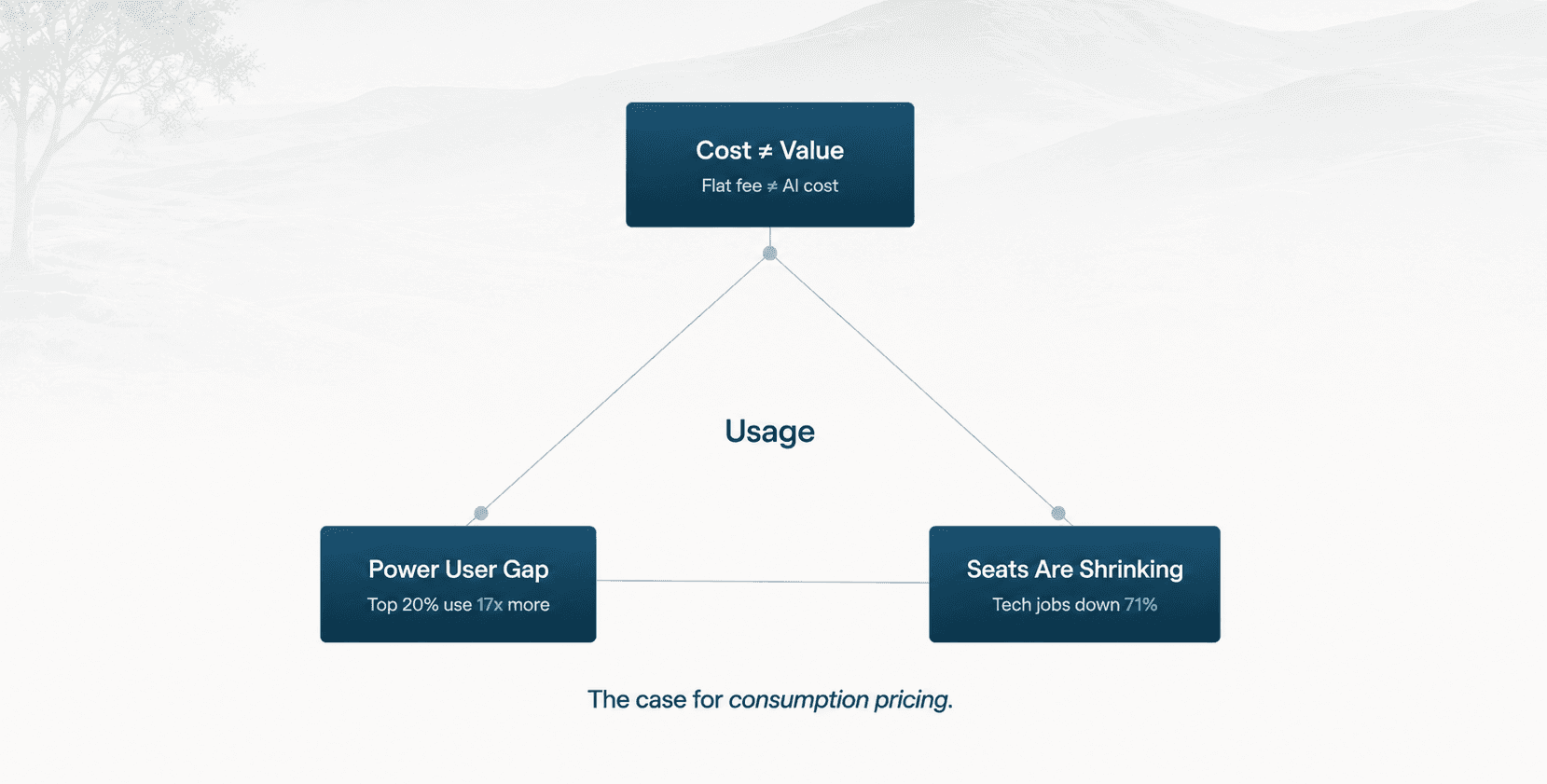
With AI the cost moves with the value
When a customer gets more done, runs more agents, processes more documents, resolves more tickets, your bill goes up with theirs.
That's actually a beautiful alignment but only if your pricing follows the same logic. If you're still charging a flat seat fee while your infrastructure costs track every single prompt, you've built a business where your best customers are your least profitable ones. And that's a wish no one wants to make.
Then there's the power user problem
Or more accurately, the lack of them.
Seat pricing has always followed one assumption, that the people paying for access are roughly getting the same value out of it.
That was always a little untrue. With AI it became obviously, measurably false. OpenAI's own enterprise data shows that the top users send 17x more messages than the average user. Not more than the worst users.
More than the average. Even in the most AI-forward companies on the planet, fewer than 1 in 5 employees uses AI heavily every day. And honestly, in our own company, not everyone opens Claude or ChatGPT every single day.
Which means if you're selling AI on a per-seat basis, 4 out of every 5 of your customers are paying for something they barely touch and they feel it. The 1 in 5 who actually live in your product are getting a bargain you can't afford to keep offering.
And the problem with non-power users isn't just that someone is getting a bad deal. It's that nobody can tell who. Seat pricing creates a fog.
Every month the invoice arrives with a number and without any information. The companies that get enormous value look identical on paper to the companies that barely use the product at all. And in that fog, good products die, cut by CFOs who couldn't see what they were actually paying for.
You are literally digging your own grave if you're still hanging on to seat based pricing for an AI product
Most software that priced on seats made a quiet bet that the company you sold to would keep growing and keep adding people to the org chart who needed access to your product.
For 20 years that bet worked very much in the favor of vendors. Then AI came and companies started doing more with less.
Tech job additions fell 71% in a year. 55,000 people lost jobs directly attributed to AI in 2025 alone.
Larry Ellison, the man who built Oracle, actually thanked AI coding tools on an earnings call for letting Oracle build more software with fewer people.
And every one of those empty seats is a line item that disappears from some vendor's renewal. This should wake you up if it hasn't yet.
The more useful AI becomes, the fewer seats anyone needs which means the more your product succeeds, the more your revenue shrinks. And that is literally digging your own grave.
Put all three of those together and you have the holy trinity that explains why more and more companies are moving towards consumption based pricing.
Recently the CEO of ZoomInfo got on an earnings call and said that their data asset has historically been trapped underneath a SaaS application. That the old model of more SDRs equaling more licenses was under pressure. That they were moving from pay-for-seats to pay-for-data-consumption. The internet treated it like news.
We've been saying this for the last two years.
Not because we're clairvoyant. Because when you're building billing infrastructure for companies that actually charge on consumption, you don't have to predict the future. You're already living inside it. Every customer we onboarded was a company that had already figured out that usage was the honest unit. ZoomInfo just said it on a quarterly call.
This is where Flexprice comes in. We built the billing infrastructure that actually fits how value moves today so that if you want to charge on usage, you just can. No bolting on, no custom engineering, no midnight oil spent on something that shouldn't be your problem.
Hopefully this gave you a good sense of why we started it. It's not a small problem to solve but someone had to.
If this resonates, come check out what we've built. And if you think we're wrong about any of this, write in. We genuinely want to hear it.
See you on the other side.