
Ayush Parchure
Content Writer, Flexprice

In January 2026, Stripe paid about $1 billion to buy Metronome.
That one fact should shape how you read every Stripe price tag this year. Metronome handled usage billing for OpenAI, Anthropic, NVIDIA, and Databricks. Stripe could not build what those companies needed, so it bought the team.
Patrick Collison put it plainly in the announcement: "The shift toward usage-based models will be a defining feature of the next decade for our industry."
You want to know what Stripe actually costs in 2026. Not the marketing number. The number your CFO will see once Billing, Connect, Tax, Radar, international, and disputes stack on top.
Here is every fee, every add-on, every plan, and every trap.
TL;DR
Stripe paid about $1 billion for Metronome in January 2026 because native Billing could not handle AI-scale usage pricing.
US Standard rates are 2.9% plus 30 cents online, 2.7% plus 5 cents in-person, 3.4% plus 30 cents keyed, 0.8% ACH capped at $5, and $15 per dispute.
Stripe Billing is now a flat 0.7% of billing volume, consolidated from Starter 0.5% and Scale 0.8% in July 2024.
Add-ons stack fast with Tax at 0.5%, Radar Fraud Teams at 2 to 7 cents, Connect at $2 per month plus 0.25% plus 25 cents per payout, Atlas at $500 plus $100 per year, and Identity at $1.50.
International hides your real cost because 1.5% plus 1% currency conversion pushes a $100 non-US charge to $5.70 in fees.
Reviews split hard with 4.0 to 5.0 on G2 and Capterra from developers, and 1.8 on Trustpilot across 17,000 reviews from merchants hit by the risk engine.
Stripe Billing runs out of road on ramped contracts, quotes, pooled credits, parent-child accounts, rollover credits, granular filtering, and metering above 1,000 events per second, which is where Flexprice slots in alongside Stripe Payments.
Stripe in 2026: a payments stack, not one product
Stripe started in 2010 as a card processor. Today it ships eleven products plus the Metronome team. You will meet these on the pricing page:
Payments
Billing
Connect
Tax
Radar
Terminal
Issuing
Atlas
Sigma
Identity
Financial Connections
Two 2026 launches matter for your stack. Stripe shipped LLM token billing inside Billing in March. The Agentic Commerce Suite went live for AI agents that buy things on your behalf.
That sprawl is why "Stripe pricing" is never one number. You pay a base payment fee, plus a fee on each add-on, plus whatever international and dispute math catches you that month.
If you want a product-by-product tour first, read the earlier Flexprice guide to what Stripe is in 2026.
Stripe is free to open. It is not free to run.
Yes, Stripe is free to open. No setup fee. No monthly fee. No cancellation fee on the Standard plan. Your Stripe account costs zero until a customer pays you.
That is the easy part.
You pay the second money moves. Every online card charge costs 2.9% plus 30 cents. Every dispute costs $15, even when you win. Every add-on has its own fee:
Billing adds 0.7% of billing volume
Tax adds 0.5% per transaction
Radar for Fraud Teams adds up to 7 cents per screened transaction
Plain SMB checkout? Free-to-open is close to free-to-run.
AI or SaaS? You will turn on Billing, and probably Tax and Radar. The fees stack fast.
Stripe's 2026 pricing at a glance
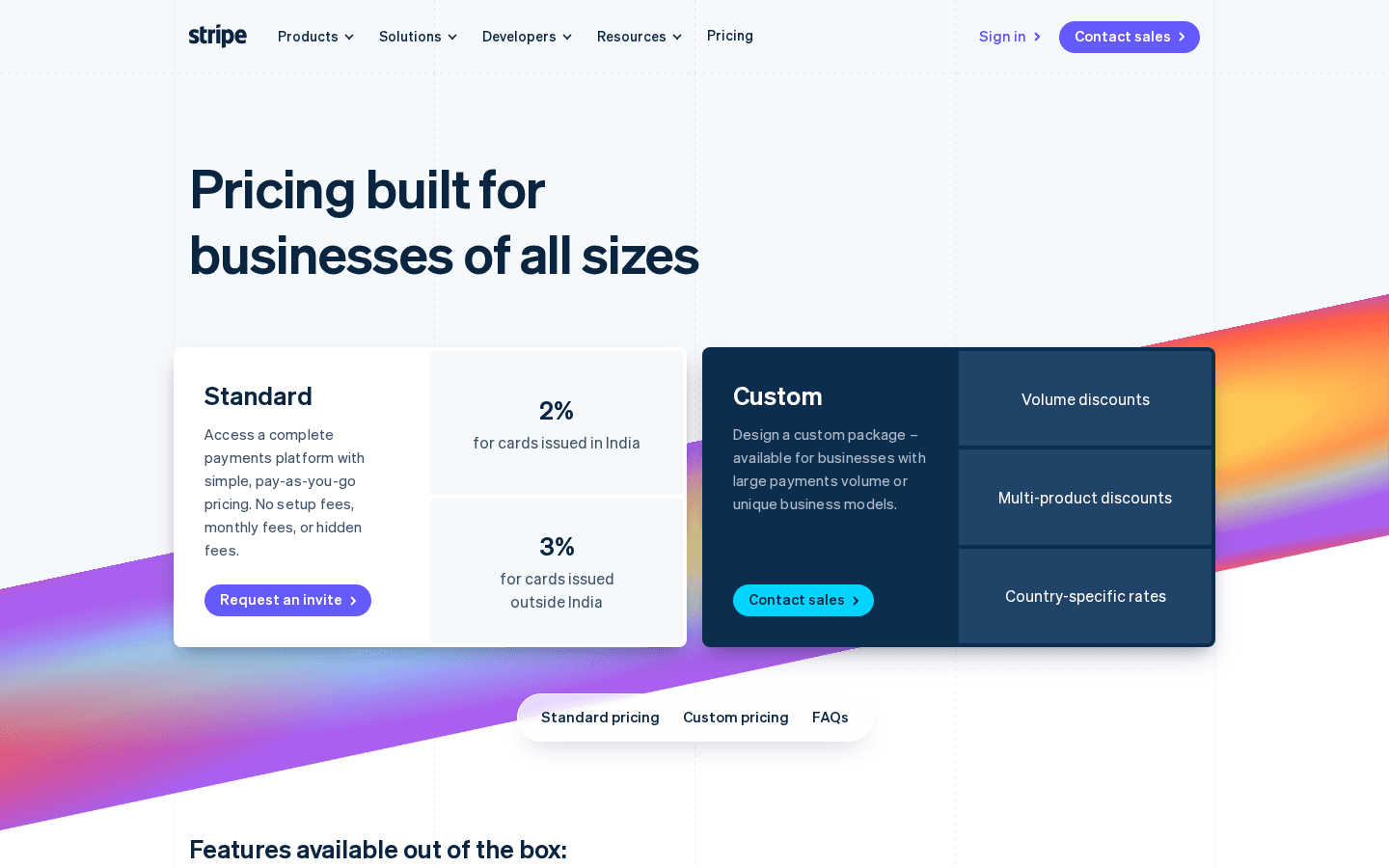
Here is the 2026 fee card for US merchants on the Standard plan.
Category | Rate |
Online cards (US domestic) | 2.9% + $0.30 |
In-person via Terminal | 2.7% + $0.05 |
Manually keyed cards | 3.4% + $0.30 |
International card (non-US issued) | +1.5% on base |
Currency conversion | +1% |
ACH Direct Debit | 0.8% (cap $5) |
ACH Credit | $1 per payment |
Wire (inbound) | $8 |
Dispute fee | $15 (refunded if you win) |
Instant Payout | 1% (min $0.50) |
Stripe Billing | 0.7% of billing volume |
Stripe Invoicing | 0.4% per paid invoice |
Connect Express / Custom | $2/mo per active account + 0.25% + $0.25/payout |
Stripe Tax (Basic) | 0.5% per transaction |
Radar for Fraud Teams | $0.02 to $0.07 per screened transaction |
Stripe Identity | $1.50 per verification |
Stripe Issuing | $0.10 virtual / $3.50 physical |
Stripe Atlas | $500 one-time + $100/year |
Custom (Enterprise) | Volume, multi-product, country-specific discounts |
One number trips people up. Most blogs still list Stripe Billing as "Starter 0.5%" and "Scale 0.8%". That split died in July 2024. Stripe merged both into one 0.7% plan. Check Stripe's help center if a teammate pushes back.
The 1.5% international card fee and 1% currency conversion fee stack. A $100 charge on a non-US card converted to USD costs $5.70 in fees, not $3.20. Your CFO will notice.
The Custom plan has no public minimum. Most advisors peg the useful threshold around $80K per month in card volume. Below that, you stay on Standard.
The fees you pay on every transaction
Online card payments: 2.9% plus 30 cents
You pay 2.9% plus 30 cents on every online card charge. Covers Visa, Mastercard, Amex, Discover, Apple Pay, Google Pay, and Link.
The flat 30 cents hurts small tickets. A $5 charge costs you 44 cents (8.8%). A $500 charge costs $14.80 (2.96%).
Model your average order before you sign.
In-person: 2.7% plus 5 cents
Card-present transactions on Terminal cost less because networks charge less for swipes and taps.
Readers are one-time buys:
Reader M2 at $59
BBPOS WisePOS E at $249
Reader S700 at $349
Manually keyed and international cards
Typed-in card numbers cost 3.4% plus 30 cents. Send a Stripe Invoice link so the customer pays at the online rate.
Non-US cards add 1.5% on base. Currency conversion adds 1% more. A $100 international charge costs $5.70 in fees, not $3.20.
That is where Stripe's real cost hides on global SaaS.
ACH, wires, and BNPL
ACH Direct Debit costs 0.8% capped at $5. Cheapest US rail for B2B invoices.
ACH Credit costs $1. Wires cost $8 inbound.
Klarna at 5.99% + $0.30 and Afterpay at 6% + $0.30 roughly double your card fee.
Disputes, payouts, and nonprofits
Every dispute costs you $15. Win it, Stripe refunds the fee. Lose it, you pay $15 plus the original charge.
Cross a 1% dispute rate and Stripe's risk engine flags your account. Add Chargeback Protection at 0.4% per transaction if your category has dispute problems.
Instant Payouts cost 1% with a 50-cent minimum. Standard payouts are free. Refunds are free, but Stripe keeps the 30-cent fixed fee on the original charge.
Verified nonprofits pay 2.2% + $0.30 online.
What each Stripe add-on costs
Stripe Billing
Billing sits on top of payments. You pay 2.9% + $0.30 on the card, then 0.7% of billing volume for the subscription layer.
The 0.7% covers recurring billing, usage metering up to 100 million events per month, Smart Retries, dunning, quotes, and multi-phase subscription schedules.
Extras cost more:
Custom customer-portal domain at $10 per month
Credit grants (price not published)
Metronome-grade usage billing (not generally available as of April 2026)
The 0.7% applies to subscription revenue, not a flat per-invoice charge. At scale, it grows fast.
If you run hybrid or credit-based pricing, Stripe Billing gets awkward.
Stripe Invoicing
For one-off invoices, not subscriptions, you pay 0.4% per paid invoice on top of the payment fee.
Stripe Connect
Marketplace and platform teams use Connect.
Standard accounts cost the platform nothing because Stripe bills the seller directly.
Express and Custom accounts cost $2 per active account per month, plus 0.25% plus 25 cents per payout.
Stripe Tax
Stripe Tax calculates and collects sales tax, VAT, and GST at 0.5% per transaction on Basic.
Important: Stripe Tax does not file or remit in most jurisdictions.
You still need Avalara, Anrok, or Stripe's paid filing add-on.
Stripe Radar
Baseline Radar comes with Standard pricing.
Radar for Fraud Teams adds a rules engine and review queue at 7 cents per screened transaction, or 2 cents if you stay on Standard.
Smaller products: Issuing, Atlas, Sigma, Identity
Issuing: 10 cents per virtual card, $3.50 per physical card, $15 per card dispute. Interchange passes through.
Atlas: $500 one-time plus $100 per year to form a Delaware C-corp.
Sigma: starts at $10 per month plus 2 cents to $1.40 per charge for SQL on your Stripe data.
Identity: $1.50 per KYC check.
Financial Connections: custom pricing.
Standard or Custom: which plan you actually need
Stripe publishes two tiers. Most companies start on Standard. A few graduate to Custom.
Standard is pay-as-you-go. Every published rate, no commitment. If you process under $80K per month, or use only one or two Stripe products, stay here.
Custom (Enterprise) covers volume discounts, multi-product discounts, and country-specific rates. No public minimum.
Start the Custom conversation when:
Your card volume crosses $80K per month
Your cross-border mix makes the 1.5% + 1% stack hurt margin
You run Billing, Tax, and Connect together
Get Stripe to quote you line by line, including dispute-rate assumptions. Headline discounts can hide fine print.
Stripe pricing changes when you cross a border
Stripe charges US merchants the highest domestic card rate of any developed market it serves.
Region | Domestic online cards | International cards | Currency conversion | Dispute fee |
United States | 2.9% + $0.30 | +1.5% | +1% | $15 |
United Kingdom | 1.5% + 20p | 3% + 20p (non-EEA) | +2% | £20 |
European Union (SEPA) | 1.5% + €0.25 | 3.25% + €0.25 (non-EEA) | +2% | €15 |
India | 2% (debit cap ₹200) | 3% (Amex 3.5%) | +2% | ₹1,000 |
US merchants pay roughly twice the UK and EU rate on domestic cards. EU and UK merchants pay 2% on currency conversion, not 1%. UK-to-EU and UK-to-US cards sit between the domestic and non-EEA rates shown above. India has the widest domestic-to-international spread.
If you run US-incorporated SaaS selling mostly to EU customers, you are stuck on US-issuer-versus-international math. Your real cost is 2.9% + 1.5% + 1% + $0.30.
Some teams fix this by incorporating a subsidiary in the customer region. Talk to finance before you try it.
What Stripe customers actually say in 2026
Stripe's reviews split hard. Developer and SaaS reviewers rate it 4.0 to 5.0. Merchants who hit the risk engine rate it 1.8.
Both groups are telling the truth.
Source | Score | Reviews | Reviewer type |
Trustpilot | 1.8 / 5 | 17,019 | Merchants and consumers |
Capterra | 4.6 / 5 | 3,327 | SMB software buyers |
NerdWallet | 5.0 / 5 | Editorial | SMB editorial |
G2 | 4.2 / 5 | 442 | SaaS and tech |
What positive reviews praise:
API and docs (Capterra Ease of Use 4.5/5)
Fast onboarding
Flat published pricing
What negative reviews flag:
Account freezes and 90-day fund holds when the risk engine triggers
Slow, templated support
Fees that compound on small tickets or heavy usage billing
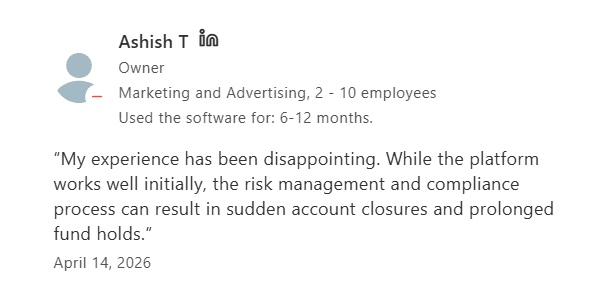
One Capterra reviewer (Ashish T, April 14, 2026) put it plainly: "The risk management and compliance process can result in sudden account closures and prolonged fund holds."
Stripe works if your business lives on the developer-experience side. It struggles on the compliance or usage-billing side.
When Stripe fits, and when it doesn't
Stripe fits you if
You run US-first SaaS or e-commerce with 2 or 3 simple pricing plans, seat-based or fixed-price subscriptions, and card volume under $500K per month.
You run a marketplace on Stripe Connect. Standard costs the platform nothing.
Stripe stretches you if
You close enterprise deals with ramped pricing, for example "$1,000 for 3 months, $1,500 for 6 months, $2,000 after." Stripe does not model ramped contracts natively, so you track the schedule manually or create multiple plans.
You negotiate quotes, renewals, and custom terms with mid-market customers. Stripe has no native quote system, so deal terms sit in Notion or PDFs until the subscription gets rebuilt.
You sell internationally. The 1.5% + 1% stack compresses margin on every cross-border charge.
You sell hybrid plans with a base fee plus usage plus seats plus credits.
Stripe starts to run out of room if
You sell AI or token-metered products. The 1,000-events-per-second meter cap and 20-line-item subscription limit hit at scale.
You need parent-child account billing with shared credits across a customer's teams. Stripe treats each subscription as standalone.
You want to charge differently for GPT-4o versus GPT-4 Turbo inside one event stream. Stripe asks you to create separate schemas for each variant.
You operate in a policy-gray or high-dispute vertical. Account reviews can pause payouts until Stripe's risk team completes its checks.
Where Stripe Billing runs out of road, and how Flexprice slots in
Stripe built Billing for seat-based SaaS. It does that well.
It starts to strain the moment your pricing looks like an AI or enterprise deal. These are the areas where Stripe Billing is less flexible today, based on Flexprice's direct feature-by-feature comparison with Stripe:
Ramped contracts. Stripe does not model deal timelines like "$1,000 for 3 months, $1,500 for 6 months, $2,000 after." You track the schedule manually or stand up multiple plans.
Quotes and renewals. No built-in quote system. Terms sit in Notion or PDFs until the subscription gets rebuilt.
Committed usage and credit pooling. No native support for volume commitments like "1 million API calls a month" or usage pooled across a customer's teams.
Parent-child account billing. Stripe treats each subscription as standalone. No hierarchy. No shared credits or usage across a single organization.
Granular usage filtering. You cannot price the same event stream differently by metadata. Charging separately for GPT-4o and GPT-4 Turbo means creating separate schemas.
Feature entitlements. No native way to assign per-plan limits like "10 credits, 50 video minutes, 30 seconds of generative output."
Recurring and rollover credits. Stripe supports one-time and promotional credits. Monthly grants, rollover caps, auto top-ups, and wallet thresholds require custom code.
Custom credit values per feature. You cannot price a GPU-heavy action at more credits than a cheap one. Margin protection moves into application code.
Contract amendments. Stripe shows the latest subscription config only. Historical versioning for upgrades, downgrades, and renegotiations lives in spreadsheets.
Mixed billing intervals in one subscription. All products share one currency and one billing interval. No annual base plus monthly overage in a single subscription.
Arbitrary aggregations. Stripe supports sum, count, and last. Count-unique, average, max, and weighted sum are not native.
Throughput above 1,000 meter events per second per Stripe account.
Gateway-agnostic billing. Stripe Billing runs on Stripe Payments only.
That list is why OpenAI, Anthropic, NVIDIA, and Databricks chose Metronome over Stripe Billing. Stripe paid $1 billion in January 2026 to catch up.
How Flexprice slots in
Flexprice is enterprise-grade, open source usage based billing infrastructure for AI and SaaS companies. It can be deployed in your own VPC, on-prem, or on Flexprice's managed cloud.You run it alongside Stripe Payments, not instead of.
Flexprice covers what Stripe Billing does not:
Ramped contracts with auto-updating price timelines
Built-in quotes, renewals, and negotiated pricing workflows
Committed usage, pooled credits across teams, and parent-child account billing
Granular filtering inside one event stream, so model: gpt-4o and model: gpt-4-turbo get priced differently without new schemas
Feature entitlements with usage tracking and reset logic per plan
Recurring and rollover credits with caps, expiration rules, auto top-ups, and wallet thresholds
Custom credit values per feature to protect margins as backend costs shift
Full contract history with versioning for audits and revenue forecasting
Event-driven usage at scale with the aggregations Stripe does not support (count-unique, average, max, weighted sum)
Gateway-agnostic setup, so you are not locked into Stripe Payments if you add other gateways later
Self-hosting, so there is no revenue cut on your billing data
Stripe is good at payments. Flexprice handles everything pricing-related that happens after the card charges, which got harder the day AI pricing stopped looking like a seat.
If Stripe Billing fits your team, stay on Stripe Billing. If not, you know where to look next.
Read the Flexprice vs Chargebee vs Stripe comparison or star Flexprice on GitHub.
Wrapping up
Stripe is still the simplest developer-friendly payment stack you can plug in this afternoon. That counts for something.
What changed in 2026:
Billing moved to a flat 0.7%
The Metronome acquisition reshaped how Stripe sells to AI companies
UK regulators started forcing 90-day closure notices
What did not change: 2.9% + $0.30 is your floor, not your ceiling. Once Billing, Connect, Tax, Radar, international, and disputes stack, your real rate sits 1 to 2 full points above the headline.
Model your stack before you commit.
If Stripe fits, ship. If not, you know where to look next.
What percentage does Stripe charge?
Is Stripe cheaper than PayPal or Square?
What does Stripe Billing cost on top of payments?
Does Stripe charge a monthly fee?
What is the best Stripe alternative for AI and usage billing?