
Ayush Parchure
Content Writing Intern, Flexprice

Stripe processed $1.9 trillion in payments last year. Half the YC batch runs on it. OpenAI, Anthropic, Shopify, and Amazon. If you build software and accept money, Stripe sits somewhere in your evaluation shortlist.
2026 made Stripe more complicated. They bought Metronome for usage billing. They shipped the Agentic Commerce Suite for AI agents. They launched Tempo, their own stablecoin chain. The five-minute answer you got in 2023 no longer covers what Stripe actually does.
This guide walks you through what Stripe is, what it shipped this year, what it really costs, what customers say on review sites, and where it falls short for AI and usage-based SaaS. Every number carries a source.
What is Stripe?
Source
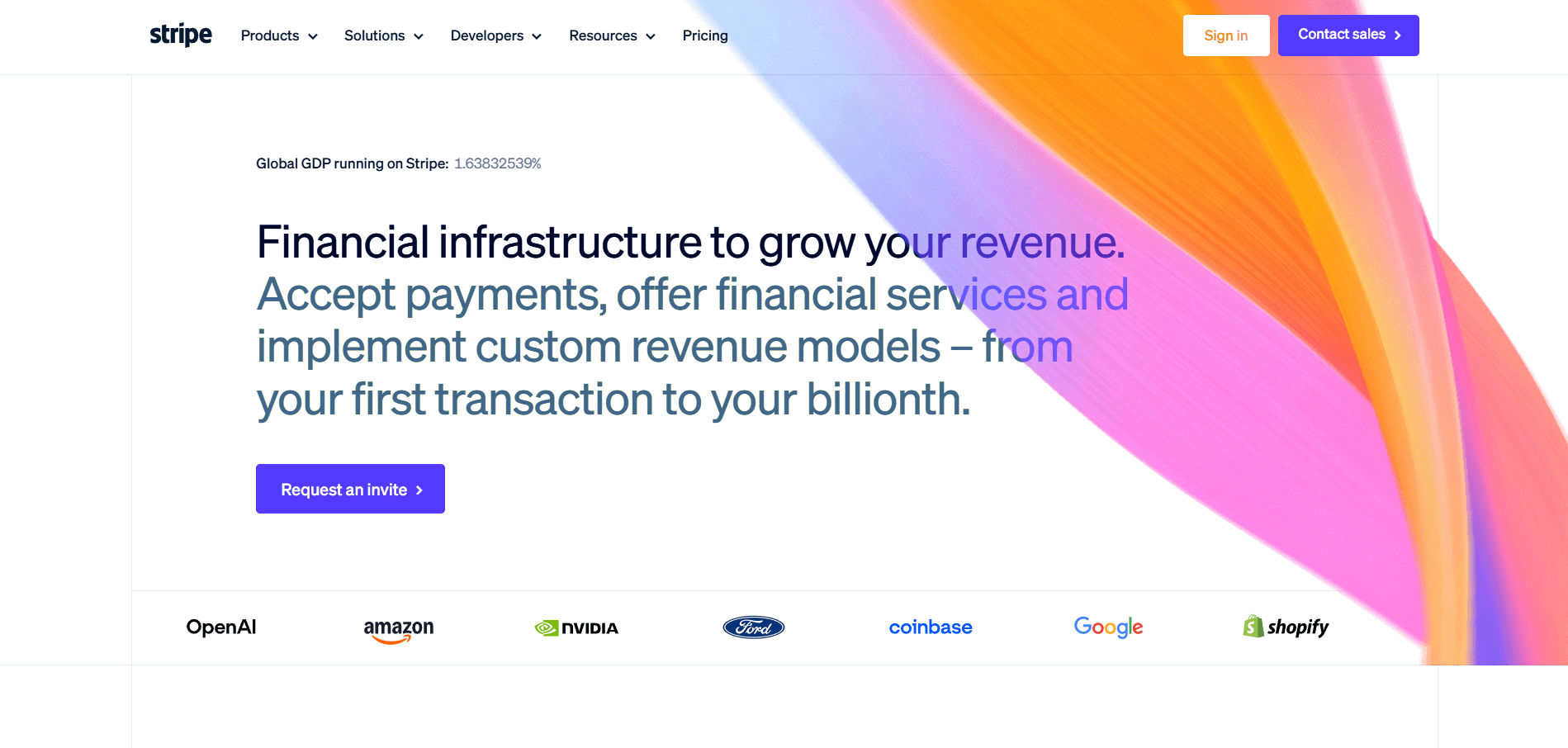
Stripe is a payments and billing platform you plug into your product with a few lines of code. You accept cards, run subscriptions, send invoices, handle tax, and fight fraud from one dashboard.
Patrick and John Collison started it in 2010 out of Palo Alto. The company now runs dual HQs in San Francisco and Dublin. A February 2025 tender offer pegged Stripe at $159 billion, making it one of the highest-valued private companies in the world.
Who runs on Stripe? OpenAI, Anthropic, Shopify, Amazon, Ford, Hertz, and roughly half of every recent Y Combinator batch. If you open a SaaS homepage and see a checkout, the odds favor Stripe under the hood.
Stripe is not one product, though. That's the part most 90-second explainers miss.
How Stripe works
Stripe ships one unified API. Everything else is composed on top.
You install the SDK, your customer pays, webhooks fire into your backend, and the dashboard aggregates what happened. That loop covers payments. Everything else (subscriptions, tax, invoicing, fraud) is a product you turn on, not a separate platform you integrate from scratch.
The product surface looks like this:
Product | What it does | Doc |
Payments | Accept cards, wallets, and bank debits in 135+ currencies | stripe.com/payments |
Billing | Subscriptions, usage billing, invoicing | stripe.com/billing |
Connect | Payments for marketplaces and platforms | stripe.com/connect |
Terminal | In-person and point of sale | stripe.com/terminal |
Radar | Fraud prevention using Stripe's ML | stripe.com/radar |
Tax | Sales tax and VAT calculation and filing | stripe.com/tax |
Invoicing | Send one-off invoices | stripe.com/invoicing |
Sigma | SQL queries on your Stripe data | stripe.com/sigma |
Atlas | Incorporate a US company | stripe.com/atlas |
Capital | Revenue-based financing for Stripe merchants | stripe.com/capital |
You start with one product and layer others as you grow. That modularity is why Stripe beat competitors for a decade. It also sets up the pricing surprise you'll hit in a minute.
That suite grew again in 2026. Here's what shipped.
What's new in Stripe for 2026
This year, Stripe made four big moves. Each one tells you something about where the product is heading.
Agentic Commerce Suite. Stripe launched this at Sessions 2026. It gives AI agents a native way to pay on a user's behalf. Partners at launch included OpenAI, Perplexity, and Vapi. If you sell to agent builders, this is the stack they'll expect you to speak to.
Metronome acquisition. In February 2026, Stripe acquired Metronome, a usage-based billing platform built specifically because Stripe Billing couldn't handle real usage billing at scale. Read that twice. OpenAI, Anthropic, and a long list of AI companies ran on Metronome, not on Stripe Billing. Stripe folded the company into to close that gap.
AI token billing. Stripe shipped native metering for LLM tokens, plus automated markup so AI resellers can price above their wholesale model cost. This matters if you resell LLM output and want a clean way to book margin.
Bridge and Tempo. Stripe bought Bridge for $1.1 billion in 2024. Tempo, Stripe's own stablecoin chain, went live mid-2025. 2026 brought USDC settlement and cross-border payouts on-chain. If your business touches stablecoins or crypto-native payouts, this is a real option now.
How much does Stripe actually cost?
The headline rate is 2.9% + 30¢ per successful US card charge. International cards add 1%. Currency conversion adds another 1%. That's what Stripe's own pricing page says.
Now here's the part that surprises people.
Most SaaS companies don't just use Payments. They use Billing for subscriptions, Tax for sales tax, and sometimes Invoicing for manual invoices. Each of those adds a layer.
The full Stripe fee stack
Layer | Cost | Source |
Payments base | 2.9% + 30¢ | stripe.com/pricing |
Billing Starter | 0.7% of recurring revenue | stripe.com/billing/pricing |
Billing Scale | 0.8% of recurring revenue | stripe.com/billing/pricing |
Tax | 0.5% on transactions where Tax calculates | stripe.com/tax |
Invoicing | 0.4% per paid invoice | stripe.com/invoicing |
Radar for Fraud Teams | +2¢ per transaction | stripe.com/radar |
Disputes | $15 per chargeback, you keep the fee even if you win | Stripe docs |
Instant payouts | 1.5% of the payout amount | Stripe docs |
Worked example: a $50K MRR SaaS
Here's real math on a normal SaaS shape. $50,000 monthly recurring revenue. 500 customers. 1% monthly churn. 0.3% dispute rate. All US card volume. You use Billing, Tax, and Invoicing.
Line | Math | Monthly cost |
Payments fees | $50,000 × 2.9% + 500 × $0.30 | $1,600 |
Billing | $50,000 × 0.7% | $350 |
Tax | $50,000 × 0.5% | $250 |
Invoicing | ~25% of volume × 0.4% | $50 |
Disputes | 0.3% × 500 × $15 | $22.50 |
Effective total | ~$2,272 (4.55% of MRR) |
So the 2.9% headline turns into a 4.5% real rate. That gap is 1.6 percentage points. On a $50K MRR business, that's roughly $9,600 a year you probably didn't price into your CAC model.
Callout: The 2.9% number is a floor, not a ceiling. Model your real effective rate before you sign.
That's what Stripe costs. Next question most buyers ask: what do actual users say about running on it?
Stripe reviews: the unfiltered take
Stripe's reviews are split hard depending on where you look.
Platform | Rating | Review count | Link |
G2 Stripe Payments | 4.4/5 | ~650 | g2.com/products/stripe-payments |
G2 Stripe Billing | 4.6/5 | ~120 | g2.com |
Trustpilot | 2.8/5 | 16,977+ | trustpilot.com/review/stripe.com |
Capterra | 4.7/5 | 3,200+ | capterra.com |
Notice the gap. G2 and Capterra sit above 4.4. Trustpilot sits at 2.8 across nearly 17,000 reviews. Same product, very different pictures. Here's why.
G2 and Capterra skew toward developers and buyers. Those users love Stripe's docs, SDK, and breadth.
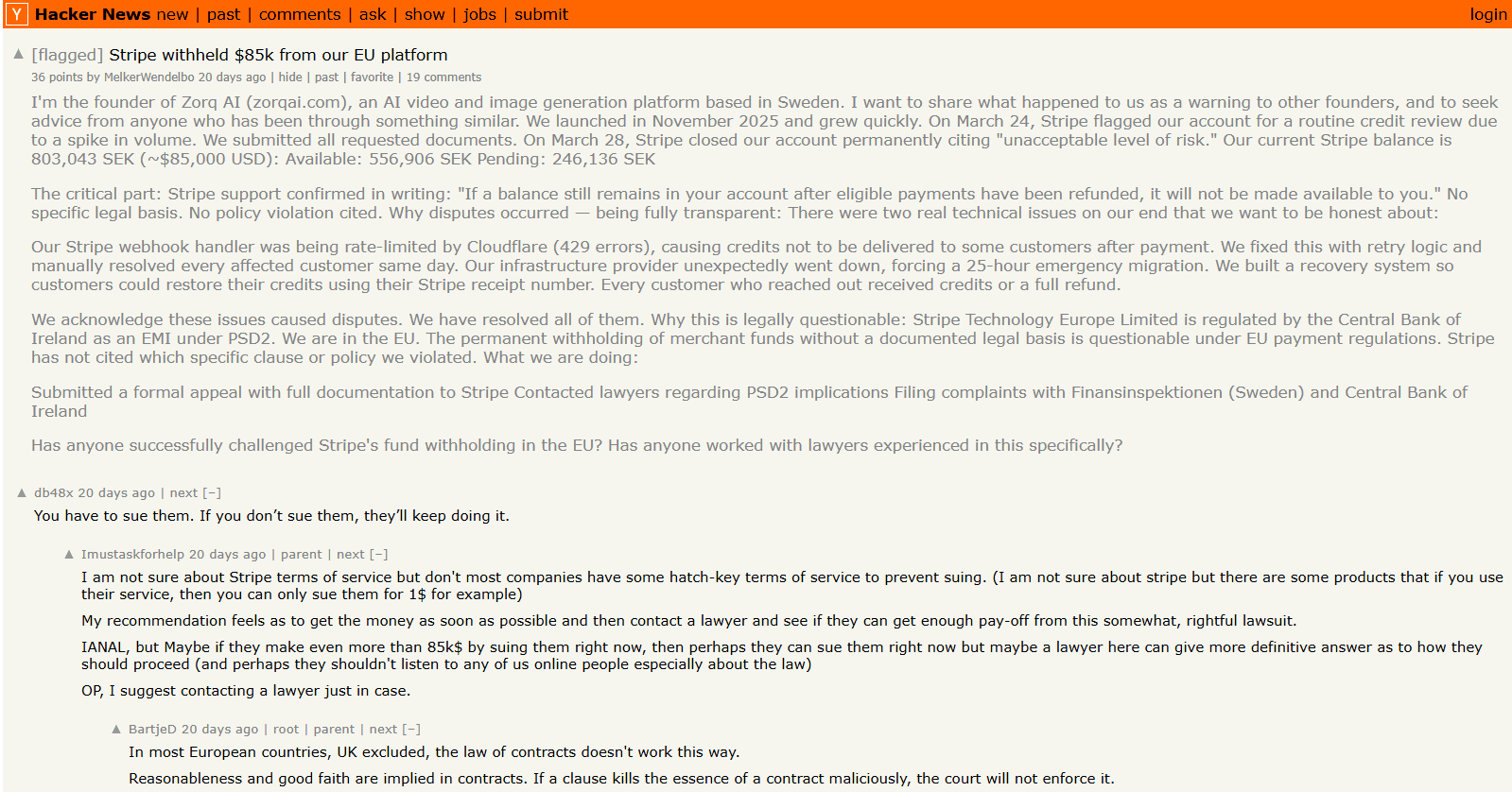
Trustpilot skews toward merchants whose accounts got frozen. The complaint pattern repeats: Stripe holds funds for 30, 60, or 120 days with little explanation. One Hacker News thread in 2024 documented an EU merchant with $85,000 stuck for months before resolution.
Source
Three more complaints show up across communities.
The 20-line-item subscription cap. IndieHackers has a thread from a multi-meter AI company that hit the limit and had to split customers across multiple subscriptions.
Dispute fees are $15, even when you win the chargeback. Reddit's r/ecommerce has years of threads on this.

Source
Most of these complaints cluster around one shape: usage-based billing for modern AI and SaaS workloads.
Where Stripe falls short for AI and usage-based SaaS
This is the section nobody in the top Google results talks about. Every claim here links to Stripe's own docs.
Hard rate limits
Stripe caps you at 100 read/write operations per second. And meter events at 1,000 per second
If you run an agentic AI workload with bursty inference traffic, you'll hit 1,000 events per second on a bad Tuesday. Stripe will 429 you. Your metering loses events. Your invoices are wrong.
Subscription architecture caps
Stripe caps subscriptions at 20 line items. Stripe caps subscription schedules at 10 phases.
Most AI products bill on more than 20 dimensions. Tokens in, tokens out, image generations, function calls, vector operations, storage, egress. You hit 20 quickly. Your options are ugly: split the customer across multiple subscriptions, or pick which line items to drop.
Missing billing primitives
This list reads from Stripe's own docs, not from a competitor slide.
Capability | Stripe status | Source |
Ramped contracts | Partial (via 10-phase schedules) | schedules doc |
Quote to renewal to amendment flow | Not supported natively | docs gap |
Committed usage with true-up | Partial (credit grants) | credit-grants doc |
Parent-child customer hierarchies | Not supported | customers doc |
Granular usage filtering by dimension | Partial | meters doc |
Rollover or custom-value credits | Not supported | credit-grants doc |
Mid-term contract amendments | Manual workaround | schedules doc |
Why AI companies feel this first
AI and agentic workloads are usage-first, committed-capacity, multi-meter, and often contract-heavy on the enterprise side. Many sell to parent organizations with child teams. That shape is exactly what Stripe Billing wasn't designed for. It's also why Stripe bought Metronome in February.
None of this makes Stripe wrong. It makes Stripe wrong for certain shapes.
When Stripe is the right pick
You should probably stay on Stripe if you fit any of these.
You run pure e-commerce or one-time payments. Stripe still sets the benchmark.
You sell seat-based SaaS with simple plans. Stripe Billing handles this cleanly.
You lead with developers and want payments first. The SDK and docs have no peer.
You're launching globally and need 135+ currencies on day one.
You're an early-stage and want Atlas, Capital, and the dashboard in one place.
If your shape is card-based, plan-based, and non-hierarchical, Stripe is often the fastest way to ship. That's not a throwaway compliment. It's the right call for most companies most of the time.
Stripe alternatives for usage-based and AI companies
Here's how the alternatives space lines up in 2026.
Tool | Best fit | Full stack or billing only? |
Metronome (now Stripe) | Usage billing at enterprise scale | Billing only |
Flexprice | AI and usage billing with committed contracts, ramps, parent-child hierarchy, and rollover credits | Full stack |
Chargebee | Subscription SaaS with traditional plans | Full stack |
Orb | Event-driven usage billing | Billing only |
Maxio | B2B SaaS with revenue recognition needs | Full stack |
Recurly | Subscription commerce | Full stack |
How you should actually pick
If you're simple, stay on Stripe. Don't over-engineer. If you're usage-heavy but not contract-heavy, Metronome or Orb fit well.
If you're AI, agentic, or enterprise-contract heavy, you need primitives that Stripe doesn't have natively. That's where Flexprice lives.
Flexprice ships ramped contracts, committed usage with true-up, parent-child customers, rollover credits, granular usage filtering, contract amendments, and 100k+ meter events per second as native features. Simplismart and WizCommerce picked Flexprice specifically because Stripe couldn't model their contracts. Here’s the full comparison.
Pick based on your shape, not on the logo.
The takeaway
Stripe is the default for a reason. The docs are unbeaten. The payment coverage is global. Time from signup to first dollar is minutes.
In 2026, the line between Stripe's payments business and its billing business blurred. Metronome absorbed. Agentic Commerce shipped. Tempo went live.
The question isn't "is Stripe good?" It's "Is Stripe good for your shape?" If you sell simple plans to consumers or teams, yes. If you bill AI usage against committed contracts with hierarchies and ramps, Stripe's primitives run out fast.
Pick the tool that matches your contracts.
Book a demo → flexprice.io/demo
What is Stripe used for?
How much does Stripe actually cost?
Is Stripe good for AI companies?
What is the best Stripe alternative?
Is Stripe safe?