
Manish Choudhary
CEO & Co-founder, Flexprice

For decades, software has meant the same thing, a fancy new tool you buy, learn and operate. We judged it by its features and its dashboards, and buying a better one felt like progress. What rarely came up was the work itself, which everyone assumed would stay with the team. We only saw how much work that assumption leaves behind once we started building billing.
What billing showed us
We started Flexprice with billing because it sits at the center of revenue management.
Deals get closed in the CRM and the books live in the ERP. Somewhere in between, every contract your sales team signs has to make its way from one to the other.
From that seat, we got a close look at how that journey actually happens.
Someone reads a signed contract and enters its terms into the billing platform. Someone checks the invoice before it goes out. Someone follows up when a customer hasn’t paid. And someone reconciles the payment when it arrives.
Each system does its part, but people remain responsible for carrying the work from one to the next.
For years, that was a fair trade. Pricing was simple, so you set up a subscription once and it billed the same amount every month without anyone thinking twice about it.
That world is mostly gone. Most B2B SaaS and AI companies now sell on usage, credits, commitments or some mix of all three, and every new contract seems to arrive with its own terms, its own payment schedule and its own little surprises.
So the work grows with every deal the business closes, and in most companies it lands on the same finance team that was already stretched.
Until recently, there wasn’t much of an alternative.
Software was great at calculating charges and recording transactions. But the moment a contract needed reading or a payment looked off, it handed the job back to a person. So did every decision about what should happen next.
AI has changed that. It can read a signed contract and pull out the terms that matter. It can prepare the invoice from those terms and match a payment to the right customer. And it flags anything that looks odd along the way. A lot of the work that used to bounce between people and apps can now be done by the software itself.
What hasn’t changed is who answers for the numbers. You still sign the books, and your controller still has to explain every entry. Your auditors want to see how each one got there and who approved it.
So when I talk to finance leaders about AI, the conversation rarely stops at whether it can do the work. What they really want to know is whether they can trust it. And whether they’ll still be able to see what it’s doing. Answering that well takes a very different approach to software.
We call it the zero software approach.
Not because software disappears. Quite the opposite. The underlying systems, databases, billing engines, and financial records remain essential.
What changes is the role people play in operating them.
Today, finance teams move between their CRM, billing platform, payment systems, ERP, and spreadsheets to complete work. The information may exist in those systems, but someone still has to connect the dots.
We believe finance teams should be able to hand over the work itself.
The software should operate across the systems they already have, complete the necessary steps, and bring decisions to the team when human judgment is required.
That means three things.
The work matters more than the interface. Finance teams should get the work done without navigating multiple applications.
No rip and replace. AI works across the tools companies already use, without replacing their CRM, ERP, or financial infrastructure.
Finance stays in control. Routine work can run independently under approved rules being auditable end to end, while decisions and exceptions remain with the team.
That’s our vision for zero-touch finance: less manual intervention, without giving up judgment or accountability.
And Ferry is our first step toward it.
Ferry, the AI revenue coworker
Today, we’re introducing Ferry, Flexprice’s AI revenue coworker, and our first step toward bringing the zero software approach to revenue operations.
Ferry starts by understanding how your team actually works: who approves what, how you bill, and what counts as an exception. Then it does the work across your existing systems the way your team would, and pulls you in on Slack whenever something needs your call.
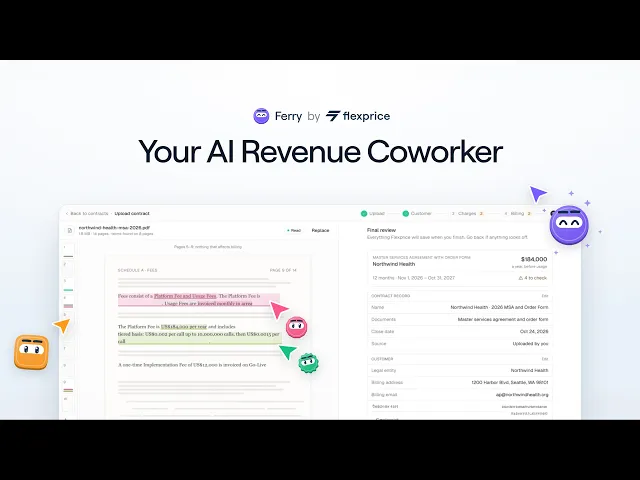
You shouldn’t have to operate Ferry like another application. You will be able to rely on it to take responsibility for work, keep you informed, and involve you when a decision is needed.
And unlike a conventional workflow that depends on someone triggering the next step, an always-on revenue agent is designed to keep work moving as new information arrives.
This is the difference between software that helps people manage revenue and software that actually takes on revenue work.
From signed contracts to collected revenue
Ferry begins by connecting to the systems your team already uses, including your CRM and ERP. This is a one-time setup, with no need to replace your existing infrastructure.
From there, it takes on the operational work that follows each signed contract.
Contract setup. When a deal closes, Ferry reads the signed agreement and sets up the customer, charges and billing schedule. Anything open to interpretation goes to your team first.
Invoicing and collections. Ferry prepares each invoice from the agreed terms and sends it to your team in Slack for approval. It also follows up on payments and matches the cash when it lands.
Ledger alignment. Ferry keeps your ERP in line with the contracts, invoices and payments behind it, so reconciliation doesn’t pile up at month end.
Your team already knows this work inside out. With Ferry, they stop doing it by hand and step in only when something needs their judgment.
Finance stays in control
The biggest mistake anyone can make with autonomous finance is flipping it on all at once. Matching a routine payment and approving an invoice with disputed terms carry very different levels of risk, and they shouldn’t be treated the same.
So with Ferry, your finance team decides what needs approval and what can run on its own under the rules you set. Anything that needs a decision shows up in Slack with the context attached. And when something goes wrong, Ferry tells you why, so your team can fix it instead of digging for the cause.
That’s how we think zero-touch finance should grow: one task at a time, and only where your team trusts the work.
The next step is self-learning finance agents. Today, when someone on your team corrects a contract clause or explains how a payment should be matched, that knowledge mostly stays in their head, and the same fix gets made again next month. We want Ferry to learn from those corrections, within the limits your team sets. Over time, fewer things need a second look and more of the routine work can go zero-touch. That’s how trust in autonomous finance gets built: one correction at a time.
Taking repetitive revenue work off finance teams’ shoulders is where we’re starting.
But we believe it leads to a larger change in how finance operates.
Consider the month-end close.
A significant part of the effort involved in closing the books comes from work that wasn’t completed, verified, or reconciled when the underlying activity occurred.
Much of this work accumulates until the end of the month.
But what if revenue was recorded correctly as it happened, and your records stayed in sync all month? That’s close-ready finance.
So when the month ends, there’s nothing to piece back together. Most of what you need to close is already there, waiting for a final look.
Take that far enough and you get continuous close, where the work happens as the business runs and closing the month is a quick review instead of a week of catching up.
Ferry doesn’t get you all the way there today, and we won’t pretend it does. We’re starting with revenue because it’s the part of finance we know best, and clean contract, billing and payment data is the foundation the rest of the close sits on.
For me, autonomous finance is a future in which their responsibilities fundamentally change.
Finance leaders should spend their time on forecasting, pricing decisions, capital allocation, risk, and understanding where the business is heading.
They shouldn’t have to spend the same amount of time moving information between systems, following up on routine tasks, or checking whether the work has progressed.
The zero software approach is our belief about how that changes.
Zero-touch finance is how routine execution becomes less dependent on people.
Self-learning finance agents are part of how we intend to make that execution progressively more capable.
And close-ready finance and continuous close are among the outcomes we believe this approach can make possible.
Ferry is our first step toward that future.
We’re starting with billing and revenue operations. Our ambition is to bring the same approach to more of the work across the office of the CFO.
Finance teams should be responsible for the decisions, not for operating every piece of software required to carry them out.
That’s the future we’re building at Flexprice.
We’re opening Ferry to [early-access customers / design partners]. If your finance team spends more time operating software than making decisions, we’d like to build this with you.